

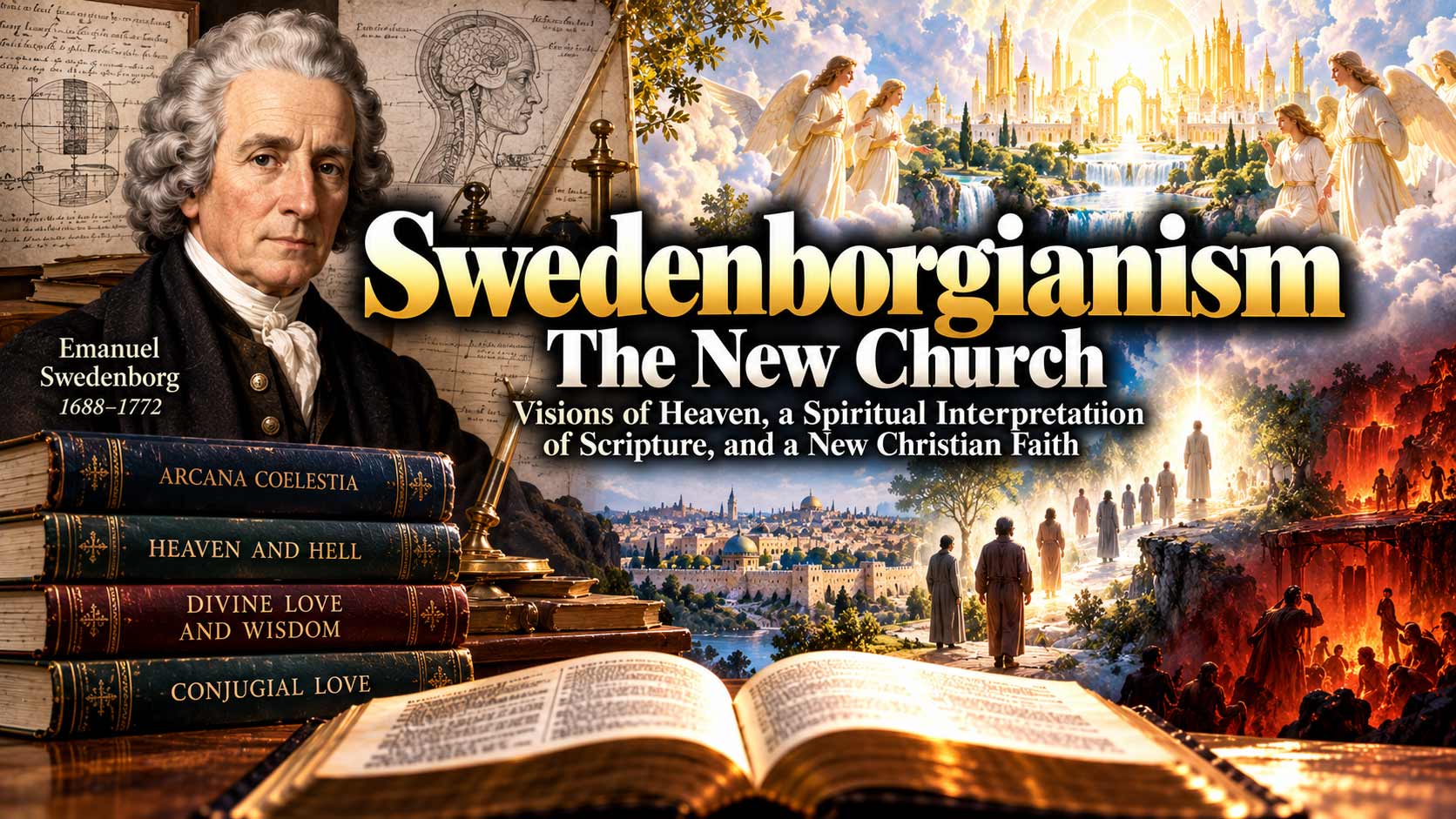
Emanuel Swedenborg is one of the stranger figures in Christian history, partly because the first half of his life gives almost no indication of what the second half is going to look like. He was a respected Swedish scientist, engineer, inventor, government official, and intellectual who wrote about subjects ranging from metallurgy and anatomy to astronomy and economics. Then, when he was in his fifties, Swedenborg began reporting extraordinary spiritual experiences in which heaven was opened to him and he was permitted to communicate with angels and spirits. He spent much of the rest of his life explaining what he believed those experiences revealed about God, Jesus Christ, Scripture, heaven, hell, marriage, salvation, and the spiritual world.
The religious movement that eventually developed from his writings is commonly called Swedenborgianism, although its churches usually prefer names such as the New Church or the Church of the New Jerusalem. Swedenborg himself didn’t establish a denomination, claim to be a new messiah, or gather followers into a church under his personal leadership. He believed instead that Christianity had entered a new spiritual age in which the deeper meaning of Scripture was being disclosed. That distinction is important, but so is the result: Swedenborg produced a theological system that uses thoroughly Christian language while redefining several of the doctrines historic Christianity considers foundational.
Emanuel Swedenborg
Swedenborg was born Emanuel Swedberg in Stockholm in 1688. His father, Jesper Swedberg, was a Lutheran clergyman who eventually became a bishop, so Christianity was part of Emanuel’s world from childhood. The younger Swedenborg studied at Uppsala University and then traveled extensively through Europe, immersing himself in mathematics, mechanics, astronomy, engineering, and the natural sciences. He eventually served for decades on Sweden’s Board of Mines and became well known enough in Swedish intellectual life that reducing him to “mystic who saw angels” misses half the story.
That scientific background matters because Swedenborg never really stopped thinking like someone searching for an ordered universe. Even after his attention turned toward theology and spiritual experience, he tried to describe the unseen world systematically. Heaven had structure. Human beings had spiritual anatomy. Scripture operated according to identifiable principles. The natural world corresponded to spiritual realities. Swedenborg didn’t abandon his desire to explain how things worked; he simply expanded the territory he believed could be investigated.
His religious transformation developed during the 1740s. Swedenborg experienced vivid dreams and visions and eventually claimed that God had opened his spiritual senses so that he could perceive heaven, hell, angels, and spirits. He believed Christ had commissioned him to reveal the spiritual meaning of Scripture and the true nature of Christianity. From that point forward, theological writing became the central work of his life.
Arcana Coelestia and a New Reading of the Bible
Beginning in 1749, Swedenborg published the massive work commonly known by its Latin title, Arcana Coelestia, or Heavenly Secrets. It offered an extensive interpretation of Genesis and Exodus based on the conviction that biblical narratives contain an internal spiritual meaning beneath their ordinary historical sense.
This became one of the foundations of Swedenborg’s theology. The Bible wasn’t merely a collection of historical events, commandments, poetry, prophecy, and apostolic teaching. Its language contained a deeper structure connecting earthly images with spiritual realities. Swedenborg called this relationship correspondence.
Water, light, animals, cities, numbers, directions, body parts, and countless other biblical images could therefore signify spiritual truths. A biblical story could describe an actual event while simultaneously communicating something about the human soul, the spiritual world, or God’s work within humanity. Swedenborg believed this wasn’t an imaginative technique he had invented but part of the divinely designed structure of revelation.
Christians had long recognized symbolism, typology, allegory, and multiple layers of meaning in Scripture, so Swedenborg didn’t invent the idea that biblical language can signify more than its surface meaning. His system went much farther, however, because the doctrine of correspondences became a comprehensive interpretive framework through which the Bible’s deeper meaning could be uncovered.
The obvious question is who gets to determine what all those correspondences mean. Swedenborg’s answer was supplied largely by the spiritual insight he believed God had given him, which makes his authority difficult to separate from the system itself.
Heaven Was Opened
Swedenborg’s most famous claims concerned his experiences in the spiritual world. He said that for many years he was permitted to converse consciously with angels, spirits, and inhabitants of heaven and hell while continuing his ordinary earthly life. These weren’t described merely as dreams or brief mystical impressions. Swedenborg presented them as sustained experiences through which he learned how the spiritual world actually operates.
His best-known book on the subject, Heaven and Hell, published in 1758, describes heaven as an ordered society of angels whose outward environment corresponds to their inward spiritual condition. Angels aren’t a separately created species in Swedenborg’s system. They are human beings who have died and entered heavenly life. The same basic principle applies to evil spirits in hell: they are deceased human beings rather than fallen angels belonging to another order of creation.
Swedenborg described communities, occupations, relationships, worship, communication, clothing, landscapes, and other features of spiritual existence. Heaven isn’t pictured as an endless church service in the clouds, and hell isn’t primarily a torture chamber in which God externally inflicts punishment. Both are environments corresponding to what people have freely chosen to love.
For Swedenborg, death reveals rather than fundamentally changes the person’s inner character. What someone truly loves eventually determines where that person belongs.
It is a remarkably detailed picture of the afterlife. Whether that detail represents genuine revelation is, of course, the question on which the entire system turns.
God and the Trinity
Swedenborg regarded himself as a Christian and placed Jesus Christ at the center of his theology, but his understanding of God differs substantially from Nicene Christianity. He rejected the idea that the Trinity consists of three eternal divine persons, believing that this effectively divides God into three gods no matter how carefully theologians insist otherwise.
Instead, Swedenborg taught that God is one person and that this one God is the Lord Jesus Christ. Father, Son, and Holy Spirit describe distinguishable aspects of the one divine reality rather than three eternal persons. Swedenborg sometimes compared them to soul, body, and activity within one human being.
The Father is the divine reality or soul, the Son is the divine humanity through which God became visible and accessible, and the Holy Spirit is the divine proceeding or activity flowing from God. The incarnation therefore wasn’t one divine person becoming human while remaining distinct from another divine person called the Father. It was the one God assuming humanity and progressively glorifying that humanity in Jesus Christ.
This means Swedenborg can’t simply be classified as a conventional Unitarian who reduces Jesus to a human teacher. His theology actually places enormous emphasis on the divinity of Christ. The problem from the standpoint of historic Christianity is almost the reverse: Swedenborg identifies the one divine person entirely with Jesus and rejects the eternal personal distinctions of Father, Son, and Holy Spirit confessed by the historic church.
There are superficial similarities to later Oneness Pentecostalism, but the systems developed independently and shouldn’t be treated as identical. Swedenborg’s doctrine grows out of his own metaphysical understanding of God, incarnation, and divine humanity.
Jesus and the Incarnation
Swedenborg believed that God entered the world through the virgin birth because humanity had become increasingly dominated by evil and needed divine intervention. Jesus received His divine nature from God and His human nature through Mary. During His earthly life, He underwent genuine temptations and progressively overcame the inherited weaknesses associated with His human nature.
Through this process, Swedenborg taught, Christ’s humanity was gradually glorified, becoming completely united with the divine. The resurrection represents the completion of that glorification. Jesus didn’t simply return from death with the same mortal human body He had before; His humanity had become fully divine.
This understanding allows Swedenborgians to speak very strongly about Jesus as God while rejecting traditional Trinitarian Christology. Salvation isn’t accomplished by one divine person offering Himself to another divine person. God Himself enters human existence, confronts the powers of hell, restores spiritual order, and opens a new path through which humanity can be reunited with Him.
There is something in this account that resembles the ancient Christian theme of Christ defeating the powers of evil. But Swedenborg places that theme inside a theological framework very different from the one developed by the early ecumenical councils.
The Cross and Atonement
Swedenborg strongly rejected the idea that Jesus died in order to satisfy the Father’s wrath by receiving punishment that properly belonged to sinners. In other words, penal substitutionary atonement has no place in Swedenborgian theology.
He believed God didn’t need to be persuaded to forgive humanity. God already loves humanity and desires salvation. The problem was not that an angry Father demanded payment before He could extend mercy, but that evil had gained tremendous spiritual power over human beings.
Christ’s life, temptations, death, and resurrection formed part of God’s victory over hell. Jesus confronted evil, overcame it, restored the proper relationship between the spiritual and natural worlds, and made genuine human freedom possible again.
Swedenborg therefore interpreted redemption primarily as divine conquest and restoration rather than a legal transaction in which Christ’s punishment satisfies a judicial penalty. Christians have debated different models of the atonement throughout church history, and not every rejection of penal substitution places someone outside Christian orthodoxy. Swedenborg’s departure is broader because his doctrine of atonement is connected with his rejection of the historic Trinity and his distinctive account of the incarnation.
Sin, Freedom, and Salvation
Swedenborg rejected both salvation by mere intellectual belief and the idea that good works earn God’s favor. He believed salvation involves a genuine transformation of what a person loves and how that person lives.
Human beings are free to turn toward God or toward self-centered evil. Repentance means recognizing sinful desires and practices, resisting them because they are contrary to God, and learning to live according to divine commandments. God provides the power for transformation, but human beings must cooperate with that grace.
This is one reason Swedenborgians frequently emphasize useful living. Religion isn’t primarily a matter of accepting correct propositions about God and then waiting for heaven. Love for God should express itself through useful service to other people.
Swedenborg’s understanding of faith and works therefore avoids both crude legalism and a version of faith that leaves character untouched. In that respect, some of his criticism of Christianity can sound surprisingly familiar to Christians who have never read a page of Swedenborg. The theological difference appears when this moral transformation is placed within his larger understanding of God, revelation, spiritual regeneration, and the afterlife.
Heaven, Hell, and What We Really Love
One of Swedenborg’s most distinctive teachings is that God doesn’t arbitrarily assign people to heaven or hell after death. People gravitate toward the spiritual environment that corresponds to what they have become.
Someone whose deepest love is directed toward God and neighbor finds the life of heaven desirable. Someone whose deepest love is domination, selfishness, cruelty, or evil finds the atmosphere of heaven intolerable and chooses association with spirits who share those desires. Hell therefore reflects the internal character of its inhabitants.
This doesn’t mean Swedenborg regarded evil as harmless. Hell is miserable precisely because selfish desires ultimately produce misery, conflict, and disorder. But the misery isn’t presented primarily as externally imposed divine torture. It develops from the kind of life the inhabitants have chosen.
Between earthly death and a person’s final state is what Swedenborg called the world of spirits, an intermediate realm in which outward appearances are stripped away and the person’s genuine character becomes increasingly visible. This shouldn’t be confused with the Roman Catholic doctrine of purgatory. It functions more as a process of disclosure and preparation than as punishment intended to satisfy temporal penalties for sin.
Swedenborg also rejected the doctrine of eternal conscious torment if that phrase means God perpetually tortures people in anger. Yet he did regard heaven and hell as enduring states because the basic orientation of a person’s ruling love becomes settled.
Marriage in Heaven
Swedenborg devoted extraordinary attention to marriage, including the belief that genuine marriage can continue eternally in heaven. His book Conjugial Love, also translated as Marriage Love, develops an elaborate theology of spiritual marriage.
He believed male and female were created in complementary forms and that a truly spiritual marriage joins two people in increasingly profound unity. Earthly marriages aren’t automatically eternal simply because a legal ceremony occurred. Some relationships reveal themselves as genuine spiritual unions while others do not.
People whose earthly marriages weren’t genuine may eventually find a compatible partner in the spiritual world. Swedenborg therefore pictured heaven not as a place where human relationships disappear but as one in which their true spiritual character is fulfilled.
That immediately raises the obvious biblical objection: Jesus said that in the resurrection people “neither marry nor are given in marriage.” Swedenborg interpreted that statement through his broader spiritual framework rather than taking it to mean that all marital relationships cease. His interpretation is another example of how the doctrine of correspondences allows biblical passages to acquire meanings quite different from their ordinary reading.
The Last Judgment Already Happened
Swedenborg’s teaching about the Second Coming and Last Judgment is one of the clearest examples of how far his system moves from conventional Christian expectations.
He didn’t teach that Christ would necessarily return bodily to earth in the manner expected by most Christians. Instead, the Second Coming is fundamentally a new revelation of Christ through the spiritual understanding of the Word.
Even more remarkably, Swedenborg claimed that the Last Judgment occurred in the spiritual world in 1757. Humanity on earth understandably failed to notice.
According to Swedenborg, vast numbers of spirits had accumulated in an intermediate spiritual realm, creating disorder between heaven and humanity. The judgment removed these false spiritual communities and restored proper order. This event opened the way for a new era of spiritual freedom and understanding.
Swedenborg connected this transformation with the appearance of the New Jerusalem described in Revelation. Rather than a literal city descending from heaven, the New Jerusalem represents the establishment of a new church based upon a restored understanding of God and Scripture.
Revelation becomes, in effect, a symbolic account of spiritual developments that culminate in the New Church.
The New Church
Swedenborg died in London in 1772 without organizing a new denomination. His writings nevertheless attracted readers in Britain, continental Europe, and eventually North America. Groups devoted to his theology began meeting, and the first organized New Church congregation was established in London during the 1780s.
Several Swedenborgian organizations eventually developed rather than one unified worldwide church. Names have included the General Church of the New Jerusalem, the Swedenborgian Church of North America, and other New Church bodies. Differences among them involve church government, interpretation of Swedenborg’s writings, and the degree of authority assigned to those writings.
Some Swedenborgians regard Swedenborg’s theological works as divinely authorized revelation explaining the internal meaning of Scripture. Others approach them with greater interpretive freedom. That range makes it risky to assume that every modern Swedenborgian holds every proposition with precisely the same emphasis Swedenborg gave it in the eighteenth century.
What unites the tradition is the conviction that Swedenborg uncovered something essential about Christianity that conventional churches had missed.
Swedenborg’s Surprising Influence
Swedenborgianism has never become a large religious movement, but Swedenborg’s influence has been considerably greater than the size of his churches would suggest. His writings attracted or influenced artists, poets, philosophers, theologians, and spiritual seekers who found his vision of the spiritual world compelling even when they didn’t become members of the New Church.
William Blake read Swedenborg and initially admired him before becoming sharply critical. Ralph Waldo Emerson discussed him as one of the great representative thinkers of history. Henry James Sr., father of novelist Henry James and psychologist William James, became deeply influenced by Swedenborg’s thought. Helen Keller also embraced Swedenborgian theology and wrote about the effect it had on her understanding of Christianity and spiritual reality.
Swedenborg’s concept of correspondences proved particularly attractive to writers and artists because it presented the visible world as a language through which invisible realities could be expressed. Nature wasn’t spiritually mute. Everything could potentially signify something beyond itself.
That idea traveled much farther than organized Swedenborgianism.
Scripture and Swedenborg’s Authority
Swedenborgians generally insist that the Bible is the Word of God, which raises an important question about the status of Swedenborg’s own writings. If Scripture is sufficient, why is an enormous body of eighteenth-century spiritual revelation necessary to explain what Scripture really means?
The New Church answer is that Swedenborg doesn’t replace the Bible. His writings disclose its spiritual sense and explain doctrines that had become obscured through centuries of misunderstanding. In that view, he functions less like Joseph Smith bringing another book of Scripture and more like a divinely commissioned interpreter revealing what was already hidden within biblical revelation.
The distinction is real, but it doesn’t completely remove the authority problem. If Swedenborg’s interpretation of Genesis, Revelation, the Trinity, heaven, hell, marriage, and the Last Judgment is accepted because he was uniquely permitted to see the spiritual world, his revelatory experiences inevitably carry enormous theological weight.
Without Swedenborg, there is no obvious route from an ordinary reading of Revelation to the conclusion that the Last Judgment happened invisibly in the spiritual world in 1757. You need Swedenborg to tell you that.
That is one of the points at which the movement’s claim to be simply restored Christianity becomes difficult to maintain.
Is Swedenborgianism Christian?
Swedenborgianism is unquestionably Christian-derived, and Jesus Christ stands at the center of its religious system. Swedenborg wasn’t trying to replace Jesus with himself. He taught that Jesus is the one God manifested in human form, that God entered human history to defeat evil, that Scripture is divinely inspired, that repentance is necessary, and that human beings are called to lives of love and useful service.
Those facts make Swedenborgianism different from movements that merely borrow Christian vocabulary while building their religion around an unrelated deity or modern messiah. Yet they don’t erase the theological differences. Swedenborg rejected the historic doctrine of the Trinity, reconstructed the incarnation, claimed extraordinary access to the spiritual world, developed an elaborate system of biblical correspondences, reinterpreted the Second Coming, and announced that the Last Judgment had already occurred in 1757.
For that reason, Jew & Greek places Swedenborgianism under Christian Cults, using cult in the theological rather than sociological sense. Modern Swedenborgian churches aren’t being accused simply by that classification of coercive behavior, isolation, or domination by a living leader. The issue is whether the movement remains within the boundaries of historic Christian doctrine.
Swedenborg presents an especially interesting case because he didn’t diminish Jesus in the usual way associated with non-Trinitarian movements. He exalted Jesus as the one God while redefining what Christians had historically meant by Father, Son, and Holy Spirit. He didn’t discard the Bible; he claimed to reveal the spiritual structure hidden within it. He didn’t announce that Christianity should be abandoned; he announced that Christianity was entering its promised new age.
That is what makes Swedenborgianism more than an eccentric footnote in church history. It forces the same question that appears repeatedly throughout the Christian cults we’ve studied: when someone claims to restore Christianity by fundamentally redefining its central doctrines, at what point has restoration produced a different religion?