

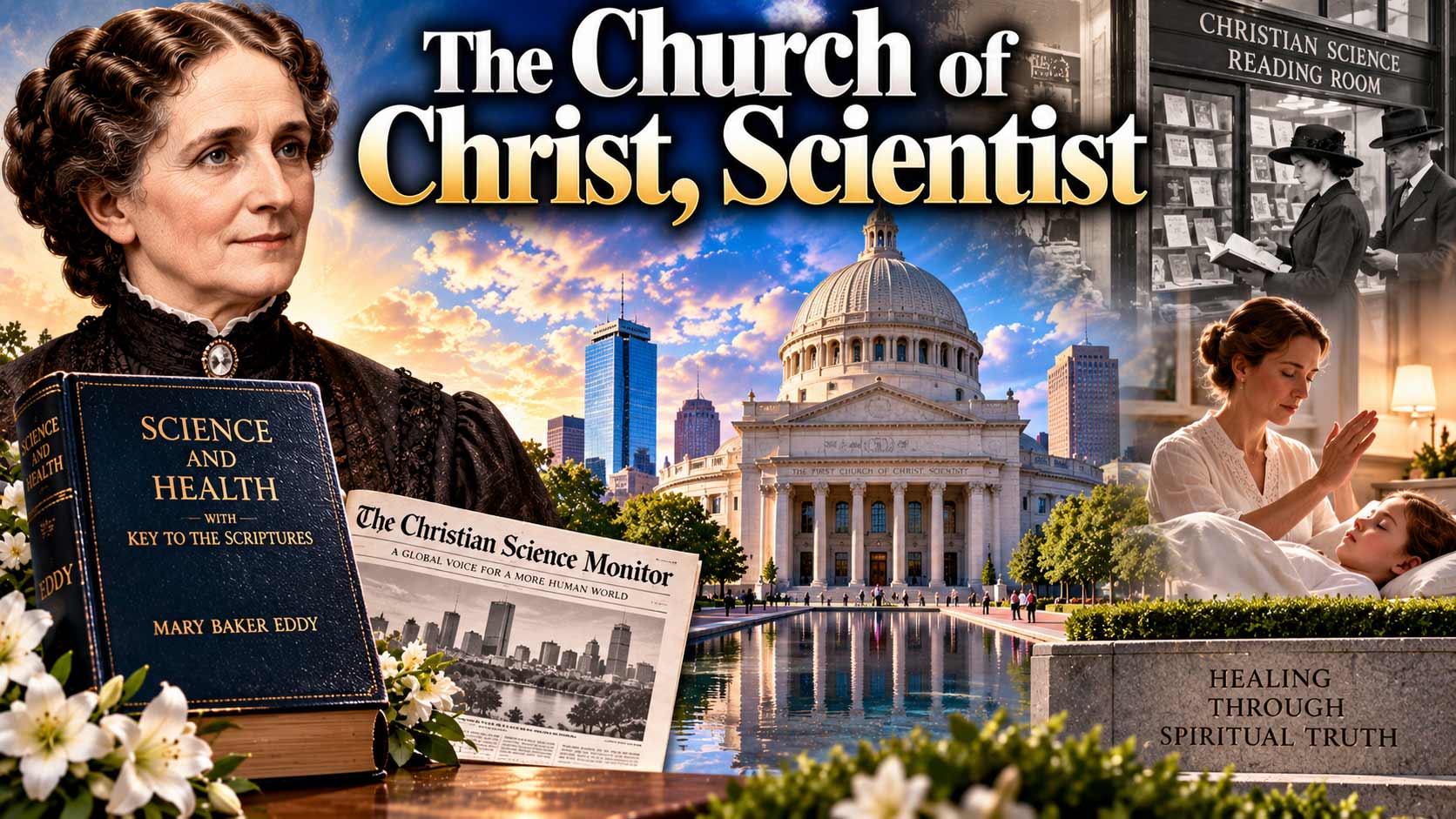
Christian Science has one of the more confusing names in American religion. It isn’t a branch of Christianity devoted to laboratory science, and it has nothing to do with Scientology despite the unfortunate similarity of the names. Christian Science is a religious movement founded in the nineteenth century by Mary Baker Eddy, built around a radically spiritual understanding of God, humanity, sickness, sin, and the physical world.
The official name of the denomination is The Church of Christ, Scientist, and its followers are commonly called Christian Scientists. They read the Bible, speak extensively about Jesus Christ, pray for healing, and understand their religion as a restoration of the healing Christianity practiced by Jesus and the early church. Yet their interpretation of basic Christian concepts differs so substantially from historic Christianity that Christian Science has generally been classified by evangelical countercult ministries as a Christian-derived cult rather than another Christian denomination.
And despite another persistent source of confusion, Christian Scientists aren’t simply Christians who refuse to go to the doctor. Their beliefs about healing make sense only after understanding the much larger metaphysical system Mary Baker Eddy constructed around them.
Mary Baker Eddy
Mary Baker Eddy was born Mary Morse Baker in New Hampshire in 1821 and grew up in a Congregationalist environment. She suffered from recurring health problems through much of her early life and investigated various approaches to healing. Her religious system eventually emerged from the intersection of her Christian background, her own physical struggles, nineteenth-century interest in alternative healing, and her conviction that Jesus’ healings revealed spiritual laws that Christians had largely forgotten.
A decisive moment came in 1866 after Eddy suffered injuries in a fall on ice. She later described experiencing a dramatic recovery while reading the account of Jesus healing the paralytic in Matthew 9. She came to understand her recovery not simply as an answer to prayer but as evidence of a spiritual principle underlying Jesus’ healing ministry.
Eddy spent the following years developing those ideas. In 1875 she published the first edition of Science and Health, the book that would eventually become Science and Health with Key to the Scriptures. She organized the Church of Christ, Scientist in 1879 and continued revising her teachings and building the movement until her death in 1910.
Eddy didn’t believe she had invented a new religion. She believed she had discovered the spiritual Science underlying biblical Christianity.
Science and Health
The foundational texts of Christian Science are the Bible and Eddy’s Science and Health with Key to the Scriptures. Christian Scientists regard the Bible as sacred Scripture, while Science and Health provides the interpretive framework through which much of the Bible is understood.
The word Science in Christian Science doesn’t mean experimental science in the ordinary modern sense. Eddy used it to describe what she believed were fixed spiritual laws governing reality. Just as physical science discovers laws operating in nature, Christian Science claimed to uncover the spiritual laws demonstrated by Jesus.
This is why healing occupies such a prominent place in the movement. Jesus didn’t perform miracles because God occasionally suspended the normal order of things. From the Christian Science perspective, His healings demonstrated the deeper spiritual reality that ordinary human perception fails to recognize.
Eddy believed Christianity had largely preserved Jesus’ moral teachings while losing the practical healing dimension of His ministry. Christian Science was supposed to restore it.
God as Divine Mind
Christian Science describes God with terms such as Mind, Spirit, Soul, Principle, Life, Truth, and Love. These aren’t understood merely as characteristics God possesses. They express the nature of ultimate divine reality.
God is infinite Spirit and perfect Mind. Because God is completely good and spiritual, what God creates must ultimately reflect that goodness and spirituality. This becomes the foundation for Christian Science’s unusual understanding of matter, sickness, sin, and death.
Historic Christianity teaches that God created a real physical universe and declared it good. Christian Science takes a very different direction. Matter doesn’t possess ultimate reality in the way it appears to human perception. What people experience as material existence belongs to a mistaken or limited understanding of reality, while true existence is spiritual.
That distinction is essential. Without it, Christian Science healing can sound like nothing more than positive thinking with Bible verses attached. Eddy was making a much larger claim about what reality itself actually is.
Matter, Sickness, and the Mortal Mind
Christian Science teaches that sickness isn’t ultimately a condition created by God or belonging to the true spiritual identity of a person. Disease belongs to the mistaken material understanding of existence associated with what Eddy called mortal mind.
This doesn’t mean a Christian Scientist experiencing pain simply pretends it isn’t there. The claim is metaphysical rather than merely psychological. The physical symptoms appear real within ordinary human experience, but they don’t express the ultimate spiritual reality established by God.
Healing therefore involves correcting the false understanding underlying the condition. Prayer turns thought away from fear, matter, disease, and mortality toward the perfection of God and the spiritual identity of humanity.
From within the system, that has a certain logic. If God is infinite Spirit, God is entirely good, and God’s creation perfectly reflects Him, then disease can’t belong to ultimate reality. The task of healing becomes awakening to what is spiritually true rather than manipulating matter to repair what appears physically wrong.
Historic Christianity begins somewhere else. It regards physical creation as real, sickness as genuinely part of the fallen human condition, and healing as God’s intervention within a real embodied world. The disagreement therefore goes much deeper than whether Christians should pray before calling a physician.
Christian Science and Medicine
Christian Science became famous, and controversial, for its reliance on spiritual healing rather than conventional medical treatment. Historically, many Christian Scientists have preferred prayer and treatment by Christian Science practitioners when confronting illness.
A Christian Science practitioner isn’t a physician practicing an unusual form of medicine. Practitioners devote themselves professionally to helping people through Christian Science prayer. Their work is based on Eddy’s teachings concerning the spiritual nature of reality and healing.
Christian Scientists aren’t universally prohibited from receiving medical care, and it would be inaccurate to claim that every Christian Scientist refuses doctors or medicine under every circumstance. Individuals make decisions about healthcare, and contemporary church materials acknowledge personal responsibility in those choices. Nevertheless, reliance on spiritual healing remains deeply embedded in the movement’s identity.
The issue has produced serious controversy when children have been involved. Cases in which parents relied exclusively on prayer while a child suffered from a treatable illness have raised difficult questions involving religious liberty, parental rights, medical responsibility, and the state’s obligation to protect minors.
Those controversies shouldn’t be used merely as ammunition against people whose beliefs we reject. But they demonstrate that theology can have consequences extending well beyond Sunday morning. What someone believes about the reality of sickness matters considerably when someone is actually sick.
Jesus Christ
Christian Science speaks frequently and reverently about Jesus, but it makes an important distinction between Jesus and the Christ. Jesus was the human man who uniquely demonstrated the divine Christ, while Christ represents the eternal spiritual idea or manifestation of God.
Eddy therefore didn’t understand Jesus Christ in the same way historic Christianity does. Traditional Christianity confesses Jesus as the eternal Son who became genuinely human while remaining genuinely divine. Christian Science separates the human Jesus from the divine Christ in a way that changes the meaning of the Incarnation.
Jesus remains extraordinarily important because He demonstrated spiritual reality more completely than anyone else. His healings reveal the truth Christian Science seeks to recover, and His life shows humanity how divine Truth overcomes the apparent limitations of material existence.
The difference isn’t that Christian Scientists don’t respect Jesus enough. They assign Him an enormous role. The disagreement concerns who He actually is.
That distinction appears repeatedly when studying Christian-derived movements. Asking whether a religion “believes in Jesus” doesn’t get us very far. Muslims believe in Jesus. Jehovah’s Witnesses believe in Jesus. Mormons believe in Jesus. The more useful question is what the movement means when it uses His name.
Sin and Salvation
Christian Science understands sin differently from historic Christianity because it understands humanity differently. Human beings in their true spiritual identity reflect God and aren’t ultimately the fallen material creatures they appear to be.
Sin nevertheless has consequences because people believe and act according to false understandings. Christian Science isn’t teaching that cruelty, dishonesty, selfishness, or immorality should simply be ignored because evil is unreal. Eddy took moral transformation seriously.
Salvation involves liberation from false beliefs about sin, sickness, materiality, and death. Jesus’ life and work demonstrate the spiritual truth that frees humanity from those errors.
This also changes the meaning of the atonement. Historic Christianity places enormous emphasis on Christ’s death for human sin and His bodily resurrection. Christian Science places greater emphasis on Jesus’ demonstration of humanity’s unity with divine Life and Truth. The cross remains important, but it operates within a theological framework quite different from substitutionary sacrifice, justification, and reconciliation as those concepts have traditionally been understood.
Once again, familiar Christian vocabulary remains while the theological structure underneath it changes.
The Resurrection
Christian Science affirms Jesus’ resurrection, but its understanding of resurrection reflects its larger view of matter. Eddy interpreted the events surrounding Jesus’ death and resurrection as demonstrating the supremacy of spiritual Life over material appearances and death.
Historic Christianity insists upon the bodily resurrection of Jesus. The tomb was empty because the same Jesus who was crucified was raised, transformed and glorified, from the dead. Paul goes so far as to say that without Christ’s resurrection Christian faith is useless.
Christian Science doesn’t simply deny that something extraordinary happened after the crucifixion. Rather, it interprets the event through a metaphysical system in which matter itself doesn’t possess ultimate reality.
That difference may seem abstract until we realize how much Christianity stakes on creation and resurrection. Biblical Christianity doesn’t present salvation as an escape from physical existence because physical existence was a mistake. It ends with resurrection and a renewed creation.
The Trinity
Christian Science uses the word Trinity, but not in the historic Nicene sense of one God eternally existing as Father, Son, and Holy Spirit. Eddy described the Trinity using concepts associated with God, Christ, and divine Science rather than three divine persons sharing one divine being.
That places Christian Science outside the Trinitarian theology historically shared by Catholicism, Eastern Orthodoxy, and the overwhelming majority of Protestant Christianity.
As with The Way International, this isn’t merely a disagreement over terminology invented by theologians with too much time on their hands. The doctrine of the Trinity grew from the early church’s attempt to make sense of what Scripture says about the Father, Jesus Christ, and the Holy Spirit while maintaining the biblical insistence that there is only one God.
Christian Science resolves those questions through a metaphysical system substantially different from the one that produced the historic Christian creeds.
Worship Without a Traditional Pastor
Christian Science congregations have an unusual approach to preaching. Local churches don’t ordinarily employ an ordained pastor who prepares a sermon every week. Instead, services use readings from the Bible and Science and Health.
The two books function together so centrally that Eddy designated the Bible and Science and Health as the denomination’s pastor. Congregations elect Readers who present the prescribed selections during worship.
This structure serves an obvious purpose. It prevents a charismatic preacher from gradually turning a congregation into his personal theological kingdom and keeps the movement centered on its authorized texts. Considering what has happened in more than a few churches with charismatic leaders, one can at least appreciate the problem Eddy was trying to avoid.
Christian Science services also include prayer, hymns, and other elements recognizable as Christian worship, but the absence of conventional clergy and sermons gives them a distinctive character.
Christian Science Reading Rooms
Another recognizable feature of the movement is the Christian Science Reading Room. These public spaces provide access to the Bible, Eddy’s writings, Christian Science publications, and other denominational materials.
Reading Rooms reflect the movement’s emphasis on individual study. Christian Science expects its followers to engage directly with its texts rather than receiving everything through clergy. For decades, Reading Rooms also gave the movement a visible presence in cities where people might otherwise have had little direct contact with Christian Scientists.
They serve a purpose somewhere between bookstore, library, study center, and outreach ministry. In an age before websites could place an entire religious library in someone’s pocket, that was an effective way to make the movement’s teachings accessible.
The Christian Science Monitor
One of Mary Baker Eddy’s most surprising legacies is The Christian Science Monitor, founded in 1908. Despite its connection with the church, the Monitor wasn’t created primarily as a newspaper devoted to Christian Science theology.
Eddy wanted a publication that would provide serious journalism while avoiding the sensationalism she believed characterized much of the press. The newspaper developed a reputation far beyond the membership of the church and became respected for international reporting and thoughtful coverage of public affairs.
That distinction is worth making because people sometimes assume The Christian Science Monitor is simply the denomination’s version of a church newsletter. It isn’t. Its journalism has historically been aimed at a general audience, even though the publication remains connected to the church Eddy founded.
A religious movement known primarily for spiritual healing producing an internationally respected news organization is one of the more interesting side roads in American religious history.
Christian Science and Scientology
Because the names are so similar, the distinction deserves to be stated plainly: Christian Science and Scientology have no historical connection.
Christian Science began with Mary Baker Eddy in the nineteenth century and developed from her interpretation of Christianity, healing, and metaphysical idealism. Scientology began with L. Ron Hubbard in the twentieth century and grew out of Dianetics, eventually developing teachings about thetans, auditing, past lives, and spiritual advancement.
Christian Science talks about Jesus, the Bible, divine Mind, spiritual healing, and the unreality of matter. Scientology talks about auditing, engrams, the reactive mind, thetans, and Operating Thetan levels.
The similarity is mostly the word Science. If that is enough to make two religions related, political science and computer science are going to have some explaining to do.
Christian Science Today
Christian Science never became one of America’s largest religious traditions, but its cultural influence has been greater than its numbers might suggest. Eddy became one of the most prominent female religious leaders in American history at a time when women rarely exercised comparable institutional authority.
The movement established congregations and Reading Rooms internationally and developed a substantial publishing operation. The Mother Church, formally The First Church of Christ, Scientist, in Boston became the institutional center of the movement.
Like several religious movements that flourished in the late nineteenth and early twentieth centuries, Christian Science has experienced substantial decline from its period of greatest visibility. Reading Rooms and church buildings that once made the movement conspicuous in many American cities are less common than they were generations ago.
But the church remains active, and its teachings continue through congregations, practitioners, publications, broadcasting, online resources, and The Christian Science Monitor. It shouldn’t be treated merely as an artifact from the era of spiritualism, metaphysical religion, and patent medicines. People still believe and practice Christian Science.
Is Christian Science Christian?
Christian Scientists unquestionably understand themselves in relation to Christianity. Their church is named for Christ. They read the Bible constantly, study the teachings and healings of Jesus, pray, worship, and believe that Eddy recovered something essential that Christianity had lost.
But historic Christianity doesn’t define itself simply by the presence of Christian vocabulary. Christian Science substantially reinterprets the nature of God, creation, matter, humanity, sin, Christ, the Trinity, atonement, sickness, death, and resurrection. Those aren’t peripheral doctrines.
That is why Jew & Greek places the Church of Christ, Scientist under Christian Cults. The term is being used theologically, not as shorthand for saying Christian Scientists are dangerous people or members of a sinister organization. Christian Science arose within Christianity and presents itself as authentic Christianity while redefining doctrines that Catholic, Orthodox, and Protestant Christians historically regarded as fundamental to the faith.
Mary Baker Eddy believed the church had lost the spiritual Science demonstrated by Jesus and that recovering it would restore Christian healing. Historic Christianity answers that the problem goes deeper than whether miraculous healing continues today. The Jesus of the New Testament didn’t come merely to demonstrate that sickness, matter, sin, and death aren’t ultimately real. He entered a real physical creation, suffered a real physical death, and rose bodily from a real grave.
Christian Science and historic Christianity can use many of the same words. Their disagreement begins with what kind of world those words are describing.