

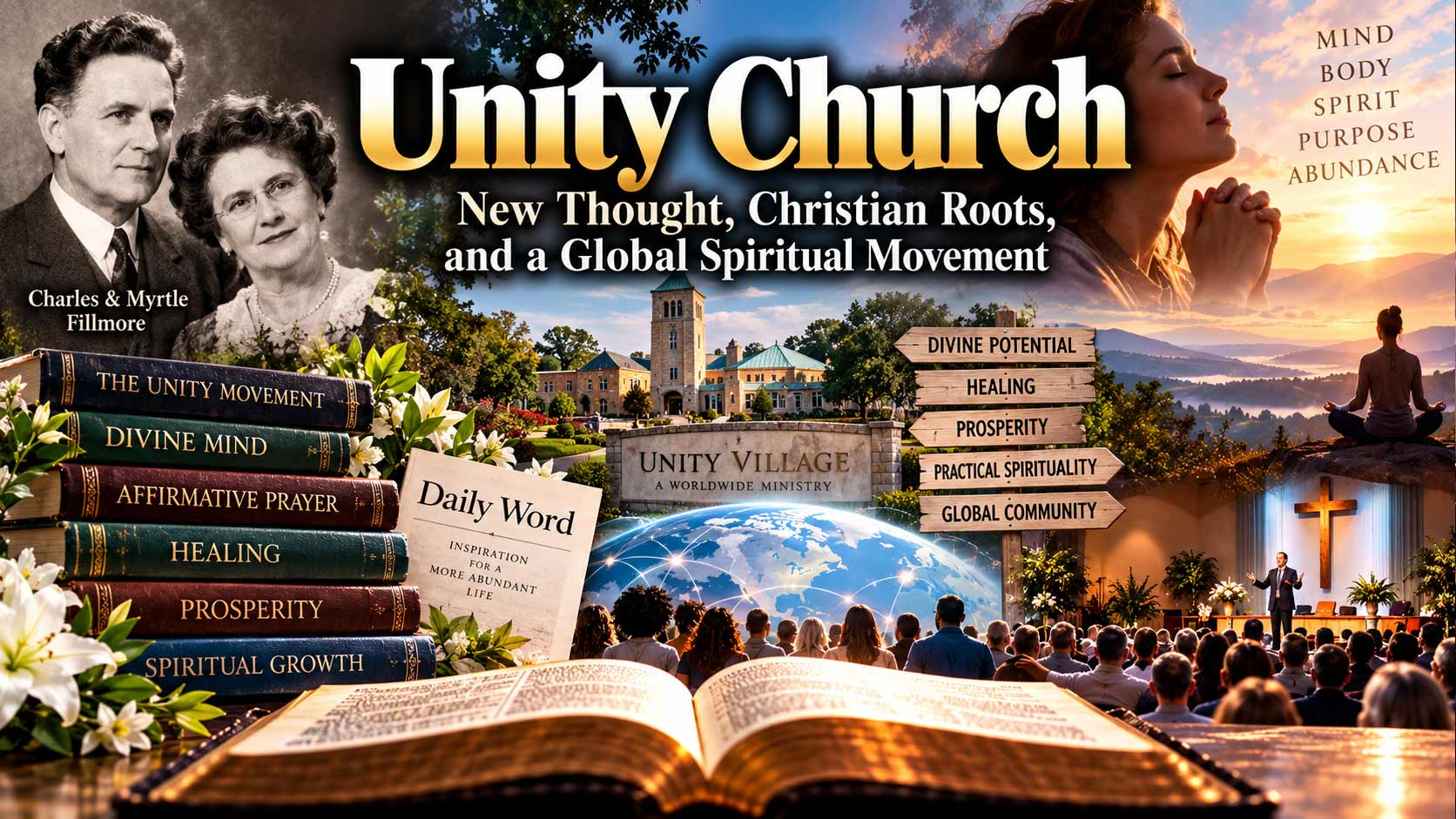
Unity Church is easy to confuse with several other movements because unity is one of those words Christians have been putting into church names for a very long time. The Unity movement we’re discussing here isn’t a denomination formed by several churches merging, and it isn’t connected with the Unification Church of Sun Myung Moon. It is an American New Thought movement founded by Charles and Myrtle Fillmore in the late nineteenth century, combining Christian language and Scripture with metaphysical ideas about God, human consciousness, healing, prosperity, and the power of thought.
Unity describes itself today as a positive and practical approach to Christianity, although it also openly draws wisdom from religions outside Christianity. Jesus occupies an important place in Unity teaching, the Bible is regularly used, prayer is central, and many local congregations look enough like ordinary Protestant churches that a visitor might initially assume that is what they are. Once the sermon begins talking about the Christ within every person, divine Mind, affirmations, spiritual consciousness, and the creative power of thought, however, it becomes apparent that Unity is operating with a very different understanding of Christianity.
For our purposes, that places Unity within Christian Cults in the theological sense we’ve been using throughout this section. The issue isn’t that Unity is sinister or authoritarian. In fact, modern Unity congregations tend to be remarkably open and inclusive. The issue is that Unity grew out of Christianity, continues to use Christian language, and substantially redefines doctrines concerning God, Christ, humanity, sin, salvation, Scripture, and the nature of reality.
Charles and Myrtle Fillmore
Unity began with a husband and wife rather than a dramatic prophet claiming a new revelation. Charles Fillmore was born in 1854 and was largely self-educated. Myrtle Fillmore, born Mary Caroline Page in 1845, grew up in a Methodist family and attended Oberlin College before becoming a teacher. They married in 1881 and eventually settled in Kansas City, Missouri.
Myrtle suffered from chronic health problems for much of her early life. In 1886 the Fillmores attended a lecture by E. B. Weeks, a teacher associated with the growing New Thought movement. Myrtle came away from the experience with an idea that transformed her understanding of herself: she was a child of God and therefore didn’t have to accept sickness as her true inheritance.
She began praying, meditating, using affirmations, studying the Bible, and speaking positively about her body and health. Myrtle eventually concluded that she had been healed through changing her thinking and recognizing her true spiritual relationship with God. Charles, who suffered from problems associated with a childhood hip injury, began experimenting with the same principles and reported physical improvement as well.
The Fillmores didn’t initially set out to establish another church. They wanted to investigate the spiritual principles they believed had produced these healings and make them available to others. That search eventually produced a movement.
The New Thought Movement
Unity can’t really be understood apart from New Thought, a broad metaphysical movement that developed in the United States during the nineteenth century. New Thought teachers differed considerably among themselves, but they generally emphasized the spiritual nature of reality, the relationship between mind and experience, the presence of God within human beings, and the possibility of transforming life through changes in consciousness.
The movement developed alongside other nineteenth-century experiments in religion and healing. Ralph Waldo Emerson and Transcendentalism contributed ideas about divine reality within the individual, while Phineas Parkhurst Quimby became influential through theories connecting thought and physical health. Emma Curtis Hopkins, sometimes called the “teacher of teachers” within New Thought, influenced numerous religious leaders and movements.
Christian Science emerged from roughly the same broader metaphysical environment, which explains why Christian Science and Unity can sound similar at certain points. They aren’t the same movement. Mary Baker Eddy developed a much more tightly defined theological system and established the Church of Christ, Scientist, while Unity became considerably more eclectic and willing to borrow ideas from different spiritual traditions.
The Fillmores read widely. Christian metaphysics, Theosophy, Transcendentalism, Eastern religious ideas, New Thought teachers, and the Bible all contributed to the intellectual environment in which Unity developed. Unity’s own historical accounts acknowledge that the Fillmores studied texts associated with Hinduism, Buddhism, yoga, Theosophy, and other traditions while developing their theology.
That willingness to borrow broadly remains characteristic of Unity today.
The Beginning of Unity
The Fillmores began publishing a magazine called Modern Thought in 1889, the year Unity recognizes as its founding. Myrtle’s interest in helping others through prayer led to the establishment of the Society of Silent Help in 1890, later called the Society of Silent Unity and eventually simply Silent Unity.
People could write to the ministry requesting prayer, and the Fillmores and their associates would pray with them. This became one of Unity’s most enduring ministries and eventually reached people far beyond Kansas City.
The name Unity reflected one of the movement’s central convictions: beneath the divisions separating people and religions lies a deeper spiritual unity grounded in God. The Fillmores weren’t particularly interested in establishing another denomination arguing that everyone else had gotten Christianity wrong. They believed spiritual truth appeared in many places and could be recognized wherever it was found.
In 1892 Charles and Myrtle signed a covenant dedicating themselves, their resources, and their future to what they called the “Spirit of Truth.” The language reflected the increasingly metaphysical Christianity they were developing.
Their publishing work, prayer ministry, classes, correspondence courses, and study groups expanded steadily. Eventually Unity centers and churches began appearing around the country.
God as Divine Mind
Unity’s understanding of God differs significantly from historic Christian theology. God isn’t primarily described as a personal being existing separately from creation. Unity commonly speaks of God as Spirit, Divine Mind, Principle, Life, Love, and universal Presence.
God is everywhere and present within everything. Unity’s first commonly stated spiritual principle is essentially that God is absolute good and present everywhere.
This naturally changes the relationship between God and humanity. If divine Spirit is the fundamental reality underlying existence, then human beings aren’t simply creatures standing outside God and trying to establish a relationship with Him. Divine life is already present within them.
Unity therefore speaks frequently about discovering or awakening to the divine presence within.
Historic Christianity certainly teaches that God is omnipresent and that believers are indwelt by the Holy Spirit. But Christianity has historically maintained a distinction between the Creator and creation. Human beings can know God, be united with Christ, and participate in divine life without becoming expressions of God in the metaphysical sense found in Unity.
The difference can sound subtle until we reach Unity’s understanding of human nature.
The Divine Nature of Humanity
Traditional Christianity begins its description of humanity with two realities held together: human beings are created in God’s image, and human beings are fallen creatures affected by sin. Unity places much greater emphasis on the first idea while substantially reinterpreting the second.
Human beings are understood as inherently spiritual and fundamentally good because their true nature comes from God. Unity commonly teaches that each person possesses divine potential and that spiritual growth involves awakening to this true identity.
This is one of the movement’s most attractive ideas. Instead of beginning with humanity as guilty, depraved, or separated from God, Unity begins by telling people that divine life already exists within them.
Sin therefore becomes less a matter of rebellion against a holy God and more a matter of mistaken thinking, spiritual ignorance, or failure to live according to one’s true divine nature. Human beings suffer because they think and live from a false understanding of themselves.
Salvation consequently becomes awakening rather than primarily forgiveness. The problem isn’t simply that God must reconcile guilty sinners to Himself. People must discover who they truly are and bring their consciousness into harmony with divine reality.
That is a very different gospel from historic Christianity, even when both systems use words such as God, Christ, prayer, and salvation.
Jesus and the Christ
Unity makes an important distinction between Jesus and the Christ. Jesus was the historical person who expressed the Christ consciousness more completely than anyone else. Christ, however, isn’t limited to Jesus as the eternal divine Son in the historic Christian sense.
The Christ represents the perfect divine idea or spiritual potential present within humanity. Jesus demonstrated what happens when a person fully realizes and expresses that divine identity.
This makes Jesus enormously important within Unity. He is the supreme example, teacher, and revealer of humanity’s spiritual possibilities. Unity doesn’t dismiss Him or treat Him as irrelevant.
But saying that Jesus revealed the Christ and saying that Jesus is the Christ, the eternal Son of God made flesh, aren’t the same theological claim.
Charles Fillmore’s writings make the difference particularly clear. He could speak of the “Christ man” as the perfect idea existing within divine Mind and identify that spiritual reality with the true self that human beings are capable of expressing.
The distinction resembles what we encountered in Christian Science, although the two systems shouldn’t simply be collapsed into one. Both preserve Jesus while interpreting Christ as a universal spiritual reality that extends beyond the unique person of Jesus of Nazareth.
Historic Christianity takes the opposite direction. Christians can become like Christ and be united with Christ, but they don’t possess their own version of the eternal Christ waiting to be discovered within themselves. Jesus isn’t simply the man who demonstrated most successfully what everybody essentially is. He is uniquely the incarnate Son.
The Trinity
Unity sometimes uses Trinitarian terminology, but it doesn’t mean by the Trinity what the Nicene Creed means. Charles Fillmore interpreted Father, Son, and Holy Spirit metaphysically rather than as three distinct divine persons eternally sharing one divine being.
The Father could be understood in terms of divine Mind or the source of ideas, the Son as God’s perfect idea or expression, and the Holy Spirit as the activity through which divine ideas become manifest. The Trinity therefore becomes a description of divine process rather than the historic Christian doctrine of God’s tri-personal existence.
This fits naturally within Unity’s larger theology. The movement isn’t primarily concerned with defining relationships among three divine persons. It is concerned with understanding how divine reality expresses itself in consciousness and experience.
That distinction places Unity outside historic Trinitarian Christianity even though Unity writers may use the words Father, Son, Holy Spirit, and Trinity.
Once again, vocabulary can conceal as much as it reveals.
Prayer and Affirmations
Prayer is one of Unity’s defining practices, but Unity prayer differs considerably from the conventional idea of asking God to intervene from outside a situation.
Unity often practices affirmative prayer. Instead of pleading with God to provide something that is absent, the person praying affirms the spiritual reality already present in God. Prayer changes consciousness and aligns the individual with divine truth.
Someone praying for healing, for example, may affirm divine life and wholeness rather than concentrate on sickness. Someone facing financial difficulties may affirm divine abundance rather than dwell on scarcity. Fear is countered by affirmations of divine love and presence.
This approach grows directly from Unity’s metaphysics. If God is everywhere present and divine good is already the fundamental reality, prayer doesn’t have to persuade a distant God to send something. The person praying needs to become conscious of the good already available in Spirit.
Affirmations therefore aren’t merely motivational slogans. Within Unity theology, thoughts participate in shaping experience. That leads to one of the movement’s most influential teachings.
The Creative Power of Thought
Unity teaches that thoughts have creative power. The ideas people repeatedly hold in consciousness influence how they experience life and what they bring into expression.
This doesn’t necessarily mean every Unity teacher believes a person can simply think about a Cadillac long enough and eventually find one in the driveway. Popular versions of positive thinking sometimes turn New Thought principles into little more than spiritualized wish fulfillment. Unity’s theology is broader than that.
Nevertheless, the connection between consciousness and circumstances remains fundamental. Negative thinking, fear, resentment, and beliefs about limitation can restrict a person’s experience, while spiritual understanding, faith, gratitude, and affirmative thought can help bring life into greater harmony with divine good.
This teaching contributed to the larger American positive-thinking tradition and has obvious similarities with later prosperity and Word of Faith movements. There are important theological differences between them, but the family resemblance isn’t imaginary.
The appeal is obvious. People would generally rather hear that their thoughts can help transform their circumstances than that life occasionally runs straight over faithful people despite everything they think, confess, or believe.
The biblical question is how much power Scripture actually assigns to human thought and whether spiritual truth changes reality or teaches us to live faithfully within reality as God has made it.
Healing
Healing stands near the beginning of Unity’s story because Myrtle Fillmore’s reported recovery provided the practical experience around which the movement developed.
Unity teaches that divine life and wholeness are present within human beings and that prayer, spiritual understanding, and changes in consciousness can contribute to healing. Myrtle believed that accepting her divine inheritance rather than an inheritance of sickness transformed her health.
Unlike Christian Science, modern Unity generally doesn’t build its identity around rejecting conventional medicine. The movement’s emphasis is on spiritual healing and the relationship between consciousness and physical well-being rather than a categorical prohibition against medical treatment.
Still, the theology raises some of the same difficult questions that appear wherever health becomes closely connected with thought or faith. What happens when someone prays correctly, thinks positively, understands spiritual principles, and remains sick?
Any healing theology has to leave room for that question. Pentecostals face it when healing doesn’t come after prayer. Word of Faith believers face it when positive confession doesn’t produce the promised result. Unity faces it when changing consciousness doesn’t change the physical condition.
Suffering has a stubborn habit of testing theology under conditions considerably less comfortable than the classroom in which the theology was learned.
Prosperity
Unity also developed an influential theology of prosperity. Prosperity doesn’t necessarily mean accumulating enormous wealth. It refers more broadly to living from the abundance of divine good rather than a consciousness of limitation and scarcity.
Charles Fillmore wrote extensively about prosperity, and Unity teachers continued developing the subject. The basic principle follows naturally from the movement’s understanding of God: if divine good is unlimited and God is everywhere present, then spiritual consciousness should move away from fear of lack toward confidence in divine supply.
That can involve finances, but it can also involve relationships, creativity, health, opportunity, emotional well-being, and a general sense of flourishing.
These ideas became part of the wider stream of American metaphysical religion that eventually influenced positive-thinking teachers, self-help movements, and some forms of prosperity Christianity. The boundaries between those traditions can become blurry because ideas have traveled freely between religious and secular culture.
Norman Vincent Peale didn’t invent positive thinking out of nowhere, and neither did modern motivational speakers. America had been experimenting with the religious power of thought for generations.
Silent Unity
One of the movement’s most enduring institutions is Silent Unity, the prayer ministry that grew out of Myrtle Fillmore’s early work.
People contact Silent Unity with prayer requests, and trained prayer associates pray with them. The ministry eventually expanded from letters to telephone calls and, later, online communication. It became one of the best-known continuous prayer ministries in American religion.
Silent Unity also illustrates something important about the movement. Whatever theological disagreements historic Christians have with Unity, the movement wasn’t built merely around abstract metaphysical speculation. The Fillmores wanted their ideas to help people facing sickness, fear, grief, financial problems, family difficulties, and other ordinary human struggles.
That practical orientation remains one of Unity’s strongest attractions. People don’t generally enter a Unity church because they’ve been lying awake wondering whether Nicene Christology should be replaced by metaphysical idealism. They come because they’re looking for healing, hope, spiritual growth, peace, or a less condemning understanding of God.
The theology usually arrives with the answer.
Daily Word
Unity’s influence has extended well beyond people who formally belong to Unity churches. One reason is Daily Word, its long-running devotional publication.
Daily Word offers brief inspirational readings centered on themes such as faith, healing, peace, prosperity, gratitude, and divine presence. Many readers have encountered it without knowing much about the theology of the organization that publishes it.
This is characteristic of Unity’s broader influence. Its ideas often travel more easily than its institutional identity. Positive affirmations, divine potential, spiritual laws, visualization, universal religious truth, and the creative power of thought have become so common in American spirituality that people can absorb New Thought assumptions without ever hearing the term New Thought.
In that sense, Unity has been considerably more influential than its membership numbers might suggest.
Unity Village
As the movement expanded, the Fillmores acquired land southeast of Kansas City that eventually became Unity Village, the headquarters of the movement.
What began as Unity Farm developed into a substantial campus containing administrative buildings, educational facilities, gardens, prayer spaces, and other institutions associated with Unity’s work. Unity Village eventually became an incorporated municipality in Missouri.
The setting reflects the Fillmores’ larger vision. Unity wasn’t intended merely to produce Sunday congregations. It developed publishing, education, prayer ministries, retreats, ministerial training, and a broader spiritual community.
Local Unity churches and spiritual centers developed with considerable independence, which helps explain why individual congregations can vary. Some retain a strongly Christian vocabulary, while others sound more broadly interfaith or metaphysical.
There isn’t always a sharp line separating Unity as a Christian movement from Unity as a universal spiritual movement because the tension exists inside Unity itself.
Christianity and the World’s Religions
Modern Unity is notably open toward other religions. It doesn’t ordinarily teach that Christianity possesses the exclusive revelation through which everyone else must come to God. Instead, it looks for universal spiritual principles expressed through different religious traditions.
That approach grew naturally from the Fillmores’ own reading. They studied Christianity alongside Hindu, Buddhist, Theosophical, and other spiritual ideas and believed truth could appear across religious boundaries.
Unity can therefore speak highly of Jesus without insisting that everyone must become a conventional Christian. The movement’s understanding of Christ as a universal spiritual principle makes that easier because Christ isn’t confined in the same way to the historical incarnation of Jesus.
For contemporary Americans uncomfortable with religious exclusivity, this can make Unity extremely attractive. A person can appreciate Jesus, meditation, the Bible, Eastern spirituality, positive thinking, and mystical experience without being required to choose one tradition against all the others.
Historic Christianity presents a more difficult claim. Jesus doesn’t merely point toward a universal truth that appears equally through many spiritual teachers. He makes claims about Himself that force the question of who He uniquely is.
Unity softens that problem by universalizing the Christ.
Unity Today
Unity today describes itself as a global, inclusive spiritual community offering practical spiritual resources to people of all faiths. Its churches and spiritual centers continue the traditions established by the Fillmores while adapting them to contemporary religious culture.
Many congregations are socially progressive and welcoming toward people who have felt rejected by more traditional churches. Services may include music, meditation, affirmative prayer, biblical passages, metaphysical teaching, and ideas drawn from a wide range of spiritual sources.
The movement’s emphasis remains remarkably consistent with its origins: God is present everywhere, human beings possess an essentially divine spiritual nature, thoughts have creative power, prayer aligns consciousness with God, and spiritual truth must be practiced rather than merely believed.
Those ideas are often summarized today as Unity’s Five Principles. They provide a much simpler introduction to the movement than attempting to master the extensive metaphysical vocabulary found in Charles Fillmore’s writings.
The packaging has become more contemporary. The basic worldview remains recognizable.
Is Unity Church Christian?
Unity certainly comes from Christianity. Charles and Myrtle Fillmore read the Bible, centered much of their teaching on Jesus, used Christian terminology, established what became churches, and understood themselves as recovering spiritual truths demonstrated in the ministry of Christ.
But Unity’s Christianity differs fundamentally from historic Christianity. God becomes universal divine Mind or Spirit rather than the personal triune Creator understood by historic Christian theology. Jesus becomes the supreme expression of the universal Christ rather than uniquely God the Son incarnate. Human beings possess divine spiritual potential that must be awakened rather than standing primarily as sinners needing reconciliation with God. Sin becomes erroneous consciousness, salvation becomes spiritual awakening, and prayer becomes the alignment of thought with divine reality.
Those aren’t small denominational differences comparable to disagreements over baptism, church government, predestination, or spiritual gifts. They represent a different understanding of God, Christ, humanity, and salvation.
That is why Jew & Greek places Unity Church under Christian Cults, while recognizing that the word cult here is being used theologically rather than sociologically. Unity isn’t being placed beside high-control movements because it supposedly isolates members or demands unquestioning obedience to a charismatic leader. That isn’t the point. It belongs here because it developed within Christianity while reconstructing Christianity through New Thought metaphysics.
Unity’s enduring appeal isn’t difficult to understand. It offers a God who is always present, a humanity that is fundamentally divine rather than depraved, a Jesus who shows us what we can become, prayer that promises practical results, and a spirituality willing to find truth almost anywhere.
Historic Christianity offers something less flattering but, from its perspective, considerably more radical. Humanity’s problem isn’t merely that we’ve forgotten the divinity within us. We need reconciliation with a God who is genuinely other than us, and Jesus didn’t come simply to demonstrate the spiritual potential we already possess. He came to do for us what we couldn’t do for ourselves.