

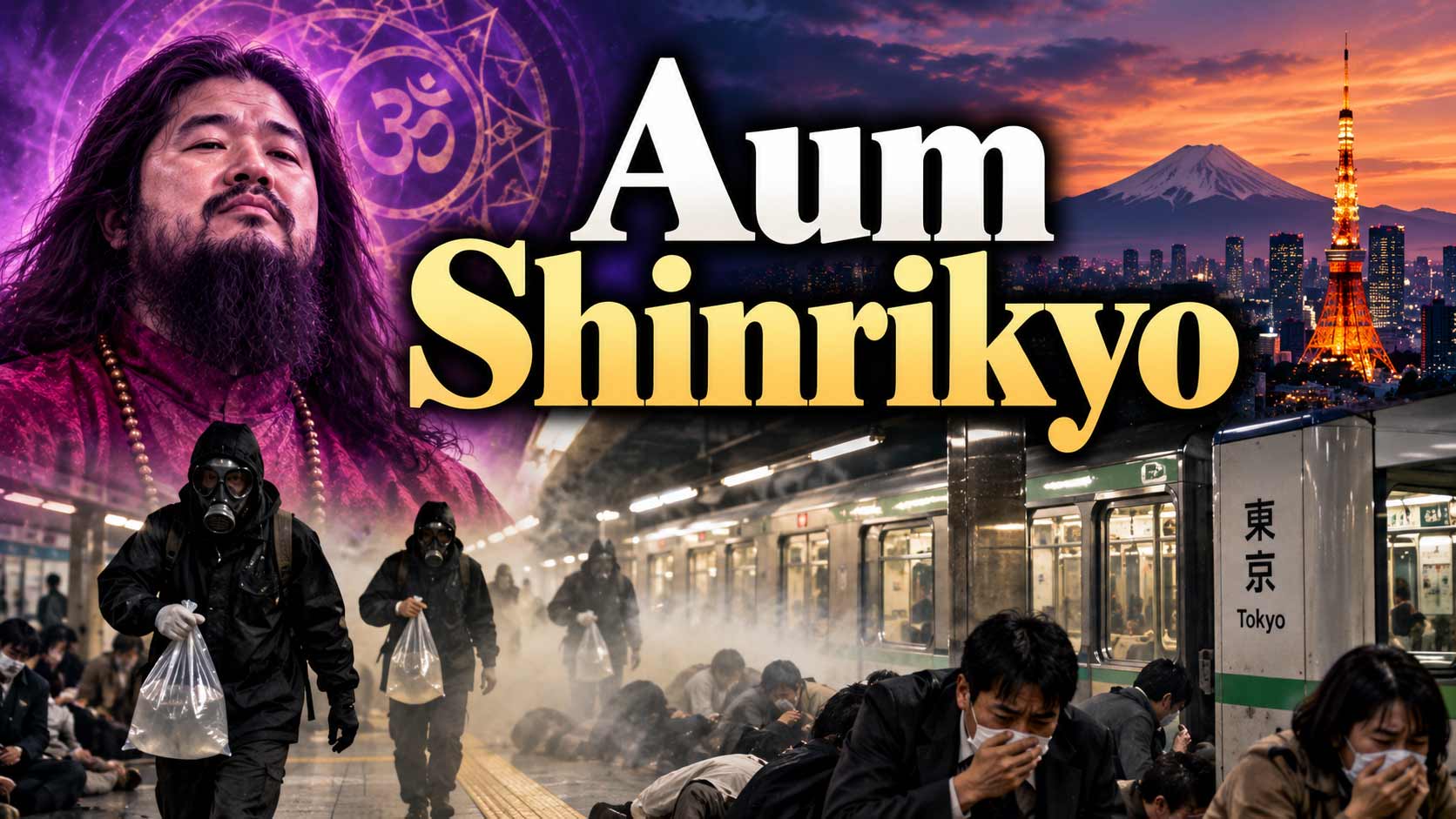
At 8:00 on a Monday morning in March 1995, Tokyo’s subway system was doing what it did every weekday: carrying enormous numbers of commuters into the center of one of the world’s largest cities. Members of a Japanese religious movement boarded several trains carrying plastic bags containing liquid sarin, a nerve agent developed for chemical warfare. They punctured the bags and left the trains, allowing the poison to spread through crowded subway cars and stations.
The attack killed people and injured thousands, many of whom suffered lasting effects. It shocked Japan partly because of where it happened, but even more because of who had done it. Aum Shinrikyo wasn’t a foreign terrorist organization. It was a Japanese religious movement led by a partially blind yoga teacher named Shoko Asahara, whose followers included physicians, scientists, engineers, and graduates of some of Japan’s leading universities. The movement had begun with meditation, yoga, and promises of spiritual enlightenment. Less than a decade later, it was manufacturing chemical weapons.
Few modern religious movements demonstrate more dramatically how spiritual elitism, apocalyptic expectation, absolute obedience, and a charismatic leader can combine into something genuinely dangerous.
Chizuo Matsumoto Becomes Shoko Asahara
Shoko Asahara was born Chizuo Matsumoto in 1955 on the Japanese island of Kyushu. He suffered from impaired vision from childhood and attended a school for the blind, although he retained some sight.
As a young adult, Matsumoto developed interests in traditional Chinese medicine, acupuncture, yoga, meditation, Buddhism, Hinduism, and various forms of esoteric spirituality. He also encountered the kinds of supernatural and New Age ideas circulating internationally during the 1970s and 1980s. His religion would eventually become an unusual mixture of all of them.
During the early 1980s he began teaching yoga and meditation. In 1984 he established a spiritual group that became known as Aum Shinsen no Kai, and over the next several years his claims about himself grew dramatically. Matsumoto adopted the name Shoko Asahara and increasingly presented himself not simply as a teacher but as someone who had achieved extraordinary spiritual enlightenment.
By 1987 the movement was known as Aum Shinrikyo, usually translated something like “Aum Supreme Truth.” The Sanskrit syllable Aum or Om carries sacred significance in Hindu religious traditions, while Shinrikyo conveys the idea of teaching or religion of supreme truth.
The name itself told followers what Asahara was offering. This wasn’t supposed to be one spiritual path among many. It was the truth behind them.
Buddhism, Hinduism, and a Little Bit of Everything Else
Aum Shinrikyo is often described simply as a Buddhist cult, but that can be misleading. Asahara drew heavily from Buddhist ideas, particularly concepts associated with Tibetan and esoteric Buddhism, but he combined them with Hindu yoga, tantric practices, supernatural powers, New Age spirituality, apocalyptic Christianity, and his own revelations.
Concepts such as karma, reincarnation, enlightenment, meditation, liberation from attachment, and escape from the cycle of rebirth were fundamental to Aum’s worldview. Asahara also incorporated Hindu figures, especially Shiva, and emphasized rigorous spiritual practices designed to transform consciousness.
The movement developed elaborate levels of spiritual advancement. Members practiced meditation, breathing exercises, yoga, ascetic disciplines, chanting, visualization, and other techniques. Some practices involved extreme physical discomfort or sensory deprivation, which could be interpreted as evidence that the disciple was overcoming attachment to the body.
This gave Aum something that attracted spiritually serious people. It wasn’t merely asking members to believe propositions. It offered an intensive program through which they could supposedly experience spiritual realities for themselves.
For someone dissatisfied with ordinary material life, that could be compelling.
Shoko Asahara, the Enlightened Master
Asahara’s authority expanded as the movement grew. He claimed extraordinary spiritual accomplishments and presented himself as uniquely capable of guiding disciples toward enlightenment.
Eventually his claims went considerably further. Asahara identified himself with figures and expectations drawn from multiple religious traditions. He portrayed himself as an enlightened master and, in various contexts, made claims associated with the Buddha and with Christ. He also claimed the ability to transfer spiritual power to followers.
Aum publications promoted stories of supernatural abilities. Photographs famously showed Asahara apparently levitating in a lotus position. Followers were encouraged to believe that advanced spiritual practice could produce unusual powers.
None of this was merely decorative. If Asahara had reached a level of consciousness inaccessible to ordinary people, then his judgment naturally carried more weight than theirs. A disciple who disagreed with him wasn’t necessarily recognizing a problem in Asahara. The disciple might simply be demonstrating his own spiritual ignorance.
That is one of the recurring dangers of enlightenment-based authoritarian systems. The leader doesn’t merely know more. He occupies a higher level of reality.
Recruiting Japan’s Educated Young Adults
Aum Shinrikyo’s membership is particularly interesting because it attracted people whom outsiders often assume should be immune to cults.
Japan in the 1980s was prosperous, technologically sophisticated, and intensely competitive. Young adults could follow a well-defined path through education, career, marriage, and economic advancement, but some found that path spiritually empty. Aum offered something that corporate life couldn’t: cosmic significance.
The movement recruited university students and young professionals, including people with training in science, medicine, chemistry, engineering, and computer technology. Their education didn’t necessarily undermine Asahara’s worldview because he presented his religion as compatible with science. Meditation, altered states of consciousness, spiritual energy, and supernatural powers could be wrapped in scientific-sounding explanations.
This is worth remembering whenever someone assumes education automatically protects against religious deception. Education can make a person extremely competent at evaluating evidence within a field of expertise. It doesn’t automatically make that person equally competent at recognizing manipulation, testing metaphysical claims, or resisting the desire to belong to an enlightened elite.
In Aum’s case, scientific expertise eventually became something far worse than ineffective protection. The organization learned to use the technical abilities of its members.
Renouncing the World
As commitment deepened, some followers became renunciants, leaving careers, possessions, and family relationships to live within Aum’s communal structure.
Renunciation has a long history in several legitimate religious traditions, so leaving ordinary society isn’t by itself evidence of a cult. Buddhist monks, Christian monastics, Hindu ascetics, and members of other traditions have voluntarily embraced forms of poverty and communal discipline for centuries.
The important question is what happens to authority after the person leaves. Within Aum, Asahara increasingly controlled the spiritual framework through which followers interpreted their experiences. Separation from outside relationships reduced competing influences. Demanding spiritual practices strengthened commitment. Members could surrender money and property to the organization, while the movement increasingly determined how they lived and worked.
Leaving then became more than changing churches. It could mean admitting that years of sacrifice, spiritual experiences, relationships, and personal identity had been built around a false system. The greater the investment, the harder that conclusion becomes.
Apocalypse Enters the Picture
During the late 1980s and early 1990s, Asahara’s teachings became increasingly apocalyptic. He drew upon Buddhist ideas about the degeneration of the age, but he also incorporated Christian language about Armageddon. The Book of Revelation, nuclear war, global catastrophe, and predictions associated with figures such as Nostradamus became part of Aum’s developing vision of the future.
Asahara warned that civilization was approaching destruction. A catastrophic war could kill most of humanity, while Aum’s spiritually prepared followers would survive or advance spiritually through the coming crisis.
This changed the movement’s relationship with the outside world. Society was no longer merely spiritually ignorant. It was approaching judgment and destruction.
At the same time, Aum members increasingly saw themselves as the small spiritually enlightened community that understood what was really happening.
Apocalyptic belief can produce urgency without producing violence; Christianity itself is an apocalyptic religion in the broad sense that it expects Christ’s return, resurrection, judgment, and the consummation of history. The dangerous turn comes when a leader moves from predicting catastrophe to believing his movement has permission to help bring it about.
Aum crossed that line.
Politics and Humiliation
In 1990, Asahara and other Aum members entered Japanese politics through a party associated with the movement. They ran candidates for the national legislature and expected greater public support than they received.
The result was humiliating. Aum’s candidates lost badly.
Rather than interpreting the defeat as evidence that Japanese voters simply weren’t interested, Asahara increasingly incorporated opposition into his worldview. The outside world wasn’t merely unconvinced; it was hostile to the truth.
That shift is common in closed ideological systems. Failure can either challenge the belief or become additional evidence for it. If people reject the prophet because he is wrong, the system weakens. If they reject him because the world persecutes prophets, the system becomes stronger.
A worldview that can explain every possible outcome eventually becomes almost impossible to correct from inside.
From Spiritual Movement to Criminal Organization
Aum Shinrikyo didn’t become violent for the first time in 1995.
Years earlier, people who threatened the movement had already begun disappearing or dying. One of the most notorious cases involved Tsutsumi Sakamoto, an attorney representing families concerned about relatives who had joined Aum.
In November 1989, Aum members entered Sakamoto’s home and murdered him, his wife, and their infant son. Their bodies were concealed, and the crime remained unresolved for years.
This event reveals how early the moral transformation had occurred. The movement was still publicly presenting itself as a religion seeking spiritual enlightenment while people inside it were willing to murder a lawyer, his wife, and a baby because he threatened the organization.
Once protecting the movement becomes morally superior to ordinary moral obligations, almost anything can eventually be justified.
“Poa” and the Morality of Killing
Aum’s leaders developed religious justifications for violence by distorting Buddhist concepts, particularly an idea they called poa or phowa.
Within Tibetan Buddhist traditions, phowa refers to practices involving the transfer of consciousness at death. Asahara radically reinterpreted the idea. Killing someone under the direction of an enlightened master could supposedly prevent that person from accumulating worse karma and could therefore become, perversely, an act of spiritual compassion.
This is one of the darkest features of Aum’s theology because it allowed ordinary moral categories to be reversed. Murder could become salvation. Obedience could become compassion. A victim could supposedly benefit from being killed.
Once a leader acquires the authority to redefine evil as good, conscience itself becomes an obstacle to spiritual advancement. The member who hesitates may then be told that his reluctance isn’t moral insight. It is attachment, ignorance, ego, or insufficient faith in the master.
Building Weapons
Aum’s apocalyptic worldview combined with something unusual for a religious cult: significant money and highly trained personnel.
The organization pursued an astonishing range of weapons programs. Members investigated chemical and biological weapons and sought technologies capable of producing mass casualties. The group experimented unsuccessfully with biological agents and developed chemical weapons capabilities far beyond what most private organizations could accomplish. Aum also pursued other ambitious weapons ideas, including efforts related to military technology.
The organization’s scientists eventually succeeded in producing sarin, an extremely toxic nerve agent.
Sarin disrupts the nervous system by interfering with the body’s ability to regulate muscles and glands. Exposure can produce constricted pupils, breathing difficulty, convulsions, paralysis, and death. The danger is compounded by the fact that victims may not immediately understand what they have encountered.
A spiritual movement that began with yoga classes was now operating a chemical-weapons program. The transition sounds unbelievable only if we ignore everything that happened between those two points.
Matsumoto
Aum used sarin before the Tokyo subway attack. On the night of June 27, 1994, members released sarin in a residential area of Matsumoto, a city in Nagano Prefecture. The intended targets included judges involved in a property dispute affecting Aum.
The gas drifted through the neighborhood, killing people and injuring many more. Authorities initially failed to identify Aum as the perpetrator, and suspicion notoriously fell upon an innocent resident whose wife had been severely poisoned.
For Aum, the attack demonstrated that sarin could be used outside the laboratory.
The movement had crossed another boundary. It wasn’t merely murdering particular opponents in secret. It was willing to release a chemical weapon into a populated civilian area in order to influence a legal proceeding.
And it was preparing to do something larger.
March 20, 1995
By early 1995, Japanese authorities were closing in on Aum. Police were preparing searches connected with the movement, and its leadership feared that the organization might soon be exposed.
On the morning of March 20, 1995, five Aum teams entered Tokyo’s subway system during rush hour. They carried packages containing liquid sarin aboard trains traveling on three subway lines converging near the center of government.
The attackers punctured the packages and departed. As the sarin evaporated, passengers and subway workers began collapsing. Some victims couldn’t see properly. Others vomited, convulsed, struggled to breathe, or lost consciousness. Emergency personnel initially didn’t know what substance they were confronting, which increased the chaos and exposed additional people.
The attack killed 13 people according to the count now commonly used in Japan and injured thousands. Some suffered long-term physical and psychological effects.
The casualties could have been far worse. Aum had succeeded in manufacturing sarin, but the purity and delivery method were imperfect. Had the organization possessed military-grade dissemination capability, the same attack might have killed vastly more people.
Why Attack the Subway?
The Tokyo attack wasn’t random violence for its own sake. It arose from the movement’s deteriorating situation and apocalyptic worldview.
Aum’s leadership knew that police pressure was increasing. Creating a major emergency could disrupt an anticipated police action, while the attack also fit Asahara’s larger narrative of conflict between Aum and the forces supposedly conspiring against it.
This is where prophecy and self-fulfillment become difficult to separate. Asahara predicted that the world would move toward catastrophic conflict with his movement, while Aum itself was committing crimes almost guaranteed to produce catastrophic conflict with the state.
If you predict persecution while murdering people and manufacturing nerve agents, the arrival of police isn’t particularly impressive evidence of prophetic insight.
It is evidence that police eventually noticed.
The Investigation and Arrests
After the subway attack, Japanese authorities launched massive raids against Aum facilities.
What investigators found revealed an organization far more dangerous than most outsiders had imagined. There were chemical facilities, evidence of weapons research, illegal drugs, confinement facilities, and records connected with crimes extending well beyond the subway attack.
Asahara was discovered hiding at an Aum compound in May 1995 and arrested. Over time, investigations connected Aum members with murders, kidnappings, chemical attacks, illegal confinement, and other crimes. The image of a strange but essentially harmless yoga cult disappeared permanently.
Asahara was eventually tried and convicted for his role in numerous crimes, including the Tokyo subway attack. He was sentenced to death.
After years of appeals and legal proceedings, Shoko Asahara was executed in July 2018, along with several senior Aum members. Additional executions of former members followed later that month.
Was Aum Buddhist?
Aum Shinrikyo used a great deal of Buddhist language, imagery, and practice, but simply calling it Buddhism creates the same problem as calling Raëlism Christianity because it talks about Jesus. Asahara selected ideas from Buddhist traditions and radically reinterpreted them around his own authority. He mixed them with Hinduism, yoga, Christianity, Western apocalypticism, New Age spirituality, conspiracy theories, and his personal revelations.
Mainstream Buddhist organizations strongly rejected Aum and its violence. The idea that murder could be spiritually beneficial because an enlightened guru ordered it isn’t a reasonable summary of Buddhism.
The better classification is syncretic new religious movement. Aum borrowed heavily from Asian religions but became something distinct under Asahara. That makes it a natural fit under Other Cults & New Religious Movements on Jew & Greek rather than under Buddhism itself.
Jesus and Armageddon
Aum’s use of Christian material deserves particular attention because Asahara eventually adopted Christian apocalyptic language and made extraordinary claims involving Christ. This didn’t make Aum Christian.
Asahara wasn’t preaching the historic Christian gospel of humanity reconciled to God through the death and resurrection of Jesus. He incorporated Jesus into a larger spiritual system alongside Buddhist and Hindu concepts while treating Armageddon as confirmation of his own apocalyptic role.
This is another example of something we’ve encountered repeatedly in New Age and syncretic movements: religious figures are easier to combine after their original teachings have been detached from the traditions that explain them.
Jesus can be made compatible with almost anyone if “Jesus” is allowed to mean whatever the new teacher needs Him to mean.
Historic Christianity is considerably less cooperative.
What Happened to Aum?
The organization didn’t simply disappear after Asahara’s arrest.
Aum Shinrikyo eventually changed its name to Aleph. Other factions also emerged, most notably Hikari no Wa, or the Circle of Rainbow Light, associated with former senior Aum spokesman Fumihiro Joyu.
Joyu publicly distanced himself from Asahara and the violent doctrines of the old organization, and Hikari no Wa presents itself as having broken with Asahara’s teachings. Japanese authorities, however, continue to monitor organizations they regard as descendants of Aum Shinrikyo.
As of 2026, this isn’t merely historical housekeeping. Japanese public-security authorities continue conducting inspections of facilities associated with Aleph and Hikari no Wa. Recent inspections of Aleph facilities have found photographs of Asahara and collections of his recorded teachings, and Japanese authorities continue to regard Aleph as retaining organizational continuity with Aum Shinrikyo. The government’s treatment of the different successor organizations isn’t identical, but the Aum legacy remains a current issue rather than a closed chapter from the 1990s.
That is worth emphasizing because the founder is dead and the original name is largely gone. Religious organizations can change names much faster than the beliefs and relationships inside them change.
Why Intelligent People Followed Asahara
The most comfortable explanation of Aum Shinrikyo is that Asahara attracted gullible people. Unfortunately, he didn’t.
Some followers were gullible, no doubt, as people are everywhere. Others were highly educated and technically accomplished. What they shared wasn’t low intelligence but participation in a system that gradually reorganized how evidence itself was interpreted.
Spiritual experiences confirmed Asahara. Sacrifice confirmed commitment. Opposition confirmed persecution. Apocalyptic events confirmed prophecy. Doubt demonstrated spiritual weakness. Obedience advanced enlightenment.
Eventually the system could defend itself against almost anything.
That doesn’t mean members lacked responsibility for their actions, especially those who participated in murder and terrorism. It means intelligence alone doesn’t provide an escape hatch once a person’s entire framework for evaluating reality has been placed under someone else’s authority.
Aum and the Problem of Spiritual Authority
Aum Shinrikyo represents an extreme case, but the principle behind it isn’t exotic.
Every religious movement has to answer the question of authority. Who gets to say what God, enlightenment, salvation, or spiritual truth requires? How can that claim be tested? What happens when the leader is challenged? Can members leave without being treated as enemies? Is moral behavior still subject to standards that the leader himself can’t rewrite?
Aum’s answers progressively concentrated everything in Shoko Asahara.
Once he became the enlightened master capable of seeing realities ordinary disciples couldn’t see, disagreement with him became almost impossible on equal terms. When he taught that killing could become spiritually beneficial, followers no longer had an independent moral authority capable of telling the guru no.
Christianity has had plenty of authoritarian leaders of its own, so Christians don’t get to treat this as somebody else’s problem. The New Testament repeatedly places teachers and prophets under judgment rather than above it. Paul could be questioned. Prophecy could be weighed. Spirits could be tested. Leaders were judged by character as well as gifts.
The more extraordinary the spiritual claim, the greater the need for testing, not the smaller.
Why Aum Shinrikyo Matters
Aum Shinrikyo belongs in any serious study of cults because it destroys several comforting assumptions at once.
Cults don’t necessarily recruit only the uneducated. Meditation and spiritual discipline don’t necessarily make someone morally wiser. A movement can borrow respected religious traditions without faithfully representing them. Scientific education can coexist with extraordinary metaphysical beliefs. Apocalyptic expectations can move from predicting catastrophe to rationalizing its creation.
Most importantly, Aum shows what can happen when spiritual authority becomes self-validating. Asahara claimed enlightenment, and his enlightenment validated his teaching. His teaching established his authority, and his authority determined how followers understood morality. When reality contradicted the system, reality could be reinterpreted.
By March 1995, that system had traveled an astonishing distance from yoga and meditation. Thousands of ordinary commuters discovered how far when the train doors opened.