

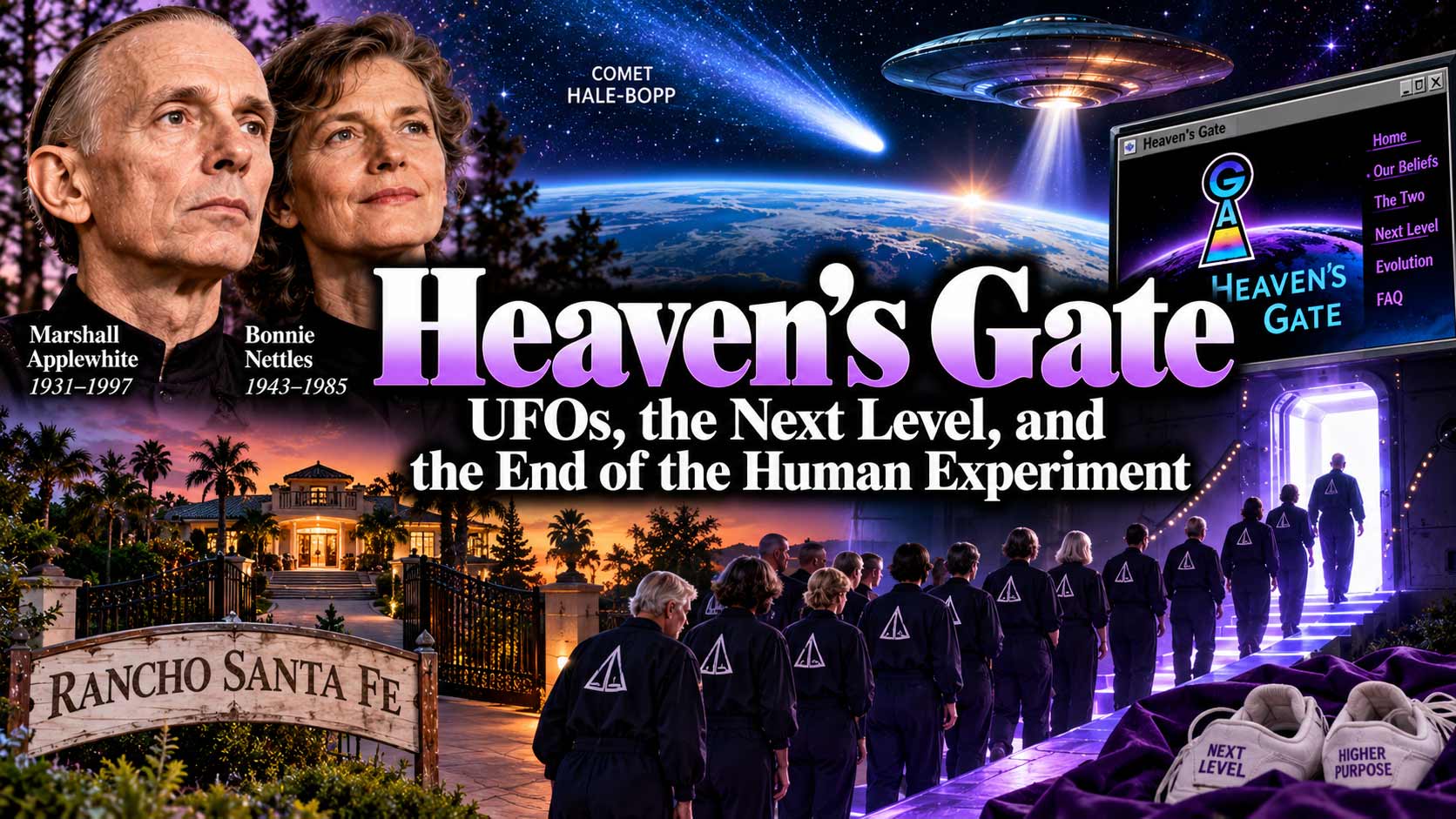
When police entered a rented mansion in Rancho Santa Fe, California, on March 26, 1997, they found 39 members of Heaven’s Gate dead. They were dressed similarly, their bodies had been carefully arranged, and many were covered with purple cloths. The group had taken their own lives over a period of several days because they believed a spacecraft associated with the Hale-Bopp comet offered them an opportunity to leave Earth and enter what they called the Next Level.
That description makes Heaven’s Gate sound like something created specifically for a bad science-fiction movie, but dismissing it that way misses what makes the movement worth studying. Its members didn’t simply believe in flying saucers. Heaven’s Gate combined Christianity, biblical prophecy, New Age spirituality, extraterrestrials, ascetic discipline, evolutionary ideas, and the language of modern technology into a remarkably coherent alternative religion. Jesus remained important, but He was reinterpreted as a representative from an extraterrestrial level of existence. Heaven became a literal higher evolutionary realm, the human body became a disposable vehicle, and salvation became graduation from the human kingdom.
The result was one of the strangest religious movements of the twentieth century, but also one of the clearest examples of what happens when familiar Christian ideas are detached from their historical and biblical setting and reconstructed inside an entirely different worldview.
Marshall Applewhite and Bonnie Nettles
Heaven’s Gate began with Marshall Herff Applewhite and Bonnie Lu Nettles, who met in Texas in the early 1970s. Applewhite was born in 1931, the son of a Presbyterian minister, and studied for the ministry before pursuing music. He became a singer, teacher, and college music professor, but by the early 1970s his personal and professional life had entered a period of considerable turmoil.
Nettles was a nurse with strong interests in astrology, mysticism, spiritualism, and alternative religion. When she and Applewhite met in 1972, both were searching for a larger explanation of their lives. Nettles increasingly interpreted their relationship through a spiritual framework, and Applewhite found in her ideas a way of bringing together his Christian background with the alternative spirituality that fascinated them both.
They became inseparable spiritual partners. Over time they adopted several names, eventually becoming best known to their followers as Ti and Do, pronounced like the musical notes. Applewhite’s musical background apparently followed him farther into theology than most seminary professors would have predicted.
Their relationship wasn’t presented as romantic. In fact, sexuality would eventually be regarded as one of the strongest attachments binding human beings to the lower, earthly level of existence. Ti and Do saw themselves instead as partners sent to Earth for a mission.
And that mission was considerably larger than starting another church.
The Two
Applewhite and Nettles initially called themselves The Two and came to believe that they were the two witnesses described in Revelation 11. In the biblical passage, two prophetic witnesses testify, are killed, and then are raised and taken into heaven while their enemies watch.
But Applewhite and Nettles interpreted the passage through an extraterrestrial framework. Biblical descriptions of heaven, angels, resurrection, clouds, and ascension were understood as ancient descriptions of realities that modern people might describe using the language of spacecraft and advanced beings.
God therefore wasn’t merely the traditional supernatural deity of Christianity. Heaven’s Gate increasingly described a hierarchy of highly evolved beings inhabiting what it called the Evolutionary Level Above Human, later commonly called the Next Level.
Jesus had come from that level. So had Ti and Do.
The basic claim was that humanity had misunderstood what biblical religion was actually describing. Ancient people had seen advanced extraterrestrial beings and interpreted them using the religious vocabulary available to them. What Christians called angels could therefore be understood as beings from the Next Level, and what Christians called ascension could involve something much closer to extraterrestrial transportation.
The Bible hadn’t necessarily been discarded. It had been translated into UFO language.
UFO Religion in America
Heaven’s Gate didn’t invent the idea that extraterrestrials might explain ancient religion. UFO culture had been developing rapidly since the late 1940s, and by the 1960s and 1970s various writers were suggesting that beings described as gods or angels in ancient texts might actually have been visitors from other planets.
Erich von Däniken’s enormously popular 1968 book Chariots of the Gods? helped bring ancient-astronaut theories into mainstream popular culture. Meanwhile, the New Age movement encouraged people to combine Eastern religion, occultism, astrology, channeling, reincarnation, alternative psychology, and extraterrestrial speculation with relatively little concern about whether the pieces had originally belonged together.
Applewhite and Nettles operated inside that environment. Their distinctive contribution was to combine UFO spirituality with a strongly Christian apocalyptic structure. There would be judgment. Earth faced destruction or “recycling.” A higher kingdom existed beyond ordinary human life. Messengers had been sent from above, and only those who responded correctly would escape what was coming.
It was almost a technological version of the Rapture, except nobody was waiting for Jesus to descend from heaven. They were waiting for transportation to the Next Level.
The Class
During the mid-1970s, Applewhite and Nettles traveled around the United States holding meetings and attracting followers. Their message appealed particularly to spiritual seekers already dissatisfied with conventional religion and ordinary American life.
The followers became known internally as the Class, while Ti and Do were their teachers. Members were encouraged to abandon attachments that tied them to ordinary human existence, which could include careers, possessions, families, romantic relationships, and previous religious identities.
This wasn’t simply a matter of joining a congregation on Sunday morning and returning home afterward. Heaven’s Gate demanded a radical redefinition of identity. Members increasingly understood themselves as students preparing to leave the human level altogether.
The group lived communally and often moved from place to place. Members adopted disciplined routines and attempted to suppress individual preferences that might reinforce attachment to their human identities.
From their perspective, this wasn’t pointless deprivation. It was training.
If you genuinely believe you’re preparing to leave the human kingdom permanently, building a comfortable career and upgrading the kitchen aren’t likely to remain high priorities.
The Human Body as a Vehicle
One of the most important ideas in Heaven’s Gate was that the human body wasn’t the person’s ultimate identity. Members often referred to bodies as vehicles.
A member was therefore something like a consciousness temporarily occupying a biological container. The vehicle had appetites, emotions, sexual desires, habits, family attachments, and individual preferences, all of which could interfere with preparation for the Next Level.
The goal wasn’t self-expression. It was almost the opposite. Members attempted to overcome the characteristics that made them distinctively human. They dressed similarly, wore similar hairstyles, followed detailed routines, and attempted to minimize differences between men and women. Sexual relationships were prohibited, and celibacy became an important part of the group’s discipline.
For several male members, including Applewhite, rejection of sexuality eventually went considerably farther. They underwent surgical castration as an attempt to eliminate sexual desire. That extreme practice makes sense only after understanding the theology behind it. The body wasn’t sacred as part of God’s good creation. It was temporary equipment belonging to a level of existence they hoped to leave behind.
Christianity and Heaven’s Gate therefore disagreed about the body long before they disagreed about spaceships.
Jesus From the Next Level
Jesus occupied an important place in Heaven’s Gate theology, but He wasn’t the Jesus of historic Christianity. Applewhite taught that a representative from the Next Level had entered or taken over a human body approximately two thousand years earlier. That individual became known as Jesus and attempted to teach humanity about the kingdom above the human level.
Jesus was therefore significant because He represented the same higher evolutionary reality Heaven’s Gate believed Ti and Do represented. His mission had been misunderstood and eventually transformed into conventional Christianity. Applewhite increasingly understood his own mission as a continuation of that work. He wasn’t merely offering commentary on Jesus. He was presenting the same essential message from the Next Level for a new period of human history.
This pattern appears repeatedly in new religious movements. The founder doesn’t necessarily begin by saying Jesus was meaningless. More often, Jesus remains important while nearly everything Christians historically meant by Jesus is redefined. Once the reinterpretation is complete, the familiar name is still there, but it now belongs to an entirely different theological system.
That is one reason Christian apologetics has to ask more than whether a group “believes in Jesus.” The more useful question is what it believes Jesus actually is.
The Death of Bonnie Nettles
The death of Bonnie Nettles in 1985 created a serious theological problem.
The group had expected transformation into the Next Level to involve a physical process. Ti and Do had taught that members could eventually be changed into higher beings rather than simply dying like everyone else. Nettles’s death from cancer therefore forced Applewhite and the group to reconsider how that transformation would occur.
Instead of destroying the movement, her death changed its theology. Applewhite came to teach more clearly that the physical body could be discarded and that the individual could continue into the Next Level without it.
That development is important because it eventually made the events of 1997 theologically possible. Death no longer represented failure to achieve transformation. Leaving the body could itself become the means of transformation.
When a prophecy or expectation fails, religious movements generally have several choices. They can admit the belief was mistaken, dissolve, or reinterpret what happened so that the unexpected event becomes part of the system. Heaven’s Gate chose reinterpretation.
And the reinterpretation eventually became deadly.
Ti and Do
After Nettles died, Applewhite continued to speak of her as having returned to the Next Level. Her physical absence didn’t diminish her spiritual authority within the system. If anything, it provided evidence to believers that the physical vehicle wasn’t necessary for continued existence.
Applewhite, now primarily known as Do, became the group’s sole earthly leader. He presented himself not as an independent religious genius but as someone remaining under Ti’s guidance and the authority of the Next Level. This allowed Heaven’s Gate to maintain a hierarchy extending beyond the visible community. Members obeyed Do, Do followed Ti, and Ti belonged to the Next Level.
From the outside, Applewhite was the human leader of a small religious movement. From the inside, he was part of a chain of command extending beyond Earth. Those two perspectives explain why instructions that appeared increasingly bizarre to outsiders could seem perfectly rational to members who accepted the underlying worldview.
Earth Was About to Be Recycled
Heaven’s Gate developed an increasingly pessimistic view of human civilization. Earth wasn’t progressing toward some wonderful spiritual awakening. The present civilization was approaching the end of its usefulness.
The group described the coming judgment as the recycling of Earth. The terminology sounded technological rather than biblical, but the structure remained apocalyptic. Humanity had been given an opportunity to respond to representatives from the Next Level, and that opportunity was running out.
Those who remained attached to ordinary human existence would remain part of a world headed for destruction. Those who successfully overcame their humanity could graduate.
The message contained both judgment and salvation, but neither meant what those words mean in Christianity. Judgment wasn’t fundamentally God’s moral response to sin, and salvation wasn’t reconciliation with God through Christ. The problem was membership in the human evolutionary level itself.
The solution was to become something else.
Luciferians and the Opposition
Heaven’s Gate also developed an explanation for why its message wasn’t widely accepted. Hostile extraterrestrial forces, sometimes called Luciferians, were understood to be working against the Next Level and deceiving humanity.
That provided a cosmic explanation for opposition. Governments, conventional religions, media organizations, and broader culture could all become parts of a system that kept people attached to false understandings of reality.
This is a particularly dangerous feature of closed belief systems because criticism can become self-confirming. If outsiders agree with the leader, the leader appears credible. If outsiders strongly disagree, their opposition proves that hostile forces are attempting to suppress the truth.
A belief system becomes difficult to test when every possible outcome confirms it.
Christianity certainly teaches the reality of spiritual deception and opposition. But Christianity also preserves ways of testing teachers by Scripture, historical claims, moral character, and the public proclamation of the gospel. The Bereans were praised for examining Paul’s teaching rather than rebuked for failing to accept the apostle unquestioningly.
Any religious system that makes itself immune to correction has created a very convenient theology for whoever happens to be in charge.
Heaven’s Gate Discovers the Internet
One of the fascinating features of Heaven’s Gate is how early the group embraced the internet.
By the 1990s members were earning money through a web-design business and using the emerging online world to distribute their teachings. Heaven’s Gate established a website containing theological statements, explanations of its beliefs, and material directed toward potential converts.
This gives Heaven’s Gate an unusual place in religious history. It was simultaneously an apocalyptic UFO religion and an early internet religion. Members who believed human civilization was about to be recycled were building websites for the civilization in question.
The technology also fit naturally with their worldview. Heaven’s Gate already described bodies as vehicles, minds almost as programmable systems, and spiritual development in language resembling technological upgrading. Cyberspace provided an environment in which identity could appear increasingly independent of the physical body.
The movement’s vocabulary sounded considerably less strange in 1997 than it might have in 1975.
Hale-Bopp
Astronomers discovered the Hale-Bopp comet in 1995, and it soon became apparent that it would produce a spectacular appearance in the night sky. Heaven’s Gate interpreted the approaching comet through its existing expectations about the Next Level.
A rumor circulated that an unidentified object was traveling behind or near Hale-Bopp. Despite the absence of credible astronomical evidence, Applewhite and his followers became convinced that a spacecraft associated with the Next Level was accompanying the comet.
For Heaven’s Gate, Hale-Bopp wasn’t simply an interesting astronomical event. It was the sign they had been waiting for.
The timing was perfect within their theology. Earth was approaching recycling. The Class had spent years preparing. Ti had already left her vehicle. A spectacular object was crossing the heavens, and reports suggested something else might be traveling with it.
Everything in the belief system began pointing toward departure.
“Graduation”
Heaven’s Gate didn’t describe what happened in March 1997 as suicide in the ordinary sense. Members believed they were graduating from the human level by voluntarily leaving their physical vehicles.
The distinction mattered enormously to them. Their own material argued that genuine suicide would mean turning away from the opportunity offered by the Next Level. Leaving the body when the Next Level called, by contrast, represented successful completion of their earthly training.
That reasoning demonstrates how dramatically language can reshape moral perception. If a body is merely a vehicle, death becomes abandonment of equipment. If Earth is about to be recycled, remaining alive becomes pointless. If a spacecraft is waiting to receive you, dying becomes departure. If the leader represents the Next Level, obedience becomes the rational response.
Change enough definitions and an action that would otherwise appear horrifying can begin to look like spiritual victory.
That doesn’t mean the members were incapable of making decisions. Many left extensive statements explaining what they believed and why they were acting. Understanding their agency, however, doesn’t require accepting the worldview that made their decision appear reasonable.
The Deaths at Rancho Santa Fe
In late March 1997, 39 members of Heaven’s Gate, including Marshall Applewhite, died inside a large rented house in Rancho Santa Fe, near San Diego.
The deaths occurred in stages. Members consumed phenobarbital mixed with food or drink and used alcohol as part of the process. Other members assisted those who died before taking their own turn. The bodies were arranged carefully, dressed similarly, and covered with purple cloths. Authorities discovered them on March 26.
The dead included 21 women and 18 men and ranged widely in age. Their matching clothing and shoes became some of the most memorable images from the event, but focusing too heavily on the visual oddities can turn human beings into props in a bizarre news story.
These were people who had families, histories, talents, disappointments, convictions, and reasons they believed made sense. They had spent years constructing an understanding of reality in which the decision made in that house appeared not to be an ending but a beginning.
They were wrong, and the consequences of that error couldn’t be corrected afterward.
Was Heaven’s Gate a Christian Cult?
Heaven’s Gate used Christian material extensively, but I wouldn’t place it under Christian Cults in the taxonomy we’re using at Jew & Greek. By its mature stage, Christianity had become one ingredient inside a much larger UFO religion.
Jesus was reinterpreted as a representative of an extraterrestrial evolutionary level. Heaven became the Next Level. Angels became advanced beings. Ascension took on technological overtones. Biblical prophecy was incorporated into an extraterrestrial cosmology, and Applewhite’s authority depended upon his supposed relationship with beings beyond Earth.
That puts Heaven’s Gate more naturally under Other Cults and New Religious Movements, alongside Scientology and Krishna Consciousness, although the three movements have almost nothing else in common.
The category is intentionally broad. What connects them isn’t a shared theology but the fact that they represent religious systems outside historic Christianity that became significant enough in modern Western culture to warrant explanation and apologetic engagement.
Heaven’s Gate also qualifies as a cult in the more common sociological sense because it developed around highly authoritative leaders, required extraordinary separation from ordinary society, regulated members’ behavior intensively, and eventually produced a closed worldview in which leaving one’s physical body could be understood as obedience.
Heaven’s Gate and Christian Apologetics
It would be easy to make an apologetic article about Heaven’s Gate consist of little more than pointing out that there was no spaceship behind Hale-Bopp. That part isn’t particularly difficult.
The more interesting question is how a religious system should be tested before its final claim becomes obviously false.
Heaven’s Gate borrowed from Christianity while removing the historical anchors that Christianity gives its central claims. The resurrection of Jesus isn’t presented in the New Testament as secret knowledge available only to an enlightened spiritual class. The apostles publicly claimed that Jesus had been crucified under identifiable political authorities, buried, and subsequently seen alive by witnesses.
Paul even acknowledged the possibility of falsification: if Christ wasn’t raised, Christian faith was false.
Heaven’s Gate worked differently. Its decisive claims depended upon the revelations of Ti and Do. Their interpretation explained the Bible, extraterrestrials, human bodies, the approaching judgment, Nettles’s death, opposition from outsiders, and eventually Hale-Bopp itself. When events challenged the system, the system could be adjusted to absorb them.
That is an apologetic warning considerably more useful than laughing at UFOs. Every religion, Christianity included, should be asked where its claims touch reality strongly enough that they can actually be tested.
When the Extraordinary Becomes Ordinary
One of the unsettling things about Heaven’s Gate is how ordinary its members could appear when speaking for themselves. Their recorded statements don’t necessarily resemble people screaming incoherently about aliens. Many spoke calmly, intelligently, and with apparent confidence about what they believed they were about to do.
That should cure us of the idea that false religion is always easy to recognize because its followers will look irrational. Intelligent people can reason quite effectively from false premises. Once the foundational assumptions are accepted, conclusions that look absurd from outside the system can become internally consistent.
If the body really is only a disposable vehicle, if Applewhite really did represent the Next Level, if Earth really was about to be recycled, and if a spacecraft really was arriving to receive prepared souls, then the final act at Rancho Santa Fe followed a terrible kind of logic.
The place to challenge that logic wasn’t at the final step. It was at the beginning.
Christian apologetics therefore has to do more than compare religious conclusions. It has to examine the authorities, evidence, and assumptions that produce them. Heaven’s Gate reminds us that sincerity doesn’t establish truth, internal consistency doesn’t establish truth, sacrifice doesn’t establish truth, and confidence doesn’t establish truth.
Thirty-nine people were convinced enough of their worldview to stake their lives on it. Their conviction was real, but the spacecraft wasn’t.