

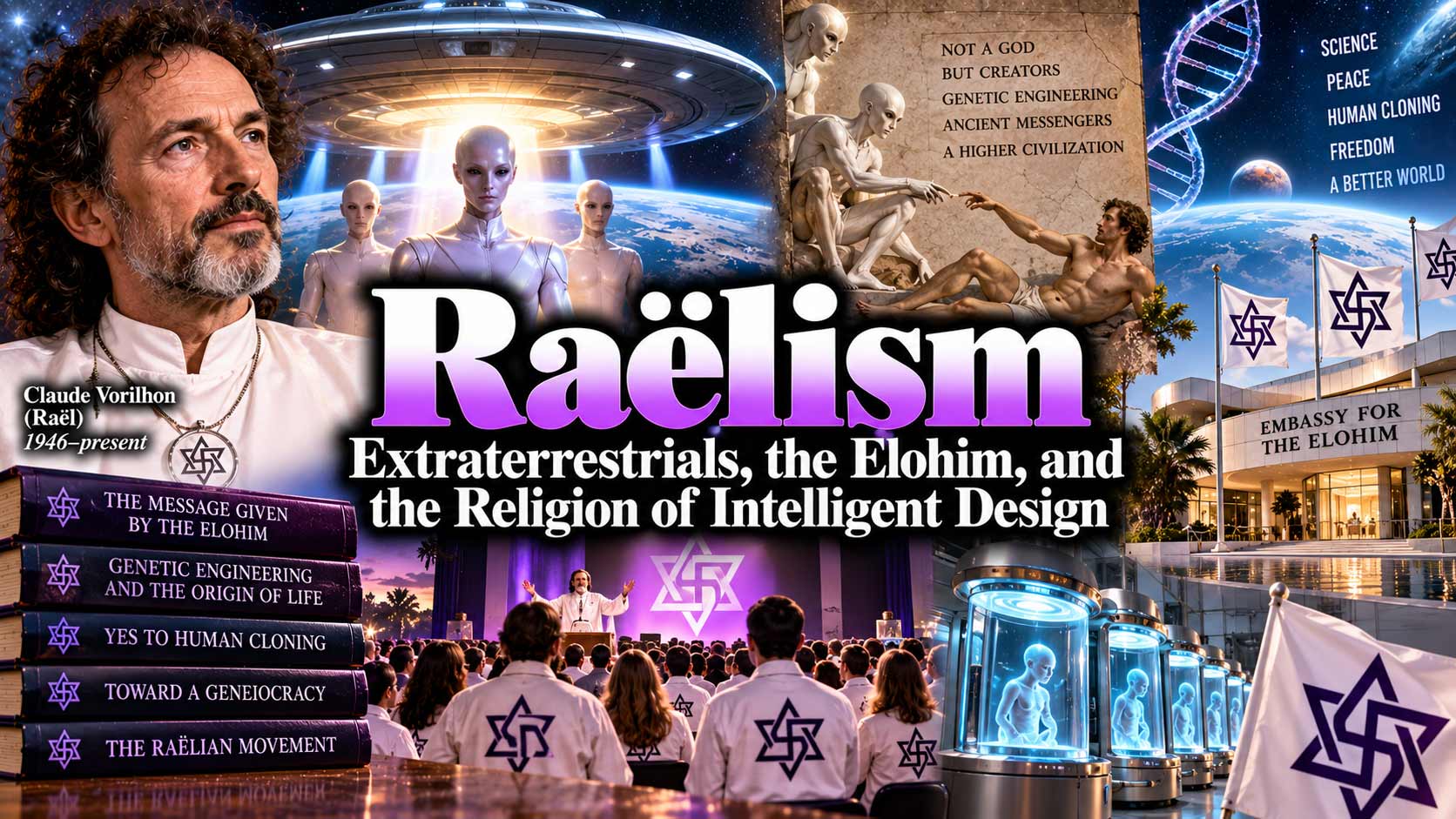
Raëlism may be the rare religion in which Genesis, UFOs, genetic engineering, human cloning, free love, and an extraterrestrial embassy all fit into the same theological system. From the outside, that can sound like someone dumped several decades of science fiction into a blender and called the result a religion. From inside the movement, however, the pieces fit together surprisingly well. Raëlians believe humanity has finally become scientifically advanced enough to understand what ancient religions were trying to describe all along.
The movement teaches that there is no supernatural God. Instead, life on Earth was scientifically created by technologically advanced extraterrestrial beings called the Elohim. Moses, Jesus, Buddha, Muhammad, and other great religious figures were messengers connected with these creators, while the founder of Raëlism, Claude Vorilhon, now known as Raël, claims to be their final messenger for our scientific age.
That puts Raëlism squarely in our Other Cults and New Religious Movements category. It isn’t a Christian cult in the sense that Mormonism or Jehovah’s Witnesses are. It doesn’t claim to restore biblical Christianity. It claims to explain why humanity mistakenly invented supernatural religion in the first place.
Claude Vorilhon Becomes Raël
Claude Vorilhon was born in France in 1946. Before becoming a religious leader, he pursued careers in music and automobile journalism and developed a strong interest in motor racing. Nothing in that résumé necessarily suggested that he was about to become humanity’s ambassador to extraterrestrial creators.
According to Vorilhon, everything changed on December 13, 1973. He says he visited the Puy de Lassolas volcanic area near Clermont-Ferrand in central France, where he encountered a small humanoid extraterrestrial who emerged from a spacecraft. Over a series of meetings, the being supposedly explained the true history of humanity and instructed Vorilhon to spread the message throughout the world.
Vorilhon adopted the name Raël and began publishing the teachings he said he had received. He organized what became the Raëlian Movement in 1974 and gradually developed an international following. A second claimed encounter in 1975 expanded the story considerably, with Raël saying that he was taken to another world and encountered advanced beings as well as figures associated with Earth’s religious history.
The movement continues to regard these encounters as the foundation of its message. That immediately creates the central apologetic question surrounding Raëlism: almost everything distinctive about the religion ultimately depends upon whether Claude Vorilhon really met extraterrestrials in France in 1973.
The Elohim
The beings Raël says he encountered are called the Elohim, a word familiar to anyone who has studied the Hebrew Bible. Elohim is one of the biblical Hebrew words translated as God, and its grammatical form is plural even though it frequently takes singular verbs when referring to the God of Israel.
Raëlism gives the word a radically different interpretation. The movement claims that Elohim refers not to God but to technologically advanced beings from another planet. Raëlians commonly explain the term as referring to those who came from the sky and argue that ancient people misunderstood extraterrestrial scientists as supernatural gods because they lacked the scientific knowledge necessary to understand what they were seeing.
This interpretation becomes the key that unlocks the entire Bible for Raëlians. God creating humanity in His image becomes extraterrestrial scientists creating human beings through genetic engineering. Angels become advanced visitors. Miracles become applications of superior technology. Biblical encounters with heavenly beings become ancient accounts of contact with extraterrestrials.
There is a legitimate linguistic observation buried inside the argument: Elohim is grammatically plural in form. But the Raëlian conclusion doesn’t follow from that observation. Hebrew usage, grammar, and the larger biblical context don’t turn the God of Genesis into a laboratory team from another planet simply because the noun has a plural form. A little Hebrew can sometimes be a dangerous thing when it is carrying an entire spaceship.
Creation in a Laboratory
Raëlism rejects both traditional creationism and conventional evolutionary explanations of life’s origin. Instead, it proposes what the movement calls atheistic intelligent design.
According to Raëlian teaching, the Elohim arrived on an Earth that didn’t yet contain life and established laboratories where they engineered living organisms using advanced knowledge of DNA. They progressively created plants, animals, and eventually human beings. Genesis is therefore interpreted as an ancient description of a scientific creation project.
When Genesis says humanity was created in the image of the Elohim, Raëlians take that with unusual literalness. Humans resemble their creators because the Elohim themselves are humanlike beings. We aren’t made in the spiritual image of an immaterial God; we’re biological creations modeled after extraterrestrial scientists.
The Elohim didn’t create the universe. Raëlism rejects the idea of an ultimate supernatural Creator altogether. The Elohim themselves were created by an earlier advanced civilization, which was created by another civilization before it, continuing indefinitely. Humanity may eventually become advanced enough to travel to another planet and create life there, adding another link to the chain.
That solves the question of who created the creators by making sure the chain never actually reaches a beginning. Whether that solves the philosophical problem or merely sends it infinitely backward is another matter.
An Atheist Religion
Raëlians openly describe themselves as atheists because they don’t believe in a supernatural God. At the same time, they regard Raëlism as a religion.
That sounds contradictory only if religion is defined exclusively as belief in a deity. Raëlians use religion more broadly to describe the connection between humanity, its creators, the universe, and one another. Their religion has a founder, cosmology, moral teachings, ceremonies, spiritual practices, an account of human origins, expectations about humanity’s future, and a community organized around those beliefs.
The result is an unusual combination of atheism and religion. There is no omnipotent Creator, but there are creators. There is no supernatural revelation, but there is a message from beings possessing knowledge vastly beyond our own. There are no divine miracles in the traditional sense, but sufficiently advanced technology can accomplish things ancient people would inevitably have regarded as miraculous.
Raëlism doesn’t eliminate religion nearly as much as it translates religion into the language of technology.
Jesus, Moses, Buddha, and Muhammad
Raëlism doesn’t simply dismiss the great religious figures of human history as frauds. Instead, it incorporates them into its extraterrestrial account of history.
Moses, Jesus, Buddha, Muhammad, and other important teachers are understood as messengers through whom the Elohim attempted to guide humanity at different stages of development. Each brought teachings appropriate for the scientific and cultural understanding available at the time.
Jesus receives a particularly interesting interpretation because Raëlian teaching connects him directly with the Elohim. Traditional Christian doctrines such as the virgin birth, miracles, resurrection, and ascension can be reinterpreted through advanced extraterrestrial technology rather than supernatural divine action.
This gives Raëlism a convenient way of affirming religious history while rejecting the religions that grew from it. Christians weren’t necessarily foolish for believing something extraordinary happened around Jesus; they simply misunderstood what happened. The same general principle can be applied to other religions.
Raël then becomes the messenger suited for the final stage. Humanity has reached the scientific age, so the Elohim no longer need to communicate through stories that will be interpreted as supernatural events. We now understand genetics, space travel, cloning, and advanced technology well enough to hear the explanation directly.
At least, that’s the claim.
Raël as the Final Messenger
Raël isn’t presented merely as someone who happened to see a UFO. His position within the movement is considerably more important.
Raëlian teaching identifies him as the messenger chosen by the Elohim to announce their final message to humanity and prepare the world for their return. The movement also associates him with prophetic expectations from multiple religious traditions, presenting his mission as the culmination of a long history of messengers.
That gives Raëlism an interesting relationship with earlier religions. It doesn’t need to prove Moses, Jesus, Buddha, and Muhammad were completely wrong. It can reinterpret them as earlier stages of the same program that has now reached its clearest expression through Raël.
This is a pattern we’ve encountered elsewhere. A new religious movement can absorb previous revelation more easily than it can defeat it. Instead of saying Jesus had nothing important to say, the founder explains what Jesus was really talking about and then places himself in the privileged position of supplying the explanation.
Once that move is accepted, the older revelation can be made to say almost anything.
The Embassy for the Elohim
One of the movement’s central goals is surprisingly concrete: Raëlians want to build an embassy for the Elohim.
The idea follows logically from their theology. The Elohim don’t want to return as invaders. According to the movement, they respect humanity’s freedom and therefore want to be officially invited. An internationally recognized embassy with appropriate diplomatic status and neutral airspace would provide the location for their arrival.
Raëlians have spent years promoting the project and seeking a country willing to host it. The proposed complex is envisioned not simply as a landing pad but as a diplomatic facility where humanity can formally welcome its creators.
The movement presents construction of the embassy as one of its two principal missions, alongside spreading the Elohim’s message. That gives Raëlism something many apocalyptic religions lack: a major goal that could, at least in principle, be photographed by a building inspector.
The more difficult part is the guest list.
Science as Salvation
Raëlism is strikingly optimistic about science and technology. Where some religions look suspiciously at technological progress as a threat to spirituality, Raëlians see scientific advancement as the means by which humanity will eventually overcome many of its limitations.
Genetic engineering, artificial intelligence, nanotechnology, automation, and cloning can all fit naturally into this worldview. Technology isn’t moving humanity farther away from spiritual truth. Properly understood, it is moving us closer to the level already reached by our creators.
That optimism extends to the possibility of overcoming death. Raëlian teaching has connected advanced cloning and the preservation of information about an individual with the possibility that a person could eventually be recreated. The Elohim, possessing technology thousands of years beyond ours, are believed capable of restoring individuals and granting forms of extended or effectively immortal existence.
This is very different from Christian resurrection. Christianity teaches that God raises the dead. Raëlism imagines sufficiently advanced beings reconstructing life through science.
The distinction illustrates one of the deepest differences between the two worldviews. Christianity sees death as an enemy ultimately defeated by the Creator. Raëlism sees death as a technical problem that advanced creators may eventually learn to solve.
Cloning and Clonaid
Raëlism received enormous international publicity around the turn of the twenty-first century because of its association with human cloning.
A company called Clonaid, founded with Raëlian involvement, promoted the possibility of cloning human beings. In late 2002, Clonaid announced that the first cloned human baby, reportedly named Eve, had been born.
The announcement produced worldwide headlines. It also produced a fairly obvious request from scientists: show us the evidence.
Independent verification never materialized. No publicly demonstrated genetic testing established that Eve was a human clone, and the claim was never accepted by the scientific community. The episode nevertheless placed Raëlism in the middle of an international debate about reproductive cloning and biotechnology.
The connection wasn’t accidental publicity. Cloning fits the religion almost perfectly. If extraterrestrial scientists created humanity through advanced biological engineering, then humanity’s growing ability to manipulate life represents progress toward becoming like the Elohim.
For most religions, human cloning would raise a new theological question. For Raëlism, it practically comes with the furniture.
Immortality Without Resurrection
Raëlian ideas about immortality follow from this technological understanding of life. If human beings are biological organisms whose identity can ultimately be reproduced through sufficiently advanced science, then physical death need not have the finality it appears to possess.
The Elohim are believed capable of recreating individuals from preserved biological material and information. Exceptional people may therefore be restored and allowed to live in the company of advanced beings.
This shouldn’t be confused with the Christian doctrine of resurrection. The New Testament doesn’t describe God manufacturing another biological copy of a deceased person. Resurrection means God raises the person who died, with continuity between the person buried and the person raised.
Cloning introduces an entirely different philosophical problem. If scientists created a genetically identical copy of me after I died, why should I assume that I woke up rather than that another person now exists with my genetic information?
A photocopy may reproduce every word on the page. That doesn’t make it the original sheet of paper.
Sensuality and Human Freedom
Raëlism has also attracted attention for its unusually permissive approach to sexuality. The movement teaches that human beings should be freed from religious guilt and repression and encouraged to experience pleasure responsibly.
Sexuality is therefore treated positively rather than primarily as a source of temptation or moral danger. Raëlian teaching emphasizes consent, personal freedom, contraception, and liberation from traditional sexual restrictions. The movement has also supported campaigns associated with sexual autonomy and bodily freedom.
This reflects its larger philosophy. If there is no supernatural God issuing moral commandments, then traditional religious sexual ethics lose their ultimate authority. Human beings should instead develop ethical standards based on happiness, consent, nonviolence, and scientific understanding.
Christianity begins somewhere very different. The body and sexuality belong to God’s creation and therefore have meaning that isn’t determined solely by human preference. Christian sexual ethics can certainly be distorted into shame or unhealthy repression, but correcting those distortions doesn’t require concluding that sexuality has no divinely given boundaries.
Once again, the disagreement goes back to creation. If the body belongs ultimately to the Creator, the Creator has something to say about how it is used. If the body is the product of extraterrestrial biological engineering in a godless universe, the argument has to be constructed on entirely different ground.
Meditation and Sensuality
Despite its fascination with science, Raëlism isn’t merely a technological philosophy. The movement also emphasizes meditation, personal happiness, sensory awareness, and what it calls sensual meditation.
The goal is to become more conscious of one’s body, environment, emotions, and connection with the infinite universe. Raëlian spirituality generally rejects guilt-driven asceticism and instead encourages enjoyment of life while cultivating peace, self-awareness, and harmony with others.
This combination can initially seem strange because Western culture often assumes religion and sensual pleasure belong on opposite sides of the room. Raëlism deliberately rejects that assumption. It wants the authority and meaning traditionally supplied by religion without the supernaturalism or moral restrictions traditionally associated with it.
That helps explain why the movement can describe itself simultaneously as atheist, scientific, spiritual, and religious. Those categories aren’t opposites within the Raëlian system.
The Swastika Controversy
One of Raëlism’s most controversial symbols combines the Star of David and a swastika. The movement explains the design as an ancient symbol representing infinity in time and space and argues that the swastika existed as a religious symbol for thousands of years before Nazi Germany.
Historically, that much is true. Swastika-like symbols appeared in numerous cultures long before Adolf Hitler, including Hindu, Buddhist, Jain, and other traditions. The Nazis appropriated a symbol with a history far older than National Socialism.
But historical explanation doesn’t erase modern associations. In the Western world, and especially for Jews, the swastika became inseparable from Nazism and the Holocaust. Raëlian campaigns to rehabilitate the symbol have therefore generated understandable controversy.
The movement’s use of the Star of David alongside it makes the image even more provocative. Raëlians interpret the combination through their own cosmology rather than Nazi ideology, but symbols acquire meanings through history whether their users like it or not.
Knowing what a symbol meant three thousand years ago doesn’t make people forget what it meant eighty years ago.
Geniocracy and the Future of Government
Raëlism doesn’t stop with religion and biotechnology. Raël has also proposed political and economic ideas intended for a future society transformed by science.
One concept is geniocracy, a system in which political influence would be tied to intelligence. Raël has argued that societies would function better if unusually intelligent people played a greater role in government rather than allowing every political decision to depend entirely upon mass opinion.
The proposal raises obvious questions about who defines intelligence, how it would be measured, and why intellectual ability should automatically produce moral wisdom. History provides no shortage of highly intelligent people who were spectacularly wrong about important things.
Raëlian thought also anticipates a technologically advanced society in which automation reduces or eliminates much compulsory human labor. This future vision, sometimes described through the movement’s concept of Paradism, imagines technology eventually producing abundance while human beings devote themselves more freely to creativity, pleasure, relationships, and personal development.
Here again, the worldview is consistently optimistic about technological progress. Humanity’s problem isn’t that we possess too much power. It is that we haven’t yet become scientifically and socially mature enough to use power correctly.
Peace and Nonviolence
Raëlians strongly emphasize peace and opposition to nuclear war. If humanity destroys itself, it obviously won’t survive long enough to welcome the Elohim or become a civilization capable of creating life elsewhere.
The movement therefore promotes nonviolence, international cooperation, and efforts intended to reduce conflict. Raëlian campaigns have encouraged meditation for peace and portrayed humanity as standing at a crossroads between self-destruction and technological flourishing.
This is one area where Christians can recognize a legitimate moral concern while disagreeing completely about its foundation. Nuclear war really would be catastrophic. Peace really is preferable to mass destruction. Loving one’s neighbor doesn’t become a bad idea merely because someone explains its importance using extraterrestrials.
But shared ethical conclusions don’t establish shared theology. Christians and Raëlians can agree that humanity shouldn’t annihilate itself while disagreeing about virtually everything concerning who humanity is, who created us, and what our ultimate destiny is.
Raëlism Today
The Raëlian Movement continues to operate internationally and describes itself as having members in many countries. Its organizational structure includes various levels of guides, with Raël occupying the highest position as the movement’s founding messenger.
Its major goals remain remarkably consistent with the movement’s beginnings: spread the message attributed to the Elohim and prepare an embassy for their eventual return. The organization also continues campaigns related to peace, sexuality, biotechnology, women’s bodily autonomy, and its vision of a future society shaped by scientific advancement.
As with many new religious movements, membership numbers are difficult to verify independently, and organizational claims shouldn’t automatically be treated as demographic census data. What is clear is that Raëlism has survived far beyond the initial UFO enthusiasm of the 1970s and remains an active international movement.
That persistence is worth noting. Raëlism is strange, but it isn’t merely a forgotten UFO club that existed for six months after somebody saw a light in the sky.
It has developed theology, rituals, leadership, moral teachings, political ideas, missionary activity, and an explanation of human history broad enough to function as a complete worldview.
Raëlism and the Bible
From a Christian apologetic standpoint, Raëlism provides an excellent example of the difference between using the Bible and interpreting the Bible.
Raëlian teaching refers repeatedly to Genesis, Elohim, angels, prophets, Jesus, resurrection, and other biblical concepts. But those concepts are removed from the theological framework of Scripture and placed inside a story about extraterrestrial genetic engineers.
The Bible never tells us that Elohim are scientists from another planet. Genesis doesn’t describe laboratories or DNA manipulation. The prophets don’t identify angels as technologically advanced humanoids. Jesus doesn’t explain His resurrection as extraterrestrial reconstruction.
Those ideas have to be brought to the biblical text from outside it.
Once they are imported, almost any miracle can be converted into technology. The Red Sea can involve advanced machinery. Angels can be astronauts. Resurrection can become cloning. Ascension can become transportation aboard a spacecraft. The reinterpretation appears to explain everything because there is almost nothing it can’t reinterpret.
But explanatory flexibility isn’t the same thing as evidence.
The Problem of Evidence
Raëlism presents itself as unusually scientific. That makes its evidential problem especially interesting.
Science ordinarily depends upon observations that can be examined, experiments that can be repeated, evidence that can be independently evaluated, and hypotheses that can potentially be proven wrong. The foundational event of Raëlism doesn’t meet those standards. We have Raël’s testimony that an extraterrestrial contacted him and delivered the message.
There is no publicly available Elohim spacecraft that scientists can examine. There is no verified extraterrestrial DNA sample. The claimed cloned baby announced by Clonaid wasn’t independently demonstrated. The Elohim haven’t appeared publicly to confirm that Raël accurately represents them.
The movement answers some of these objections by saying the Elohim don’t want to force humanity into belief and are waiting to be welcomed. That is possible within the story, but it also conveniently explains why the decisive evidence remains unavailable.
Calling a claim scientific doesn’t make it scientific. The word still has to earn its keep.
Raëlism and Christianity
Raëlism and Christianity give radically different answers to nearly every foundational question.
Christianity says one eternal God created the universe and humanity. Raëlism says there is no supernatural God and that extraterrestrial scientists engineered life on Earth.
Christianity says humanity’s deepest problem is sin and alienation from God. Raëlism emphasizes ignorance, superstition, violence, repression, and humanity’s failure to mature scientifically.
Christianity says Jesus is the incarnate Son of God who died and rose bodily from the dead. Raëlism places Jesus among a succession of messengers associated with extraterrestrial creators.
Christianity says eternal life comes through reconciliation with God and resurrection. Raëlism looks toward advanced science, biological recreation, and the knowledge possessed by the Elohim.
The contrast couldn’t be much clearer. Raëlism isn’t Christianity with UFOs added. It is an entirely different account of reality that takes pieces of biblical language and gives them extraterrestrial meanings.
Is Raëlism a Cult?
Raëlism has frequently been described as a cult because it centers on the extraordinary revelations of a charismatic founder and presents Raël as humanity’s chosen messenger from advanced extraterrestrial creators. Critics have also raised questions about authority, sexuality, organizational structure, financial support, and the degree of devotion given to Raël.
At the same time, the movement publicly describes itself as voluntary and emphasizes that people should examine its message rather than accept it blindly. As we’ve done throughout this section, it’s useful to distinguish theological classification from specific allegations about organizational behavior rather than assuming the word cult settles every question.
For Jew & Greek, Raëlism belongs comfortably under Other Cults and New Religious Movements. It isn’t derived from Christianity in the same sense as Peoples Temple or Christian Science, and it isn’t a Hindu tradition brought into a Western missionary setting like Krishna Consciousness. It is a modern UFO religion built around the claimed revelations of Claude Vorilhon.
And that makes the central apologetic issue refreshingly straightforward. Raël says extraterrestrial scientists created humanity, guided our religions, chose him as their final messenger, and intend eventually to return to an embassy we build for them.
If the Elohim really landed in France and told him that, Christianity has a rather serious problem.
If they didn’t, Raëlism does.