

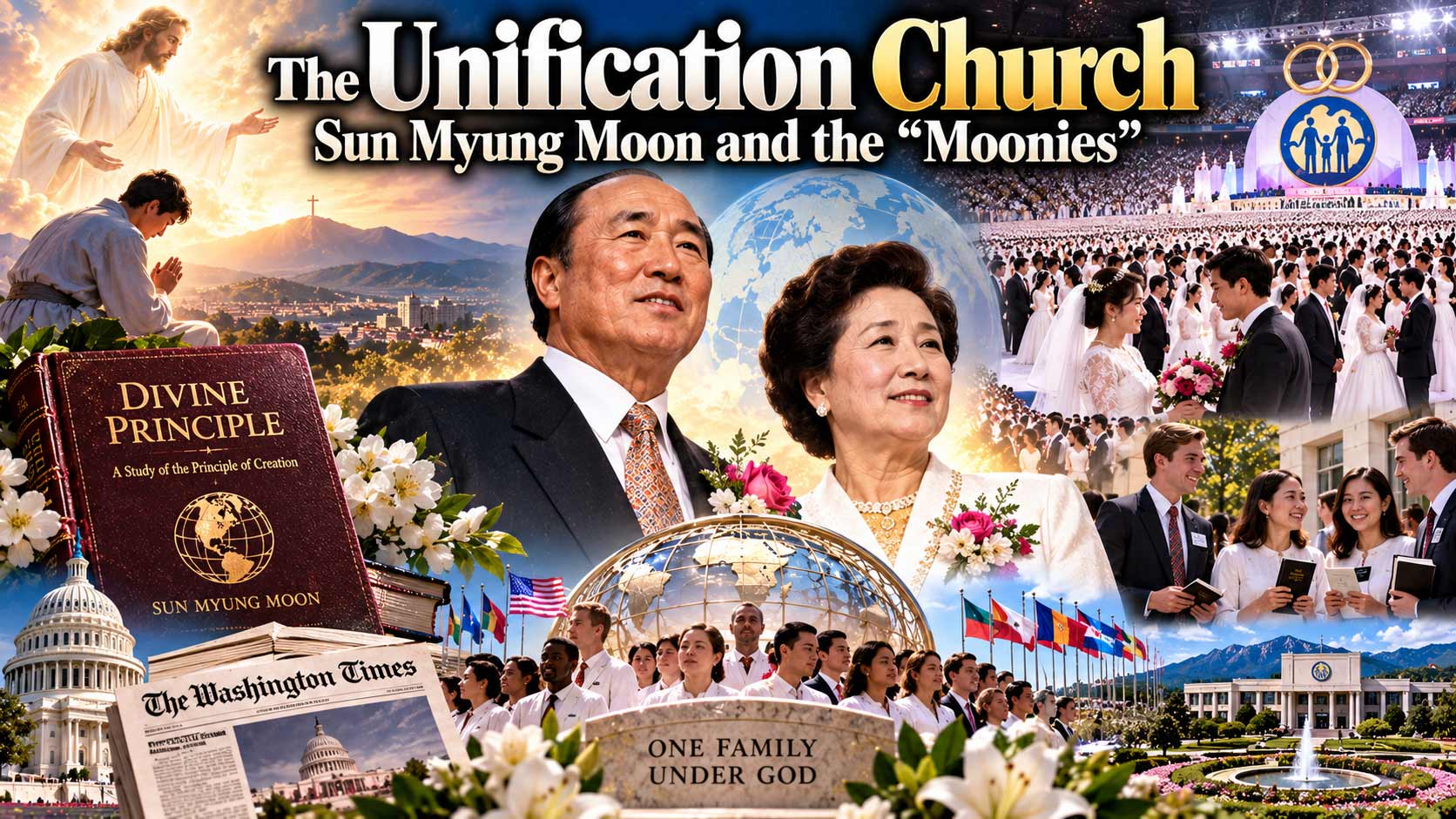
For Americans of a certain age, the word Moonies probably brings to mind thousands of couples getting married simultaneously in a stadium, young people selling flowers on street corners, and a Korean religious leader named Sun Myung Moon. The nickname became so common that many people knew the Moonies without knowing much of anything about what they believed. Behind the mass weddings and unusual public image, however, was a complicated religious movement built around a sweeping reinterpretation of Christianity, the Fall, the mission of Jesus, marriage, human sexuality, and the restoration of God’s original plan for the family.
The movement is properly known as the Unification Church, although the organization Moon founded has undergone changes and today operates principally under the name Family Federation for World Peace and Unification. Its followers generally don’t call themselves Moonies, and the term has often been used derisively. We’ll use Unification Church for the movement and reserve Moonies mainly for explaining the familiar historical nickname.
What makes the Unification movement especially relevant to our Christian Cults section is that it doesn’t merely borrow a few Christian symbols. Its entire religious story begins with biblical creation, Adam and Eve, the Fall, Jesus, the Messiah, and the restoration of humanity. But by the time Sun Myung Moon finished reinterpreting those ideas, the resulting theology was far removed from historic Christianity.
Sun Myung Moon
Sun Myung Moon was born in what is now North Korea in 1920. His family converted to Christianity while he was young, placing him within the rapidly growing Korean Christian environment of the early twentieth century. Korea at the time was experiencing missionary activity, revivalism, charismatic religious movements, Japanese occupation, and enormous political upheaval.
Moon later claimed that on Easter morning in 1936, when he was sixteen, Jesus appeared to him while he was praying on a mountainside. According to Moon’s account, Jesus told him that God’s work on earth remained unfinished and called him to complete the mission.
That claim became the foundation for everything that followed. Moon didn’t understand himself merely as a preacher calling Christians back to neglected biblical teaching. His mission involved completing something Jesus Himself had been unable to complete during His earthly life.
After World War II and the division of Korea, Moon preached in North Korea and was imprisoned by the communist government. He was eventually freed during the Korean War and traveled south. In 1954 he formally established the Holy Spirit Association for the Unification of World Christianity in Seoul, the organization generally known as the Unification Church.
The name itself revealed Moon’s ambitions. He wasn’t trying to create another Korean denomination. He believed God was bringing Christianity toward a final stage in which the divisions of religion, family, race, and eventually the entire world could be overcome.
The Divine Principle
The central theological system of the Unification movement is contained in the Divine Principle, developed from Moon’s teachings. It uses the Bible extensively but interprets biblical history through a distinctive framework involving creation, the Fall, restoration, and recurring patterns of indemnity through which humanity moves back toward God’s original purpose.
At the center of the system is the family. God created Adam and Eve to mature spiritually, unite in a God-centered marriage, have sinless children, and establish an ideal family. From that family would eventually have come an ideal human society and God’s kingdom on earth.
That didn’t happen because Adam and Eve fell before reaching spiritual maturity. The Fall therefore wasn’t simply one act of disobedience involving forbidden fruit. Unification theology connects it with improper love and sexual relationships, beginning with a spiritual sexual relationship between Eve and the archangel Lucifer and followed by a premature sexual relationship between Eve and Adam.
That interpretation changes almost everything that follows. Humanity inherits not merely a sinful disposition but a corrupted lineage. Satan gained a claim over human beings through the Fall, and God’s work throughout history became the restoration of humanity to the original lineage and family structure He intended.
The Bible’s story therefore becomes, in Unification theology, a long series of attempts to repair the original failure of Adam and Eve.
Why Jesus Came
The Unification Church teaches that Jesus was the Messiah sent by God. That statement sounds thoroughly Christian until we ask what Jesus was supposed to accomplish.
According to Unification theology, Jesus wasn’t originally intended to die on the cross. His mission was to establish God’s kingdom by succeeding where Adam failed. He was to find a perfected bride, establish a sinless marriage, create the ideal family, and begin a new human lineage free from Satan’s dominion.
Because the people of Israel rejected Jesus, however, that complete mission couldn’t be accomplished. Jesus was crucified and through His death achieved spiritual salvation, but physical restoration remained unfinished. The cross therefore became a secondary course necessitated by human rejection rather than the intended culmination of Christ’s earthly mission.
This represents one of the movement’s sharpest breaks with historic Christianity. The New Testament presents Christ’s death and resurrection not as an unfortunate interruption of His real mission but as central to it. Jesus repeatedly speaks of His coming death, and the apostles proclaim the crucified and risen Christ as the heart of the gospel.
For Moon, however, an unfinished mission required someone to finish it.
The Second Coming
The Divine Principle teaches that the Messiah must return and complete the work Jesus couldn’t complete physically. The returning Messiah must establish the ideal marriage and family, restore humanity’s lineage, and bring about God’s kingdom on earth.
Moon increasingly came to be understood by followers as occupying this messianic role. He and his wife, Hak Ja Han, were presented as the True Parents of humanity. Their marriage in 1960 became enormously important within the movement because it was understood as establishing the restored family Adam and Eve should originally have created.
This explains why marriage occupies such a prominent place in Unificationism. The famous mass weddings weren’t simply publicity stunts, even though they certainly attracted publicity. They expressed the heart of the movement’s theology.
If humanity’s problem began with a corrupted marriage and lineage, restoration had to involve a restored marriage and lineage. Couples blessed through the True Parents could participate in establishing families centered on God and ultimately contribute to the restoration of the entire human family.
A stadium filled with thousands of brides and grooms looks bizarre if we see only the spectacle. Within Unification theology, it makes perfect sense.
The True Parents
The title True Parents summarizes Moon’s understanding of his mission better than almost anything else. Adam and Eve were supposed to become humanity’s true parents but failed. Jesus came as a new Adam but died before establishing the necessary marriage. Moon and Hak Ja Han therefore stood at the center of the restoration of God’s original family ideal.
This placed Moon in a position far beyond that of pastor, theologian, or denominational founder. His family became woven into the cosmic story of salvation. Members weren’t simply accepting Moon’s interpretation of Scripture; they were participating in a providential history in which Moon himself occupied an essential role.
Historic Christianity recognizes Jesus alone as the decisive mediator between God and humanity. The Unification system effectively requires another messianic stage because Jesus’ mission remained incomplete. From a historic Christian perspective, that isn’t a minor disagreement about eschatology. It changes the meaning of Christ’s finished work.
The Blessing and Mass Weddings
The Unification Church became internationally famous for enormous marriage ceremonies known as Blessing ceremonies. Couples dressed in similar wedding attire gathered by the hundreds, thousands, and eventually tens of thousands to receive Moon’s blessing.
In the movement’s earlier years, Moon sometimes played an important role in matching prospective spouses. Couples could come from different countries, cultures, and racial backgrounds, reflecting the movement’s goal of overcoming divisions within the human family. Later practices became more flexible, and the Blessing expanded well beyond the original system of Moon personally selecting couples.
The ceremonies weren’t understood merely as weddings. The Blessing was connected with purification from the fallen lineage and incorporation into the restored lineage associated with the True Parents. Marriage therefore became part of the movement’s theology of salvation and restoration.
This also helps explain the movement’s strong emphasis on sexual morality before marriage and fidelity afterward. Sexuality wasn’t peripheral to the theology because Unificationism understood the original human catastrophe in sexual and familial terms. Fix the family, and eventually you fix humanity.
It is an extraordinarily ambitious idea, whatever one thinks of the theology behind it.
Indemnity and Restoration
Another important Unification concept is indemnity. Human history is understood as a process in which conditions must be established to reverse failures that occurred earlier in providential history. Individuals, families, nations, and historical figures can occupy positions corresponding to earlier biblical people and events.
This produces an elaborate interpretation of history in which biblical patterns repeat themselves. Cain and Abel, Jacob and Esau, Israel, Christianity, Korea, communism, democracy, and other historical developments can all become pieces in a providential framework.
The concept helps explain why Unification theology reaches far beyond personal salvation. Moon’s vision included religion, politics, economics, family life, international relations, and world peace. The goal wasn’t simply getting individuals into heaven after death. It was restoring the entire human order to God’s original purpose.
That enormous scope made the movement both religious and intensely involved in social and political causes.
Anti-Communism
Sun Myung Moon became an outspoken opponent of communism. His own experience under the North Korean regime contributed to a lifelong conviction that atheistic communism represented one of the great threats to humanity.
During the Cold War, the Unification movement became heavily involved in anti-communist organizations and causes. This brought Moon into contact with conservative political figures around the world and made the movement politically influential in ways that seemed unusual for a relatively small religious organization.
Moon’s political activity also complicated public perceptions of the movement. Was it a church, an anti-communist organization, a business network, a family movement, or an international peace organization? The answer, depending on the particular institution involved, could be some combination of all of them.
The movement’s ambitions were never small. Moon wasn’t merely interested in convincing people to attend a different church on Sunday. His theology envisioned the transformation of civilization.
The Washington Times and a Religious Empire
One of Moon’s most visible American projects was The Washington Times, founded in 1982. The newspaper became an influential conservative voice in Washington and gave Moon’s movement a level of political visibility far beyond what its membership numbers alone might have produced.
Organizations associated with Moon and his followers became involved in media, business, education, cultural programs, peace initiatives, conferences, and international organizations. Critics argued that this network sometimes obscured the connection between apparently independent organizations and the Unification movement. Supporters saw the projects as different expressions of Moon’s broad effort to promote world peace and God-centered values.
The combination of religion, business, and politics contributed to the movement’s controversial reputation. Moon was also convicted in the United States of tax-related offenses and served time in federal prison during the 1980s. Supporters argued that he had been unfairly targeted in part because of religious prejudice, while prosecutors maintained that the case involved ordinary violations of tax law.
Whatever one’s view of that controversy, by then Sun Myung Moon was no longer an obscure Korean religious leader. He had become a significant and remarkably well-connected international figure.
Why Were They Called Moonies?
The nickname Moonies emerged from Sun Myung Moon’s surname and became common during the movement’s rapid expansion in the United States during the 1970s. Young converts were highly visible through fundraising, recruitment, communal living, and public evangelism.
Critics accused the movement of brainwashing converts, manipulating vulnerable young adults, separating members from their families, and controlling their lives. Concerned parents sometimes hired “deprogrammers” who abducted adult members and attempted to force them out of the movement. That response created its own serious ethical and legal problems.
The broader “cult scare” of the 1970s and 1980s often mixed legitimate concerns about coercive groups with exaggerated claims about mysterious mind-control techniques. The Unification Church became one of the principal targets of that anxiety.
There were genuine reasons to examine recruitment practices, leadership authority, financial expectations, and the intense environment experienced by some members. But “they brainwashed everybody” is too easy an explanation. Religious conversion is usually more complicated than that, and people can become deeply committed to unusual belief systems without surrendering every capacity for independent thought.
Moon’s Death and the Movement After Him
Sun Myung Moon died in 2012 at the age of ninety-two. His death created an obvious problem for a movement in which he had occupied such a central theological and organizational position.
Hak Ja Han increasingly assumed leadership within the Family Federation and has emphasized her own position within the True Parents theology. At the same time, members of the Moon family have become associated with competing organizations and interpretations of Moon’s legacy.
One of the most visible splinter movements is associated with Moon’s son Hyung Jin “Sean” Moon, whose Sanctuary Church attracted public attention partly because of ceremonies involving firearms and its distinctive political culture. Another son, Hyun Jin Moon, developed separate organizations emphasizing peace and family ideals.
These divisions illustrate a recurring problem for movements built around charismatic founders. While the founder is alive, disputes can ultimately be settled by appealing to him. Once he dies, followers must decide who possesses legitimate authority to interpret and continue his mission.
The Unification movement continues, but the religious world created by Sun Myung Moon is now considerably more fragmented than it appeared during the height of his influence.
Is the Unification Church Christian?
The Unification Church emerged from a Christian environment and uses the Bible, Christian history, Jesus, the Fall, the Messiah, resurrection, and the kingdom of God throughout its theology. Members historically regarded their movement as fulfilling Christianity rather than simply replacing it with an unrelated religion.
But its understanding of those concepts differs fundamentally from historic Christianity. Jesus’ earthly mission is regarded as incomplete. The cross provides spiritual salvation but doesn’t accomplish the complete restoration originally intended. Another messianic figure must complete the physical and familial dimension of redemption, and Sun Myung Moon came to occupy that role as the True Parent.
That is why Jew & Greek places the Unification Church under Christian Cults. The classification isn’t based on strange clothing, Korean origins, mass weddings, or the fact that outsiders thought its members were weird. Christianity has produced plenty of strange clothing and unusual religious behavior without needing Sun Myung Moon’s assistance.
The theological issue is much more substantial. Historic Christianity proclaims that Jesus Christ accomplished the decisive work of redemption through His death and resurrection and that no later messiah is needed to finish what He failed to complete. Unification theology begins with the opposite premise: Jesus accomplished something essential, but something remained unfinished.
Once that difference is understood, the mass weddings, True Parents, restoration of lineage, and Moon’s messianic role all fit together. What looked from the outside like a collection of bizarre practices turns out to be a remarkably coherent religious system. The problem from a Christian perspective isn’t that the system makes no sense. It is that it rewrites the Christian story around the proposition that Jesus didn’t finish the job.