

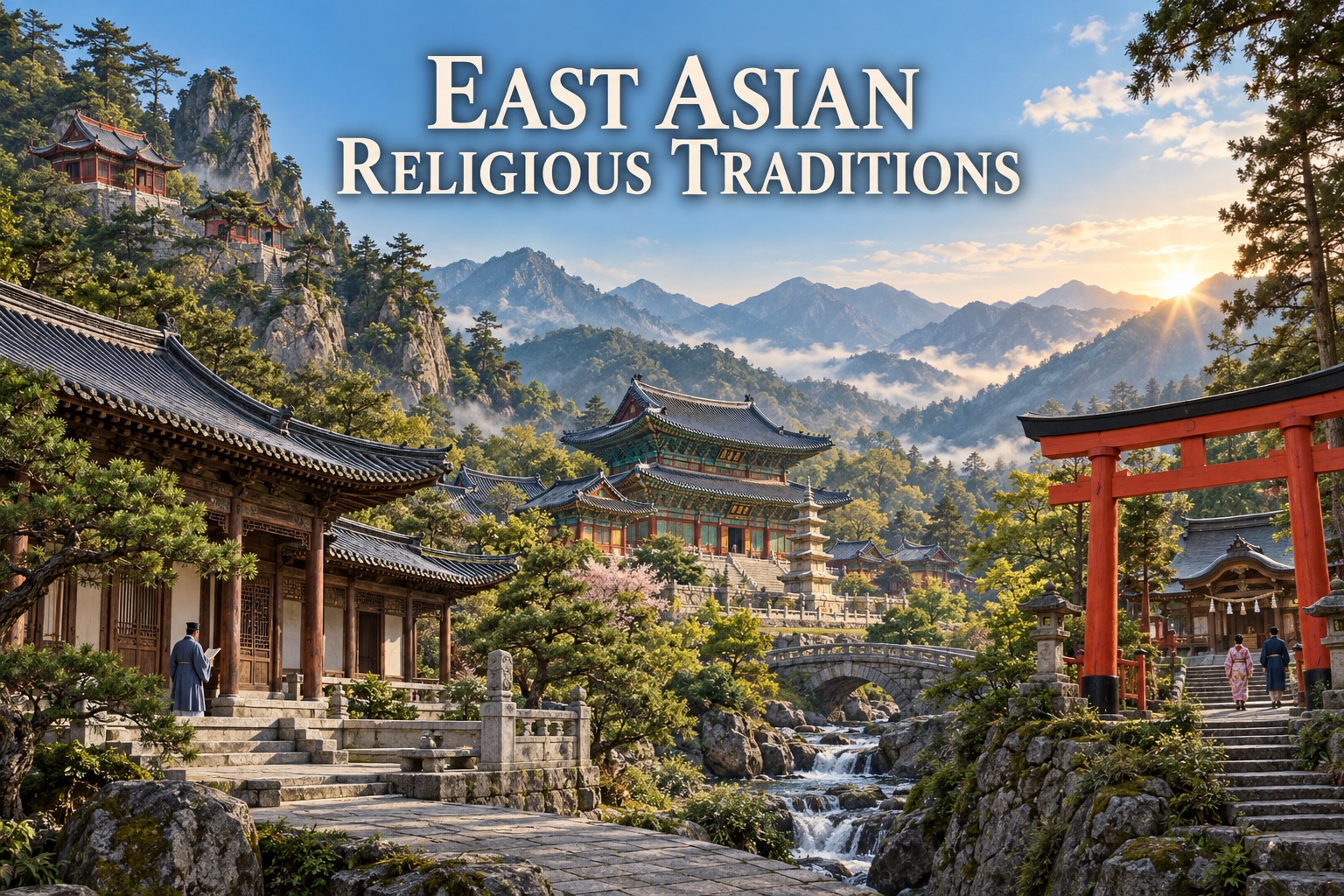
Ask someone in the West what religion a person follows, and we usually expect one answer. Christian, Jewish, Muslim, Hindu, Buddhist, or perhaps none of the above. That way of sorting people can become misleading when we turn to East Asia. A person may honor ancestors according to family custom, participate in Buddhist funeral rites, visit a Shinto shrine at New Year, and conduct daily life according to values shaped by Confucianism without seeing those practices as mutually exclusive.
This doesn’t mean religious differences are unimportant. Confucianism, Daoism, Buddhism, Shinto, and the many forms of Chinese, Korean, and Japanese popular religion aren’t interchangeable, and they don’t all make the same claims about reality. It means they developed in cultures where religious identity has often been less exclusive and less dependent upon formal membership than Western readers expect. To understand East Asian religion, we have to resist the temptation to force a complicated history into tidy boxes that the people living within that history didn’t always use.
An Umbrella, Not a Single Religion
East Asia includes several nations, languages, and civilizations, each with its own history. China exercised enormous cultural influence throughout the region, but Japan and Korea didn’t merely copy Chinese religion. They received ideas, texts, institutions, and rituals, then adapted them within their own societies. Indigenous practices continued alongside imported traditions, sometimes blending with them and sometimes resisting them.
The word religion can also create problems. Modern Western usage often assumes a defined institution, an authoritative creed, a recognized founder, and a clear boundary between members and outsiders. Some East Asian traditions possess several of these features, but others are woven into family life, government, seasonal festivals, local customs, and respect for the dead. Scholars therefore continue to debate whether Confucianism should be called a religion, a philosophy, an ethical system, or some combination of the three. The disagreement isn’t merely academic fussiness. It reflects the fact that our categories don’t always fit the subject as neatly as we would like.
Ancient Chinese Religion and the Moral Order
Long before Confucius or organized Daoism, Chinese communities practiced divination, offered sacrifices, honored ancestors, and appealed to spiritual powers. Early royal religion connected political authority with the worship of ancestors and with Shangdi, often translated as the Supreme Ruler or High God. During the Zhou dynasty, the idea of Tian, or Heaven, became especially important. Heaven was understood as the source of moral and political order, and a ruler’s legitimacy depended upon governing justly.
This conviction developed into the doctrine of the Mandate of Heaven. A dynasty could lose its right to rule through corruption and oppression, while a successful challenger might claim that Heaven had transferred its mandate. The principle didn’t create democracy in the modern sense, but it placed a moral limit upon political power. The emperor ruled under Heaven, not simply by raw force, even if emperors and their officials could be remarkably creative when explaining why Heaven happened to favor them.
Traditional Chinese thought also developed ways of describing the patterns of the natural and social world. Yin and yang referred to complementary forces or aspects of reality, while qi described the vital energy or material force through which the world functions. These ideas appeared in medicine, philosophy, politics, ritual, and popular religion. They shouldn’t be treated as the creed of one Chinese religion, since different schools used them in different ways, but they helped provide a shared vocabulary through which later traditions explained harmony, disorder, health, and human life.
Confucianism and the Formation of Character
Confucius, known in Chinese as Kongzi, lived from 551 to 479 BC during a period of political fragmentation and social unrest. He didn’t claim to have invented an entirely new religion. He presented himself as a transmitter of ancient wisdom and believed that social order could be restored through moral formation, education, proper relationships, and the recovery of worthy traditions. His conversations and sayings were preserved by later followers in the Analects, though the collection took shape over time rather than appearing as a book written directly by Confucius.
At the center of Confucian ethics is ren, commonly translated as humaneness or benevolence. A humane person learns to treat others with the conduct appropriate to their relationships and responsibilities. Li, often translated as ritual propriety, includes ceremonies but reaches beyond them to manners, customs, and disciplined patterns of behavior. Xiao, or filial piety, emphasizes the duties of children toward parents and the wider importance of family loyalty. Confucianism assumes that character is formed through practice. We don’t become virtuous merely by agreeing with good ideas; we learn virtue by repeatedly acting in ways that train our desires and habits.
Confucianism eventually became deeply connected with Chinese government, education, and civil service. Later thinkers developed its metaphysical dimensions, especially in the form often called Neo-Confucianism, which arose partly through sustained engagement with Buddhist and Daoist ideas. Confucian teaching shaped Korea, Japan, and Vietnam as well as China, influencing family structures, education, political theory, and respect for learning. Its legacy includes serious reflection on virtue and public responsibility, but it has also been used to reinforce rigid hierarchy, patriarchy, and deference to authority. As with any durable tradition, its history contains both its ideals and the uses to which those ideals were put.
Daoism and Living According to the Way
Daoism takes its name from the Dao, meaning the Way. The Dao De Jing is traditionally attributed to Laozi, but historians generally regard its formation and authorship as more complicated than the traditional picture of one elderly sage producing the finished text. Along with the writings associated with Zhuangzi, it questions human attempts to control life through excessive rules, ambition, and artificial distinctions. The Dao cannot be captured fully in words because it is the underlying Way by which reality unfolds.
One of Daoism’s best-known concepts is wu wei, sometimes translated as nonaction. That translation can sound like laziness, but the idea is closer to acting without coercive striving or working in harmony with the grain of reality. Water became a favorite Daoist image because it is yielding yet persistent, taking the shape of its surroundings while gradually wearing down stone. Daoist writers often used humor and paradox to expose the vanity of people who were certain that their schemes could organize the entire world.
It is common to distinguish philosophical Daoism from religious Daoism, but the boundary isn’t always clean. Organized Daoist movements developed temples, priesthoods, rituals, sacred texts, systems of meditation, practices intended to promote health or longevity, and complex teachings about gods and spiritual beings. The Celestial Masters movement, which emerged in the second century AD, is one important example of institutional Daoism. Later Daoist traditions interacted extensively with Buddhism and Chinese popular religion, borrowing, adapting, and disputing ideas as living traditions normally do.
Ancestors, Local Gods, and Popular Religion
Most Chinese religious life can’t be explained simply by discussing formal Confucian, Daoist, and Buddhist institutions. Families and local communities have long honored ancestors, maintained household shrines, celebrated festivals, consulted ritual specialists, and sought help from a wide range of deities associated with places, occupations, protection, healing, prosperity, or moral order. The category Chinese popular religion covers an enormous variety of practices rather than one centrally organized faith.
Ancestor veneration requires careful description. Participants may understand their actions as respect, remembrance, continuing family obligation, or communication with deceased relatives. Offerings of food, incense, or symbolic goods can express the conviction that family relationships continue beyond death. From a Christian standpoint, honoring one’s parents and remembering the dead are good things, while prayer to ancestors or reliance upon them as spiritual intermediaries raises a different theological question. We should distinguish those issues instead of assuming that every bow, memorial, or family ritual means exactly the same thing.
Popular religion also shows why official labels can be deceptive. A family might invite a Daoist priest to conduct one ritual and a Buddhist monk to conduct another while following Confucian expectations in family life. This doesn’t necessarily mean anyone has developed a systematic theory reconciling every belief involved. Religion is often lived before it is organized into a neat chart, a fact that isn’t limited to East Asia.
Buddhism Comes to China
Buddhism began in India and entered China during the first centuries AD through travelers, missionaries, merchants, and the translation of Buddhist texts. Its teachings brought unfamiliar ideas, including karma, rebirth, monastic life, and liberation from the cycle of suffering. Chinese translators had to find language for concepts that didn’t fit perfectly within existing vocabulary, and early interpreters sometimes used Daoist terms to make Buddhist ideas more intelligible.
Over time, distinctively Chinese Buddhist schools developed. Pure Land traditions emphasized trust in Amitabha Buddha and hope for rebirth in his Pure Land, where enlightenment could be pursued under favorable conditions. Chan Buddhism emphasized disciplined practice and direct insight into the nature of reality; in Japan it became known as Zen. Other schools developed sophisticated systems of philosophy, meditation, ritual, and scriptural interpretation. Chinese Buddhism wasn’t simply Indian Buddhism wearing Chinese clothes. It became a family of Chinese traditions through centuries of translation, debate, adaptation, and institutional growth.
Confucian, Daoist, and Buddhist traditions eventually became known as the Three Teachings. They sometimes competed fiercely for patronage and influence, so the familiar picture of effortless harmony shouldn’t be romanticized. At other times, thinkers argued that the three could complement one another, perhaps assigning Confucianism to social ethics, Daoism to harmony with nature, and Buddhism to liberation and the fate of the person after death. The boundaries remained real, but many people drew upon more than one tradition.
Shinto and Buddhism in Japan
Japan’s indigenous religious practices centered upon kami, sacred beings or powers associated with natural features, places, clans, ancestors, and extraordinary persons. Shinto, usually translated as the Way of the Kami, has no single founder and no creed comparable to the historic Christian creeds. Its practices emphasize ritual purity, offerings, festivals, and relationships between communities and the kami connected with particular shrines and places.
Buddhism reached Japan through Korea and China in the sixth century. After periods of conflict, Buddhist and kami traditions became deeply intertwined. Japanese thinkers sometimes understood kami as local manifestations or protectors of Buddhist realities, and shrines and temples could exist in close association. For much of Japanese history, separating Shinto and Buddhism as if they had always operated as independent modern denominations would seriously distort the evidence.
The Meiji government changed that relationship beginning in 1868 by formally separating kami worship from Buddhism and connecting shrine practice with national identity and the emperor. What later came to be called State Shinto served political as well as religious purposes, particularly as Japanese nationalism and imperial expansion intensified. After Japan’s defeat in World War II, the state formally ended its sponsorship of this system. Contemporary Shinto includes many forms of shrine practice, festival life, and personal devotion, while Buddhism continues to play a major role, especially in funerals and memorial practices. Many Japanese participate in both without experiencing the contradiction a Western observer might expect.
Korean Religious Traditions
Korea developed its own religious landscape through the interaction of indigenous practices and traditions received from China. Korean shamanic religion, often called musok, centers upon ritual specialists who mediate between human communities and the spirit world. It has remained influential despite repeated attempts by political and religious authorities to suppress or marginalize it. As elsewhere, calling it a single organized religion can hide substantial local diversity.
Buddhism entered Korea from China during the fourth century and became a major religious and cultural force, particularly during the Unified Silla and Goryeo periods. Confucianism later gained political and social dominance under the Joseon dynasty, shaping education, family organization, government, and ancestral rites. Korean Buddhism nevertheless survived, and shamanic practices continued beneath and alongside official institutions. Christianity arrived much later and became unusually influential in modern Korea, adding another major tradition to an already layered religious history.
Korea also served as an important route through which Buddhism, texts, artistic forms, and other cultural influences reached Japan. That fact is sometimes lost when East Asian history is told as though ideas moved directly from China to Japan while Korea merely watched from the shoreline. Korean kingdoms and scholars were active interpreters and transmitters, not a passive bridge between two supposedly more important civilizations.
Where Christianity Agrees and Disagrees
Christians can recognize genuine moral insight in East Asian traditions without pretending that their theological differences don’t matter. Confucian concern for character, family responsibility, education, and just government raises questions Christians should take seriously. Daoist warnings about pride, coercion, and frantic striving can expose real human folly. Buddhist analysis of craving recognizes that disordered desire produces suffering, while many East Asian practices preserve habits of gratitude, reverence, community, and respect for the past that modern Western individualism often neglects.
Agreement at those points doesn’t erase the larger differences. Christianity proclaims a personal Creator who is distinct from creation yet present and active within it. The Dao isn’t simply another name for the God of Abraham, Isaac, and Jacob, and the Christian doctrine of creation isn’t equivalent to a theory of cosmic balance. Christianity understands the deepest human problem as sin and alienation from God, not merely ignorance, disharmony, or attachment. Its hope rests upon God’s action in history through Jesus Christ, particularly his death and bodily resurrection, rather than upon moral cultivation, harmony with the Dao, ritual purity, ancestral assistance, or escape from a cycle of rebirth.
The New Testament’s account of Paul in Athens provides a useful model even though Athens was Greek rather than East Asian. Paul observed the religious world around him carefully, quoted pagan writers, and found points of contact with his audience. He also contradicted their assumptions by proclaiming one Creator, calling for repentance, and grounding his message in the resurrection of Jesus. Respectful understanding and serious disagreement belonged in the same conversation.
Christians studying East Asian religion should follow that pattern. It is easy to condemn a caricature, but doing so proves very little. We need to ask what a ritual means to the people performing it, how a tradition has changed over time, and whether the same word carries different meanings in different settings. Only then can we compare its claims with Christianity honestly.
East Asian religious traditions remind us that people don’t always arrange belief, family, politics, ritual, and philosophy in the categories familiar to Western churches. They also remind us that human beings everywhere wrestle with order and suffering, virtue and death, the seen world and the unseen. Christianity enters that conversation with a definite claim: the source of truth isn’t an impersonal principle or a carefully maintained balance, but the living God who made the world and has made himself known in Jesus Christ.