

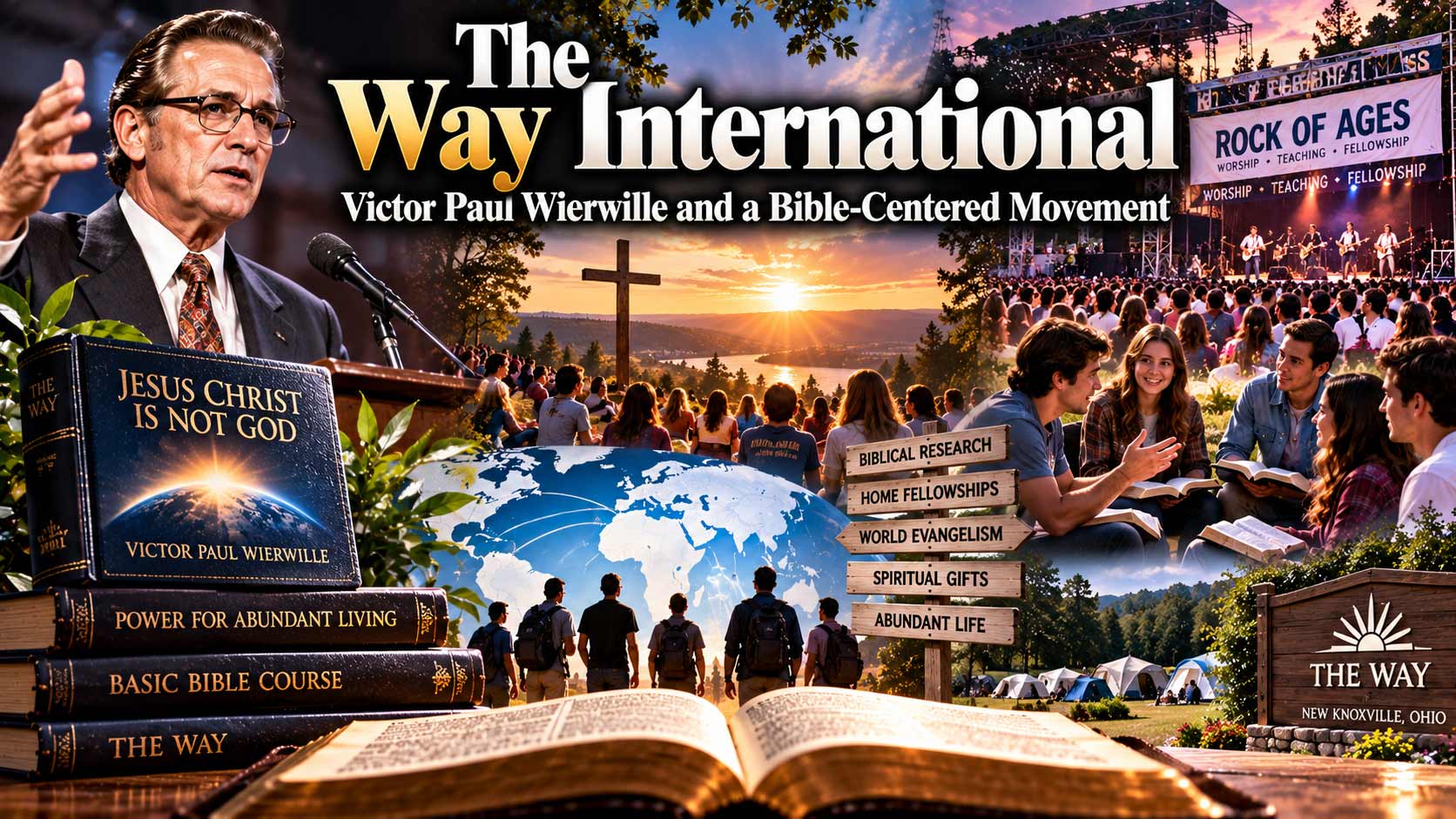
The Way International is one of those religious movements that can sound surprisingly familiar until you discover what some of the familiar words mean. Its followers talk about being born again, studying the Bible, receiving the holy spirit, speaking in tongues, healing, the return of Christ, and living the abundant life Jesus promised. Put someone from The Way in conversation with a Pentecostal Christian and they might agree enthusiastically for quite a while.
Then somebody brings up the Trinity.
The Way International rejects the historic Christian doctrine that the Father, Son, and Holy Spirit are three persons in the one eternal God. Its founder, Victor Paul Wierwille, made the distinction unmistakable in the title of one of his books: Jesus Christ Is Not God. The organization continues to sell that book today, and its current statement of beliefs distinguishes the one God from Jesus Christ, whom it describes as God’s only begotten Son, Lord, Savior, mediator, and the man whom God raised from the dead.
That combination makes The Way particularly interesting. This isn’t a movement that discarded the Bible in favor of an entirely new scripture. On the contrary, it built its identity around the claim that Christians had been reading the Bible incorrectly and that careful research could recover the accuracy and power of the original Word of God.
Victor Paul Wierwille
Victor Paul Wierwille was born in Ohio in 1916 and entered the Christian ministry long before The Way became a recognizable religious movement. He was ordained in the Evangelical and Reformed tradition, which later became part of the United Church of Christ, and served as a pastor before leaving denominational ministry. By the late 1950s, he had turned increasingly toward an independent teaching ministry centered on biblical research and what he believed was the recovery of truths largely lost by conventional Christianity.
Wierwille eventually established his headquarters on his family’s farm near New Knoxville, Ohio. The rural setting became the center of a movement that spread rapidly during the religious ferment of the 1960s and 1970s. The Way appealed particularly to young people who were suspicious of traditional institutions but still interested in Jesus, the Bible, supernatural experience, and a Christianity that seemed more immediate than Sunday morning denominational religion.
Wierwille presented himself primarily as a biblical researcher and teacher. The Way still describes its mission in terms of “Biblical research, teaching, and fellowship,” emphasizing Hebrew, Greek, Aramaic, figures of speech, biblical customs, and close examination of the text. The assumption beneath the method is that God’s Word was perfect as originally given but that errors and misunderstandings entered through translation and traditional interpretation.
That sounds like a call to serious Bible study, and in part it was. The problem is that Wierwille’s reconstruction of biblical Christianity led him to reject some of the doctrines Christians had considered foundational for centuries.
Power for Abundant Living
The teaching most closely associated with Wierwille was his course Power for Abundant Living, commonly known as PFAL. The course became the principal means by which thousands of people encountered his theology. Christianity Today reported during the movement’s rapid growth in the 1970s that Wierwille had developed an energetic following centered around his interpretation of Scripture, and The Way continues to offer descendants of the PFAL teaching program today.
The title came from Jesus’ statement in John 10:10 that He came so that people might have life “more abundantly.” Wierwille believed Christians often lived far below what God had made available to them because they didn’t understand His Word or the spiritual power they had received.
That emphasis gave The Way a strongly practical character. Bible study wasn’t supposed to produce merely theological information. Correctly understanding the Word was supposed to produce confidence, healing, spiritual power, answered prayer, freedom from fear, and an abundant Christian life. The Way’s current description still uses essentially this framework, presenting the application of God’s Word as the path toward a life of abundance and power.
For people coming out of churches they regarded as lifeless or overly institutional, that was an attractive message. Wierwille wasn’t offering another hour of religion each Sunday. He was promising that the Bible, properly understood and believed, actually worked.
Jesus Christ Is Not God
The theological dividing line between The Way and historic Christianity is clearest in its doctrine of Christ. Wierwille rejected the Trinity and denied that Jesus is God in the historic Christian sense. The Father alone is God, while Jesus is the uniquely conceived Son of God, Messiah, Lord, Savior, and mediator between God and humanity.
That distinction remains visible in The Way’s present statement of beliefs. It affirms one God as Creator and then separately identifies Jesus Christ as God’s only begotten Son. It affirms Christ’s virgin conception, sacrificial death, bodily resurrection, ascension, position at God’s right hand, and future personal return. This isn’t a movement denying that Jesus matters; Jesus occupies an enormous place in its theology.
The disagreement is over who Jesus is.
Historic Christianity eventually expressed its understanding through the Nicene confession that the Son is truly God, eternally sharing the divine nature with the Father. Christians didn’t arrive at that position merely because somebody centuries later decided Jesus deserved a promotion. They were trying to account for the New Testament’s simultaneous insistence that there is one God, that the Father is God, that Jesus is distinct from the Father, and that divine names, works, worship, and attributes are nevertheless applied to Christ.
Wierwille believed the church had gotten that synthesis wrong. His solution was essentially biblical Unitarianism: Jesus is the Son of God but not God the Son. From the standpoint of historic Christianity, that places The Way outside orthodox Christian Christology even though much of its vocabulary remains recognizably Christian.
The Holy Spirit and “holy spirit”
The Way’s teaching concerning the Holy Spirit is similarly distinctive. Wierwille distinguished between God, who is holy and spirit, and the gift of holy spirit received by a person at the new birth. The capitalization can therefore become theological. What traditional Christians identify as the third person of the Trinity isn’t understood in the same way within The Way’s system.
The movement places enormous emphasis on what believers can do because they have received this spiritual gift. Its current statement of beliefs affirms “the fullness of the holy spirit” and what it calls the nine manifestations of the holy spirit available to born-again believers.
Those manifestations are derived primarily from 1 Corinthians 12 and correspond roughly to what Pentecostal and charismatic Christians commonly call the gifts of the Spirit. Wierwille preferred the term manifestations, understanding them as ways the gift of holy spirit operates through believers rather than separate spiritual gifts distributed differently among Christians.
Speaking in tongues received particular attention. Wierwille taught extensively on the subject, and The Way continues to make his teachings on speaking in tongues, receiving the holy spirit, healing, and spiritual power available through its official ministry resources.
This is another reason The Way can initially sound remarkably Pentecostal. The difference isn’t whether supernatural manifestations continue. The difference lies in the theology of the Holy Spirit behind them.
Speaking in Tongues
For Wierwille, speaking in tongues wasn’t merely one charismatic experience among many. It became an important demonstration that someone had received spiritual power. His teaching sought to make tongues understandable and practically available rather than mysterious or emotionally unpredictable.
That approach distinguished The Way from some forms of classical Pentecostalism, where believers might pray repeatedly for the Spirit to “fall” or wait for an overwhelming experience. Wierwille emphasized learning what Scripture says, believing it, and then acting accordingly. Spiritual manifestations operated according to principles believers could understand.
The result was a highly confident supernaturalism. The believer wasn’t supposed to wonder helplessly whether God might decide to do something. God’s promises had already been given, spiritual power had already been made available, and the Christian needed to learn how to believe and operate what God provided.
Anyone familiar with portions of the twentieth-century charismatic movement will recognize some of that language. Wierwille’s system nevertheless developed its own vocabulary and theology around it.
Believing and the Abundant Life
One of Wierwille’s recurring themes was believing. God’s promises become effective in a person’s life as the believer learns the Word, renews the mind, and acts in faith. The Way’s current statement still says that believers can receive what God promises “according to our believing faith.”
That emphasis can sound similar to Word of Faith teaching, although the movements shouldn’t simply be treated as identical. Both place unusual stress on the practical effectiveness of believing and on Christians appropriating what God has already made available. The Way’s version grew out of Wierwille’s larger system of biblical interpretation and his understanding of spiritual laws and principles.
Healing naturally became important within this framework. Wierwille taught repeatedly on healing and on what believers possessed spiritually through Christ. His surviving teachings include subjects such as healing, prosperity, spiritual warfare, speaking in tongues, renewing the mind, and recognizing the believer’s spiritual rights.
The attraction isn’t difficult to understand. A Christianity promising that Scripture contains precise principles for victorious living will appeal to people frustrated by a religion that seems to consist mainly of enduring problems until heaven.
The danger comes when confidence in God’s promises becomes a system in which unsuccessful outcomes are attributed too easily to inadequate believing. That problem isn’t unique to The Way, but any theology that tightly connects faith with expected results has to explain what happens when faithful people pray, believe, and still don’t receive the outcome they wanted.
Rightly Dividing the Word
The Way places extraordinary emphasis on what it calls the accuracy of God’s Word. Second Timothy 2:15 and the language of “rightly dividing” Scripture became central to Wierwille’s approach. The idea is that apparent contradictions can be resolved when the biblical text is handled correctly.
That led Wierwille into detailed studies of vocabulary, grammar, figures of speech, Eastern customs, biblical chronology, manuscript questions, and dispensational distinctions. Some of that approach encouraged serious engagement with Scripture. It also gave Wierwille’s interpretive system tremendous authority because disagreements with established Christian doctrine could be explained as the result of centuries of Christians incorrectly dividing the Word.
The Way’s current ministry still describes biblical research in similar terms. It prefers the King James Version partly because words supplied by translators appear in italics and because many traditional study tools are keyed to it, while also consulting other versions and biblical languages.
There is nothing wrong with questioning tradition or checking translations against Hebrew and Greek. Christians have been doing that for centuries. The more important question is whether the person correcting everybody else’s interpretation is himself being corrected by sound scholarship and the broader evidence of Scripture.
The Way Tree
As The Way expanded, it developed an organizational system using the imagery of a tree. The international ministry formed the trunk, while geographical and local structures were described with terms such as limbs, branches, twigs, and leaves. Home fellowships formed the basic level of religious life.
The home fellowship remains central today. The Way describes itself primarily as a home fellowship ministry where believers gather for Bible teaching, prayer, singing, spiritual manifestations, and fellowship. It reports fellowships in the United States, two U.S. territories, and more than thirty other countries.
This structure helped the movement expand without building a conventional church on every corner. It also reinforced the idea that The Way wasn’t supposed to become just another denomination with stained glass, pews, and an institutional Sunday routine.
Of course, once a movement has headquarters, leaders, training programs, publications, recognized teachers, organizational structures, and approved doctrine, it has acquired quite a bit of institution whether it calls itself a denomination or not. Religious movements have a remarkable ability to rediscover organization while insisting they haven’t organized.
Rock of Ages and Word Over the World
The Way became particularly visible during the 1970s through its annual Rock of Ages festival. Beginning in 1971, the event brought followers together for teaching, music, fellowship, and ministry activities. The Way says attendance eventually reached approximately 16,000 people at its peak.
The festival reflected the movement’s ability to connect biblical teaching with the youth culture of the era. Christianity Today’s 1975 account described a gathering dominated by young people, with informal prayer, enthusiastic fellowship, camping, music, and intense devotion to Wierwille’s teachings.
The movement also sent out Word Over the World, or WOW, Ambassadors. Teams traveled to communities to evangelize and establish fellowships. At the end of the Rock of Ages gathering, new ambassadors could be commissioned and sent into the field.
It was an ambitious missionary strategy, and for a time it worked remarkably well. The Way became one of the more recognizable alternative Christian movements to emerge from the religious upheavals surrounding the Jesus Movement era.
Wierwille’s Death and the Crisis That Followed
Victor Paul Wierwille died in 1985. Leadership had already passed to L. Craig Martindale, but Wierwille’s death removed the personality around whom the movement’s theology and institutional identity had been built.
Serious internal conflict followed. Former leaders accused the organization of authoritarianism, financial pressure, sexual misconduct, and other abuses. By the late 1980s, prominent leaders had broken away, attendance and contributions had fallen, and competing ministries had begun forming from former Way members. Contemporary reporting described accusations involving mismanagement, intolerance, adultery, forced tithing, and disputes over leadership authority.
Wierwille himself has also been accused by former members and critics of serious sexual misconduct and of using the work of other Christian writers without adequate acknowledgment. Those claims have become an important part of critical assessments of his legacy. Because allegations involving particular incidents and individuals vary in documentation, they should be evaluated carefully rather than turned into a collection of sensational stories.
The broader historical point doesn’t depend on resolving every allegation. The Way experienced a major institutional crisis after its founder’s death, lost substantial numbers of followers, and produced numerous offshoots formed by people who retained portions of Wierwille’s biblical system while rejecting the organization that had grown around him.
The Way International Today
The Way didn’t disappear. It remains headquartered in Ohio and continues to describe itself as a worldwide, nondenominational biblical research, teaching, and fellowship ministry. Its website remains active, it publishes The Way Magazine, conducts classes, maintains home fellowships, distributes Wierwille’s books and teachings, and continues to promote the biblical research system established by its founder.
Its present leadership consists of a board of directors rather than another figure possessing Wierwille’s public stature. The organization continues to honor Wierwille as its founding president and makes an extensive selection of his recorded teachings available.
That continuity matters because The Way isn’t merely a historical curiosity from the 1970s. Some people encounter it today through a home fellowship or Bible class without knowing the controversies surrounding its history or realizing how significantly its theology differs from traditional Christianity.
And at first, much of it sounds familiar.
Is The Way International a Christian Cult?
The Way identifies itself as Christian and affirms a remarkable amount that Christians will recognize: biblical authority, the virgin conception of Jesus, His sinless role as Savior, His death for sins, bodily resurrection, ascension, future return, salvation through faith, the new birth, prayer, evangelism, spiritual gifts, and resurrection of the dead. Calling it non-Christian without explaining what we mean would obscure more than it clarifies.
But this is precisely where the theological definition of a Christian cult becomes useful. The Way emerged from Christianity, uses Christian Scripture almost exclusively, speaks Christian language, and claims to recover biblical truth obscured by traditional churches. At the same time, it rejects the Trinity and denies the full deity of Jesus Christ as understood throughout historic Catholic, Orthodox, and Protestant Christianity.
That puts The Way in a different category from something like the International Churches of Christ, whose controversies have centered much more on authority, discipling, exclusivity, and high-control practices than on replacing historic Christian doctrine about God. The Way raises both kinds of questions, but the theological issue exists even if every organizational abuse alleged against it were removed from the discussion.
This is why the title Jesus Christ Is Not God tells us more about The Way than the old photographs, communes, festivals, or stories about its founder. Wierwille believed Christianity had misunderstood one of its most fundamental doctrines and that careful study of the Bible proved it. Historic Christianity answers that the church’s confession of Christ’s deity arose precisely because Christians were trying to take the whole biblical witness seriously.
The Way therefore presents a particularly instructive kind of Christian cult. It doesn’t ask people to throw away the Bible. It asks them to believe that, after centuries of Christian interpretation, someone finally learned how to divide it correctly—and discovered along the way that Christianity had been wrong about who Jesus is.