

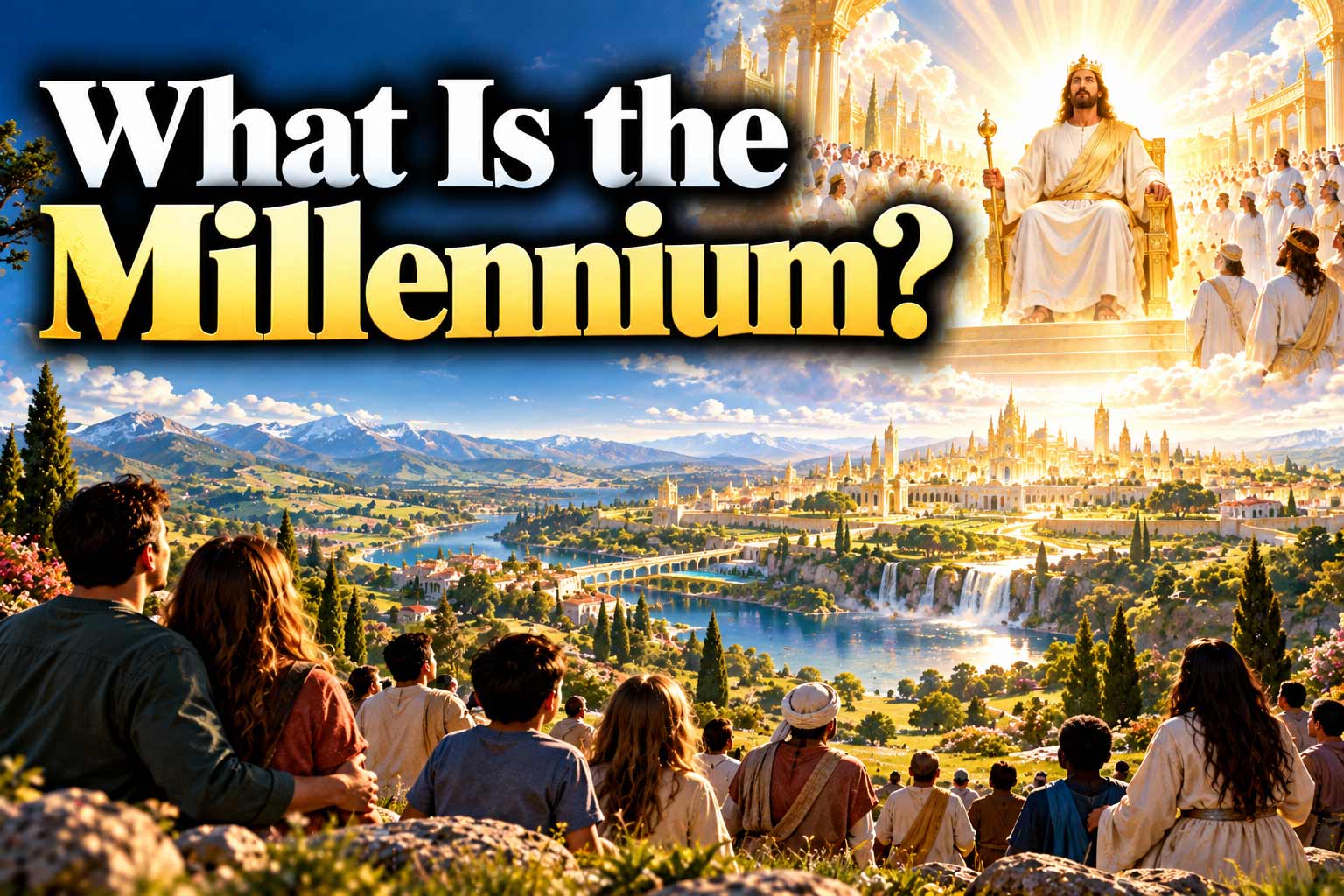
If you’ve spent much time studying Bible prophecy, you’ve probably encountered the millennium, the thousand-year reign of Christ described in Revelation 20. Some Christians believe Jesus will return to earth and establish a literal kingdom that lasts exactly one thousand years. Others believe the millennium is happening right now, while still others expect a future period of extraordinary spiritual prosperity before Jesus returns. All three positions appeal to Scripture, and their advocates have been debating the subject for centuries.
The word millennium comes from the Latin words for a thousand years. Although the term itself doesn’t appear in most English Bibles, Revelation 20 refers to a thousand-year period six times. The disagreement isn’t about whether the passage exists. It’s about what John meant and how his vision relates to the rest of biblical prophecy.
The millennium is particularly important because it raises questions about the return of Jesus, the resurrection of the dead, Satan’s defeat, Israel’s future, and the establishment of God’s kingdom. Christians agree that Christ will ultimately triumph over evil, but they disagree about how the events leading to that victory will unfold.
What Does Revelation 20 Actually Say?
Revelation 20:1–6 describes an angel descending from heaven with a key to the abyss and a great chain. The angel seizes Satan, binds him for a thousand years, and confines him so that he can no longer deceive the nations until the thousand years are completed. Afterward, Satan must be released for a short time.
John then sees thrones occupied by those who have been given authority to judge. He also sees the souls of people who were executed because of their testimony about Jesus and their refusal to worship the beast. They come to life and reign with Christ for a thousand years. John calls this the first resurrection and declares that those who participate in it are blessed because the second death has no power over them.
After the thousand years, Satan is released and deceives the nations, gathering them for a final rebellion. God defeats the rebellion, Satan is thrown into the lake of fire, and the final judgment follows. Revelation 21 then describes a new heaven and a new earth.
On a straightforward chronological reading, the passage appears to describe a period of Christ’s reign followed by Satan’s final defeat and the last judgment. However, Revelation is filled with symbolic imagery, and its visions don’t always unfold in chronological order. That’s why Christians disagree about whether the thousand years should be understood literally and whether chapter 20 follows chapter 19 chronologically.
Premillennialism: Jesus Returns Before the Millennium
Premillennialism teaches that Jesus will return before the thousand-year reign described in Revelation 20. According to this understanding, Christ will defeat His enemies, establish His kingdom, and reign with His people before the final judgment and the creation of the new heaven and earth.
Premillennialists generally interpret the first resurrection as a bodily resurrection of believers. They also understand Satan’s binding as a future event that will significantly restrict his activity during Christ’s reign. The kingdom will demonstrate what the world looks like under the righteous government of Jesus Christ.
This position has roots in early Christianity. Justin Martyr, writing in the second century, acknowledged that many Christians expected a future thousand-year reign in Jerusalem, although he also recognized that some faithful Christians disagreed. Irenaeus likewise taught a future earthly kingdom associated with the resurrection of the righteous.
There are two major forms of premillennialism today. Historic premillennialism generally understands the Church as experiencing tribulation before Christ returns and establishes His kingdom. Dispensational premillennialism usually distinguishes more sharply between Israel and the Church and commonly teaches a pretribulation rapture followed by a seven-year tribulation.
Both positions anticipate a future reign of Christ, but they differ considerably in their interpretation of Israel’s restoration, the timing of the rapture, and the sequence of end-time events.
Amillennialism: The Millennium Is Happening Now
Amillennialism takes a different approach. Despite its name, which literally suggests “no millennium,” amillennialism doesn’t deny Revelation 20. It interprets the thousand years symbolically, generally identifying the millennium with Christ’s present reign from heaven.
According to this view, Jesus began exercising His messianic authority through His death, resurrection, and ascension. Satan’s binding doesn’t mean that he has become completely inactive. Rather, it means that his ability to deceive the nations has been restricted in a particular way, allowing the gospel to spread throughout the world.
Amillennialists commonly understand the first resurrection as the believer’s participation in Christ’s life or the heavenly reign of deceased believers with Him. They expect Christ to return at the end of the present age, followed by the general resurrection, final judgment, and new creation.
Augustine helped establish this interpretation as a dominant position in Western Christianity during the fifth century. It later became influential in Roman Catholicism, much of Protestantism, and other Christian traditions.
One of the strongest arguments for amillennialism is that the New Testament repeatedly describes Christ as reigning now. First Corinthians 15:25 says that He must reign until all His enemies have been placed under His feet. Ephesians 1:20–22 describes Him as exalted above every authority and power.
The difficulty is explaining how Satan can be described as bound when the New Testament also portrays him as active and dangerous. First Peter 5:8, for example, warns believers that the devil prowls around like a roaring lion. Amillennialists respond that the binding concerns a specific limitation on Satan’s power, not the elimination of all his activity.
Postmillennialism: The Gospel Triumphs Before Jesus Returns
Postmillennialism teaches that Christ will return after a prolonged period in which the gospel produces widespread righteousness and the nations increasingly acknowledge His authority. The millennium may be understood as a literal thousand years, but many postmillennialists regard the number symbolically.
Unlike premillennialism, postmillennialism doesn’t generally expect Jesus to return physically to begin this period. Christ is already reigning from heaven, and His kingdom advances through the proclamation of the gospel and the transforming work of the Holy Spirit.
Postmillennialists often appeal to passages such as Psalm 22:27, which anticipates the nations turning to the Lord, and Matthew 13:31–33, where Jesus compares the kingdom to a mustard seed that grows and leaven that spreads through dough. They also emphasize the Great Commission, understanding Christ’s command to disciple the nations as a promise of substantial success.
This position became especially influential among some Protestant theologians during periods of missionary expansion and social reform. Jonathan Edwards expressed expectations of a future era of widespread gospel success, although historical forms of postmillennialism have varied.
Critics argue that postmillennialism can underestimate biblical warnings about persecution, apostasy, and evil near the end of the age. Postmillennialists respond that the existence of opposition doesn’t prevent the kingdom from advancing and that periods of suffering can occur within a larger movement toward gospel victory.
The important distinction is that postmillennialism expects the gospel to triumph in history before Christ returns, while premillennialism expects Christ’s return to inaugurate the millennial kingdom.
Will Satan Really Be Bound for a Thousand Years?
One of the central questions concerns Satan’s binding. Revelation 20 describes him being restrained so that he can no longer deceive the nations during the millennium. But what exactly does that mean?
Premillennialists generally understand this as a future restriction far greater than anything Satan experiences today. They point to the continuing presence of deception, idolatry, persecution, and evil as evidence that the binding described in Revelation hasn’t yet occurred.
Amillennialists and postmillennialists usually connect Satan’s binding with Christ’s first coming. In Matthew 12:29, Jesus speaks of binding the strong man before plundering his house. Luke 10:18 records Jesus describing Satan falling like lightning from heaven, while John 12:31 connects Christ’s approaching death with the judgment of the ruler of this world.
These passages demonstrate that Jesus’ ministry involved a decisive defeat of Satan’s authority. The question is whether Revelation 20 describes that same victory from another perspective or anticipates an additional future restriction.
Both interpretations recognize that Satan’s defeat depends on Christ. They disagree about when the particular restraint described in Revelation reaches its fulfillment.
Will People Still Sin During the Millennium?
This question is especially significant for premillennialists because Revelation 20 describes a final rebellion after the thousand years. If Jesus is physically reigning on earth, why would anyone rebel against Him?
Many premillennialists believe the millennial kingdom will include both glorified believers and ordinary human beings who survived the events surrounding Christ’s return. Those ordinary people will continue to have children, and subsequent generations will still possess the capacity to sin.
According to this understanding, Christ’s government will be perfectly righteous, but not everyone living under His authority will necessarily submit to Him from the heart. When Satan is released, he will find people willing to join his rebellion.
Some premillennialists connect this picture with Old Testament prophecies such as Isaiah 65:20–25, which describes extraordinary longevity, peace, and prosperity while still referring to death. They understand those conditions as appropriate to the millennium rather than the eternal state, where death has been completely abolished.
Amillennialists and postmillennialists interpret these passages differently, often viewing them as prophetic descriptions of restoration that find their ultimate fulfillment in Christ and the new creation.
The question exposes one of the more difficult features of premillennialism: the existence of sin and rebellion during a period when Christ is reigning visibly. But Revelation 20 does describe a rebellion after the thousand years, and any interpretation must account for that detail.
Is the Millennium the Same as Heaven?
The millennium and the eternal state aren’t necessarily the same thing. In the premillennial understanding, the thousand-year reign occurs before the final judgment and the new creation. Satan is restrained during this period but eventually released, and the last rebellion must still be defeated.
The eternal state described in Revelation 21–22 is different. Satan has been permanently defeated, death has been abolished, and God dwells with His people in the new heaven and new earth. There’s no further rebellion or judgment awaiting fulfillment.
Amillennialists and postmillennialists also distinguish between the present or future millennial period and the eternal state. They simply understand the millennium as occurring before Christ’s return rather than after it.
This distinction is important because Christians sometimes combine every biblical description of the kingdom, heaven, and the new creation into one picture. Scripture presents God’s kingdom as already inaugurated through Christ, continuing to advance, and awaiting its final consummation. The disagreement concerns how the millennium fits into that larger process.
Which View Makes the Most Sense?
Each major position has strengths and difficulties. Premillennialism follows the apparent sequence of Revelation 19–20 and takes seriously the distinction between the first resurrection and the later judgment. Amillennialism emphasizes the present reign of Christ and recognizes the symbolic character of Revelation. Postmillennialism highlights the power of the gospel and the biblical promises concerning the nations coming under Christ’s authority.
I lean toward premillennialism because Revelation 20 appears to describe a future period of Christ’s reign followed by Satan’s release and final defeat. I also believe Scripture gives us reason to expect the kingdom of God to advance triumphantly rather than assume that the Church is destined for continual defeat.
Some might consider those expectations difficult to reconcile, but I don’t see why they must be. Christ is reigning now, His kingdom is advancing through the gospel, and there may still be a future manifestation of that reign associated with His return. The kingdom can be both a present reality and a future fulfillment.
At the same time, I wouldn’t insist that every detail of Revelation 20 must be interpreted literally. The book is apocalyptic literature, filled with symbolic imagery, and Christians should be cautious about claiming more certainty than the text warrants. The thousand years may be a literal period, but the number itself isn’t the central point of John’s vision.
What matters most is that Satan’s authority is temporary, Christ’s reign is certain, and evil won’t have the final word.
Why Does the Millennium Matter?
The millennium matters because it concerns the fulfillment of God’s promises and the ultimate triumph of Jesus Christ. Whether the thousand years represent a future earthly kingdom or the present reign of Christ, Revelation 20 portrays a Savior whose authority cannot be overturned.
The passage also reminds us that the Christian hope extends beyond escaping this world. God’s purpose is to establish righteousness, defeat evil, raise the dead, and renew creation. The millennium belongs to that larger biblical expectation, even though Christians disagree about precisely how the events will unfold.
Unfortunately, discussions about the millennium sometimes become more divisive than the subject warrants. Christians have spent centuries debating the timing of Christ’s return, the identity of the first resurrection, and the meaning of Satan’s binding. Those are legitimate questions, but our salvation doesn’t depend on getting the prophetic sequence exactly right.
I believe Jesus will return, His kingdom will triumph, and God’s purposes for creation will be fulfilled. I also believe Revelation 20 gives us good reason to expect a future manifestation of Christ’s reign, although I recognize that sincere Christians interpret the passage differently.
In the end, the millennium isn’t primarily about a number on a prophetic calendar. It’s about the certainty that the kingdom Jesus announced will reach its appointed fulfillment. Satan’s rebellion has an expiration date, and Christ’s kingdom doesn’t.