

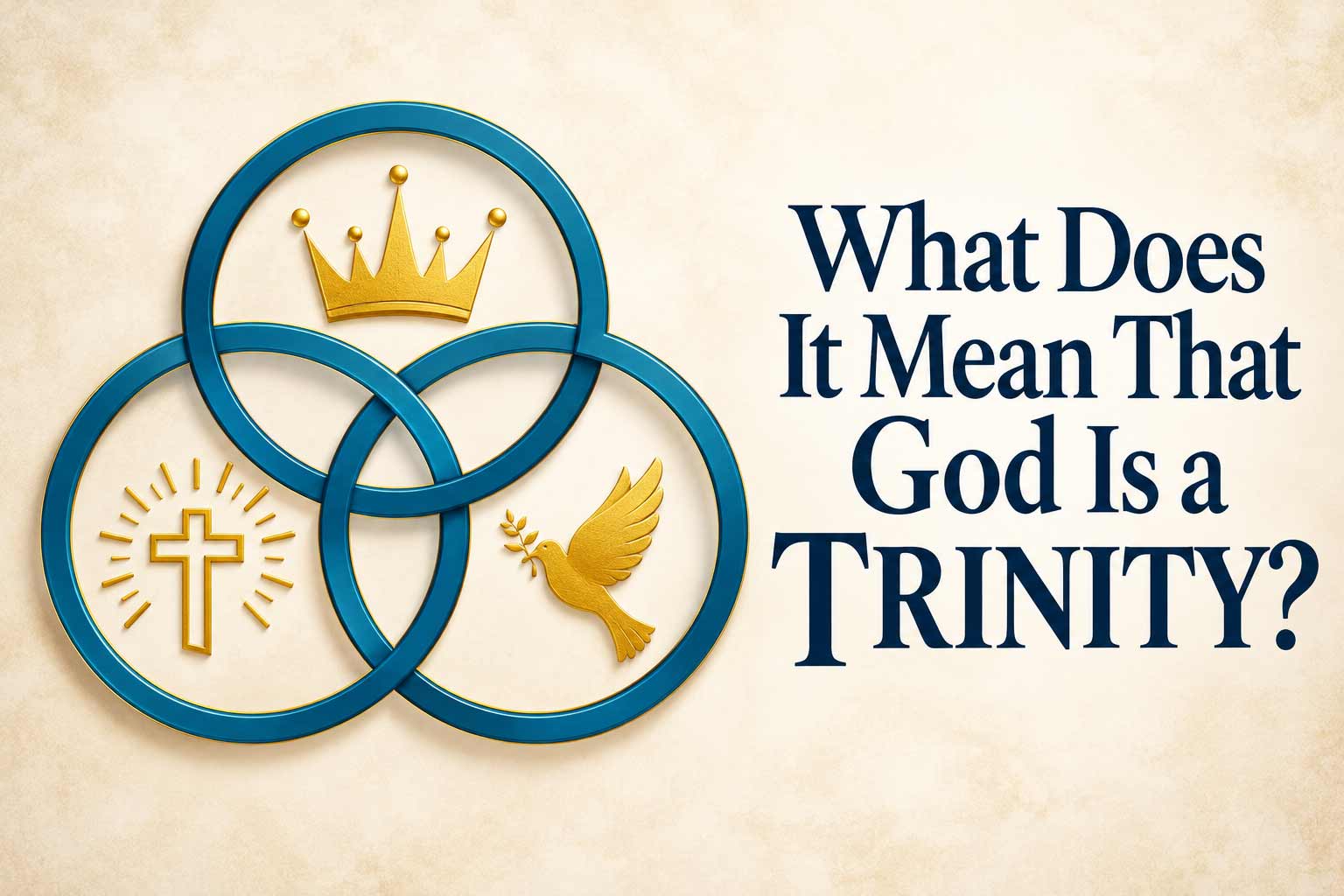
If you’ve spent much time around Christians, you’ve probably heard that God is Father, Son, and Holy Spirit. You may also have heard somebody explain that this is like water being liquid, ice, and steam, or like one man being a father, a son, and a husband. Those illustrations are easy to remember, but they can leave us with an understanding of God that the doctrine of the Trinity was developed to reject. Sometimes an illustration makes a difficult subject easier by quietly turning it into a different subject.
The Trinity means that there is one God who eternally exists as three distinct persons: the Father, the Son, and the Holy Spirit. Each is fully God, yet they aren’t three gods. The Father isn’t the Son, the Son isn’t the Holy Spirit, and the Holy Spirit isn’t the Father. That takes some careful explanation, but we shouldn’t assume that something is a contradiction merely because it’s beyond our everyday experience.
One God, Three Persons
Christianity affirms the biblical teaching that there is only one God. The Trinity doesn’t add Jesus and the Holy Spirit to the Father as two additional deities. Nor does it divide God into three pieces, with each person possessing one-third of His power or nature. The Father, Son, and Holy Spirit fully share the one divine being.
The words being and person help us express two different aspects of this belief. Being concerns what God is, while person concerns who the Father, Son, and Holy Spirit are. We’re affirming one divine being and three distinct persons, rather than saying that God is one person and three persons in the same sense. The terminology doesn’t explain everything about God’s existence, but it helps us avoid stating the doctrine as an arithmetic mistake.
Our ordinary experience makes this difficult because the human beings we know are separate individuals. Three human persons are three human beings, each with an independent existence. We can’t simply transfer that arrangement to God and imagine a divine committee. Christian theology uses the word person to express real distinctions within the one God, without claiming that divine personhood works exactly like ours.
Why Do Christians Believe This?
The word Trinity doesn’t appear in the Bible. It’s a term Christians use to summarize what they understand Scripture to teach about God. The absence of the word doesn’t settle whether the doctrine is biblical, any more than the absence of a particular modern theological label settles the idea it describes. We need to examine the passages that led Christians to use the term.
Scripture teaches that God is one, while also identifying the Father, Son, and Holy Spirit in ways that Christians understand as divine. The Father’s deity is affirmed throughout the New Testament. John 1:1 says that the Word was with God and that the Word was God, and John 1:14 identifies this Word as the One who became flesh. The passage both distinguishes the Word from the One He was with and affirms His deity.
The Holy Spirit is also presented as more than an impersonal influence. He speaks, teaches, guides, and can be grieved. In Acts 5:3–4, Peter describes Ananias’s deception as lying to the Holy Spirit and then as lying to God. Christians understand these passages, together with others, as revealing a divine person rather than merely a force God uses.
Matthew 28:19 brings Father, Son, and Holy Spirit together in Jesus’ instruction about baptism. Second Corinthians 13:14 likewise joins the grace of Jesus Christ, the love of God, and the fellowship of the Holy Spirit in Paul’s blessing. Neither passage gives us a lengthy explanation of the Trinity, but both place the three together within the church’s life and worship. The doctrine attempts to account for the whole biblical picture rather than selecting one set of passages and ignoring the others.
The Father and Son Have a Real Relationship
At Jesus’ baptism, the Son is baptized, the Spirit descends, and the Father speaks from heaven (Matthew 3:16–17). All three are present in the account. This doesn’t fit an explanation in which God first acts as the Father, then becomes the Son, and later changes into the Holy Spirit. The distinctions aren’t merely different appearances at different stages of history.
Jesus also speaks to the Father and describes a relationship that precedes His earthly life. In John 17:5, He refers to the glory He shared with the Father before the world existed. In John 17:24, He speaks of the Father’s love for Him before the foundation of the world. Trinitarian Christians understand this relationship as eternal, rather than something that began when Jesus was born.
That’s why the title Son of God doesn’t mean that God created a lesser divine being. Historic Trinitarian teaching affirms that the Son is eternal and uncreated. The Nicene Creed expresses this with the phrase “begotten, not made,” distinguishing the Son’s relationship to the Father from the creation of everything else. The terminology can require explanation, but its purpose is to affirm that the Son didn’t come into existence at some point.
Why Did Jesus Pray to God?
People sometimes ask why Jesus prayed if He was God. The Trinity provides part of the answer: the Son is distinct from the Father, so His prayers express a real relationship. The incarnation provides the other part: the eternal Son became genuinely human. Jesus lived a human life of prayer, dependence, obedience, suffering, and trust.
His humanity wasn’t a costume, and His prayers weren’t a performance put on for the disciples. In Gethsemane, His distress and submission to the Father were real. We shouldn’t explain away His human experience in an effort to defend His deity. Christianity affirms both, which means we need to take seriously the passages that show His divine authority and those that show His human vulnerability.
The Son’s submission to the Father doesn’t, by itself, establish that He possesses an inferior divine nature. His mission involves obedience, and His earthly life involves the limitations of genuine humanity. Christians have debated the details of how to describe these relationships, but the basic Trinitarian claim remains that distinction and submission don’t require us to deny the Son’s deity.
Where the Illustrations Go Wrong
The father-son-husband illustration describes one person with three relationships or roles. That can help someone understand how one individual receives different titles, but the Trinity affirms three distinct persons. If we use that illustration as a complete explanation, we’ve replaced the relationship between Father and Son with one person relating to himself under different labels. That approach is commonly called modalism.
Water, ice, and steam can create a similar problem if we describe God as changing from one form into another. An egg provides a different difficulty: shell, white, and yolk are parts of an egg, while the Father, Son, and Holy Spirit aren’t parts of God. A three-leaf clover also consists of separate portions of a larger whole. Each illustration may suggest one limited feature, but it becomes misleading when we expect it to explain the whole doctrine.
This doesn’t mean that anyone who has used one of these illustrations has consciously rejected the Trinity. Most people are trying to explain something difficult with the objects available to them. We can appreciate their intention while being honest about the illustration’s limits. It’s usually better to state the doctrine carefully than to insist that God must resemble something we can find in the kitchen.
Does the Trinity Matter in Everyday Faith?
The Trinity helps us understand salvation as the work of the one God. The Father sends the Son, the Son gives Himself for us, and the Holy Spirit brings God’s presence and work into our lives. These aren’t three separate rescue plans or three competing attitudes toward humanity. The distinctions are real, and so is their unity.
It also helps us understand prayer. Ephesians 2:18 describes our access to the Father through Christ in one Spirit. We don’t have to solve every theological question before we can pray, but this gives us a picture of how God welcomes us into relationship with Himself. The Father loves us, Christ brings us near, and the Spirit works within us.
Christians should discuss the Trinity with care and humility. We can explain why we believe it without assuming that everyone who struggles with the terminology is deliberately rejecting God. At the same time, calling it a mystery shouldn’t become an excuse for saying contradictory things and refusing to explain them. A mystery exceeds our understanding; that doesn’t relieve us of the responsibility to speak thoughtfully.
The doctrine of the Trinity is an effort to remain faithful to everything Scripture reveals about God. There is one God, the Father is God, the Son is God, the Holy Spirit is God, and the three are genuinely distinct. We may never fully comprehend how God exists, but we can know the Father through the Son and experience His presence through the Holy Spirit. The purpose of learning this doctrine is to understand more clearly the God we worship and the relationship He has invited us to share.