

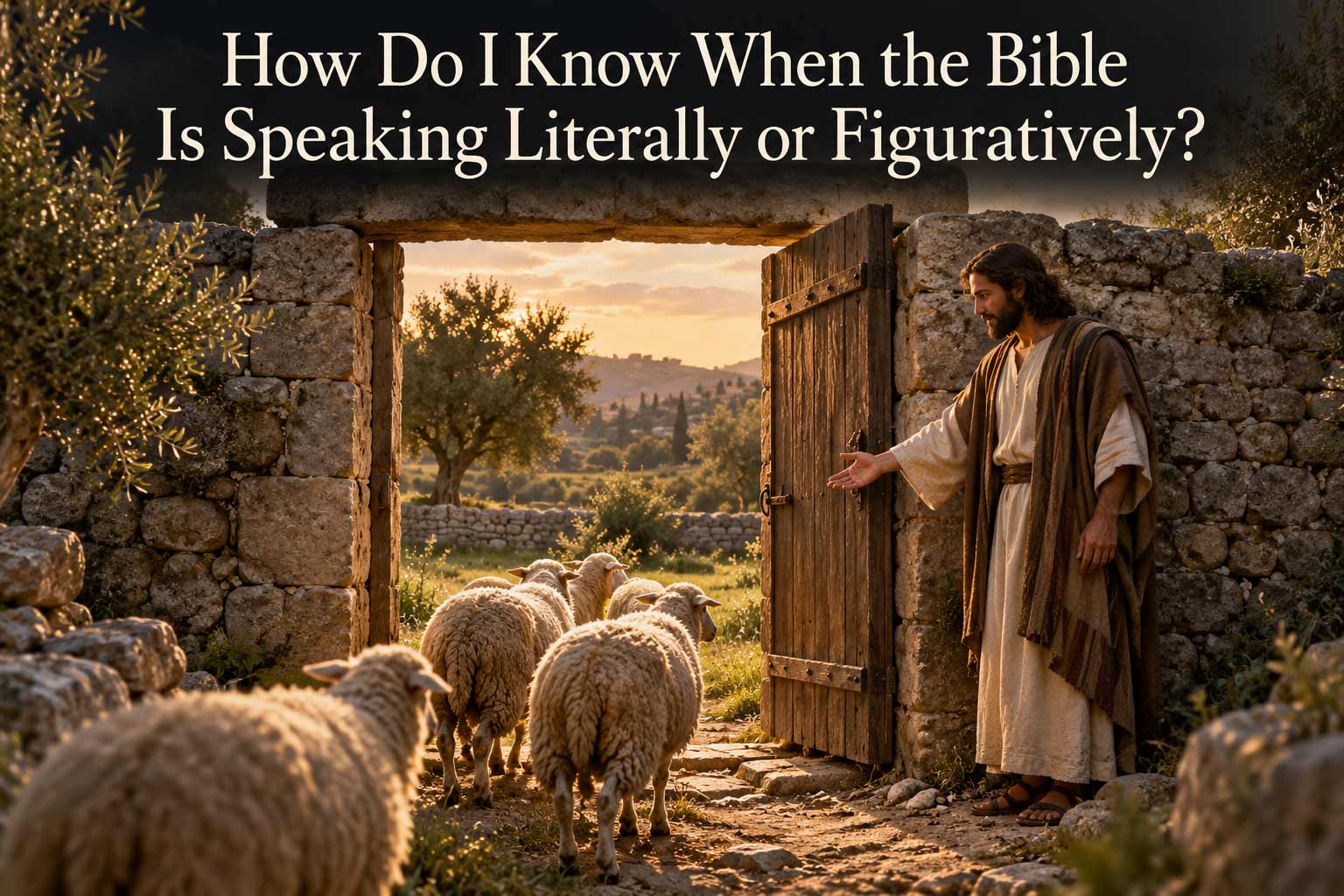
When Jesus says that He is the door, most readers don’t picture hinges and a doorknob. When a psalm describes God sheltering people under His wings, we recognize an image of protection. We understand figurative language in everyday conversation, and we bring that understanding to many biblical passages without much difficulty. The harder questions arise when a passage is unfamiliar, its imagery is complicated, or Christians disagree about how to read it.
There isn’t one mechanical rule that settles every case. We need to consider the wording, the surrounding passage, the kind of writing, and the point the author is making. Reading faithfully means recognizing figurative speech when the text uses it and taking direct statements seriously when it makes them. Our interpretation should follow the passage rather than whichever approach gives us the result we prefer.
Figurative Language Can Communicate Truth
People sometimes speak as though “literal” means true and “figurative” means untrue. But a figure of speech can communicate something true without describing it in a direct, physical way. If I say that someone has a heart of stone, I’m making a claim about his lack of compassion. You haven’t corrected my statement by pointing out that his heart is made of muscle.
The same distinction applies to Scripture. Calling God a refuge communicates something about His protection and trustworthiness. Describing a person as a sheep can communicate dependence, vulnerability, or the need for guidance. The image helps express the meaning; it doesn’t make the meaning imaginary.
We should therefore ask two related questions: What kind of language is being used, and what does that language communicate? Identifying a metaphor is only the beginning. We still need to understand the comparison and its place in the passage. “It’s symbolic” isn’t a complete interpretation any more than “it’s literal” is.
Look for Comparisons and Metaphors
Some figures of speech announce themselves through words such as “like” or “as.” These comparisons are called similes. When a writer says that something is like a lion, he identifies a resemblance without saying that the thing actually is a lion. The surrounding passage helps us determine whether the comparison concerns strength, danger, courage, or some other characteristic.
Metaphors make the comparison more directly. In John 10, Jesus calls Himself the door and the good shepherd. The discussion of sheep, entry, safety, and the shepherd’s care establishes the imagery. We understand His statements by considering how those images communicate His relationship to the people who follow Him.
However, recognizing a metaphor doesn’t authorize us to invent a meaning for every feature of the image. If Jesus is the door, that doesn’t mean we need separate theological explanations for the hinges, frame, and handle. The comparison has a purpose within the passage. Our task is to explain that purpose rather than decorate it with details the text never supplies.
Consider the Kind of Writing
Poetry, narrative, letters, parables, and visions use language differently. A poem often communicates through vivid images and emotional expression. A letter may develop a sustained argument while also using metaphors. A historical narrative presents events but can include speeches containing figurative language. The kind of writing gives us expectations, although it doesn’t determine the meaning of every sentence by itself.
Psalm 91 illustrates this well. It describes God as a refuge and fortress and speaks of His feathers and wings. These images express shelter and protection rather than providing a physical description of God. Recognizing the poetry helps us receive what the psalm communicates instead of asking it to function as an anatomical report.
At the same time, poetry can refer to real events, and a narrative can contain symbols. We shouldn’t assume that everything in a psalm is figurative or that every expression within a historical account is physically literal. A book’s general character helps us read it, but we still have to examine the particular passage.
Recognize Deliberate Exaggeration
Another form of figurative speech is hyperbole, which uses deliberate exaggeration to emphasize a point. We use it when we say that we’ve told someone something a thousand times. Usually, nobody asks to see our records. The listener understands that we’re emphasizing repetition rather than reporting a carefully counted total.
Jesus uses forceful language in Matthew 5:29–30 about removing an eye or hand that leads a person into sin. I understand this as an emphatic warning to deal decisively with sin rather than an instruction to injure ourselves. The preceding discussion concerns lust in the heart, a problem that removing a body part would not resolve. That context helps explain why the physical image should not be treated as the prescribed remedy.
Recognizing hyperbole shouldn’t weaken the warning. Jesus’ language conveys the seriousness of sin and the need to give up what draws us into it. Calling the wording figurative doesn’t make obedience optional. The figure presses the demand upon us through a deliberately arresting image.
Sometimes the Passage Explains Its Symbols
When a biblical writer supplies an explanation, that explanation should guide us. Revelation 1:20 identifies the seven lampstands as the seven churches. We don’t need to guess whether they represent seven modern nations or seven stages in our personal spiritual growth. The passage tells us what they signify.
That example also shows that a symbol can refer to something real. The lampstands represent churches rather than making the churches imaginary. Figurative imagery and real referents belong together in the passage. Recognizing symbolism doesn’t eliminate the people, circumstances, or truths being represented.
Elsewhere, a passage may explain a parable or connect an image with earlier Scripture. Those connections provide stronger grounds for interpretation than a resemblance to something in today’s headlines. We should begin with the explanations and relationships the text supplies. If it doesn’t settle a detail, we should distinguish a proposed interpretation from something the passage explicitly establishes.
Don’t Turn Figurative Language into an Escape Route
A difficult teaching doesn’t become figurative merely because we would rather avoid it. Commands about forgiveness, honesty, generosity, and sexual conduct may challenge us without relying on symbolism. We need a reason rooted in the passage before identifying a statement as figurative. Discomfort isn’t that reason.
The same caution applies to accounts of miracles. An event’s extraordinary character doesn’t establish that the writer intends it as a metaphor. If a passage presents something as an event, we should acknowledge that presentation before evaluating its historical truth. Questions about what an author means and whether his account is accurate are related, but they aren’t identical.
Christian belief in Jesus’ resurrection, for example, concerns an event rather than simply an image of renewed hope. That doesn’t require us to read every biblical image as a physical description. It requires us to examine how the relevant passages make their claims. Treating every miracle as symbolism would be as indiscriminate as treating every metaphor as an ordinary physical statement.
Don’t Make Everything Literal to Prove Your Faithfulness
The opposite mistake is assuming that the most physically literal interpretation must be the most faithful one. That can produce a reading the author never intended. If the passage uses a comparison, understanding the comparison is part of taking it seriously. Refusing to recognize it doesn’t bring us closer to its meaning.
Some people use “literal interpretation” to mean reading according to the author’s intended sense, including ordinary figures of speech. Others use it to mean avoiding figurative interpretation wherever possible. Those definitions aren’t identical. Before arguing about whether someone reads the Bible literally, it helps to establish what each person means.
Faithfulness is better assessed through the reasons offered for an interpretation. Does it fit the language? Does it account for the surrounding passage? Does it respect the kind of writing and any explanation the author provides? Those questions give us more to work with than competing claims to be the person who takes Scripture most seriously.
What About Passages Christians Disagree Over?
Not every passage is as clear as Jesus calling Himself a door. Christians disagree about prophetic imagery, sacramental language, descriptions of judgment, and other difficult texts. Sometimes they agree that a figure is present but disagree about what it represents. Sometimes the disagreement concerns whether particular wording is figurative at all.
In those cases, compare the interpretations and the evidence each uses. Read the whole section, examine related biblical imagery, and consult responsible commentaries. Ask what an interpretation explains well and what difficulties it leaves unresolved. Agreement with your existing theology doesn’t automatically make it the strongest reading.
We also need to distinguish certainty about the main point from certainty about every detail. A passage may clearly call for faithfulness while leaving aspects of its imagery difficult to explain. We can respond to what is clear while continuing to study what isn’t. Admitting that limitation is preferable to announcing a detailed explanation the text cannot support.
Read for Meaning, Then Respond
A useful starting point is to read the passage in its ordinary sense while remaining alert to clues about how its language works. Notice comparisons, striking exaggeration, symbolic settings, and explanations supplied nearby. Then state in plain language what you think the passage communicates. Check whether that explanation accounts for the whole passage rather than only the words that first caught your attention.
Prayer and humility belong in that process because interpretation can become a way of defending ourselves against correction. We can be too quick to dismiss an uncomfortable statement or too determined to impose a familiar explanation. I want to understand what Scripture communicates, including when it challenges how I’ve previously read it. That requires willingness to reconsider as well as willingness to believe.
The Bible’s figurative language gives us powerful ways to understand realities that ordinary description may express less vividly. Its direct statements also deserve careful attention. We honor both by letting the passage guide our reading. Once we understand its meaning, the next question is how we should respond to it.