

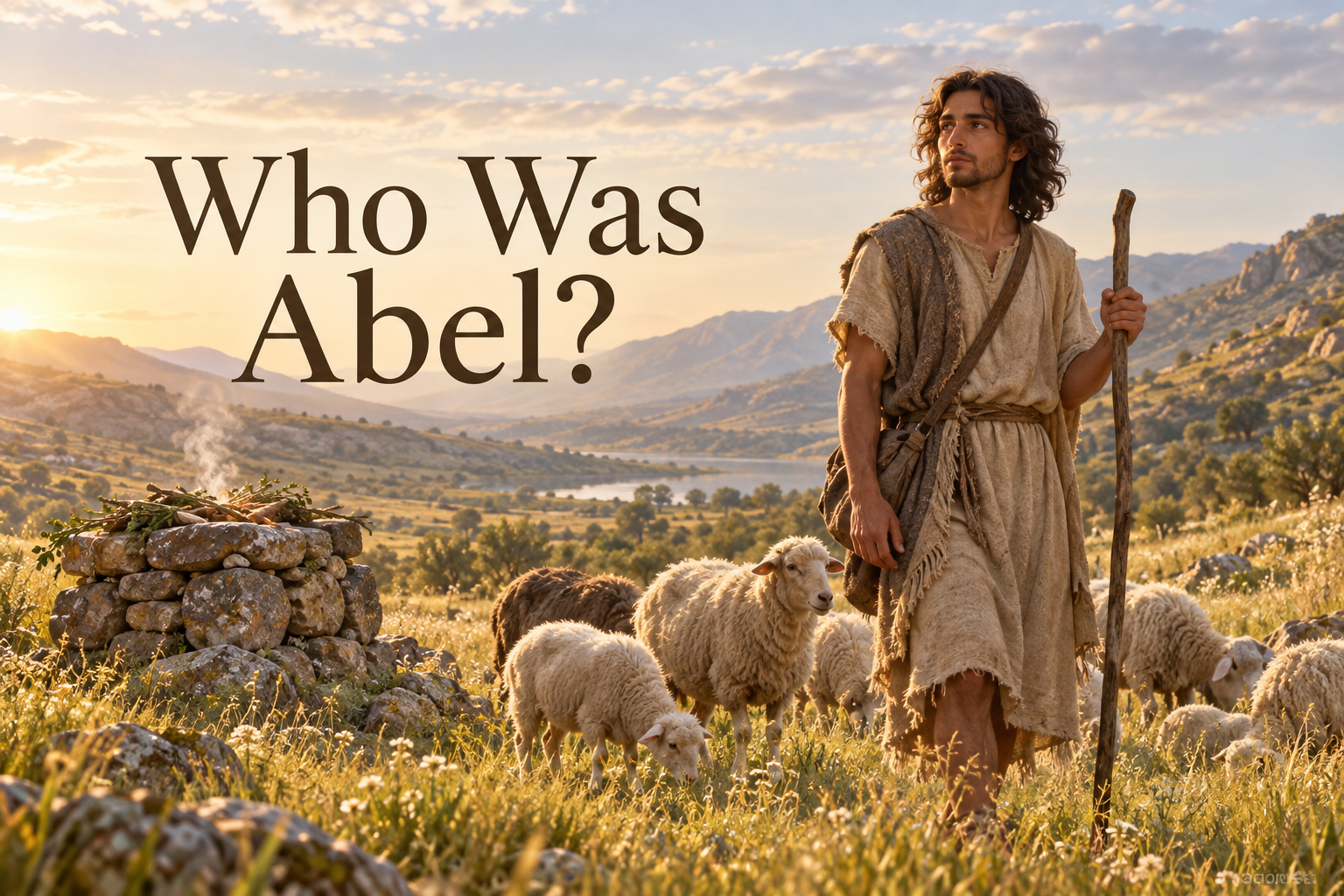
Abel speaks no recorded words in Scripture, yet his life continues to speak. He is the younger son of Adam and Eve, a keeper of sheep whose offering God regards and whose brother murders him. Much of what people think they know about Abel comes from later attempts to fill the narrative’s silences. Genesis tells us relatively little, but what it does say makes him the Bible’s first victim of human violence and a lasting witness to faithful worship.
A keeper of sheep
Genesis introduces Abel immediately after Cain. Cain works the ground, while Abel keeps flocks (Genesis 4:1–2). Their occupations aren’t presented as rival religious systems, and neither job is condemned. Both arise from ordinary human responsibility in a world where people cultivate land and care for animals. The decisive contrast appears in how the brothers come before God.
Cain brings an offering from the fruit of the ground, and Abel brings from the firstborn of his flock and their fat portions. God regards Abel and his offering but doesn’t regard Cain and his offering (Genesis 4:3–5). The wording suggests that the worshiper and the gift belong together; this is not merely a technical inspection of two objects. Genesis doesn’t explicitly say whether the distinction concerns faith, the quality of the gifts, the brothers’ character, or some combination of these.
Hebrews interprets Abel’s offering as an act of faith and says God commended him as righteous (Hebrews 11:4). First John likewise contrasts Abel’s righteous deeds with Cain’s evil deeds (1 John 3:11–12). Those later texts give readers genuine biblical guidance without turning the narrative into a detailed sacrificial manual. The common claim that God accepted Abel because blood alone could atone while rejecting Cain’s produce overlooks later grain offerings commanded in the law and says more than Genesis says.
Murder in the field
Cain responds to God’s favor toward Abel with anger. God warns Cain that sin is crouching at the door and that he must rule over it, but Cain takes Abel into the field and kills him (Genesis 4:6–8). Abel isn’t described as provoking the attack. His death exposes what envy can become when another person’s acceptance is treated as a personal injury.
God asks Cain, “Where is Abel your brother?” and then declares that Abel’s blood cries out from the ground (Genesis 4:9–10). Abel has been silenced, but his death isn’t hidden from God. The ground itself becomes a witness, receiving the blood of the shepherd from the hands of the farmer. This image helps establish the Bible’s persistent conviction that innocent blood creates moral accountability even when no human court has heard the case.
Abel is sometimes called the first martyr, though Genesis doesn’t say Cain killed him because of a spoken testimony or missionary activity. He certainly becomes the first righteous person to die because another person resents his standing before God. The label can be useful if it is explained rather than assumed. His story concerns faithful worship and lethal hostility, but the precise motive is jealousy, not a documented demand that he renounce his faith.
Abel in the words of Jesus
Jesus calls him “righteous Abel” while condemning religious leaders who complete the pattern of their ancestors by persecuting God’s messengers (Matthew 23:29–35). Many interpreters understand the reference to Abel and Zechariah as spanning the deaths of the righteous from Genesis to Chronicles, the last book in a traditional Jewish ordering. The identification of Zechariah is debated, however, because Matthew calls him the son of Berechiah while the murdered Zechariah in Chronicles is the son of Jehoiada. Jesus isn’t merely recalling an isolated family crime. He places Abel at the head of a history in which the righteous are repeatedly opposed by those unwilling to hear God.
Hebrews also says that Abel, though dead, still speaks through faith. Later in the letter, the blood of Jesus is said to speak a better word than Abel’s blood (Hebrews 12:22–24). Abel’s blood cries for justice; Christ’s shed blood establishes the new covenant and provides cleansing. The comparison doesn’t belittle Abel. It locates his unanswered death within the larger work of Jesus, where justice and mercy meet.
What Scripture doesn’t tell us
Genesis doesn’t state Abel’s age, whether he married, how long he kept flocks, or exactly what Cain said before the murder. Ancient Jewish and Christian works supplied many details, including imagined conversations and explanations of the brothers’ dispute. Islamic tradition also remembers the first fratricide, though the Qur’anic account doesn’t name the two sons. These later traditions are historically important as interpretations, but they shouldn’t be folded back into Genesis as though they were part of its wording.
Even Abel’s name invites caution. The Hebrew word commonly rendered Abel is associated with breath or vapor, a term Ecclesiastes uses for life’s transience. That association fits a life cut short, but Genesis doesn’t explicitly explain his name as a prophecy of his fate. We can appreciate the literary resonance without claiming certainty about what Adam and Eve intended when they named him.
The witness of a brief life
Abel’s biography is brief because violence makes it brief. He leaves no city, genealogy, speech, or visible monument in the story. What remains is God’s verdict that his life mattered and that his blood could not simply disappear into the soil. Scripture remembers him not because he achieved power, but because he approached God in faith and suffered at the hands of a brother who refused correction.
That makes Abel more than the unfortunate figure required to begin Cain’s story. He embodies the vulnerability of the righteous in a fallen world, while God’s response denies that victims become invisible when their killers control the account. Abel’s voice is absent from Genesis, yet God hears the witness of his blood, and the New Testament says faith allows him to speak still.