

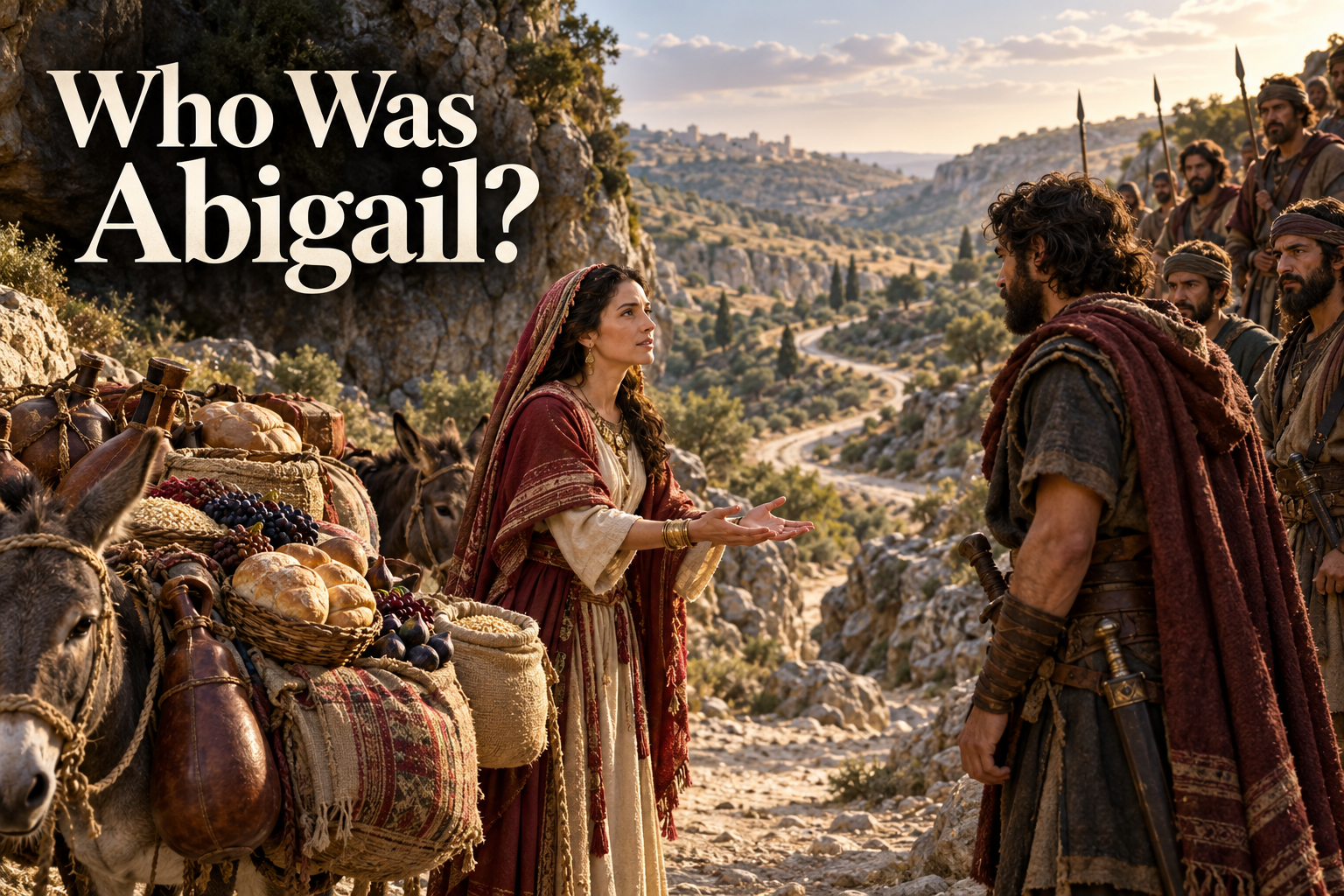
Abigail is remembered for preventing a massacre, which is accurate but incomplete. She confronted an armed and angry David when he was on his way to kill every male in her household. Her husband had created the crisis, David was prepared to answer insult with bloodshed, and Abigail had very little time to act. She brought food, chose her words carefully, and persuaded Israel’s future king that becoming a murderer would not improve his claim to the throne.
A dangerous insult in the wilderness
Abigail’s story appears in 1 Samuel 25, during the years when David was fleeing from King Saul. The chapter opens with the death of Samuel, then moves into the wilderness of Paran and the region around Maon and Carmel in Judah. A wealthy man named Nabal had three thousand sheep and a thousand goats there. The narrator describes him as harsh and badly behaved, while Abigail, his wife, is introduced as intelligent and beautiful. The contrast is not subtle, because it supplies the moral structure of everything that follows.
David’s men had been near Nabal’s shepherds and, according to the shepherds’ later testimony, protected them from raiders and caused them no harm. At sheep-shearing time, a season associated with feasting and generosity, David sent messengers asking Nabal to share provisions. Readers debate whether this was a courteous request within the customs of hospitality, an expectation of payment for protection, or something uncomfortably close to a protection racket. The narrative presents David’s men as beneficial to Nabal’s household, but it doesn’t require us to make every feature of wilderness politics sound genteel.
Nabal refused with contempt. “Who is David?” he asked, dismissing him as one of many servants breaking away from a master (1 Samuel 25:10). The insult denied David’s standing and implied that Saul’s version of events was correct. David responded by ordering his men to strap on their swords, and he vowed to wipe out every male belonging to Nabal. Whatever justice there was in expecting gratitude, the planned retaliation was wildly disproportionate. The future king was about to punish an entire household for one man’s arrogance.
Abigail acts before David arrives
One of Nabal’s servants went to Abigail rather than to his master. He told her what had happened, described David’s men as a protective wall around the shepherds, and warned that disaster was coming. The servant’s choice says something about both members of the marriage. Nabal could not be reasoned with, but Abigail had a reputation for listening and acting. She quickly assembled bread, wine, prepared sheep, roasted grain, raisins, and figs, loaded the food on donkeys, and sent the supplies ahead.
Abigail did not tell Nabal before leaving. In ordinary circumstances, secrecy between spouses isn’t a biblical ideal to imitate. These were not ordinary circumstances. Nabal’s decision had placed innocent people in immediate danger, and the person with enough sense to intervene could not wait for the approval of the man who refused to hear anyone. The passage presents her action as wisdom under pressure, not as a general technique for managing disagreement.
When Abigail met David, she bowed and accepted responsibility for the offense even though she had not heard David’s original request. Her language is deferential because she is addressing a furious warrior with hundreds of men behind him, but deference should not be confused with passivity. She asks David to listen, names Nabal’s folly, offers the provisions, and presses the moral question he has been avoiding. If the Lord is preserving David for kingship, why should he burden his future with needless bloodshed and personal vengeance?
The wisdom in Abigail’s speech
Abigail’s speech is one of the longest speeches given to a woman in the Old Testament. She speaks of the Lord establishing a lasting house for David because he fights the Lord’s battles. She pictures David’s life as bound securely in the bundle of the living with the Lord, while his enemies are flung away like stones from a sling (1 Samuel 25:28-29). The sling image fits David’s own history rather neatly, though Abigail does not pause to underline the reference. Most importantly, she tells him that when God makes him ruler, he should not have this staggering burden of bloodguilt on his conscience.
Her words have a prophetic quality because they interpret David’s future in light of God’s purpose. Later rabbinic tradition counted Abigail among Israel’s prophetesses, and many Christian interpreters have used the same description. First Samuel itself does not give her that title, so it is best to distinguish the text’s explicit claim from later interpretation. Abigail certainly speaks with theological insight, but the narrative praises her as a woman of good understanding rather than formally introducing her as a prophet.
David listened. He blessed the Lord for sending Abigail, blessed her discernment, and admitted that she had kept him from bloodguilt and vengeance (1 Samuel 25:32-34). That response matters because Abigail is not merely calming an unfortunate temper. She is confronting a genuine moral failure, and David acknowledges it. In the surrounding chapters, David repeatedly refuses opportunities to kill Saul and seize the kingdom by force. The Nabal episode shows that such restraint was not automatic; at a crucial moment, Abigail had to call him back to it.
Nabal’s death and Abigail’s marriage
Abigail returned home to find Nabal holding a feast like that of a king and very drunk. She waited until morning to tell him what she had done. When he heard it, his heart failed and he became like stone; about ten days later, the Lord struck him and he died (1 Samuel 25:36-38). The medical details aren’t sufficient for a modern diagnosis, though readers have suggested a stroke, shock, or some other sudden illness. The narrator interprets Nabal’s death as divine judgment. It does not imply that Abigail killed him or secretly arranged his death.
Afterward David sent messengers asking Abigail to become his wife, and she accepted. Some scholars note that the marriage could have strengthened David’s position among influential Calebite families in Judah, the region where he would first reign. That political benefit is plausible, but the text doesn’t state that it was the reason for the marriage. It emphasizes David’s recognition of Abigail and her willing response, while also locating the marriage within a world where marriages carried household, property, and political consequences.
Abigail was not David’s only wife. First Samuel also names Ahinoam of Jezreel, and David’s growing household later included other women. Abigail was captured with the families of David’s men when the Amalekites raided Ziklag, then rescued when David pursued the raiders (1 Samuel 30). She bore David a son who is called Chileab in 2 Samuel 3:3 and Daniel in 1 Chronicles 3:1. Scripture tells us almost nothing more about either mother or son. Attempts to supply a detailed later biography generally belong to tradition or imagination rather than the biblical record.
What Abigail’s story does and doesn’t teach
Abigail is sometimes presented as a lesson in how a godly wife should handle a difficult husband. There is truth in recognizing her courage and tact, but that framing can shrink a public moral intervention into household etiquette. Abigail protects servants, shepherds, and family members who are about to die. She also protects David from becoming the sort of ruler who treats an insult as permission for collective punishment. Her wisdom serves the whole community, including the man carrying the sword.
The passage doesn’t romanticize Nabal’s abuse of authority, and it doesn’t command Abigail to stand quietly while his folly destroys other people. Neither does it make every act of going around a spouse virtuous. Narrative wisdom pays attention to circumstances. Abigail acts because danger is immediate, Nabal is unreachable, and innocent lives are at stake. Her example is moral courage joined to practical judgment, not a slogan detached from the hard facts of the story.
Her speech also reveals something important about David. God’s promise does not excuse David’s behavior; it gives him a reason to refuse vengeance. Abigail appeals to the man he is called to become and insists that his present choices must be worthy of that calling. Divine purpose never means that the chosen person can do as he pleases. Sometimes God’s restraint arrives through another person who is willing to stand in the road and say what no one else has said.
Why Abigail matters
Abigail’s story lasts only one chapter, but it changes the direction of several hundred armed men. She sees the danger clearly, provides what a threatened household needs, and speaks truth in a form David can hear. The chapter does not pretend that she lived in an easy marriage or a safe political world. It shows wisdom doing its work in precisely that world, preventing violence before regret becomes the only thing left to offer.