

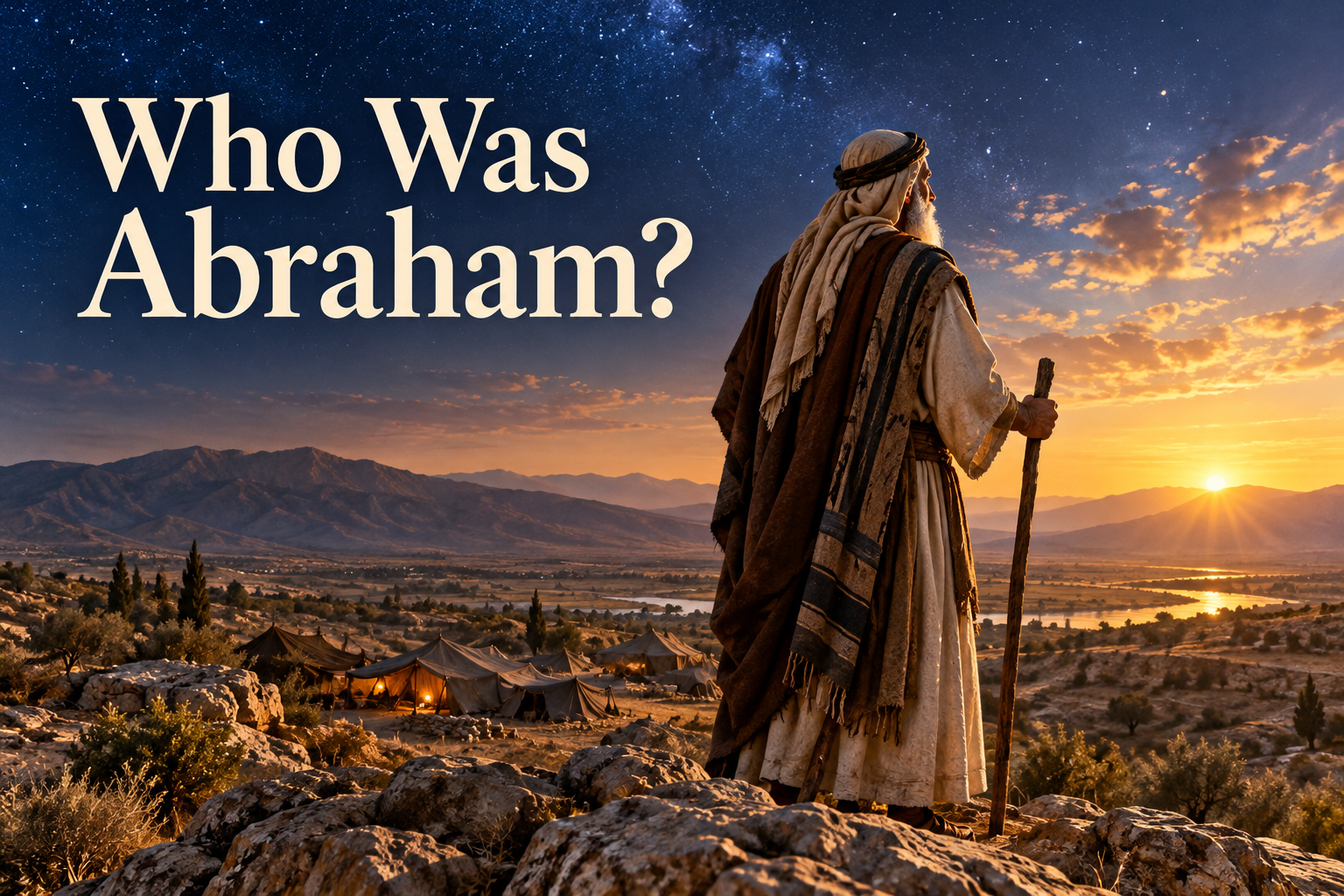
Abraham is remembered as the father of a multitude, but Genesis first presents him as a man with no child and no map of the future. God calls Abram to leave his country, extended family, and father’s household for a land God will show him. The command is followed by an astonishing promise: God will make him a great nation, bless him, make his name great, and bless all the families of the earth through him (Genesis 12:1–3). That promise becomes the organizing thread of Abraham’s story. Land, offspring, blessing, and trust keep returning, usually when circumstances make each of them look unlikely.
Abram answers God’s call
Abram’s family had already traveled from Ur toward Canaan and settled at Harran. From there Abram continued into Canaan with his wife Sarai, his nephew Lot, their possessions, and the people attached to their household. Genesis portrays a wealthy pastoral household, not a lone traveler with a walking stick. At Shechem and then between Bethel and Ai, Abram built altars to the Lord. These acts of worship matter because he was living as a resident outsider in land occupied by others, trusting a promise he did not yet possess.
Faith did not make Abram fearless or consistently wise. When famine drove the household to Egypt, he asked Sarai to say she was his sister because he feared that her beauty would get him killed. The statement had a partial truth behind it according to Genesis 20:12, but Abram used it deceptively and placed Sarai in danger so that he might survive. Pharaoh took her into his house, and Abram prospered until God intervened. Genesis narrates the rescue; it does not ask us to approve Abram’s conduct. The man of faith could also be a frightened husband whose self-protection endangered someone with less power.
After returning to Canaan, Abram handled conflict with Lot more generously. Their herds had become too large for the land to support them together, so Abram allowed his younger relative to choose first. Lot selected the fertile Jordan plain and moved toward Sodom, while Abram remained in Canaan. Later, when regional kings captured Lot, Abram mobilized trained men from his household, rescued the captives, and refused to enrich himself from the king of Sodom. Melchizedek, king of Salem and priest of God Most High, blessed him, and Abram gave him a tenth. Hebrews later uses this mysterious encounter to explain Christ’s priesthood, but Genesis itself gives very little biographical information about Melchizedek.
Covenant, delay, and the treatment of Hagar
Genesis 15 brings Abram’s problem into the open: God has promised descendants, but Abram remains childless. God answers by taking him outside and telling him to count the stars, if he can. Abram believes the Lord, and the Lord counts it to him as righteousness. Paul later draws on this verse to explain justification by faith (Romans 4; Galatians 3), while James points to Abraham’s later obedience as evidence that genuine faith acts (James 2:21–23). The writers emphasize different errors, but neither treats faith as mere optimism or works as a way of earning God’s promise.
The covenant ceremony that follows uses imagery familiar from solemn ancient agreements: animals are divided, and a smoking firepot and flaming torch pass between the pieces. The striking feature is that God symbolically takes the covenant obligation upon himself. Yet the chapter also says Abraham’s descendants will experience oppression before receiving the land. Promise does not mean an easy route, and God’s choice of this family for a vocation should not be collapsed into a complete doctrine of who is individually saved.
As the delay continued, Sarai gave her Egyptian enslaved woman Hagar to Abram in an attempt to obtain a child through her. Such arrangements have ancient Near Eastern parallels, but cultural familiarity doesn’t make the arrangement humane or divinely commanded. Hagar’s consent is never requested. After she conceived, the household became bitter, Sarai treated her harshly, and Abram refused responsibility by placing her back under Sarai’s power. God saw Hagar in the wilderness and promised a future for Ishmael, but divine care for the abused woman does not turn the actions that drove her away into acceptable behavior.
In Genesis 17 God reaffirmed the covenant, changed Abram’s name to Abraham, meaning “father of a multitude,” and established circumcision as the covenant sign for the males of his household. Sarai became Sarah, and God specified that the promised son would come through her. Abraham laughed at the idea that a man of one hundred and a woman of ninety would have a child. His laughter was not the end of his faith; it showed how staggering the promise sounded. God also promised to bless Ishmael, though Isaac would carry the covenant line.
Hospitality, intercession, and old failures
Abraham’s welcome of three visitors in Genesis 18 has become a classic picture of hospitality. He hurried to offer water, shade, bread, meat, and rest, only to learn that his guests brought another announcement of Isaac’s birth. The chapter then shifts toward Sodom. When God disclosed the coming judgment, Abraham interceded, asking whether the Judge of all the earth would sweep away the righteous with the wicked. His repeated questions are bold but reverent, grounded in God’s justice rather than in a claim that Sodom’s violence did not matter.
Abraham nevertheless repeated his old deception in Gerar, again identifying Sarah as his sister and allowing a ruler to take her. God warned Abimelech in a dream before he touched her. Abraham defended himself by explaining his fear and the family relationship, but the explanation does not remove Sarah’s peril. The repeated episode keeps the biblical portrait honest: spiritual growth is real, but people can return to familiar sins, especially when fear offers them the same old excuse.
Isaac’s birth finally brought the promised joy, but it also intensified conflict between Sarah and Hagar. At Sarah’s demand, Abraham sent Hagar and Ishmael away with provisions that soon ran out. God told him that the covenant line would be named through Isaac while also promising a nation through Ishmael. Once again God protected Hagar and her son in the wilderness. Later Jewish, Christian, and Islamic traditions all look to Abraham, though they develop his family story in different ways. Those later traditions are important historically, but they shouldn’t be quietly read back into every detail of Genesis.
The binding of Isaac
Genesis 22 records the hardest episode in Abraham’s life. God tested him by commanding him to offer Isaac, the son through whom the promise was supposed to continue. Abraham obeyed until the angel of the Lord stopped him, and a ram was offered in Isaac’s place. The story ends in provision, not child sacrifice, and the Law later condemns the sacrifice of children. Even so, the narrative is meant to disturb us. It tests whether Abraham will entrust the promise itself to the God who gave it; it does not provide parents with permission to follow destructive private revelations.
Jewish tradition commonly calls this event the Akedah, the binding, and emphasizes Isaac’s place in Israel’s story. Christian readers have often seen a pattern that points toward the Father giving the Son, although Genesis does not explicitly state that interpretation. Hebrews 11 says Abraham reasoned that God could raise Isaac from the dead. That is a later inspired interpretation of Abraham’s faith, not a sentence placed in his mouth by Genesis.
Abraham’s death and continuing significance
After Sarah died, Abraham purchased the cave of Machpelah near Hebron as a burial property. The extended negotiation in Genesis 23 underscores his status as a resident alien: he had received a divine promise of land, yet the first plot legally held by his family was one he bought at full price for a grave. He later arranged for Isaac to marry a woman from his wider family rather than a Canaanite, married Keturah, and fathered additional sons. Before his death he gave gifts to those sons while identifying Isaac as his principal heir. Abraham died at 175 according to Genesis, and Isaac and Ishmael buried him beside Sarah.
There is no known contemporary inscription that names Abraham, Sarah, Isaac, or the events of their household. Archaeology and ancient texts can illuminate pastoral life, migration, treaties, inheritance, slavery, and marriage customs in the ancient Near East, but scholars disagree about when the patriarchal narratives took their present form and how directly particular customs can date them. Christian confidence in Abraham’s significance comes primarily from Scripture’s testimony, not from claiming that archaeology has proved more than it has.
Abraham matters because the biblical story of blessing to the nations runs through the promise given to him. Israel remembers him as an ancestor; Paul presents him as the father of all who believe, circumcised and uncircumcised; and the New Testament identifies Christ as the promised offspring through whom the blessing reaches the nations. Yet Genesis doesn’t preserve a polished hero. It gives us a man who trusted, obeyed, feared, failed, interceded, and kept learning that God’s promise depended more securely on God’s faithfulness than on his own.