

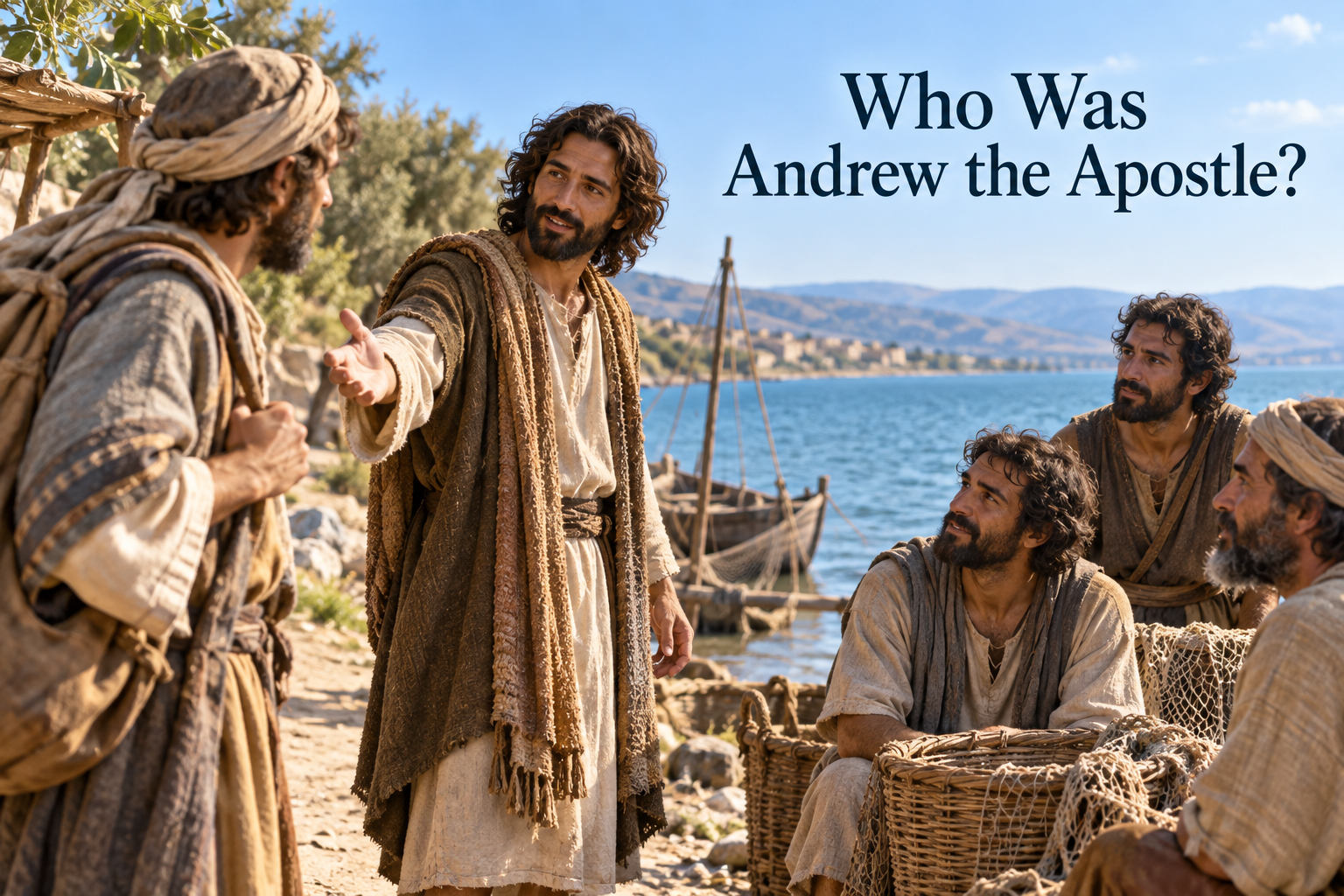
Andrew is usually introduced as Simon Peter’s brother, which tells us both his family and the problem of his reputation. Peter dominates the early church narrative, while Andrew appears in only a few scenes. Yet those scenes share a pattern: Andrew notices someone or something at the edge and brings it toward Jesus. He brings Peter, points out a boy with food, and helps Greek visitors reach Christ. The New Testament gives no sermon from Andrew, but it gives him the quiet work of connection.
A fisherman from Bethsaida
Andrew was from Bethsaida in Galilee and worked as a fisherman with his brother Simon. Mark presents Jesus calling both brothers beside the Sea of Galilee to leave their nets and become fishers of people (Mark 1:16–18). Matthew follows the same basic scene. Their immediate response does not mean they never saw Jesus before; John describes an earlier encounter that helps explain the readiness.
John says Andrew was first a disciple of John the Baptist. When John identified Jesus as the Lamb of God, Andrew and another disciple followed Jesus and spent part of the day with him. Andrew then found Simon and announced, “We have found the Messiah,” before bringing him to Jesus (John 1:35–42). The brother who would become more famous entered the story through Andrew’s witness.
In Eastern Christian tradition Andrew is often called the First-Called because John places him among the first disciples to follow Jesus. That title is a fair devotional summary of John’s sequence, though the Gospels arrange the call narratives differently. It should not become a competition over which apostle earned seniority by a few hours.
Andrew and Peter shared a house in Capernaum with Peter’s family, and Jesus healed Peter’s mother-in-law there. James and John were present nearby in the narrative (Mark 1:29–31). The household became an early base for Jesus’ Galilean work. Scripture does not say whether Andrew was married or give any further family information.
Among the Twelve
Andrew appears in every list of the Twelve, usually near Peter, James, and John. Mark places him with those three when they privately ask Jesus about the temple’s future and the signs of coming events (Mark 13:3–4). He was close enough to participate in important questions, though he is not consistently included in the inner three who witness Jairus’s daughter, the transfiguration, and Gethsemane.
The apostolic lists establish his appointment and authority but tell us little about personality. Later writers often fill such gaps with imagined traits. The canonical Andrew is neither explicitly shy nor officially in charge of introductions. We can observe his actions without turning three scenes into a psychological profile.
As one of the Twelve, Andrew participated in Jesus’ traveling ministry, heard the parables, witnessed healings, and shared the mission in which the apostles proclaimed repentance and cared for the sick. The Gospels usually speak of the group rather than naming each participant. Andrew’s presence in the Twelve means those common experiences belong to his biography even when no individual reaction is recorded.
The boy with loaves and fish
Before Jesus fed the five thousand, he asked Philip where bread could be bought. Philip calculated the cost and found the situation impossible. Andrew reported that a boy had five barley loaves and two fish, then admitted how inadequate they were for the crowd (John 6:5–9). He did not display heroic certainty, but he placed the available resource before Jesus.
The barley loaves suggest inexpensive food, and the boy’s social identity remains unknown. Andrew neither claims the food nor disappears the child who carried it. Jesus gives thanks, distributes the meal, and provides abundance. The miracle belongs to Jesus; Andrew’s role is to identify what is present when it seems embarrassingly small.
This episode is often turned into a lesson that any contribution becomes spectacular if offered to God. That application can be encouraging, but the passage’s center is Christ’s identity and provision, not a technique for multiplying personal talents. Andrew himself voices the insufficiency. Faith can bring a small reality to Jesus without pretending it already solves the problem.
Greeks who wanted to see Jesus
Near the end of Jesus’ public ministry, some Greeks who had come to worship at the feast approached Philip and asked to see Jesus. Philip told Andrew, and together they told Jesus (John 12:20–22). The text does not say whether these visitors were Gentile God-fearers or Greek-speaking Jews. Their arrival nevertheless broadens the horizon of the scene.
Jesus answered by speaking of his hour, the grain of wheat that must die, and the lifting up through which he would draw all people. John does not narrate a conventional audience with the visitors. Their request becomes the occasion for Jesus to interpret the cross as the path to worldwide fruitfulness. Andrew again participates in bringing people toward Jesus, but Jesus defines what truly seeing him will require.
After the resurrection
Andrew appears in Acts among the apostles gathered in Jerusalem after the ascension (Acts 1:12–14). He shared in the praying community awaiting the Holy Spirit, but Acts does not name him in later missionary episodes. We cannot construct a canonical itinerary from that silence.
The group’s presence at Pentecost means Andrew belonged to the apostolic witness when the Spirit was poured out and the church’s public mission began. Acts does not say he delivered part of Peter’s sermon or assign him a separate sign that day. Corporate participation matters even when one representative voice receives the narration. The apostles’ shared testimony did not require equal page space for every member.
Later traditions send Andrew to regions around the Black Sea, Scythia, Asia Minor, Greece, and sometimes as far as places claimed by later national churches. Eusebius reports a tradition that Andrew preached in Scythia. Other accounts are later and sometimes conflict. The spread of devotion to Andrew across these regions is historical; proving that he personally founded every church that claims him is another matter.
Tradition says Andrew was martyred by crucifixion at Patras in Greece. The familiar X-shaped cross, called Saint Andrew’s Cross, became associated with him much later than the earliest martyrdom accounts. Early apocryphal Acts of Andrew contain legendary speeches and miracles and cannot be treated as a simple eyewitness record. His martyrdom is an old Christian tradition, but the New Testament does not state how or where he died.
Claims about Andrew’s relics developed as remains were transferred and churches sought connection with apostolic origins. Patras, Constantinople, Amalfi, and Scotland all feature in these traditions. They matter for church history and identity, not as independent confirmation of Andrew’s travels. Relics with competing chains of custody require caution.
Andrew also became a patron saint in several countries, and the diagonal cross appears on flags and heraldry. These later cultural uses show how a lightly narrated apostle acquired an enormous afterlife. They do not tell us more about the first-century fisherman. National devotion should be distinguished from evidence that Andrew personally evangelized every nation that later claimed him.
Andrew’s legacy
Andrew’s importance is not that he discovered an overlooked method for church growth. He encountered Jesus through John’s witness and immediately involved his brother. Later he made Jesus aware of a boy in the crowd and helped visitors voice their request. Each time, Andrew’s role ends where Jesus’ action begins.
That pattern offers a needed counterweight to celebrity accounts of ministry. Andrew did not become irrelevant because Peter preached at Pentecost or because John’s name became attached to major writings. The kingdom includes work whose fruit appears most visibly in someone else’s story. Bringing Peter to Jesus was not a small contribution merely because Peter became the better-known apostle. Faithfulness is not measured by how often a narrator uses someone’s name.
The canonical record leaves Andrew without a grand conclusion, and that restraint should be preserved. We know he was called, appointed, present, and praying with the apostolic community. We have early but uneven traditions about later mission and death. The absence of a named sermon does not mean the apostle never preached, only that Luke did not preserve one under his name. What Scripture most clearly remembers is enough: Andrew found the Messiah and did not keep the news to himself.