

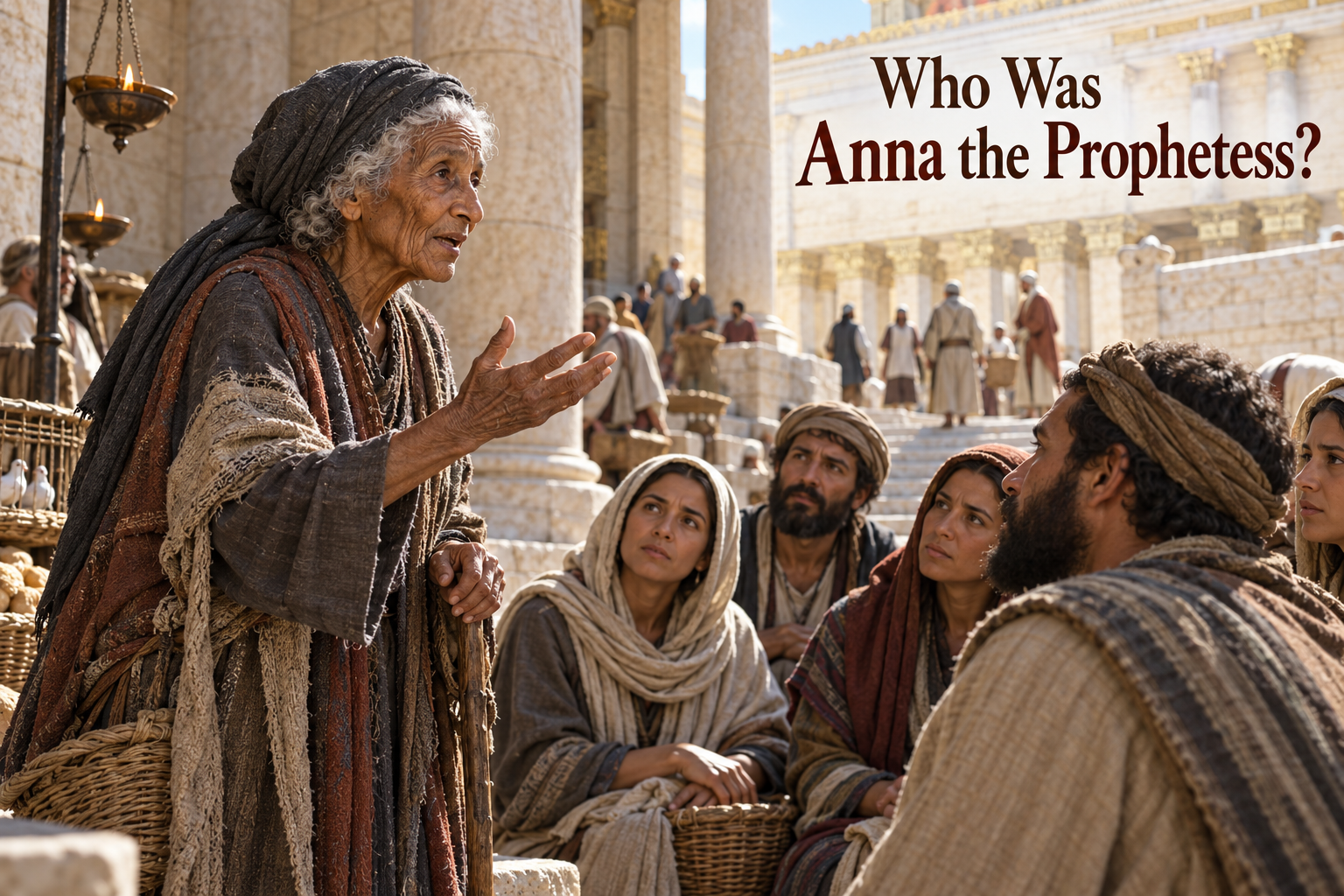
Anna the prophetess speaks no recorded line in the Bible, yet Luke makes sure that readers know her name, family, tribe, history, and vocation. She enters the story when Mary and Joseph bring the infant Jesus to the Jerusalem temple. At that moment, she thanks God and begins speaking about the child to people who are waiting for Jerusalem’s redemption (Luke 2:36-38). Her testimony joins Simeon’s, but she isn’t merely an extra witness added to his scene. Anna has her own long history of loss, worship, and hope, and Luke presents her explicitly as a prophet.
Everything the New Testament says directly about Anna is contained in three verses. She was the daughter of Phanuel, belonged to the tribe of Asher, had been married for seven years, and then lived for many years as a widow. She devoted herself to worship, fasting, and prayer at the temple. When Jesus arrived, she recognized that something decisive was happening and told others who shared Israel’s hope. Later stories may expand her biography, but Scripture gives no account of her childhood, husband’s name, death, or subsequent ministry.
A Named Woman From Asher
Luke’s precision is worth noticing. In an ancient culture where a widow could easily disappear from public memory, he identifies Anna by name and calls her a prophetess. Her father was Phanuel, and her tribal affiliation was Asher. The tribe had received territory in Israel’s north centuries earlier, but conquest, migration, and exile had scattered its population. Anna’s identification with Asher shows that at least some Jewish families continued to remember older tribal connections; it doesn’t prove that every tribal genealogy remained complete or that an entire “lost tribe” was living intact in Jerusalem.
Her name is the Greek form of Hannah, a name already associated in Scripture with prayer and a child dedicated to God. Readers may hear an echo of Samuel’s mother, especially because Luke’s infancy narrative contains songs and reversals that resemble Hannah’s story. Still, Luke never states that Anna was named to create that parallel, so it’s better treated as a literary resonance than a biographical fact. What Luke does state is strong enough: this daughter of Asher was recognized as someone through whom God spoke.
The title “prophetess” had deep roots in Israel’s Scriptures. Miriam led worship after the exodus, Deborah judged Israel, and Huldah delivered the word of the Lord during Josiah’s reforms. Anna belongs in that company, although Luke doesn’t describe the exact form her prophetic ministry took before this day. Her title confirms that women could be publicly recognized as prophetic voices among God’s people. It shouldn’t be inflated into answers for every later church debate, but neither should it be softened into a vague compliment about being devout.
How Old Was Anna?
Luke says Anna had lived with her husband for seven years after marriage and then describes her as a widow in connection with eighty-four years. The Greek wording permits two readings. Many translations understand her to be eighty-four years old; others understand her to have been widowed for eighty-four years, which would put her age well over one hundred. Either reading makes her an elderly woman whose widowhood occupied most of her adult life. The text’s emphasis is her great age and durable faithfulness, not an arithmetic puzzle.
We therefore shouldn’t speak dogmatically where competent translators disagree. If eighty-four is her age, she had still endured decades without her husband. If it marks the length of her widowhood, her longevity is extraordinary but not impossible. Luke gives no reason to think she was miraculously preserved or that her age carried a secret symbolic code. The number grounds her devotion in time: Anna’s hope survived long years when fulfillment seemed slow.
Widowhood in the ancient world could bring economic and social vulnerability, though no single description fits every widow. Some had extended family or property; others faced severe insecurity. Luke doesn’t tell us Anna’s financial circumstances, so claims that she was either destitute or independently wealthy go beyond the account. What he emphasizes is agency rather than helplessness. Anna worships, fasts, prays, recognizes, gives thanks, and speaks.
Worship at the Temple
Luke says Anna didn’t depart from the temple but worshiped night and day with fasting and prayer (Luke 2:37). This likely describes the constancy of her devotion rather than requiring us to imagine that she literally never stepped beyond the temple complex. Biblical language can describe people as continually present when their regular pattern of life centers on a place or practice. Nor does the verse prove she had living quarters inside the sanctuary. The safest conclusion is that temple worship defined her days to an exceptional degree.
Fasting wasn’t a technique for forcing God to act. In Scripture it could express grief, repentance, dependence, or concentrated prayer. Luke places Anna among people who feel the ache of Israel’s condition and seek God rather than surrendering to cynicism. Her “night and day” devotion also resists a shallow assumption that an unseen ministry is an unimportant one. Before Anna speaks publicly about Jesus, Luke lets us see the long life of prayer beneath her words.
The temple setting matters because Mary and Joseph have come in obedience to the law concerning purification and a firstborn son. Their offering of two birds was the provision available to families who couldn’t afford a lamb (Leviticus 12:6-8). Jesus is presented within the covenant practices of Israel, and Anna recognizes him there. She doesn’t announce a Messiah detached from Israel’s God, Scriptures, or worship. Her witness grows from the very hope that had kept her praying.
Speaking About the Child
Anna arrives “at that very hour,” apparently while Simeon is blessing the family. She gives thanks to God and speaks about Jesus to all who were waiting for the redemption of Jerusalem. Luke doesn’t preserve her exact words, which can make her testimony seem less substantial than Simeon’s song. But the absence of a quotation isn’t the absence of a message. Anna becomes one of the first people in Luke’s Gospel to tell a circle of expectant hearers that God’s answer is present in this child.
“Redemption” could evoke release from oppression, the restoration of God’s people, forgiveness, and the fulfillment of prophetic promises. Jews under Roman rule didn’t all define that hope in the same way. Luke will show Jesus bringing release from sin and evil while also challenging the proud use of political, economic, and religious power. Anna may not yet understand the shape of the cross and resurrection, but she knows the child belongs to God’s promised rescue. The Gospel doesn’t require complete knowledge before faithful testimony can begin.
Her audience is also carefully described. She speaks to people who were already waiting for Jerusalem’s redemption, not indiscriminately to every passerby. That detail suggests a network of hope within the city, though Luke doesn’t identify it as a formal organization. We shouldn’t invent a named movement or make Anna its leader. The text gives us a community of expectation and a prophetess who tells that community where to look.
Anna, Simeon, and Luke’s Story
Luke often places women and men beside one another: Zechariah and Mary, Simeon and Anna, and later male and female recipients of Jesus’ mercy. The pairings don’t make the individuals interchangeable. Simeon takes Jesus in his arms and speaks to Mary; Anna gives thanks and spreads the news among those awaiting redemption. Together they provide the confirming testimony of two faithful Israelites, while each reveals a different dimension of response. Simeon is ready to depart in peace, and Anna turns recognition outward in proclamation.
The scene also joins generations. Jesus is an infant, his parents are raising a young family, and Anna is advanced in years. Luke doesn’t romanticize aging or widowhood, but he refuses to treat an elderly widow as finished with meaningful service. Her years of prayer aren’t the preface to her real work; they are part of it. When the awaited moment comes, she is spiritually prepared to recognize it and socially prepared to tell others.
History and Later Tradition
No surviving inscription or outside historical record securely identifies Anna daughter of Phanuel. As with many ordinary people in the Gospels, our knowledge of her depends on the biblical narrative. The temple setting, Jewish fasting, tribal memory, and hopes of redemption fit the religious world of the period, but that general fit can’t independently prove her encounter with Jesus. Christians confess the account as Scripture; responsible historical discussion still distinguishes that confession from archaeological confirmation.
Later Christian tradition honored Anna as a saint and often portrayed her beside Simeon in icons of Jesus’ presentation. Such commemoration rightly remembers a woman Luke himself praises. Yet traditions that supply additional travels, relationships, or exact details about her long life don’t come from the Gospel. Even the familiar picture of Anna living permanently inside the temple may press Luke’s devotional language farther than it can bear. Her biblical portrait needs no embroidery to become significant.
A Faith That Endured
Anna’s story is small enough to overlook and strong enough to resist being overlooked. She experienced bereavement early, lived through decades of waiting, and remained engaged in worship rather than withdrawing from hope. Scripture doesn’t say that God caused her husband’s death in order to prepare her for this moment. It shows instead that grief didn’t have the final word over the life she went on to live.
When Jesus came, Anna did what a prophet should do: she recognized God’s work, thanked God for it, and spoke truth to people who needed hope. She had no recorded office beyond the title Luke gives her, no preserved sermon, and no public monument from her lifetime. Yet her witness has outlived rulers whose names once filled Jerusalem. Anna matters because she shows that long faithfulness can sharpen hope rather than exhaust it, and that God may entrust public testimony to someone society is tempted to place at the margins.