

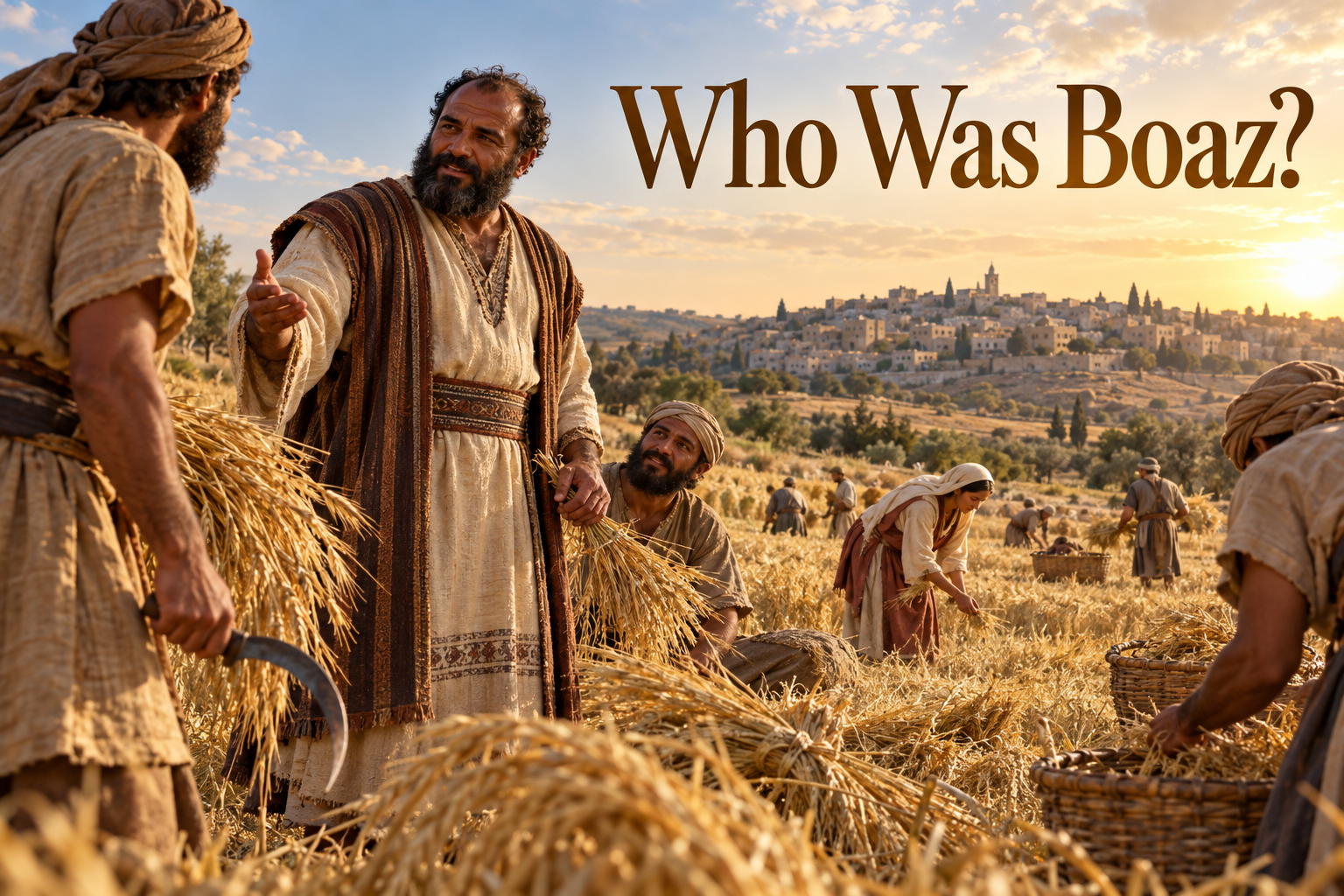
Boaz is often remembered as the wealthy man who married Ruth, but that brief description leaves most of his story untold. The book of Ruth presents him as a landowner with social power who consistently uses that power to protect, provide, and keep his word. He is generous without being careless and honorable without being colorless. His importance lies not in wealth alone but in what he chose to do with it.
A worthy man in Bethlehem
Boaz lived in Bethlehem during the era of the judges and belonged to the extended family of Elimelech, Naomi’s deceased husband. Ruth introduces him as a prominent or worthy man of considerable standing (Ruth 2:1). The Hebrew description can carry ideas of wealth, strength, and reputation, and Boaz’s later dealings at the town gate confirm that he was respected. Scripture doesn’t tell us his age, though his own words suggest that Ruth was significantly younger.
Ruth met Boaz while gleaning behind his harvesters. Israel’s law required farmers to leave the edges and dropped produce for poor people and resident foreigners rather than squeezing every possible measure from the land (Deuteronomy 24:19–22). Gleaning was real work, not a comfortable charity program, and a foreign widow could be vulnerable in the fields. Boaz noticed Ruth and asked his overseer who she was (Ruth 2:2–7).
Once he learned her identity, Boaz told Ruth to remain in his fields, stay near his female workers, and drink from the water drawn by his men. He also ordered the men not to touch or harass her (Ruth 2:8–9). His protection indicates that the danger was credible, and Naomi later spoke more bluntly about the possibility of harm in another field. Boaz didn’t congratulate himself for basic decency; he arranged the workplace so a vulnerable woman could labor safely.
Ruth asked why she had received such favor as a foreigner. Boaz answered that he had heard about her loyalty to Naomi and her decision to leave her homeland, and he prayed that the Lord would reward her for seeking refuge under God’s wings (Ruth 2:10–13). At the meal, he welcomed her to eat with the workers and gave her more than she needed. He then instructed the harvesters to let her gather among the sheaves and deliberately pull out grain for her without rebuke (Ruth 2:14–16).
More than private generosity
Boaz’s kindness was personal, but it was rooted in Israel’s covenant obligations toward the poor, widow, and foreigner. He went beyond the minimum by making those obligations effective rather than merely theoretical. A right to glean meant little if workers insulted Ruth or drove her away. Boaz used his authority to make room for her, which is one reason the book treats him as worthy.
When Ruth returned home with a large amount of barley, Naomi recognized that someone had treated her with unusual favor. On hearing Boaz’s name, she identified him as one of their family redeemers (Ruth 2:17–20). A redeemer could act to preserve family land and protect relatives from permanent loss. Boaz wasn’t the only eligible relative, and the narrative doesn’t portray “kinsman-redeemer” as a romantic title meaning predestined husband. It was a family and economic responsibility that, in this case, became entwined with marriage.
Ruth continued gleaning in Boaz’s fields through the barley and wheat harvests (Ruth 2:21–23). The passage of time matters. Boaz’s character wasn’t displayed in a single impressive conversation but in a sustained environment of safety and provision. Ruth worked, Naomi planned, and Boaz remained dependable through the harvest season.
The night at the threshing floor
At Naomi’s instruction, Ruth approached Boaz at the threshing floor after he had eaten, lain down, and gone to sleep. She uncovered his feet and lay down, and at midnight he awoke startled to find a woman there (Ruth 3:1–8). The scene is deliberately tense and carries possible sexual overtones, but the account doesn’t say they had sexual relations. Ruth identified herself and asked him to spread his garment over her because he was a redeemer, turning Boaz’s earlier prayer about refuge under God’s wings into a request that he help provide it.
Boaz praised Ruth’s faithful kindness and said she had not pursued younger men, whether rich or poor. He promised to do what she asked and described her as a woman of noble character (Ruth 3:9–11). Yet he also explained that another relative was nearer and therefore had the prior claim. Instead of using privacy and social inequality for his own advantage, Boaz submitted the matter to public legal resolution.
He allowed Ruth to remain until morning for safety, sent her away before recognition could damage her reputation, and gave her grain for Naomi (Ruth 3:12–15). Some textual details in this scene are debated, including exactly who went into the city in the following line, but the main action is clear. Boaz protected Ruth in the moment and committed himself to address the larger problem promptly.
The decision at the gate
Boaz went to the town gate, where legal and civic matters were handled, and gathered the nearer redeemer with ten elders. The man initially agreed to redeem Elimelech’s land but withdrew when Boaz explained the accompanying responsibility involving Ruth and the dead man’s inheritance (Ruth 4:1–6). Scholars differ over some legal details because no single Old Testament statute describes precisely the full arrangement in Ruth 4. The narrative draws together land redemption, family duty, marriage, and preservation of the deceased man’s name.
The nearer relative transferred his right to Boaz through the customary removal of a sandal. Boaz then called the elders and townspeople as witnesses that he had acquired the family property and would marry Ruth to maintain the dead man’s name (Ruth 4:7–10). This public process protected Ruth and Naomi from a private promise that could later be denied. Boaz accepted not only a wife but also responsibility for a household whose future had nearly disappeared.
The people blessed the marriage, invoking Rachel, Leah, and Tamar. Boaz married Ruth, and the Lord enabled her to conceive Obed (Ruth 4:11–13). Obed became the father of Jesse and grandfather of David. The genealogy places Boaz within Israel’s royal story, though the book’s attention remains on faithful conduct in an ordinary Judean town.
Boaz in Jesus’ genealogy
Matthew’s genealogy says that Salmon fathered Boaz by Rahab and that Boaz fathered Obed by Ruth (Matthew 1:3–6). The Old Testament doesn’t narrate Boaz’s parentage or explicitly connect his mother with Rahab of Jericho, so the identification comes from Matthew’s genealogy and later Christian understanding of it. Biblical genealogies can also be selective, and chronological questions shouldn’t be solved by inventing biographical details Scripture doesn’t provide.
Christian readers have sometimes treated Boaz as a direct symbolic picture of Christ, the great Redeemer. The comparison can illuminate themes of costly provision, restored inheritance, and welcome for an outsider. Still, Ruth itself presents Boaz as a faithful Israelite relative, not as a sinless messianic figure, and the legal details shouldn’t be made to correspond to Jesus at every point. Typology is most useful when it respects the actual story before drawing a larger connection.
Why Boaz matters
Boaz demonstrates that biblical kindness is more than a pleasant feeling. He knew the law, noticed the exposed person in his field, restrained those under his authority, shared his table, gave generously, respected legal order, and accepted a costly family duty. None of those actions required spectacle. Together they created the conditions in which Ruth and Naomi could move from survival to security.
The book never says every powerful man is trustworthy, and Ruth’s situation shows why trust must be earned. Boaz earns it over time by acting the same way in the field, at the threshing floor, and before the elders. His story is not merely that a good man found a wife. It is that a man with resources used them faithfully, and an endangered family found room to live because he did.