

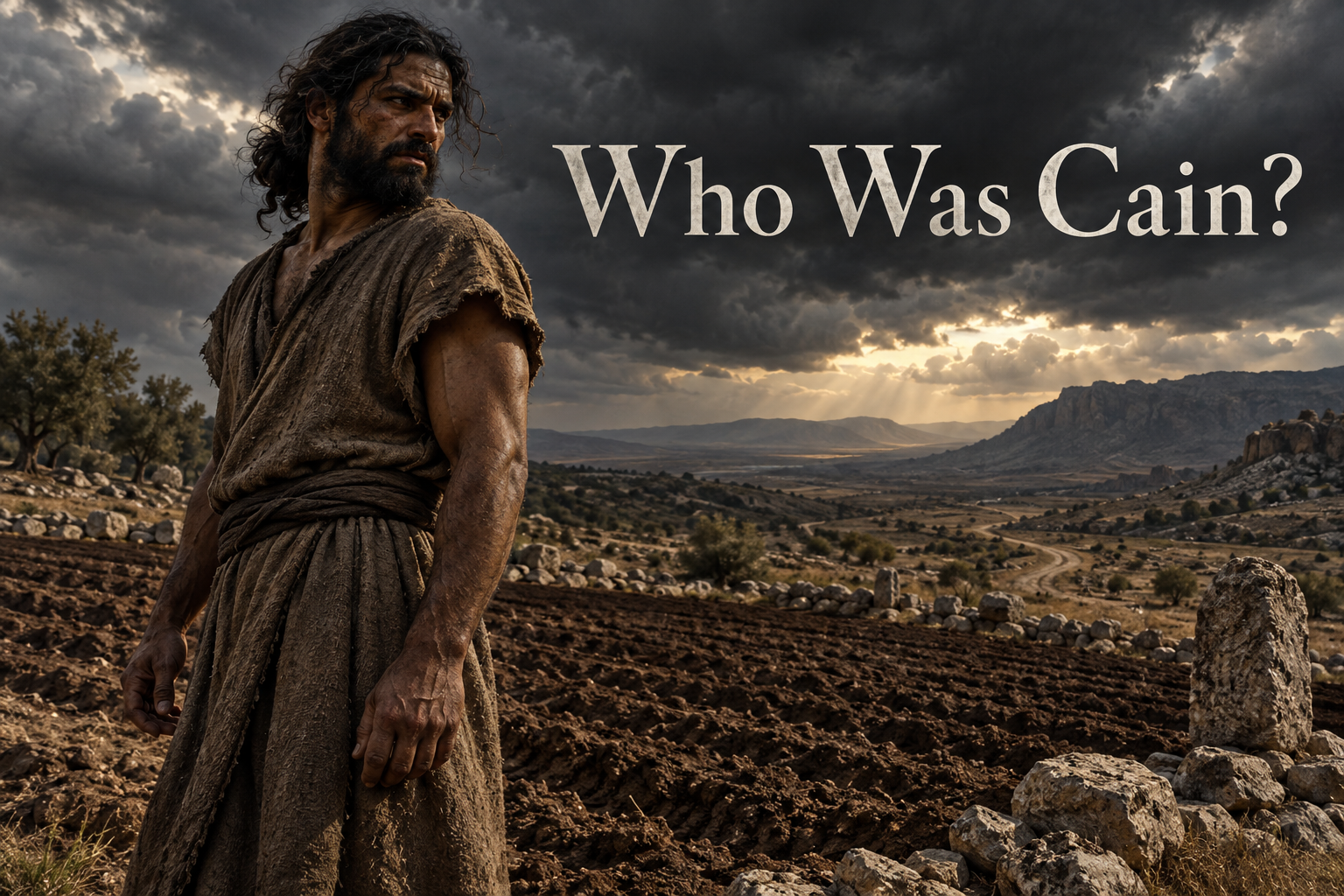
Cain is the Bible’s first child and its first murderer. That grim combination gives his story unusual force. He grows up outside Eden, works the soil, brings an offering to God, and then kills his brother when jealousy masters him. Genesis doesn’t present Cain as a monster who was born without a conscience. It presents him as a man warned about sin, responsible for his choice, judged for violence, and still protected from revenge.
The first brothers
Eve gives birth to Cain and credits the Lord with helping her bring forth a man. His brother Abel follows, and the two men take up different work: Cain cultivates the ground, while Abel keeps flocks (Genesis 4:1–2). Nothing in the text suggests that farming was morally inferior to shepherding. Adam had been commissioned to work the ground, and agricultural gifts would later be welcomed in Israel’s worship. The conflict isn’t a biblical argument between vegetables and meat.
Both brothers bring offerings. Cain presents some of the fruit of the ground, while Abel brings firstborn animals and their fat portions. God regards Abel and his offering but not Cain and his, leaving Cain angry and downcast (Genesis 4:3–5). Genesis doesn’t explicitly say why the offerings receive different responses. Hebrews later commends Abel’s sacrifice as offered by faith, and 1 John contrasts Abel’s righteous works with Cain’s evil ones (Hebrews 11:4; 1 John 3:11–12), but speculation about every ritual detail goes beyond the account.
God addresses Cain before the murder. He asks why Cain is angry, tells him that doing well will bring acceptance, and pictures sin as crouching at the door with a desire to control him (Genesis 4:6–7). The warning assumes Cain can and must resist. Sin is portrayed as a predatory power, but not as an excuse that removes moral agency. Cain hears the warning and chooses otherwise.
“Where is Abel your brother?”
Cain speaks to Abel and attacks him in the field, killing him (Genesis 4:8). Scripture gives no account of a prolonged quarrel and no mitigating cause. The first recorded death is not from age or accident but from one brother’s violence against another. Human rebellion has moved rapidly from hiding from God to erasing a human life made in God’s image.
God asks Cain where Abel is, and Cain answers, “I don’t know. Am I my brother’s keeper?” (Genesis 4:9–10). The question has echoed because its evasion is painfully recognizable. Cain isn’t Abel’s owner, but he is accountable for how he treats his brother. God says Abel’s blood cries from the ground, a vivid way of declaring that concealed violence remains known to the Judge.
The ground that received Abel’s blood will no longer yield its strength to Cain, and he will become a restless wanderer (Genesis 4:11–12). Cain protests that his punishment is more than he can bear and fears that someone will kill him. God responds by placing a sign on Cain and warning that vengeance against him will bring severe consequences (Genesis 4:13–15). The mysterious mark isn’t identified, and it is given for protection, not as a racial sign or hereditary curse. Attempts to use the “mark of Cain” to justify racism have no basis in the passage.
East of Eden
Cain leaves the Lord’s presence and settles in the land of Nod, east of Eden. His wife bears Enoch, and Cain builds a city that he names after his son (Genesis 4:16–17). This Enoch is not the later descendant of Seth who walks with God and is taken by God. The shared name is one reason biblical genealogies require attentive reading; not every person with the same name belongs to the same line or carries the same reputation.
Cain’s descendants are associated with livestock, music, and metalworking, showing real cultural development (Genesis 4:18–22). Civilization outside Eden isn’t portrayed as devoid of creativity. Yet the genealogy also culminates in Lamech boasting that he has killed a man and claiming vengeance far beyond what God said concerning Cain (Genesis 4:23–24). Human skill and human violence grow alongside one another, an uncomfortable pattern that history has hardly left behind.
Questions about Cain’s wife and city often dominate popular discussions. Genesis 5:4 says Adam had other sons and daughters, so the narrative assumes a widening family, though it never identifies Cain’s wife. A “city” in this ancient setting need not mean a metropolis; it can describe an established settlement. Genesis is tracing the spread of humanity and sin, not providing a census or a complete account of early population genetics.
Cain in later interpretation
The New Testament repeatedly uses Cain as a moral warning. Jesus refers to “righteous Abel” when speaking about innocent blood, and Jude associates Cain’s way with corrupt teachers (Matthew 23:35; Jude 11). First John has already supplied the same verdict in its contrast between the brothers. These writers don’t make Cain a tragic hero misunderstood by God, and neither do they treat his lineage as biologically cursed; the warning concerns hatred, false worship, and violence.
Later traditions invent motives, conversations, and circumstances surrounding the murder, sometimes identifying the weapon or proposing disputes over property or marriage. Such stories may reveal the questions readers asked, but Scripture doesn’t settle them. The biblical account is stark enough without embellishment: Cain wanted the regard Abel received, refused God’s warning, and treated his brother as an obstacle to remove.
Judgment without private vengeance
Cain’s life demonstrates both the seriousness of judgment and God’s restraint on retaliation. God doesn’t ignore Abel’s blood, but he also doesn’t authorize a blood feud against Cain. The murderer must live with exile, failed ground, and the consequences of his choice. His story asks every generation the question he tried to evade: we aren’t the owners of our brothers and sisters, but we are responsible for whether we guard their life or destroy it.