

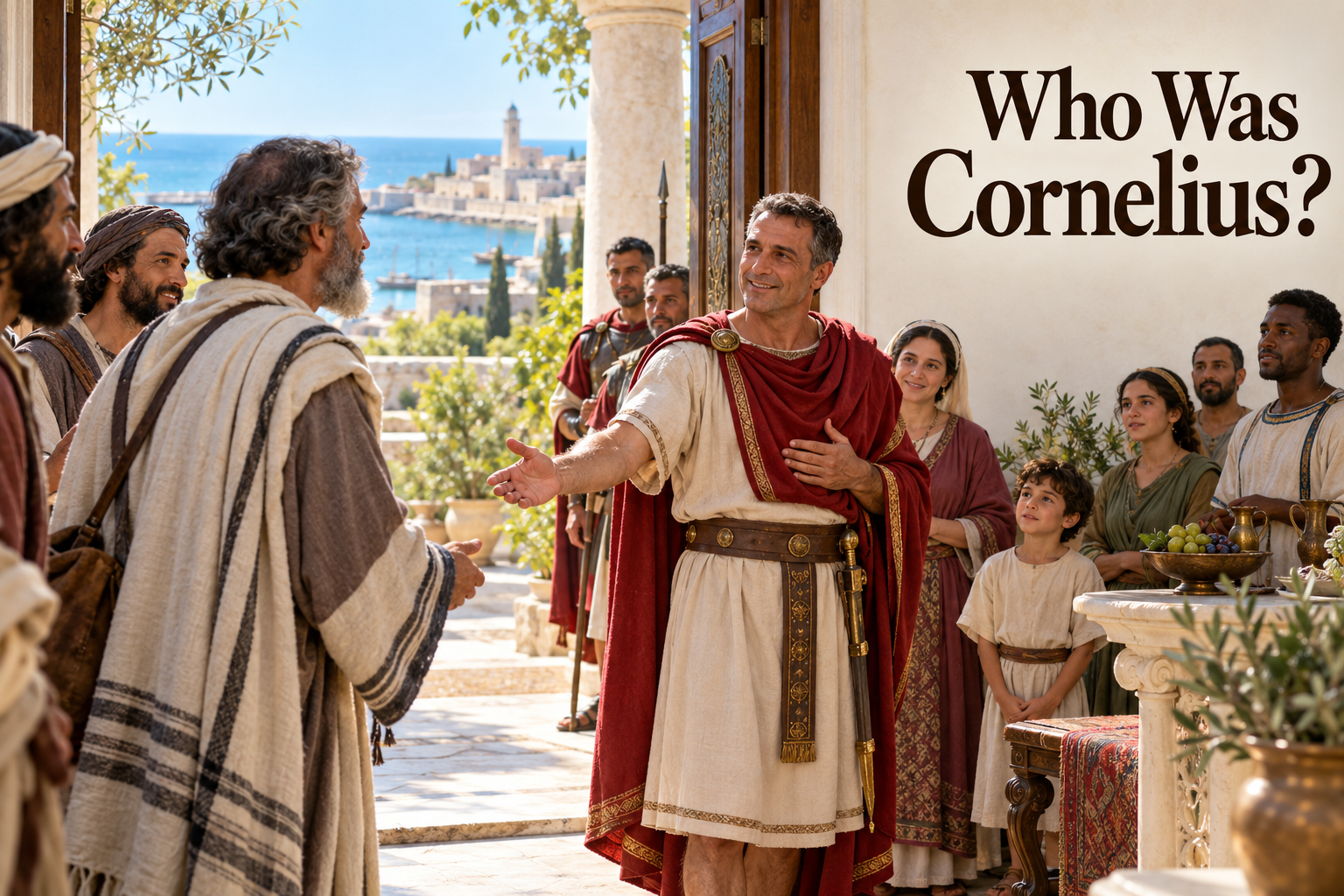
A Roman officer seems an unlikely person to become the center of a dispute about who belongs among God’s people. Cornelius served the empire that occupied Judea, lived in a largely Gentile coastal city, and stood outside the covenant sign of circumcision. Yet Acts describes him as devout, generous, and serious about prayer. His story isn’t a tale of an indifferent pagan suddenly becoming religious. It is the account of God bringing a receptive Gentile household fully into the people of Jesus and teaching the Jewish church to recognize what the Holy Spirit had already done.
A Centurion in Caesarea
Acts 10 identifies Cornelius as a centurion in the Italian Cohort stationed at Caesarea. Centurions were professional officers, though the title didn’t always mean that a man commanded exactly one hundred soldiers. Caesarea Maritima was the administrative center of Roman rule in Judea, with a harbor, government buildings, a mixed population, and the tensions that came with imperial power. Cornelius therefore wasn’t merely a man who happened to wear a uniform. He represented Rome in a place where Rome’s presence was impossible to ignore.
Questions have been raised about the precise identification and dating of the “Italian Cohort.” Evidence for similarly named Roman units is real, but matching inscriptions to the exact unit in Acts and to the date of Cornelius’s story isn’t simple. Some scholars see Luke’s military description as historically natural, while others think the unit’s documented history creates a chronological question. The evidence doesn’t justify pretending that the issue is settled in either direction. Acts clearly intends readers to understand Cornelius as an actual Roman centurion attached to an Italian unit in Caesarea.
Luke calls Cornelius devout and says that he feared God with his whole household, gave generously to the Jewish people, and prayed continually. “God-fearer” is often used as a technical label for Gentiles who worshiped Israel’s God and associated with Jewish communities without becoming full converts through circumcision. Ancient evidence suggests that Gentile attachment to Judaism took more than one form, so we can’t reconstruct Cornelius’s exact status from a label alone. Acts gives us what we need: he was a Gentile, he honored Israel’s God, and his piety was visible in prayer and mercy.
Two Visions and One Meeting
While praying in the afternoon, Cornelius saw an angel who told him that his prayers and gifts had come before God as a memorial. He was instructed to send for Simon Peter, who was staying in Joppa with Simon the tanner. Cornelius obeyed promptly, sending two servants and a devout soldier. His vision prepared one side of the meeting, but Peter also needed preparation. Sincerity on Cornelius’s part couldn’t by itself overcome the social and religious boundary that made the visit difficult.
Peter’s vision involved a sheet filled with animals and a command to kill and eat. Peter objected that he had never eaten anything common or unclean, and the voice answered that he must not call common what God had cleansed. Christians often treat the vision as though its only point were a change in food laws. Food is certainly part of the imagery, but Peter himself explains the immediate lesson in terms of people: God had shown him not to call any person common or unclean. The vision prepared him to enter a Gentile home and receive Gentile guests without treating them as contaminating.
When Peter arrived in Caesarea, Cornelius fell at his feet. Peter made him stand and said, “I too am a man.” Cornelius had gathered relatives and close friends, which turned a private encounter into a household hearing. He then recounted his vision and invited Peter to speak everything God had commanded. That willingness is one of the most appealing details in the story. Cornelius didn’t summon Peter as a religious performer; he placed himself and his household under the message Peter had been sent to deliver.
The Holy Spirit Interrupts the Sermon
Peter began by confessing what he had learned: God doesn’t show partiality, but welcomes people from every nation who fear him and do what is right. That doesn’t mean people are saved by general moral effort apart from Christ. Peter immediately preached the good news of peace through Jesus Christ, told the story of Jesus’ ministry, death, and resurrection, and declared that everyone who believes in him receives forgiveness of sins through his name. Cornelius’s prayers and generosity were genuinely noticed by God, but God answered by bringing him the gospel.
Before Peter finished, the Holy Spirit fell on everyone listening. The Jewish believers who had come with him were astonished because they heard the Gentiles speaking in tongues and praising God. The sequence mattered. These people hadn’t first become Jews, received circumcision, or passed a period of observation. God gave the same Spirit who had been poured out at Pentecost, and the visible and audible evidence left Peter with a practical question: if God had received them, who could withhold water for baptism?
This episode has an important place in Pentecostal theology because tongues served as recognizable evidence that the Gentiles had received the Holy Spirit. Acts later records Peter appealing to what the group had heard and seen. Christians disagree over whether every detail in the sequence establishes a universal pattern for conversion, Spirit baptism, and water baptism. Those questions shouldn’t erase Luke’s plain emphasis. The Spirit’s work wasn’t a private feeling hidden inside Cornelius. God gave a manifestation that crossed the expectations of the Jewish witnesses and compelled the church to acknowledge Gentile inclusion.
Peter ordered Cornelius and his household to be baptized in the name of Jesus Christ. Water baptism didn’t persuade God to give the Spirit; the Spirit had already fallen. Neither did the gift of the Spirit make baptism optional. The household received God’s action with the response Jesus had commanded. Grace and obedience aren’t rivals in the story.
Was Cornelius the First Gentile Convert?
Cornelius is commonly called the first Gentile convert, and there is good reason for the description. Acts treats his reception as the decisive case in which uncircumcised Gentiles were admitted without first becoming Jewish proselytes. Peter defended the event before skeptical believers in Jerusalem by recounting the visions and the Spirit’s descent. His critics then glorified God and acknowledged that God had granted repentance leading to life to the Gentiles.
Still, “first Gentile” needs a little care. Jesus had ministered to Gentiles, Samaritans had already received the message in Acts 8, and Philip had baptized an Ethiopian court official before Cornelius’s story. Acts doesn’t tell us enough about the Ethiopian’s relationship to Judaism to classify him with certainty, and Samaritans occupied their own complicated place in relation to Israel. Luke’s concern isn’t to publish a chronological prize list. Cornelius is the clear, public test case whose reception forced the Jerusalem church to face the implications of a Gentile household receiving the Spirit while remaining Gentile.
The matter returned at the Jerusalem council in Acts 15. Peter reminded the assembly that God had chosen him to bring the gospel to the Gentiles and had testified to them by giving the Holy Spirit, making no distinction and cleansing their hearts by faith. Cornelius isn’t named in that speech, but the reference is plainly to this event. His household’s experience became evidence in the church’s decision not to place the full yoke of Jewish conversion on Gentile believers.
History and Theology in the Account
Some interpreters read the Cornelius narrative mainly as Luke’s theological construction, designed to authorize the Gentile mission by placing Peter at its beginning. The story is certainly crafted with theological purpose. Luke repeats key details, pairs Cornelius’s vision with Peter’s, and shows divine initiative at every stage. But literary design isn’t proof that the event didn’t happen. Ancient writers selected and arranged real events to explain their meaning, just as historians do now. The repetitions in Acts emphasize that neither Peter nor Cornelius engineered the meeting on his own.
There are also historical questions we can’t answer. Acts doesn’t name Cornelius’s wife, identify everyone included in his household, or tell us whether all of them held the same social status. In the Roman world, a household could include relatives, servants, dependents, and enslaved people. The text says that the gathered hearers received the Spirit and were baptized; it doesn’t give us permission to imagine infants, coerce unbelieving dependents, or settle later debates about household baptism by filling in missing ages and responses.
Later traditions made Cornelius a bishop, sometimes of Caesarea and sometimes of another city, and various accounts describe his subsequent ministry. Those claims come from much later than Acts and don’t agree in their details. They may preserve the church’s conviction that his story must have continued fruitfully, but they can’t be treated as established biography. Scripture tells us that Cornelius asked Peter to remain for several days and then leaves his later life unrecorded.
Why Cornelius Still Matters
Cornelius’s story doesn’t teach that cultural differences disappear when people come to Christ. It teaches that those differences can’t be used to deny equal standing to people whom God has cleansed by faith and filled with the Spirit. Peter wasn’t asked to pretend Cornelius was Jewish, and Cornelius wasn’t required to become Jewish before Jesus could be his Lord. The gospel crossed the boundary without erasing either man’s history.
The account also joins devotion with revelation. Cornelius prayed, gave generously, obeyed the light he had, and was ready to hear more. Peter knew Jesus and had already preached at Pentecost, yet he still needed God to correct his categories. The outsider needed the gospel, and the apostle needed a larger understanding of the gospel’s reach. That’s why Acts makes this conversion more than one man’s private turning point. At Cornelius’s table, God showed the church that the gift of the Spirit and forgiveness in Jesus were for the nations.