

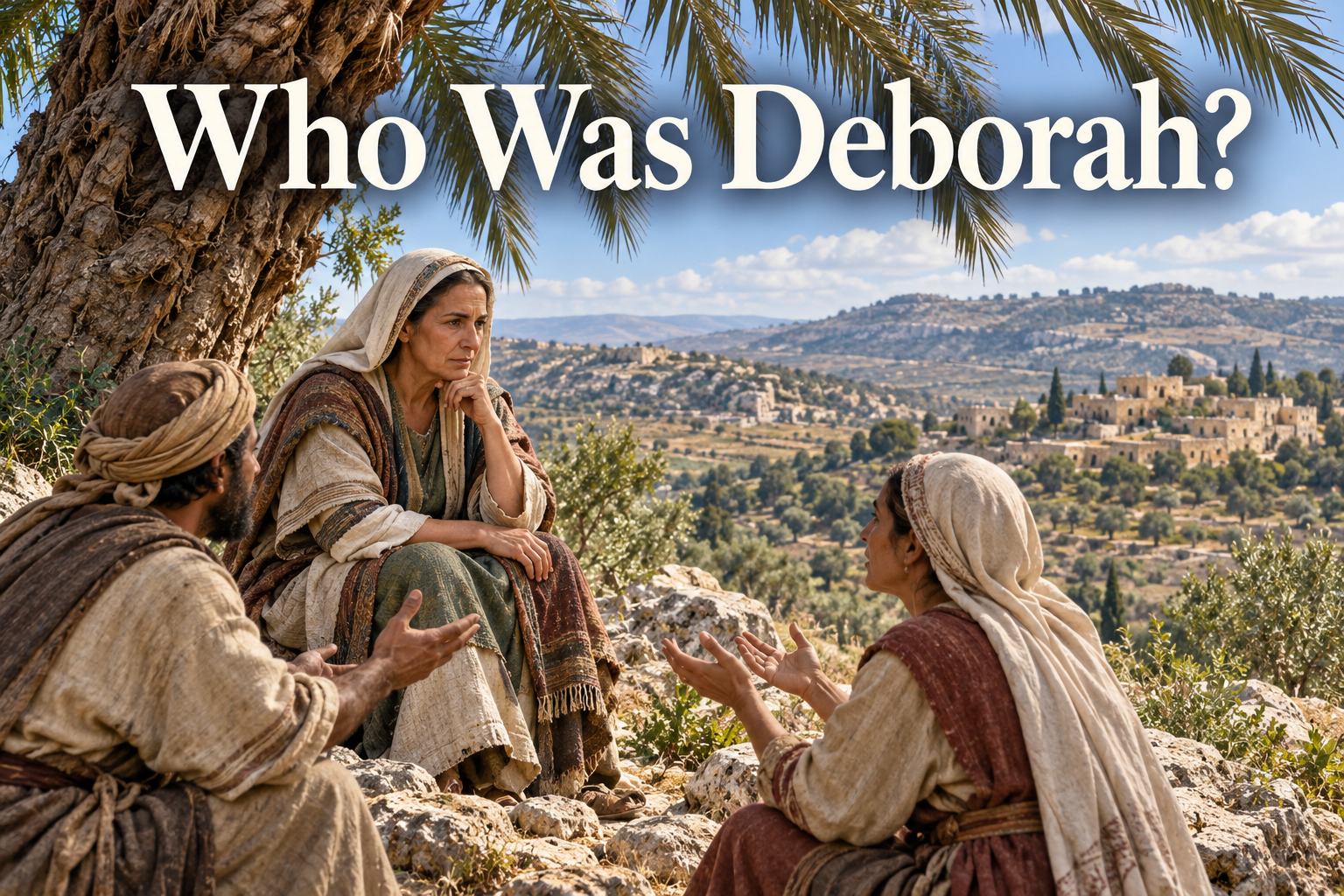
Deborah stands out in the book of Judges because she was both a prophetess and a judge in Israel at a time when the nation was struggling under foreign oppression. She wasn’t introduced as someone’s assistant or as a temporary substitute for an unnamed male leader. Judges 4 presents her as a recognized authority to whom the Israelites came for judgment, and the story that follows shows her exercising that responsibility during a national crisis.
A Prophetess and Judge in Israel
Deborah lived during the period between Joshua and the establishment of Israel’s monarchy, when the tribes repeatedly fell into idolatry, suffered oppression, and cried out to God for deliverance. Judges 4:4 identifies her as a prophetess and the wife of Lappidoth. She held court beneath the Palm of Deborah, between Ramah and Bethel in the hill country of Ephraim, where Israelites came to have their disputes settled. Her role involved more than offering occasional advice; the text describes an ongoing public ministry of judgment and prophetic leadership.
At the time, Jabin, a Canaanite king associated with Hazor, was oppressing Israel, and his military commander Sisera possessed nine hundred iron chariots. Chariots gave a formidable advantage on suitable terrain, and Israel had suffered under this domination for twenty years. Deborah summoned Barak from Kedesh in Naphtali and delivered God’s command: gather ten thousand men from Naphtali and Zebulun at Mount Tabor, where God would draw Sisera into battle and give him into Barak’s hand (Judges 4:6–7).
Deborah, Barak, and the Battle
Barak agreed to go only if Deborah accompanied him. She consented, but told him that the honor of defeating Sisera would go to a woman (Judges 4:8–9). Readers disagree about whether Barak’s condition reflected a failure of courage, a desire for prophetic assurance, or some combination of the two. Hebrews 11:32 later includes Barak among examples of faith, so it would be a mistake to reduce him to a coward. What Judges makes unmistakable is that Deborah spoke God’s command, accompanied the army, and encouraged Barak when the moment for battle arrived.
When Sisera’s forces advanced, Deborah declared that the Lord had gone before Barak. The Israelites descended from Mount Tabor, and Sisera’s army was thrown into confusion. Judges 5, the poetic account of the victory, describes the heavens and clouds pouring water, suggesting that a storm played a role in the defeat of the chariot force. Sisera abandoned his chariot and fled on foot, eventually seeking shelter in the tent of Jael, the wife of Heber the Kenite. Jael killed him while he slept, fulfilling Deborah’s announcement that a woman would receive the honor of his defeat.
The Song of Deborah
Judges 5 preserves a victory song attributed to Deborah and Barak. It’s one of the Bible’s oldest poetic compositions, though scholars debate its precise date. The song celebrates God’s intervention, honors those tribes that answered the call, and criticizes those that stayed away. It also praises Jael for her decisive role in the victory. The chapter gives us a second perspective on the battle, not merely repeating the prose narrative but interpreting the event as an act of divine deliverance.
Deborah is called a “mother in Israel” in Judges 5:7, a description that captures her protective and guiding role during a dangerous period. The account concludes by saying the land had rest for forty years (Judges 5:31). We aren’t told much about Deborah’s family, age, or later life, and there’s no reason to invent those details. Her public ministry is the focus of the biblical record.
Why Deborah Matters
Deborah frequently appears in discussions about women and leadership in the church, but the first responsibility is to read her story on its own terms. She served as a prophetess and judge under the old covenant, and her example doesn’t by itself settle every question about New Testament church offices. It does, however, prevent us from claiming that God never entrusted a woman with significant spiritual and public authority. The biblical writer doesn’t apologize for Deborah’s leadership; he presents it as part of God’s deliverance of Israel.
Her story also reminds us that faithfulness involves more than occupying a position. Deborah heard God’s word, delivered it clearly, and acted when obedience carried real risks. The victory was credited to God, yet it came through the courage and cooperation of several people, including Deborah, Barak, and Jael. In a book filled with deeply flawed leaders, Deborah is remembered for wisdom, courage, and a willingness to answer when Israel needed help.