
Who Was Jeroboam I?
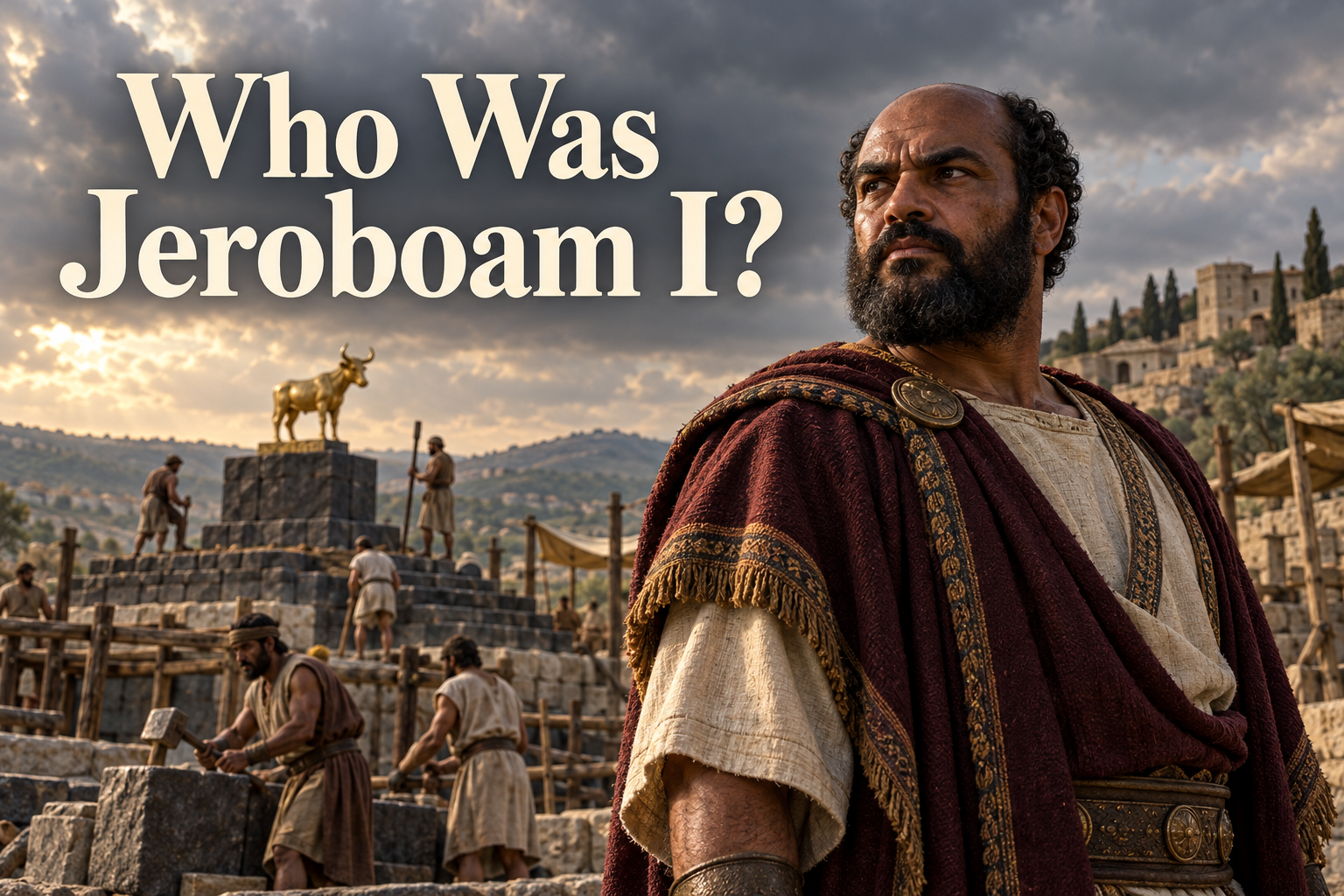
Jeroboam I founded the northern kingdom of Israel after the revolt against Solomon’s house. He was not Jeroboam II, the much later king who expanded Israel’s territory during the ministry of prophets such as Amos. Jeroboam I began as a capable administrator, received a remarkable promise through the prophet Ahijah, and led a justified protest against oppressive labor. He then built a religious system around fear that his people might return to Jerusalem and transfer their loyalty back to David’s dynasty. In Kings, that decision became the standard by which nearly every later northern king failed.
From labor official to political exile
Jeroboam son of Nebat was an Ephraimite from Zeredah. His mother Zeruah was a widow, and Scripture says little else about his family background. Solomon noticed that the young man was capable and placed him over the forced labor of the house of Joseph. The appointment gave Jeroboam firsthand knowledge of both royal administration and the burden carried by northern workers.
The prophet Ahijah of Shiloh met Jeroboam outside Jerusalem, tore a new cloak into twelve pieces, and told him to take ten. The sign announced that God would tear most of the kingdom from Solomon because of idolatry while preserving one tribe for David’s line and Jerusalem. Ahijah also offered Jeroboam a conditional promise: if he obeyed God’s commands as David had, God would build him an enduring house. His kingship was therefore presented as a vocation under covenant, not permission to invent whatever would keep him in office.
Solomon tried to kill Jeroboam, who fled to Pharaoh Shishak in Egypt and remained there until Solomon died. The text does not say exactly what triggered Solomon’s attempt, whether the prophetic promise became known, Jeroboam led resistance, or the king simply recognized a rival. Later Greek textual traditions preserve additional details about Jeroboam’s Egyptian connections, but the Hebrew account is more restrained. What is clear is that he returned when Rehoboam’s succession opened a political opportunity.
The revolt against Rehoboam
Jeroboam joined the assembly at Shechem in asking Rehoboam to lighten Solomon’s hard service and heavy yoke. When Rehoboam promised harsher discipline, the northern tribes rejected David’s house and made Jeroboam king. Their complaint had substance. A theology of divinely ordered division does not turn forced labor into an imaginary grievance or make Rehoboam’s contempt responsible leadership.
Jeroboam fortified Shechem in the hill country of Ephraim and then Penuel east of the Jordan. These centers helped secure a new kingdom whose borders, institutions, and loyalties were not yet settled. He had won the throne through tribal resistance to centralized exploitation, but he now faced the usual problem of revolutionary leaders: opposing a system is easier than building a stable alternative.
The calves at Bethel and Dan
Jeroboam feared that pilgrimage to the Jerusalem temple would restore the people’s affection for Rehoboam and lead to his own death. He made two golden calves, placed one at Bethel and one at Dan, and told the people that going to Jerusalem was too much for them. His announcement echoed the golden calf story in Exodus by identifying the images with the God who brought Israel out of Egypt. First Kings 12:26-33 traces the policy directly to political anxiety.
Ancient bull or calf images could symbolize a deity, represent a divine pedestal, or make invisible power visible. Some historians therefore argue that Jeroboam was not introducing a completely different god but creating rival centers for worship of the Lord under forbidden imagery. Kings still calls the arrangement sin. Worship directed toward Israel’s God was not automatically faithful when a king reshaped its images, priesthood, calendar, and sanctuaries to protect his throne.
Jeroboam appointed priests who were not Levites, established a festival in the eighth month similar to Judah’s feast, and personally offered sacrifice at Bethel. The narrator emphasizes that he devised these measures from his own heart. The issue was larger than religious decentralization. Jeroboam used royal authority to manufacture a dependable worship system whose geography and personnel served state security.
A warning at the altar
First Kings 13 tells of an unnamed man of God from Judah who confronted Jeroboam while the king stood at the Bethel altar. He announced that a future Davidic king named Josiah would defile the altar, and the altar split as a confirming sign. When Jeroboam stretched out his hand to order the prophet’s arrest, the hand became incapacitated and was restored only after the prophet prayed. Even then, Jeroboam did not abandon his religious policy.
The chapter continues with the man of God’s own disobedience after an older prophet deceived him, followed by his death through a lion. That strange second half warns that speaking a true word does not exempt the messenger from obeying it. For Jeroboam’s biography, the important point is that a dramatic sign and personal healing did not produce reform. Political fear had hardened into an institution.
Ahijah’s judgment on the dynasty
When Jeroboam’s son Abijah became ill, the king sent his wife to Ahijah in disguise. The aging prophet could no longer see, but God told him who was coming. Ahijah announced judgment on Jeroboam’s house because the king had made other gods and cast the Lord behind his back. The dynasty Jeroboam tried to protect through religious control would be swept away.
Ahijah said the child would die when his mother returned home, yet he alone in Jeroboam’s house would receive proper burial because something good toward the Lord had been found in him. The passage is severe, and it does not explain why the child dies within a judgment directed at his father. Readers should not pretend the grief is easy. The narrative’s limited mercy is that this child is mourned and buried rather than subjected to the violent disgrace later awaiting the dynasty.
War, succession, and the “sin of Jeroboam”
Kings summarizes Jeroboam’s reign as twenty-two years marked by war with Rehoboam. Second Chronicles 13 gives a detailed battle during Rehoboam’s son Abijah’s reign, in which Judah defeats Jeroboam with enormous casualty figures. Ancient war accounts often use large numbers rhetorically, and the figure of 500,000 Israelite dead should not be treated casually as though its scale raised no historical questions. Chronicles uses the battle above all to contrast Jerusalem’s priesthood and temple with Jeroboam’s alternative system.
Jeroboam’s son Nadab succeeded him but ruled only two years before Baasha assassinated him and destroyed the royal house. Ahijah’s announced judgment was fulfilled, and Jeroboam failed to establish the lasting dynasty he had been offered. His political achievement endured in another sense: the northern kingdom survived for roughly two centuries, though under a succession of unstable dynasties.
The phrase “the sins of Jeroboam son of Nebat” became a refrain in Kings. It normally refers to the worship system centered on the calves and its continuing influence, not a claim that every later king repeated every private act of Jeroboam’s life. The repetition makes him a founder whose institutional choices outlived his family. Personal fear had become national habit.
Jeroboam I and Jeroboam II
Jeroboam II ruled Israel many generations later, during the dynasty of Jehu in the eighth century BC. Second Kings 14 describes him as restoring territory while continuing the religious pattern associated with Jeroboam I. The prophets Amos and Hosea addressed conditions in that broader era of prosperity, injustice, and false worship. Confusing the two kings collapses separate dynasties, centuries, and political settings.
Jeroboam I belongs to the kingdom’s beginning after Solomon; Jeroboam II belongs to its powerful later period before Assyria destroyed it. Archaeological remains at Dan confirm a major cultic complex, but scholars debate its building phases and whether the calf story in its present form reflects Jeroboam I, later northern practice, or both. Bethel’s archaeology is also contested. The evidence illuminates northern worship without giving us Jeroboam I’s personal construction record.
History and theological legacy
No known contemporary inscription securely names Jeroboam I. Shoshenq I’s campaign list at Karnak provides evidence for the regional world shortly after the kingdom’s division, but it does not narrate Jeroboam’s revolt. The biblical account itself has been shaped by writers committed to Jerusalem and the Davidic line, a perspective that historians must recognize. Recognizing perspective does not require dismissing the account’s central political insight that rulers often redesign religion to stabilize power.
Jeroboam had legitimate grievances, prophetic authorization, administrative ability, and a conditional promise of an enduring house. He did not fail because northern birth made him an illegitimate person or because God was obligated to approve every policy of David’s descendants. He failed when fear of losing power became permission to control worship. The king who broke Rehoboam’s yoke forged a different one, and it lasted far longer than his dynasty.