
Who Was Jethro?
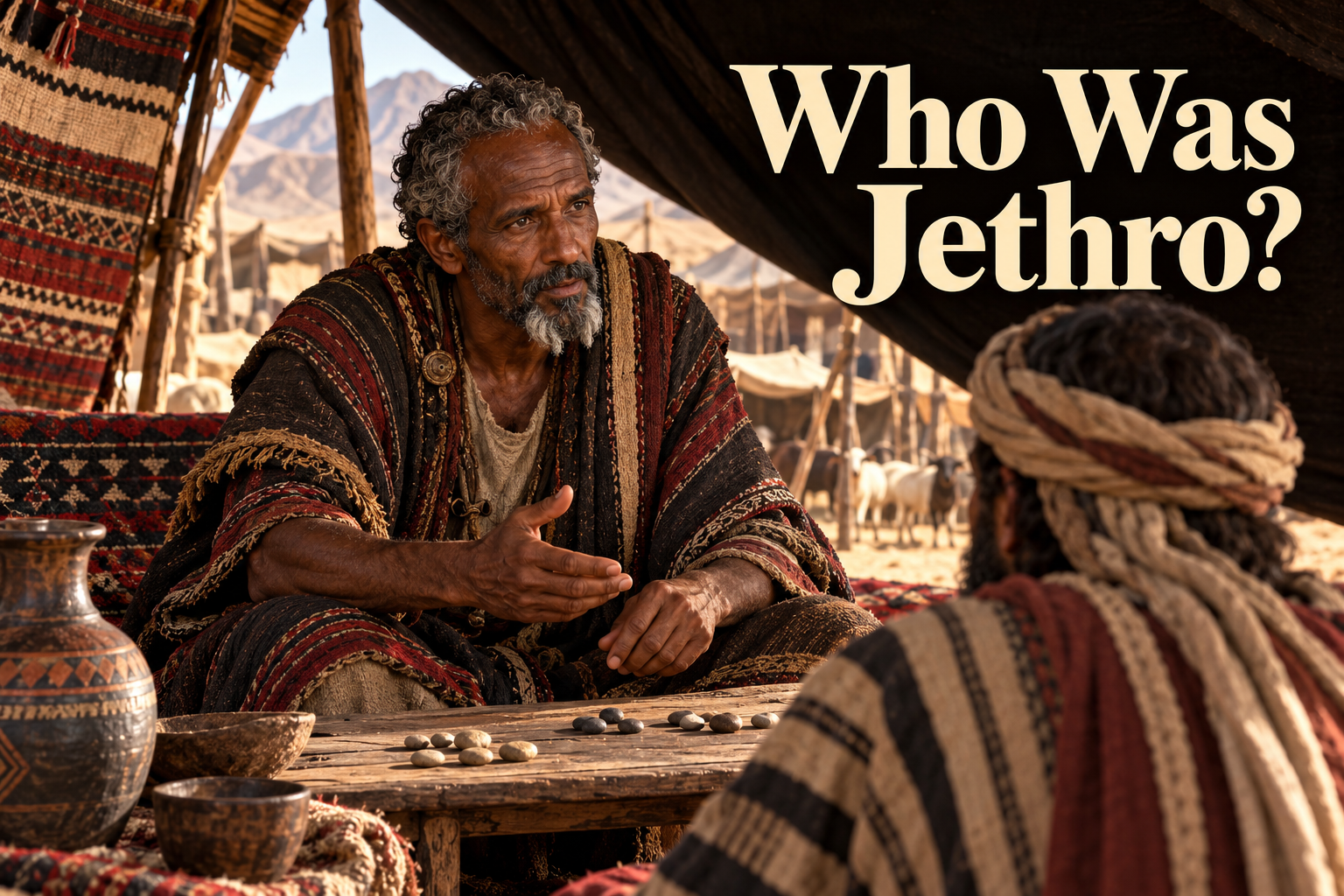
Jethro appears in only a handful of biblical chapters, yet he influences Moses at two decisive moments. He welcomes the fugitive who has nowhere to go, and years later he tells Israel’s overworked leader that his way of handling disputes is unsustainable. Jethro is also a priest of Midian, an outsider to Israel who blesses the Lord and offers sacrifice in the presence of Israel’s elders. His story is brief enough to invite speculation, but the details Scripture actually gives are substantial: hospitality, family responsibility, confession, worship, and remarkably practical wisdom.
The priest of Midian and Moses’ family
After Moses killed an Egyptian and fled from Pharaoh, he stopped at a well in Midian. Seven daughters of the priest of Midian came to water their father’s flock, but shepherds drove them away. Moses intervened and watered the animals. When the women returned unusually early, their father asked why they had left the helpful stranger behind. Moses was invited into the household and married Zipporah, one of the daughters.
The father-in-law is called Reuel in Exodus 2:18 and Jethro in Exodus 3:1 and 18:1. Numbers 10:29 refers to Hobab son of Reuel the Midianite as Moses’ father-in-law, although the Hebrew kinship term can also be understood more broadly, and Judges 4:11 associates Hobab with the Kenites. Interpreters have proposed that Jethro was a title, that Reuel and Jethro were alternate names, or that Reuel was the clan head and Jethro or Hobab belonged to the next generation. None of these solutions is stated plainly enough to remove all uncertainty. A careful biography should acknowledge the naming problem instead of quietly merging every reference and calling the result obvious.
Midian in the biblical world was associated with territories east and southeast of Canaan, though nomadic or seminomadic groups did not respect modern map lines. Genesis traces Midian to a son of Abraham and Keturah, but the label can refer to a broad people rather than one tightly bounded political state. Jethro’s priesthood means he held religious standing before Moses arrived. Scripture does not identify the full content of his earlier worship, so claims that he was already a priest of the Lord, or that he converted from a particular named deity, go beyond the text.
Moses the shepherd
Moses kept Jethro’s flock and led it beyond the wilderness to Horeb, where God appeared in the burning bush. The future leader of Israel spent years working under his father-in-law rather than preparing in a royal academy. Jethro’s household gave a violent fugitive a home, livelihood, wife, and family setting. He did not create Moses’ divine calling, but his hospitality provided the ordinary human shelter in which Moses lived before that calling became public.
When God told Moses to return to Egypt, Moses asked Jethro’s permission to go and see whether his relatives were still alive. Jethro answered, “Go in peace.” Exodus does not report that Moses explained the burning bush or the full danger of confronting Pharaoh. His respectful request reflects a continuing family bond rather than an abrupt departure from the man whose flock he had tended.
At some point Zipporah and the couple’s sons, Gershom and Eliezer, were with Jethro again. Exodus 18 says Moses had sent her away, a phrase that has prompted debate about whether this was a divorce or a temporary return for safety. The chapter still calls Zipporah Moses’ wife and Jethro his father-in-law, and Jethro brings the family to Moses in the wilderness. A temporary separation is therefore quite possible, but Scripture never narrates the arrangement in enough detail to justify certainty about why it happened.
Jethro hears what God has done
Jethro heard how God had delivered Israel from Pharaoh and came to meet Moses near the mountain of God. Moses went out, bowed, kissed him, and brought him into the tent. He then told Jethro about the Lord’s acts and the hardships Israel had survived. Jethro rejoiced, blessed the Lord, and declared that the Lord was greater than all gods because he had rescued the people from Egyptian arrogance.
Jethro offered a burnt offering and sacrifices to God, and Aaron and Israel’s elders ate bread with him before God. Some interpreters understand this confession and meal as Jethro’s conversion to Israel’s God. Others see recognition of the Lord’s supremacy without enough evidence to reconstruct a complete conversion experience. The narrative emphasizes genuine worship and fellowship but does not give Jethro an Israelite initiation ceremony or a doctrinal examination. It is better to affirm what the text shows than to make it answer a later membership question.
A scholarly theory sometimes called the Midianite or Kenite hypothesis proposes that Moses or Israel learned the worship of the Lord through Jethro’s people. The theory draws on Jethro’s priesthood and biblical passages that associate the Lord’s appearance with southern regions such as Seir, Paran, and Teman. It is an interesting historical reconstruction, not an explicit biblical claim, and the evidence does not establish precisely what Midianite religion involved. Exodus presents God revealing the divine name to Moses and Jethro responding to news of the Lord’s deliverance, not Jethro introducing Moses to an unknown deity.
The advice that preserved Moses
The day after the sacrificial meal, Jethro watched people stand around Moses from morning until evening while he judged their disputes and taught God’s instructions. He asked what Moses was doing and why he sat alone. Moses explained that the people came to him to seek God’s will. The answer sounded spiritual, but Jethro was unimpressed with the system.
Jethro told him plainly, “What you are doing is not good.” Moses and the people would wear themselves out because the burden was too heavy for one person. Jethro advised Moses to continue representing the people before God and teaching them, while selecting capable, God-fearing, trustworthy men who hated dishonest gain to handle ordinary cases. Difficult matters could still come to Moses. Delegation would allow the people to receive justice and Moses to endure.
Moses listened and implemented the advice. The account does not suggest that accepting help weakened his prophetic authority. It showed that authority had limits and that wise administration could serve a spiritual purpose. Deuteronomy 1 retells the appointment of leaders with Moses proposing the plan to Israel, which may reflect a compressed speech focused on Israel’s role rather than an attempt to deny Jethro’s contribution. Ancient narratives often retell events with different emphases; readers need not force every speech into a modern transcript.
Jethro’s counsel has become popular material for leadership teaching, sometimes with more enthusiasm than care. The principle of shared responsibility is sound, but Exodus is not a corporate management manual. The appointed leaders needed moral character because they were judging people, not merely improving workflow. Jethro sought durable justice for the community and a sustainable calling for Moses, not a more impressive organizational chart.
Departure and legacy
After the visit, Moses sent Jethro back to his own land. Numbers 10 later records Moses urging Hobab to accompany Israel and serve as eyes in the wilderness, promising him a share in the good God would give Israel. Because of the naming and kinship questions, interpreters differ on whether this is Jethro under another name, Jethro’s son, or another close relative. Judges later places descendants of Moses’ Kenite in-laws among Israel and preserves a notably positive relationship between the Kenites and Israel.
No inscription or archaeological discovery independently identifies Jethro. Archaeology can illuminate Midianite material culture, including a distinctive pottery tradition found in northwestern Arabia and parts of the southern Levant during the Late Bronze and early Iron Ages. Connecting a pottery style to the biblical priest, however, would be an unwarranted leap. Material culture can clarify the world in which a tradition is set without supplying a name tag for one individual.
Later Jewish, Christian, and Islamic traditions expand Jethro’s biography in different directions. Rabbinic writings debate his names and religious past, while Islamic tradition often associates Moses’ Midianite father-in-law with the prophet Shuayb, though the Quran does not name the old man in Moses’ story as Shuayb. These traditions are historically important in their own communities, but they should not be reported as details from Exodus.
Jethro’s biblical contribution is impressive without embellishment. He recognized God’s deliverance, worshiped with Israel’s leaders, saw a leadership failure Moses could not see from inside it, and spoke with enough candor to correct him. Moses had encountered God at Jethro’s mountain and stood before Pharaoh, yet he still needed his father-in-law to tell him that his schedule was impossible. Wisdom in this story arrives from outside Israel, sits down to dinner, and leaves the covenant leader better able to do his work.