
Who Was Jezebel?
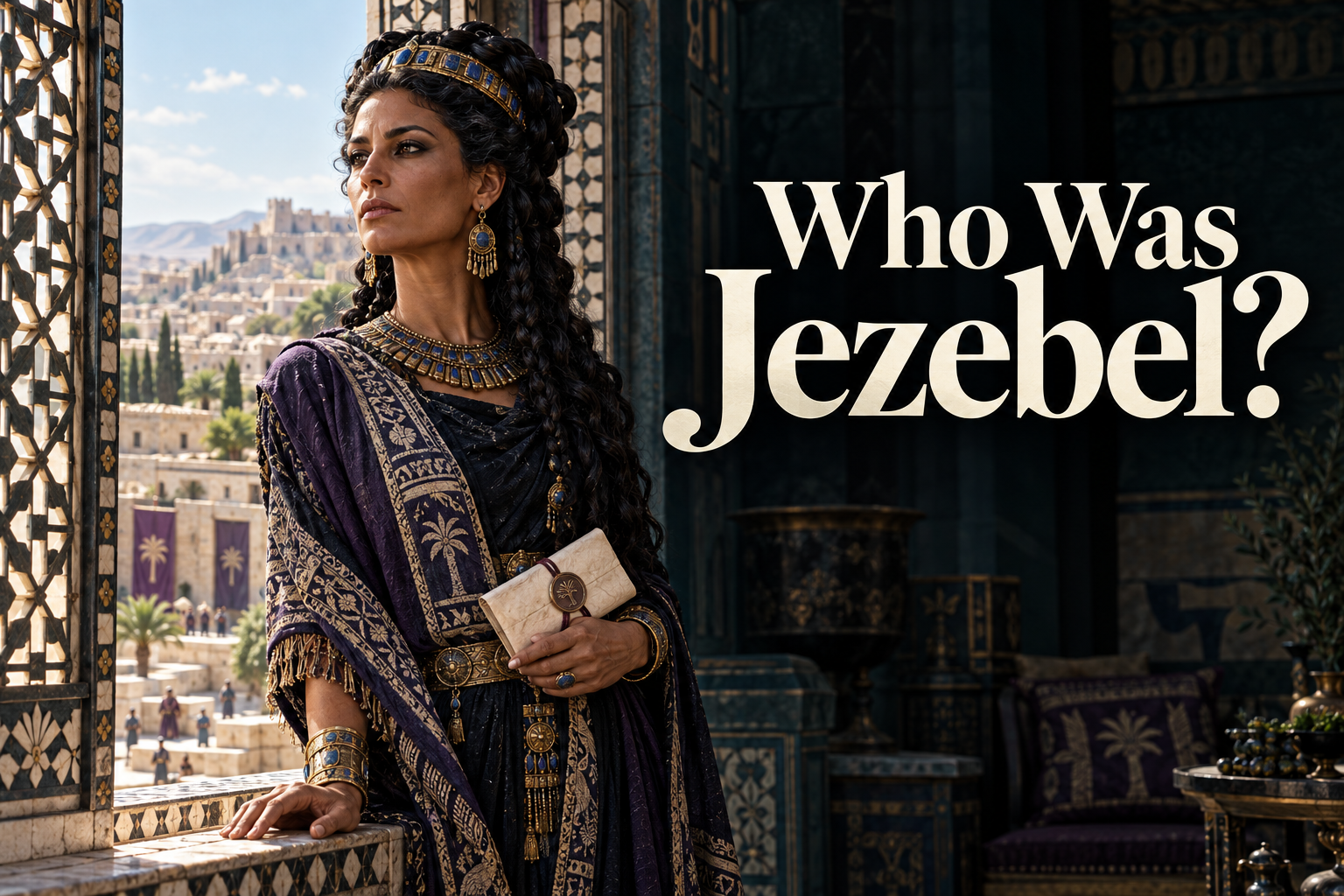
Jezebel has become more than a biblical name. It has been used as an insult for sexually manipulative women, controlling wives, religious outsiders, and women whose confidence makes somebody uncomfortable. The queen in Kings was guilty of grave abuses, but sexual seduction is not one of the charges the narrative makes against her. She used royal power to sponsor Baal worship, attack the Lord’s prophets, and arrange Naboth’s death. Telling that story accurately is more serious than turning her name into a stereotype.
A Phoenician princess in Israel
Jezebel was the daughter of Ethbaal, king of the Sidonians, and the wife of King Ahab of Israel. Her marriage joined the Omride dynasty to Phoenician political and commercial networks along the Mediterranean coast. Such royal marriages were common tools of diplomacy, and Jezebel probably arrived in Samaria with status, attendants, and religious commitments appropriate to a princess. First Kings 16:31-33 judges the alliance by what followed: Ahab served Baal, built him a temple and altar, and made an Asherah.
Jezebel’s name has been explained in several ways, but its precise Phoenician form and meaning remain debated. Later Hebrew readers may have heard or reshaped it polemically. It is safer not to build her biography on a confident name etymology. Scripture tells us far more about what she did with authority than about what her parents intended when naming her.
Royal patron of Baal worship
During Elijah’s drought, Jezebel killed prophets of the Lord while maintaining 450 prophets of Baal and 400 prophets of Asherah at her table. Obadiah, an official in Ahab’s palace who feared the Lord, hid one hundred prophets in caves and supplied food and water. The contrast reveals organized persecution rather than a private difference in devotion. Jezebel used the resources of the royal household to support one religious establishment and suppress another.
At Mount Carmel, Elijah challenged the prophets of Baal and exposed their inability to produce fire. Jezebel does not appear at the contest, and the text never says the prophets of Asherah accepted the summons. After fire fell and the people confessed the Lord, Elijah had Baal’s prophets slaughtered. Ahab reported the events to Jezebel, including the killings.
Jezebel sent Elijah a death threat, swearing by her gods that he would die like the prophets. Elijah fled into the wilderness in fear and despair. Her threat mattered because she had already demonstrated the power to carry it out. At Horeb, God met Elijah without endorsing the idea that prophetic faithfulness must always look like louder spectacle or immediate violence.
Naboth’s vineyard and judicial murder
First Kings 21 gives the clearest picture of Jezebel’s exercise of power. Ahab wanted Naboth’s vineyard beside the palace, but Naboth refused to surrender ancestral land. When Jezebel found Ahab sulking, she asked whether he was really governing Israel and promised to obtain the property. Her question assumed that kingship meant the ability to remove any limit standing between the ruler and what he wanted.
Jezebel wrote letters in Ahab’s name, sealed them with his seal, and instructed Naboth’s local elders to proclaim a fast. Two false witnesses accused him of cursing God and king, an offense treated as capital. The community took Naboth outside the city and stoned him. The performance of piety made the crime worse, not better: fasting, witnesses, law, and public assembly became props in a murder arranged for real estate.
The elders reported to Jezebel that Naboth was dead, and she told Ahab to take possession. Elijah then pronounced judgment on both the king and Jezebel, declaring that dogs would consume her by the wall of Jezreel. Ahab’s later humility delayed the destruction of his dynasty, but no separate repentance by Jezebel is recorded. The silence should not be expanded into a theory about her inner life; the narrative leaves her publicly committed to the course she chose.
Queen mother and dynastic survivor
Jezebel outlived Ahab and remained a presence during the reigns of their sons Ahaziah and Joram. Second Kings 9 calls her Joram’s mother, making her role as queen mother explicit. In ancient courts, a king’s mother could possess continuing status and influence, especially during dynastic transitions. Jezebel was therefore not politically erased when her husband died.
Athaliah, who married into Judah’s royal house and later seized its throne, belonged to Ahab’s family and is commonly regarded as Ahab and Jezebel’s daughter. The biblical wording identifies her relationship to Ahab or Omri’s house but does not explicitly name Jezebel as her mother. The distinction matters because a likely dynastic reconstruction should not be presented as a direct statement of Scripture. Athaliah’s career nevertheless shows how the Omride alliance affected Judah long after Ahab’s death.
Jehu comes to Jezreel
Elisha’s prophetic circle anointed Jehu to strike Ahab’s house. Jehu killed King Joram and drove to Jezreel, where Jezebel heard he was coming. She painted her eyes, arranged her hair, and looked down from a window. Popular retellings often turn this preparation into an attempt at sexual seduction, but the text says no such thing. Cosmetics and formal appearance could be the last assertion of royal identity by a queen facing a coup.
Jezebel greeted Jehu by asking whether there was peace for Zimri, the murderer of his master. Zimri had assassinated a king and reigned only seven days before dying, so the comparison was a pointed warning that Jehu was a traitor whose victory might be brief. She did not plead. Even at the end, Jezebel understood the politics of dynastic violence and named Jehu’s coup for what it looked like from the palace window.
At Jehu’s command, palace eunuchs threw her down. Her blood spattered the wall and horses, Jehu trampled her, and dogs consumed most of the body before burial. The death fulfills Elijah’s judgment and is intentionally degrading. It is also brutal. Divine judgment in the narrative does not require readers to enjoy the spectacle or use it as permission to fantasize about violent punishment of religious and political enemies.
Was Jezebel a prostitute or seductress?
Jehu accused Joram of the “prostitutions” and sorceries of his mother Jezebel in 2 Kings 9:22. Prophetic literature often uses sexual language metaphorically for idolatry and foreign religious allegiance. That accusation does not establish that Jezebel sold sex or seduced men. Her painted eyes at the window do not change the metaphor into a biography of prostitution.
The sexualized “Jezebel” stereotype owes more to later cultural use than to the episodes in Kings. It has sometimes carried racial contempt as well, particularly when applied to Black women in modern history. Rejecting that abuse does not rehabilitate Jezebel’s persecution or murder. It simply criticizes sins the text actually names rather than inventing more convenient ones.
The Jezebel of Revelation
Revelation 2:20 rebukes the church in Thyatira for tolerating a woman called Jezebel who claimed to be a prophet and led servants into sexual immorality and idolatrous eating. The name is probably symbolic, comparing a later teacher to the notorious queen. It does not mean the ninth-century BC Jezebel survived into the Roman period, and the passage may not preserve the woman’s actual name.
The symbolism draws on Jezebel as a powerful promoter of compromised worship. It also contributes to later Christian use of her name for almost any woman accused of corrupting men. Revelation’s charge is specific to false teaching and idolatrous accommodation; it does not authorize a vague “Jezebel spirit” diagnosis whenever a woman leads forcefully or challenges a man.
History, archaeology, and memory
A decorated seal sometimes linked to Jezebel bears letters that may form a similar name if missing characters are reconstructed. The object lacks a secure archaeological context, and the proposed reading and royal identification remain disputed. It is not responsible to call it Jezebel’s seal as settled fact. Phoenician influence, the Omride dynasty, and ninth-century Israel are historically well grounded without needing an uncertain artifact to carry the whole biography.
The books of Kings were written from a perspective fiercely opposed to Baal worship and the Omride religious program. That theological perspective explains what the authors consider important; it does not make judicial murder or royal persecution imaginary. Historical study can ask how Phoenician diplomacy, dynasty, and worship interacted while still hearing the narrative’s moral indictment.
Jezebel was not wicked because she was foreign, female, politically intelligent, or unafraid at death. Ruth was foreign, Deborah exercised authority, Abigail showed political intelligence, and many faithful people faced death bravely. Jezebel’s guilt lay in how she used power: worship was enforced through patronage and persecution, law became a weapon, and a neighbor’s life was exchanged for a vineyard. Her real story is damning enough without the mythology added to her name.