
Who Was Joanna in the Bible?
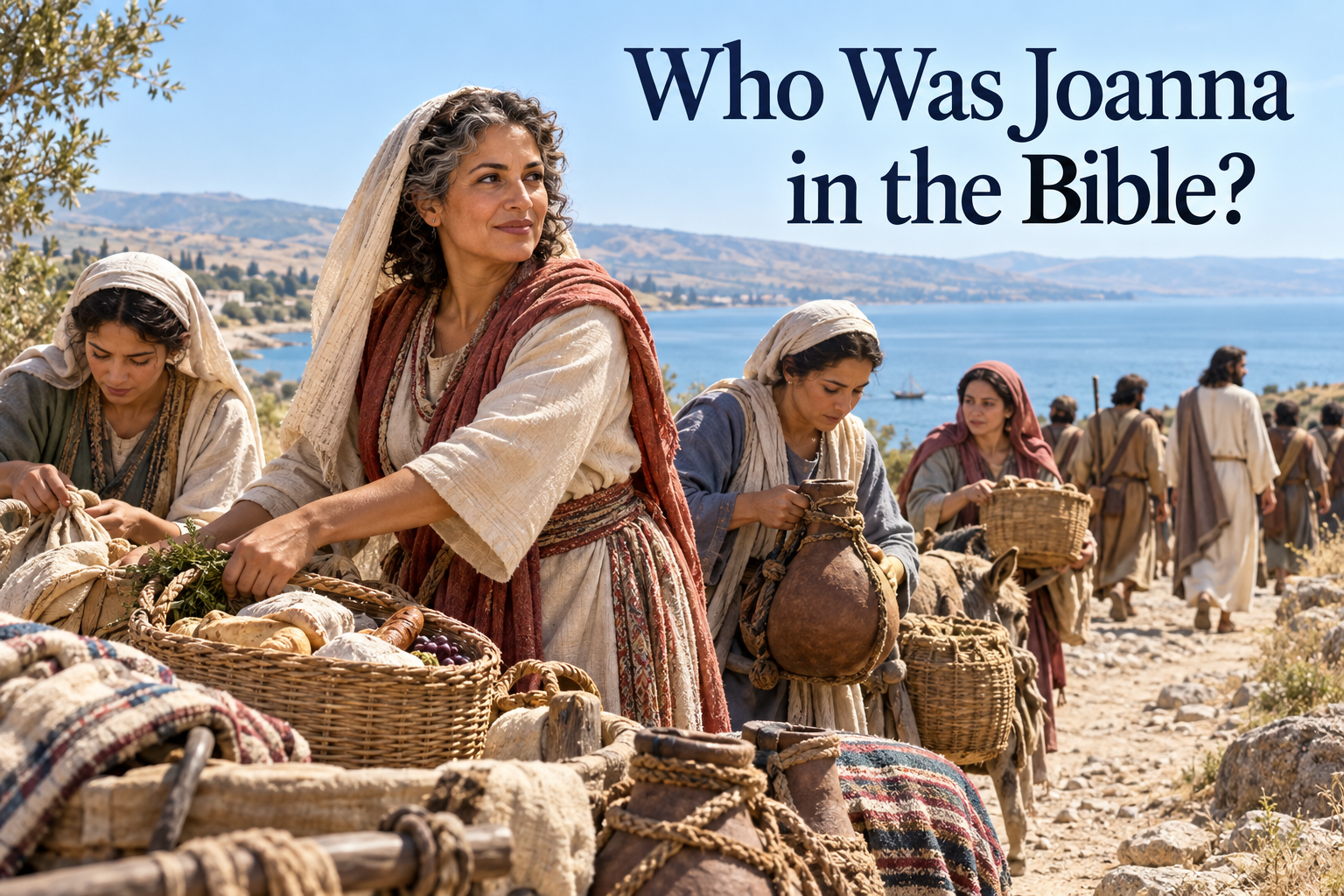
Joanna appears by name in only two parts of Luke’s Gospel, but both placements matter. She helped support Jesus’ ministry during his travels, and she later joined the women who found the tomb empty and carried the news to the apostles. Luke also identifies her as the wife of Chuza, an administrator connected with Herod Antipas. That makes Joanna a striking bridge between a royal household and the traveling movement announcing God’s kingdom.
From Herod’s Household to Jesus’ Company
Luke names Joanna among women who had been healed of evil spirits and illnesses and who traveled with Jesus and the Twelve (Luke 8:1-3). The grammar associates the group with healing, though it doesn’t tell us Joanna’s particular condition or experience. We shouldn’t invent a diagnosis or dramatic conversion story to fill the gap. Luke’s emphasis is on what followed: these women accompanied the mission and provided for it from their own resources.
Joanna was the wife of Chuza, described as a steward or manager of Herod. The Herod in view is almost certainly Herod Antipas, the ruler of Galilee during Jesus’ ministry. Chuza’s exact office isn’t known; the term could refer to oversight of estates, finances, or another substantial household responsibility. His position suggests that Joanna had access to resources and moved in a social world very different from that of many villagers who gathered around Jesus.
Luke doesn’t explain how Joanna managed prolonged travel while married to a royal official. Chuza may have approved, the marriage may have changed, or Joanna may have exercised unusual independence within an affluent household. All of those are possibilities, not facts. What Scripture states is that she used resources identified as her own to sustain Jesus and his companions. The mission depended not only on public preaching but also on people who paid for food, lodging, and travel.
The verb translated “provided for” is related to the language of service from which Christians derive the word deacon. Luke isn’t necessarily assigning Joanna a later church office, but neither is he describing casual generosity. She and the other women were active participants whose material support made the itinerant ministry possible. Calling them mere patrons can sound too distant if it hides the fact that Luke says they were traveling with the group.
A Witness at the Empty Tomb
At the end of the Gospel, women who had followed Jesus from Galilee watched his burial and prepared spices and ointments before resting on the Sabbath (Luke 23:50-56). Early on the first day of the week, they returned to find the stone rolled away and the body gone. Two heavenly messengers reminded them that Jesus had predicted his death and resurrection, and the women remembered his words (Luke 24:1-8).
Luke then names Mary Magdalene, Joanna, Mary the mother of James, and other women as those who reported the event to the apostles (Luke 24:9-11). The men regarded their words as nonsense and didn’t believe them. Joanna therefore stands among the first people commissioned by the Easter announcement to tell others that the tomb was empty. Her testimony wasn’t initially welcomed, but Luke makes the disbelief of the apostles part of the story rather than treating the women as unreliable.
Joanna’s presence in both Luke 8 and Luke 24 gives continuity to her witness. She wasn’t a stranger who happened upon the tomb; she had accompanied Jesus’ work in Galilee and knew his circle. Luke doesn’t explicitly say she witnessed the crucifixion, since he describes the women there collectively, but he places the Galilean women at the death, burial, and empty tomb. It is reasonable to include Joanna in that continuing group, while acknowledging that her name appears only when the messengers return to the apostles.
Joanna, Junia, and Later Proposals
Some modern scholars have proposed that Joanna later used the Latin name Junia and is the woman Paul greets in Rome (Romans 16:7). People in the Roman world could bear Semitic and Greco-Roman names, and both women were prominent among early believers. Even so, no ancient source directly identifies Joanna with Junia, and the New Testament never connects the names. The proposal is interesting but remains an inference, not a fact that can be built into Joanna’s biography.
Later Christian tradition has honored Joanna as one of the women who brought spices to Jesus’ tomb. Liturgical calendars and devotional accounts sometimes call these women the myrrh-bearers, a fitting description of their intended task. Other traditions supply details about Joanna’s later travels or death, but they appear too late and vary too widely to establish a reliable history. The earliest evidence remains Luke’s concise but substantial portrait.
There have also been attempts to reconstruct Joanna as a major source for Luke’s Gospel because she had access to Herodian information. She could conceivably have known events from within elite circles, and Luke does preserve more material about the Herods than some other Gospel writers. Yet Luke never names Joanna as a source or says that she supplied court reports. A plausible possibility shouldn’t be promoted into a statement Scripture doesn’t make.
Why Joanna Matters
Joanna complicates easy assumptions about Jesus’ followers. His movement included fishermen, villagers, women with little recorded status, and at least one woman tied to a ruler’s administration. Herod Antipas had imprisoned and executed John the Baptist, and Jesus later called him a fox. Yet someone from the orbit of Herod’s household invested her wealth and presence in Jesus’ kingdom mission.
Her service also makes an ordinary but important point about ministry: somebody has to provide the bread, arrange the lodging, and meet the expenses. Luke doesn’t separate that work from discipleship. Joanna’s resources became part of the proclamation, and her faithful presence carried her from the roads of Galilee to the first announcement of resurrection.
Scripture doesn’t tell us what Joanna did after Easter. She may have joined the larger company of believers in Jerusalem, but Acts doesn’t name her among them, so that remains a reasonable inference rather than a recorded event. We know enough without pretending to know more. Joanna was healed, traveled with Jesus, supported his mission, remembered his words, and told the apostles that the tomb was empty.