
Who Was John, Son of Zebedee?
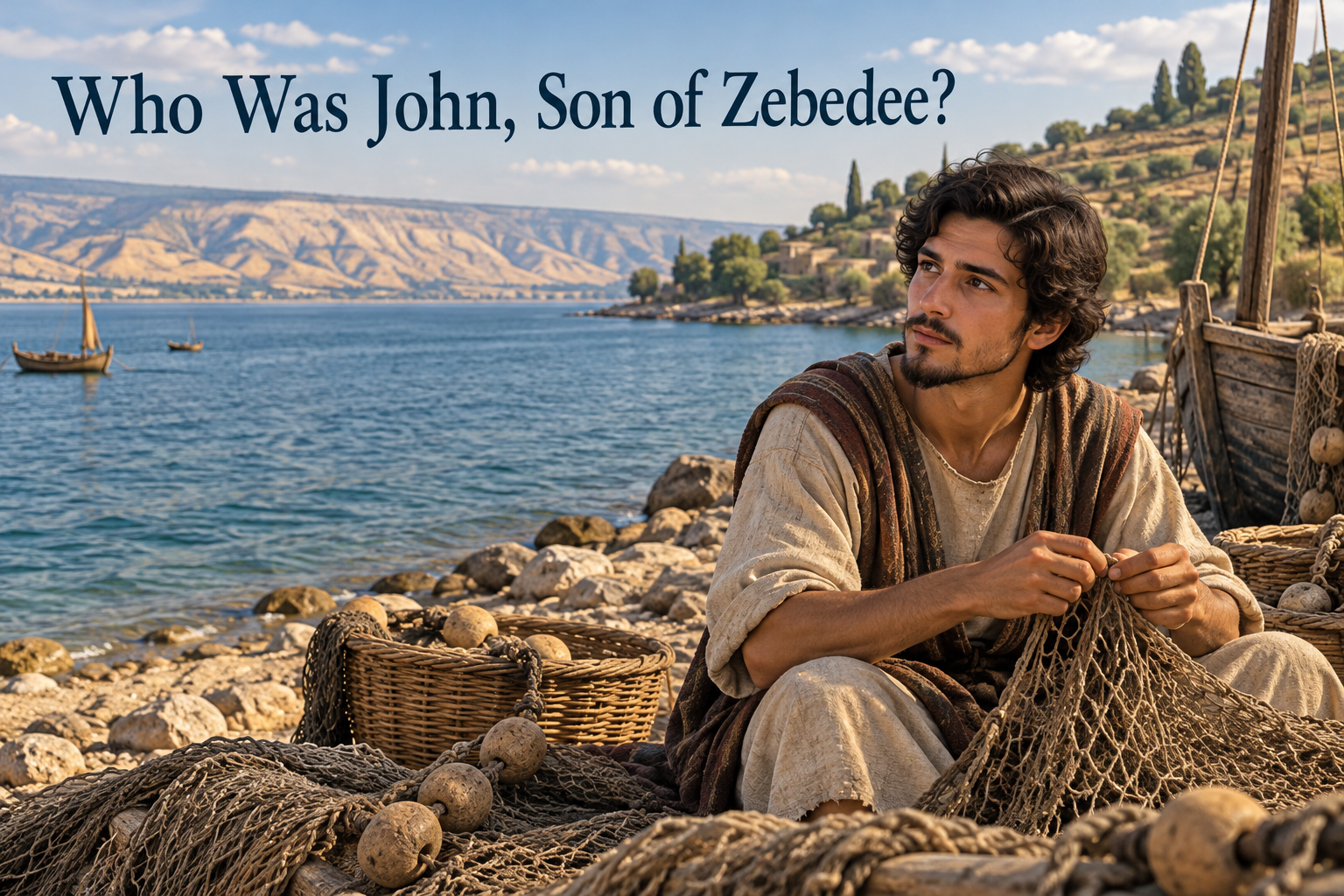
John son of Zebedee was a fisherman, one of the Twelve, and a member of Jesus’ inner circle with Peter and James. He should not be confused with John the Baptist. Christian tradition also identifies him with the unnamed disciple whom Jesus loved, the author behind the Gospel and letters of John, and John of Patmos who wrote Revelation. Those identifications have deep roots and serious defenders, but the New Testament texts do not make every link explicit. The details stated in the New Testament need to be distinguished from the debated identifications surrounding John’s literary legacy.
The fisherman Jesus called
John was the son of Zebedee and brother of James. The family operated a fishing business on the Sea of Galilee and employed hired servants. Jesus called the brothers while they were mending nets, and they left their father in the boat to follow him (Mark 1:19–20). Luke names James and John as Simon Peter’s partners in the miraculous catch (Luke 5:1–11).
Jesus nicknamed the brothers Boanerges, Sons of Thunder (Mark 3:16–17). Their request to call fire on a Samaritan village makes the name feel appropriate, though Mark does not say that episode created it. Jesus rebuked them and moved on (Luke 9:51–56). John’s zeal needed conversion as much as any other part of his life.
John and James sought positions beside Jesus in glory, or participated when their mother made the request. Jesus redirected them from status to the cup of suffering and the life of service (Mark 10:35–45). The apostle later celebrated as a teacher of love did not begin as a naturally mild religious figure. Discipleship changed the direction of his intensity rather than erasing personality.
Witness to glory and suffering
John belonged with Peter and James at the raising of Jairus’s daughter, the transfiguration, and Gethsemane. He saw Jesus’ authority over death, his unveiled glory, and his sorrow before arrest (Mark 5:37–43; 9:2–8; 14:32–34). The three disciples also failed to stay awake when Jesus asked them to watch.
Luke says Peter and John prepared the Passover meal (Luke 22:7–13). At the arrest, the Synoptic Gospels say the disciples fled. John’s Gospel places the beloved disciple at the cross, but whether that figure is John son of Zebedee is precisely one of the questions at issue. We should not quietly transfer every beloved-disciple scene into John’s biography before discussing the identification.
John in Acts
Acts pairs John repeatedly with Peter. They went to the temple when a man unable to walk was healed, stood together before the council, and refused to stop speaking about what they had seen and heard (Acts 3:1–26; 4:1–22). The authorities recognized them as unschooled ordinary men who had been with Jesus. “Unschooled” does not mean unintelligent or completely illiterate; it means they lacked elite scribal training.
Peter and John later went to Samaria after Philip’s preaching. They prayed for baptized believers to receive the Holy Spirit and confronted Simon Magus’s attempt to buy the power of imparting the Spirit (Acts 8:14–24). The man once ready to burn a Samaritan village now prayed for Samaritan believers. Luke does not underline the irony, but it is difficult to miss.
Paul calls John, along with James and Cephas, one of the recognized pillars who extended fellowship to Paul and Barnabas and affirmed their Gentile mission (Galatians 2:7–10). The James in that scene is generally understood as Jesus’ brother rather than the son of Zebedee. John’s role shows continuity between the earliest Jerusalem leadership and the expanding mission.
Was John the beloved disciple?
The Fourth Gospel never names John son of Zebedee. It presents an unnamed disciple whom Jesus loved at the supper, cross, empty tomb, and resurrection appearance by the sea. The final chapter says this disciple testifies to these things and that a concluding “we” knows his testimony is true (John 21:20–24). That wording may distinguish the eyewitness source from those who shaped or endorsed the Gospel’s final form.
Early church tradition, clearly expressed by Irenaeus in the late second century, identifies the beloved disciple and evangelist as John, a disciple of the Lord associated with Ephesus. Many Christians and scholars continue to defend John son of Zebedee as the Gospel’s author or principal eyewitness source. His place in the inner circle, relationship with Peter, and absence by name from the Gospel are offered in support.
Other scholars question the identification. The Gospel itself could have named John but does not, the beloved disciple appears explicitly only in later sections, and the final editorial voice may point to a community preserving someone’s testimony. Proposals identify the disciple as another Jerusalem follower, Lazarus, John the Elder, an idealized literary witness, or a real but unnamed disciple. None has achieved universal agreement.
The most careful conclusion is graded. The Gospel claims a close relationship to eyewitness testimony, and ancient tradition strongly associates it with John. Whether John son of Zebedee personally wrote the final Greek text, supplied its core testimony, or became identified with another witness remains disputed. Saying this does not deny the Gospel’s authority; inspiration does not depend on pretending internal anonymity is an explicit signature.
The letters of John
First John is anonymous and shares extensive language and theology with the Fourth Gospel. Second and Third John identify their author as “the elder,” not as John son of Zebedee. Traditional interpretation connects all three with the apostle and the Johannine community around him. Many modern scholars speak more broadly of a Johannine circle because common tradition does not necessarily prove one hand wrote every work.
The letters emphasize the incarnation, truth, obedience, assurance, and love. First John’s statement that God is love fits the apostle’s traditional reputation, but it should not be used to invent a smooth personality arc unsupported by texts. The same literature speaks strongly against deception and commands testing spirits. Christian love is not indifference to truth.
Was John son of Zebedee John of Patmos?
Revelation identifies its author as John, a servant and brother sharing tribulation, who received visions on Patmos (Revelation 1:1; 1:9). It does not call him an apostle or son of Zebedee. Justin Martyr and other early witnesses identified him as the apostle, and that became the dominant church tradition.
Dionysius of Alexandria in the third century argued from differences in vocabulary, style, and self-presentation that Revelation and the Fourth Gospel came from different authors named John. Many modern scholars agree that the Greek styles differ sharply, while defenders of common authorship appeal to genre, circumstances, scribal help, or different dates. John of Patmos may be John son of Zebedee, but the identity should not be presented as undisputed.
The same caution applies to claims that the apostle was exiled to Patmos under Domitian and later returned to Ephesus. These belong to early church tradition built around Revelation’s setting. They are historically plausible but not narrated in Acts or the Gospel.
Later life and death
Tradition strongly associates John with Ephesus and an unusually long life. Irenaeus says he remained until the time of Trajan, and Eusebius preserves stories about his ministry in Asia. One later story has him repeatedly telling believers to love one another; another has him pursuing a former convert who became a bandit. These traditions capture themes associated with John but are not canonical biography.
Jesus told James and John they would drink his cup, yet Acts records only James’s execution. Mark 10 does not require identical deaths. A puzzling saying in Mark 10 and later martyr traditions led some to claim John also died violently, but the dominant tradition says he died naturally at Ephesus. Evidence for the precise manner and date is insufficient.
Churches and tomb traditions at Ephesus commemorate John. Archaeology can establish long-standing Christian veneration at the site, not identify his remains with forensic certainty. Later legends that he never died arose partly from Jesus’ remark about the beloved disciple in John 21, but the Gospel explicitly says Jesus did not promise that disciple would remain alive.
John’s lasting witness
The secure John is already significant without solving every authorship question. He left the nets, received correction, witnessed Jesus’ glory and anguish, proclaimed the resurrection with Peter, welcomed Samaritans, and recognized the Gentile mission. He moved from seeking privileged rank to serving as a pillar who extended fellowship.
The traditional John adds a towering literary legacy: Gospel, letters, and Revelation. Christians may receive that tradition as persuasive while still stating where the texts themselves are anonymous or qualified. Confidence and honesty belong together. John’s own apostolic witness points toward Jesus, not toward winning an authorship argument at any cost.
Whether every Johannine line came from his pen or a community preserving related testimony, the son of Zebedee remains part of the church’s foundation. His early zeal wanted fire on opponents. The literature bearing his name calls believers to truth, patient witness, and love. That is not weakness replacing thunder; it is thunder taught to sound like Jesus.