
Who Was John the Baptist?
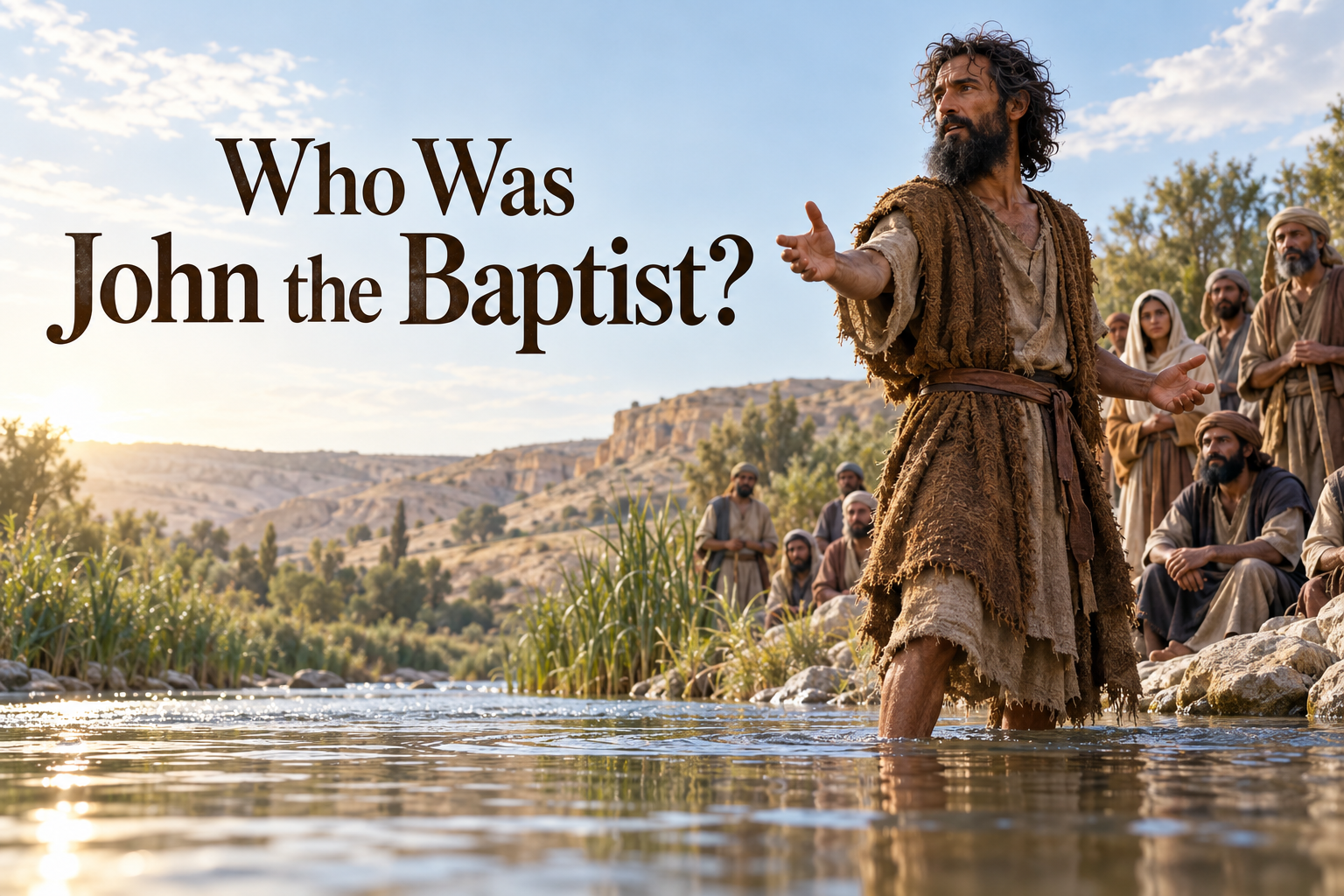
John the Baptist stood at the edge of two eras. He looked like an Old Testament prophet, preached beside the Jordan, and called Israel to repentance. Yet his central task was not to gather a movement around himself. He was sent to prepare the way for Jesus, identify him to Israel, and then accept that his own public role must diminish. Jesus called John more than a prophet and said no one born of women was greater, but John died in prison before seeing the cross, resurrection, or worldwide mission he helped announce.
A promised son with a prophetic calling
Luke introduces John as the son of Zechariah, a priest, and Elizabeth, a descendant of Aaron. They were righteous and childless, and both were advanced in years. While Zechariah offered incense in the temple, Gabriel announced that Elizabeth would bear a son named John. The child would be great before the Lord, abstain from wine and strong drink, be filled with the Holy Spirit from the womb, and turn many in Israel back to God (Luke 1:5–17).
Gabriel described John’s ministry in the spirit and power of Elijah, drawing on Malachi’s promise that Elijah would come before the day of the Lord. This did not mean John was literally Elijah returned through reincarnation. John denied being Elijah when religious representatives asked him that question, while Jesus identified him as the Elijah who was to come (John 1:19–23; Matthew 11:13–15). The best distinction is between personal identity and prophetic role: John was John, fulfilling an Elijah-like mission.
When the pregnant Mary visited Elizabeth, John leaped in Elizabeth’s womb, and she was filled with the Holy Spirit. Christians who differ over prenatal life and sacramental questions should still let Luke’s point stand: John’s witness to Jesus begins before either child is born. At his birth, relatives expected him to bear a family name, but Elizabeth and Zechariah insisted on John, the name God had given. Zechariah’s restored speech became a prophecy that his child would be called the prophet of the Most High and prepare the Lord’s ways (Luke 1:57–79).
Luke says John grew, became strong in spirit, and lived in the wilderness until his public appearance. The Gospel does not tell us who educated him, whether his parents lived into his adulthood, or whether he belonged to a community such as the Essenes. Similarities with the Dead Sea Scrolls community include wilderness setting, intense concern for purity, and expectation of divine action. Important differences remain, and no ancient source identifies John as an Essene.
A voice in the wilderness
John began preaching during the reign of Tiberius Caesar, when Pontius Pilate governed Judea and Herod Antipas ruled Galilee. He appeared in the wilderness wearing camel’s hair and a leather belt, eating locusts and wild honey. The clothing recalls Elijah, while the diet suits a wilderness prophet rather than a court religious professional. John embodied his message before he preached it.
He proclaimed a baptism of repentance for the forgiveness of sins and announced that the kingdom of heaven had drawn near (Mark 1:4; Matthew 3:1–2). Jewish washing practices already used water for purification, and immersion later became central in proselyte practice, but John’s baptism had its own urgent prophetic meaning. Israelites themselves needed repentance in view of coming judgment. Ancestry from Abraham would not substitute for fruit consistent with repentance.
John’s preaching was concrete. People with two tunics should share with those who had none, tax collectors should collect no more than authorized, and soldiers should neither extort nor accuse falsely but be satisfied with their wages (Luke 3:10–14). He did not tell everyone to abandon ordinary work. He demanded that repentance reshape possessions, power, and economic conduct.
His warning about the axe at the root, the winnowing fork, and unquenchable fire was not polite religious encouragement. John expected God to separate the fruitful from the false. Christian interpreters debate whether particular images refer to temporal judgment, final judgment, or both. The essential point is clear: the coming one would not merely affirm Israel’s existing condition.
John baptizes Jesus
John announced one stronger than himself who would baptize with the Holy Spirit and fire. He considered himself unworthy to loosen that person’s sandals, the task of a servant. When Jesus came for baptism, Matthew says John protested that he needed baptism from Jesus. Jesus answered that it was fitting to fulfill all righteousness, and John consented (Matthew 3:13–17).
Jesus’ baptism was not a confession that he had sinned. The New Testament consistently presents him as sinless. He identified himself with the people he came to save, accepted the course of obedient ministry, and was publicly revealed as the Spirit descended and the Father spoke. John’s Gospel adds John’s testimony that the Spirit’s descent identified Jesus as the one who baptizes in the Holy Spirit (John 1:29–34).
John called Jesus the Lamb of God who takes away the sin of the world. The title evokes a network of biblical images rather than one explanation everyone interprets identically: Passover, sacrifice, Isaiah’s servant, and apocalyptic victory have all been discussed. John’s words point beyond moral reform to God’s provision for sin. The preacher of repentance was not offering self-improvement as salvation.
He must increase
John gathered disciples, and some later became disciples of Jesus. When his followers worried that Jesus was baptizing and attracting people, John refused rivalry. A person can receive only what heaven gives; John was not the Messiah but had been sent ahead of him. Using the image of a bridegroom’s friend, he said his joy was complete and that Jesus must increase while he must decrease (John 3:26–30).
This humility did not mean John understood everything immediately. From prison he sent disciples to ask Jesus whether he was the coming one or whether they should expect another. Jesus answered by pointing to healings, resurrection, and good news to the poor, echoing Isaiah, then added a blessing for the one who did not stumble over him (Matthew 11:2–6). John may have been struggling with the difference between his expectation of imminent judgment and Jesus’ merciful ministry. The text gives the question, not a psychological diagnosis.
Jesus did not shame John for asking. After the messengers left, he praised John as neither a reed swayed by wind nor a courtier dressed in luxury. John was a prophet and more than a prophet, the messenger who prepared the way. Yet the least in the kingdom was greater, not necessarily in moral character, but in privilege within the new stage of God’s reign Jesus was bringing.
Herod, prison, and death
John publicly condemned Herod Antipas for marrying Herodias, the wife of his brother, and for other evils. The precise family relationships are rendered differently in the Gospel accounts and Josephus. Both sources place John’s death under Antipas, but they explain the execution differently. Josephus also says Antipas feared John’s influence might lead to unrest. The Gospel emphasizes moral confrontation; Josephus emphasizes political danger. Those explanations can coexist.
Mark and Matthew narrate a banquet where Herodias’s daughter danced and Herod promised her whatever she asked. At her mother’s prompting, she requested John’s head. Herod was distressed but chose his oath and public image over justice, and John was beheaded in prison (Mark 6:17–29). Later tradition names the daughter Salome, a name supplied by Josephus rather than the Gospels.
Josephus places John’s imprisonment and execution at Machaerus, Herod’s fortress east of the Dead Sea. That independent account strongly supports John’s historical existence and death under Antipas, though its chronology and emphasis do not match every Gospel detail neatly. Ancient authors selected material for different purposes. Corroboration does not require identical wording.
John’s continuing witness
John’s disciples remained identifiable after his death. Acts describes Apollos knowing only John’s baptism and a group at Ephesus who had received it but had not heard the full Christian message (Acts 18:24–28; Acts 19:1–7). John’s movement therefore extended beyond the Jordan and outlived him. The church did not dismiss it; believers explained how its promise had been fulfilled in Jesus and the Holy Spirit.
Later Christian tradition developed feast days, relic claims, and stories about John’s remains. Islam also honors a prophet named Yahya, commonly identified with John. These traditions show his broad influence but should be distinguished from the canonical biography. Competing relic claims cannot all function as historical proof.
John matters because he knew both the greatness and limit of his calling. He confronted religious presumption, economic abuse, political immorality, and his own disciples’ competitiveness. He prepared people for Jesus and then released them to follow Jesus. His life ended under a petty ruler at a corrupt banquet, but his witness did not end there: the true king had already stepped into the water.