
Who Was Jonathan?
Jonathan, son of King Saul, was the crown prince who helped the man destined to replace his family. He was a daring warrior, a loyal son, a covenant friend to David, and a father whose disabled child survived the collapse of Saul’s house. His loyalty wasn’t simple. Jonathan defended David against Saul, remained with Saul in Israel’s wars, and died beside his father on Mount Gilboa. The tension between those commitments is the heart of his story.
Which Jonathan?
The Bible contains several men named Jonathan, so the identification matters. This Jonathan was Saul’s son, David’s closest friend, and the father of Mephibosheth. He should not be confused with Jonathan the son of the priest Abiathar, Jonathan the son of David’s brother Shimea, or other later figures bearing the name. Most of his story appears in 1 Samuel 13-31, with his legacy continuing in 2 Samuel.
Jonathan was probably Saul’s oldest surviving son, since he commanded troops early in the reign and stood in line for the throne, though Scripture never provides his birth order in a modern family record. He emerges as a military leader before David enters the narrative. That matters because his friendship with David wasn’t the admiration of an inexperienced courtier. Jonathan already had courage, public standing, and a plausible dynastic future of his own.
A prince who attacked
Jonathan first appears commanding a thousand men and striking a Philistine outpost at Geba. The action provoked a larger confrontation in which Israel was badly outmatched and many troops hid or fled. First Samuel says that only Saul and Jonathan had swords at one stage of the crisis. Whether that reflects a broad Philistine monopoly or the equipment of this particular force, the story stresses Israel’s vulnerability.
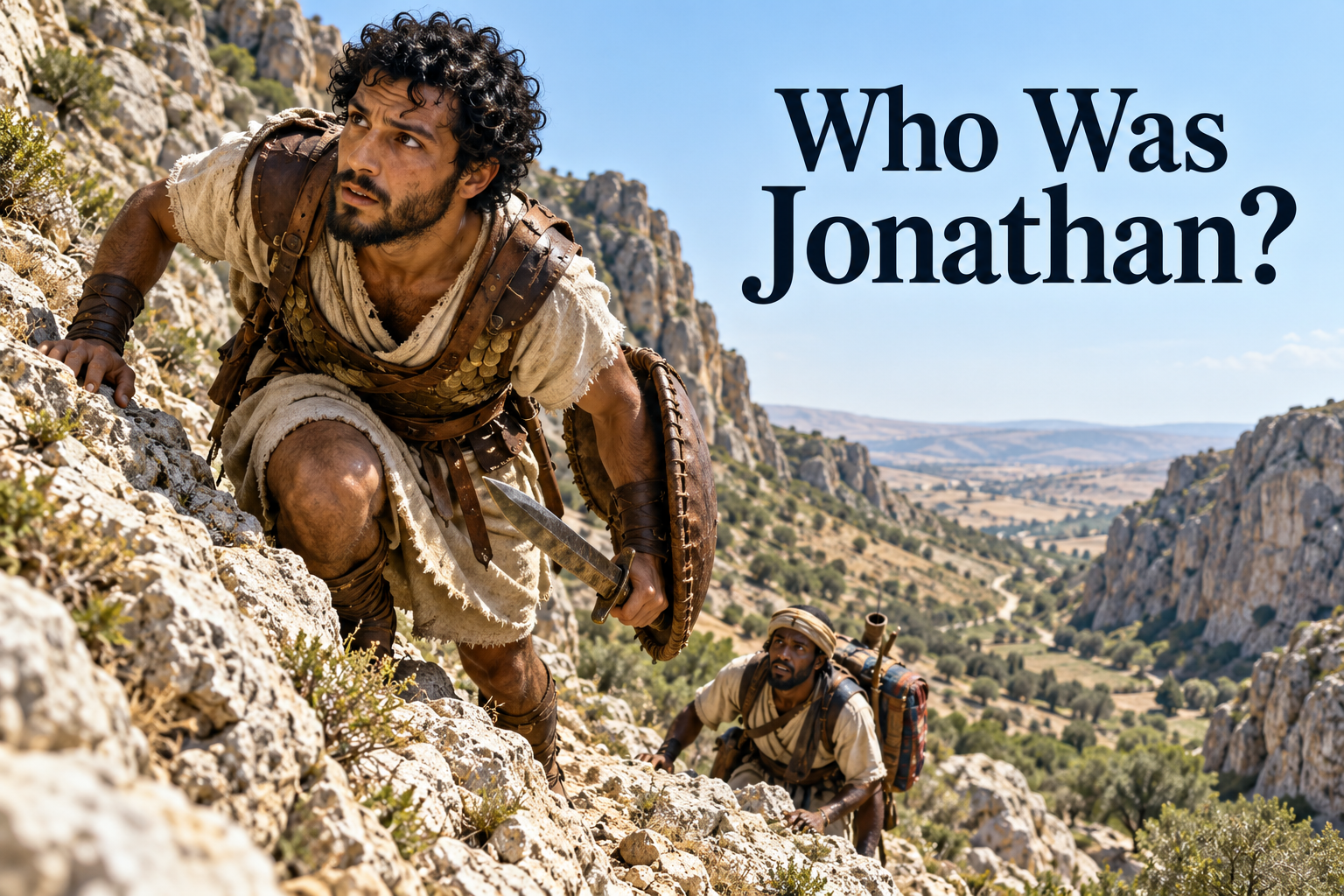
Jonathan then crossed toward another Philistine outpost with only his armor-bearer and without telling Saul. He reasoned that nothing could keep the Lord from saving by many or by few. Rather than claiming an unconditional private revelation, he proposed a sign based on the Philistines’ response and moved only when their taunt invited an ascent. Jonathan and his armor-bearer climbed steep ground, struck the outpost, and helped trigger panic through the Philistine camp.
The episode displays faith without swagger. Jonathan didn’t claim that courage made him invulnerable, and his armor-bearer freely joined him. God used their action to disrupt the enemy, while Saul’s watchmen observed the confusion from a distance. Jonathan’s first great scene therefore establishes the quality that will later govern his relationship with David: he can recognize God’s work when it does not center on his own status.
Honey and a reckless oath
During the pursuit, Saul placed the army under an oath forbidding food until evening. Jonathan had not heard it, tasted honey from the forest, and immediately revived. When told about the oath, he said his father had troubled the land and that the victory would have been greater if the exhausted troops had eaten. Events supported his judgment, since the famished soldiers later slaughtered animals and ate meat with blood in violation of Israel’s law.
Saul sought divine guidance, received no answer, and cast lots that identified Jonathan. Jonathan admitted tasting a little honey and accepted the threatened death, but the people intervened. They insisted that the man through whom God had brought victory should not die, and they ransomed or rescued him. The scene contrasts Jonathan’s proportionate judgment with Saul’s devotion to his own rash words. Royal authority nearly killed the prince who had saved the army.
Jonathan and David
After David’s victory over Goliath, Jonathan’s life became bound to David’s, and he loved David as himself. He made a covenant with him and gave David his robe, armor, sword, bow, and belt. These gifts may express friendship, covenant loyalty, military honor, or recognition that David will occupy a role Jonathan might otherwise have expected. The text doesn’t explicitly say that Jonathan formally abdicated at this first meeting, but the prince’s willingness to honor David is unmistakable.
Saul’s growing jealousy forced Jonathan to choose whether loyalty meant protecting his father’s fear or telling him the truth. Jonathan initially persuaded Saul not to kill David, reminding him that David had risked his life and brought Israel victory. Saul listened and swore that David would live, but the reconciliation didn’t last. When Saul again tried to kill David, Jonathan had to confront the fact that his father’s assurances could no longer be trusted.
The covenant under pressure
In 1 Samuel 20, David told Jonathan that Saul intended to kill him. Jonathan initially found the claim difficult to believe because Saul usually disclosed plans to him, but he agreed to test his father’s intent at the new moon feast. David would be absent, and Jonathan would observe Saul’s response. Before the test, the two renewed their covenant, extending its obligations to Jonathan’s descendants.
Saul’s anger confirmed David’s fear. He insulted Jonathan in sexualized and dynastic language, accused him of choosing David to the shame of his mother, and warned that Jonathan’s kingdom could not stand while David lived. When Jonathan defended David, Saul threw a spear at his own son. Jonathan left the table furious and grieved, not only because he had been attacked but because Saul had publicly dishonored David.
Jonathan used a prearranged signal with arrows to tell David to flee. After sending the servant away, the two men kissed, wept, and reaffirmed their oath before parting. Ancient male friends could express affection physically and emotionally without the categories modern Western readers often impose. The scene is intimate because the relationship is intimate; there is no need to drain the emotion from it in order to take the covenant seriously.
Were Jonathan and David lovers?
Some modern interpreters read the love, kissing, covenant language, exchange of clothing, and David’s later statement that Jonathan’s love surpassed the love of women as evidence of a romantic or sexual relationship. Other scholars argue that the narrative presents an intense but nonsexual friendship shaped by kinship, covenant, and royal politics. The Hebrew Bible uses the language of love for family loyalty, political allegiance, friendship, marriage, and desire, so the word by itself doesn’t settle the question.
The text never describes David and Jonathan having sex, marrying, or identifying their bond in explicitly sexual terms. It does describe David’s marriages and sexual relationships elsewhere with considerably less reserve. That weighs in favor of the traditional reading of covenant friendship, while the emotional force of the story explains why some readers perceive homoerotic overtones. Responsible interpretation should state both the explicit evidence and the inference rather than claiming the passage says what it does not say.
The relationship also shouldn’t be reduced to ammunition in a modern debate. Jonathan’s love is personal, political, sacrificial, and theological at once. He protects David because David is his friend and because he recognizes that the Lord is with him. Whatever conclusion readers reach about possible overtones, the narrative’s stated concern is covenant loyalty under the pressure of a murderous king and a threatened dynasty.
Between David and Saul
Jonathan met David once more in the wilderness at Horesh and strengthened his hand in God. He told David not to fear because Saul would not find him, David would be king, and Jonathan would be second to him. Saul also knew this, Jonathan said. The statement is Jonathan’s clearest recognition that his own future must yield to God’s purpose for David.
Yet Jonathan did not abandon Saul’s army and permanently join David. Scripture doesn’t explain every reason. He may have understood his duty as a son and military leader to remain with Israel, hoped still to restrain Saul, or lacked a practical path to David’s outlaw band. Some readers fault him for staying, but the text never does. Jonathan’s divided loyalty was costly precisely because both his father and his friend had legitimate claims on his love even after Saul’s conduct became indefensible.
Death on Gilboa
Jonathan died with Saul and his brothers Abinadab and Malchi-shua when the Philistines defeated Israel on Mount Gilboa. First Samuel gives no account of his final actions, only the devastating result. He had once routed a Philistine outpost with one companion; he could not reverse the collapse of Saul’s final battle. Courage is not a guarantee of survival.
David responded with a lament for Saul and Jonathan, commanding that it be taught to Judah. He honored Saul as Israel’s anointed king despite years of persecution and addressed Jonathan with unmistakable grief, saying that his love was extraordinary, surpassing the love of women. The poem does not pause to analyze the relationship because lament is not a courtroom brief. It gives public voice to the loss of a man David loved and a divided kingdom needed.
Mephibosheth and the covenant after Jonathan
Jonathan left a young son, Mephibosheth, who was injured in both feet when his nurse fled after news of Saul and Jonathan’s deaths. Years later, David sought a survivor of Saul’s house to whom he could show kindness for Jonathan’s sake. He restored Saul’s land to Mephibosheth and gave him a permanent place at the royal table. In the narrative, that act fulfills the covenant Jonathan had requested for his descendants.
Mephibosheth’s later story becomes tangled in competing claims during Absalom’s rebellion. His servant Ziba accused him of seeking the throne, while Mephibosheth said Ziba had deceived and abandoned him. David divided the land between them rather than fully resolving the dispute. Jonathan’s covenant legacy therefore survived, but not in a world free of political suspicion or disability-related dependence.
History and later remembrance
No known inscription independently names Jonathan son of Saul. Archaeology confirms Philistine cities and illuminates early Iron Age warfare and settlement, but it cannot verify the honey episode, the private covenants, or the battle details at Gilboa. Scholars debate how the books of Samuel combined older court, war, and family traditions into an account of David’s rise. Jonathan’s support is central to that account because a member of Saul’s own house recognizes David’s future.
Jewish and Christian tradition has usually remembered Jonathan as a model friend, while modern literature and theology have also made him an emblem of same-sex love. Each reception highlights something readers find powerful in the text, but later uses should remain distinguishable from what Samuel explicitly narrates. Jonathan deserves attention beyond serving as evidence for somebody else’s argument.
Jonathan was a warrior who knew that God could save by many or by few, and a prince who knew that God’s purpose might advance through someone else. He did not cease loving his father, flatter his friend, or pretend the conflict between them was painless. His greatness lay in using privilege to protect rather than possess. The crown he never wore reveals more about him than many crowns reveal about the kings who did.