
Who Was Joseph, Husband of Mary?
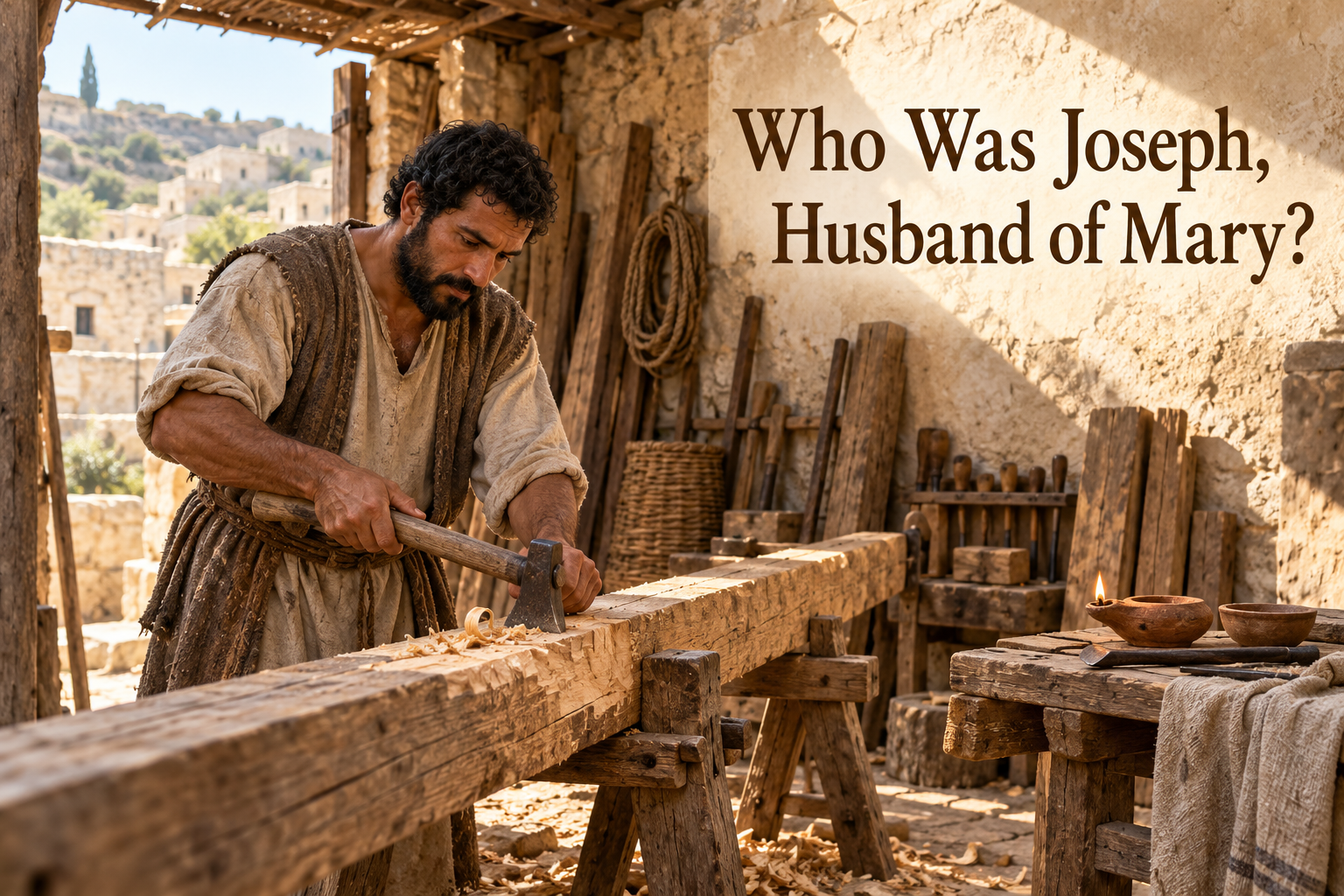
Joseph, the husband of Mary and earthly father of Jesus, never speaks a recorded word in the New Testament. He receives difficult news, obeys dreams, protects a threatened child, relocates his household, and then disappears from the Gospel narrative before Jesus’ public ministry. His silence is not emptiness. Matthew presents him as a righteous man whose righteousness combines moral seriousness, mercy, and costly obedience. He should not be confused with Joseph in Genesis or Joseph of Arimathea.
A descendant of David and a working man
Matthew identifies Joseph as a son of David and traces his ancestry through Solomon, while Luke’s genealogy gives a different line through David’s son Nathan (Matthew 1:1–16; Luke 3:23–31). Christians have proposed that one genealogy represents Joseph’s legal line and the other Mary’s biological line, or that levirate relationships explain the different fathers named for Joseph. Those solutions are possible but not stated by the Gospels. Both genealogies make the theological point that Jesus belongs within David’s royal history, even as his conception is by the Holy Spirit.
Joseph lived in Nazareth and worked as a tekton, a Greek term for a builder or craftsman who might work with wood, stone, or both. Calling him a carpenter is traditional and reasonable, but the word is broader than modern cabinetmaking. Mark later calls Jesus a tekton, suggesting that he learned the family trade. Scripture does not describe Joseph’s income, workshop, or social rank in detail.
Mary was betrothed to Joseph, a binding commitment more serious than modern engagement, when she was found to be pregnant before they lived together. Joseph did not yet know the angelic explanation given to Mary. Matthew calls him righteous and says he planned to divorce her quietly rather than expose her publicly (Matthew 1:18–19). The Law and community honor mattered, but so did mercy toward a woman he believed had broken faith with him.
Obedience in the night
An angel appeared to Joseph in a dream, addressed him as son of David, and told him not to fear taking Mary as his wife. Her child was conceived from the Holy Spirit, and Joseph was to name him Jesus because he would save his people from their sins. By naming the child, Joseph publicly accepted legal fatherhood and brought Jesus into his Davidic household (Matthew 1:20–25).
Matthew says Joseph did not know Mary sexually until she had given birth. Christians agree that Mary was a virgin when Jesus was conceived and born. They disagree over whether the word “until” implies normal marital relations afterward. The grammar does not by itself settle the question, so the perpetual virginity of Mary must be argued from broader tradition and interpretation rather than claimed as the unavoidable meaning of this sentence.
Luke narrates Joseph traveling with Mary to Bethlehem because of a registration associated with Caesar Augustus and Quirinius. The chronology of this census is historically difficult because Quirinius’s securely known Syrian governorship and census are usually dated after Herod the Great’s death. Proposed solutions include an earlier administrative role, alternative translation, or an otherwise unknown registration; none commands universal agreement. The Gospel places Joseph within David’s town and the birth within Roman imperial power, but historical humility is appropriate about the administrative mechanism.
Joseph was present when shepherds visited and when Jesus was circumcised and named. He and Mary presented the child at the temple and offered the sacrifice permitted for families unable to afford a lamb. Simeon spoke of salvation and conflict, and Anna gave thanks. Luke describes both parents marveling, reminding us that revelation did not remove the need to absorb what Jesus’ identity would mean (Luke 2:21–38).
Flight, return, and Nazareth
Matthew says Magi came to a house and honored the child. After their departure, an angel warned Joseph in a dream that Herod intended to kill Jesus. Joseph rose during the night, took Mary and Jesus to Egypt, and remained there until Herod died (Matthew 2:13–15). He did not wait for daylight or demand a more convenient assignment.
Herod’s killing of Bethlehem’s boys is not independently recorded by Josephus or another surviving ancient source. Bethlehem was small, and the number of victims may have been too limited to enter surviving royal histories, while the act is consistent with Herod’s documented brutality toward perceived rivals. Consistency is not independent proof. The massacre remains a claim of Matthew’s Gospel.
After Herod’s death, Joseph received another dream and returned, but fear of Archelaus led him to settle in Galilee rather than Judea. Matthew says this fulfilled the statement that Jesus would be called a Nazarene, though no Old Testament verse uses those exact words. Interpreters propose connections with the Hebrew words for branch, Nazirite, or prophetic themes of despised origins. Matthew may be summarizing a prophetic pattern rather than quoting one line.
Joseph’s fear of Archelaus was sensible. The ruler had a reputation for violence and was eventually removed by Rome. Divine guidance did not require Joseph to ignore political danger. The dreams and his practical judgment worked together as he protected the household.
Jesus in Joseph’s household
When Jesus was twelve, Joseph and Mary took him to Jerusalem for Passover and then began the return journey, assuming he was among the traveling group. After three anxious days they found him in the temple. Mary spoke of “your father and I” searching in distress, and Jesus answered that he must be in his Father’s house or about his Father’s business (Luke 2:41–50). The reply distinguishes his divine sonship without denying Joseph’s real parental role.
Jesus returned to Nazareth and was obedient to them. The one Christians confess as Son of God lived under the authority of Mary and Joseph within an ordinary household. Joseph’s work likely helped sustain that home, and Jesus’ identification as the carpenter’s son shows how neighbors knew him (Matthew 13:55). None of this makes Joseph Jesus’ biological father; it makes legal, social, and nurturing fatherhood meaningful.
The Gospels name brothers and sisters of Jesus. Catholics and Orthodox Christians commonly understand them as close relatives or Joseph’s children from an earlier marriage, preserving Mary’s perpetual virginity. Most Protestants understand them as later children of Mary and Joseph. The Greek word can carry more than one family relationship in context, and the canonical texts never pause to give a family chart that resolves the debate.
What happened to Joseph?
Joseph does not appear during Jesus’ public ministry, at the crucifixion, or with Mary and the disciples after the resurrection. At the cross Jesus entrusts Mary to the beloved disciple, which strongly suggests Joseph had died by then. Scripture does not say when, where, or how. The conclusion that he died before the ministry is a reasonable inference, not a narrated event.
Later writings fill the silence. The second-century Protoevangelium of James portrays Joseph as an elderly widower with children when entrusted with Mary, a tradition influential in Eastern Christianity and art. The later History of Joseph the Carpenter narrates his death in Jesus’ presence. These texts witness to developing Christian devotion but were written too late to be treated as straightforward biographical sources.
Western tradition honors Joseph as patron of workers and of a good death, while Catholic devotion also calls him patron of the universal Church. These are theological and devotional developments, not titles found in the Gospels. Scripture gives no age for Joseph and no basis for confidently portraying him either as elderly or as exactly Mary’s age.
A righteous guardian
No inscription or archaeological object independently identifies Joseph. Nazareth, Bethlehem, Herodian rule, and first-century building trades can be studied historically, but they cannot recover his private actions. The canonical evidence comes almost entirely from Matthew 1, Matthew 2, Luke 1, and Luke 2. Mark and John refer to Jesus as associated with Joseph or the carpenter, but do not add a separate biography.
Joseph’s importance does not depend on imagined adventures. He responded mercifully before he understood, obeyed after he received clarity, accepted public misunderstanding, protected Mary and Jesus, and raised a son who was not biologically his. He received no throne, sermon, or recorded miracle. His calling was to make a home in which the promised Son of David could grow, and he carried it out without needing the story to remain about him.