
Who Was Joseph in Genesis?
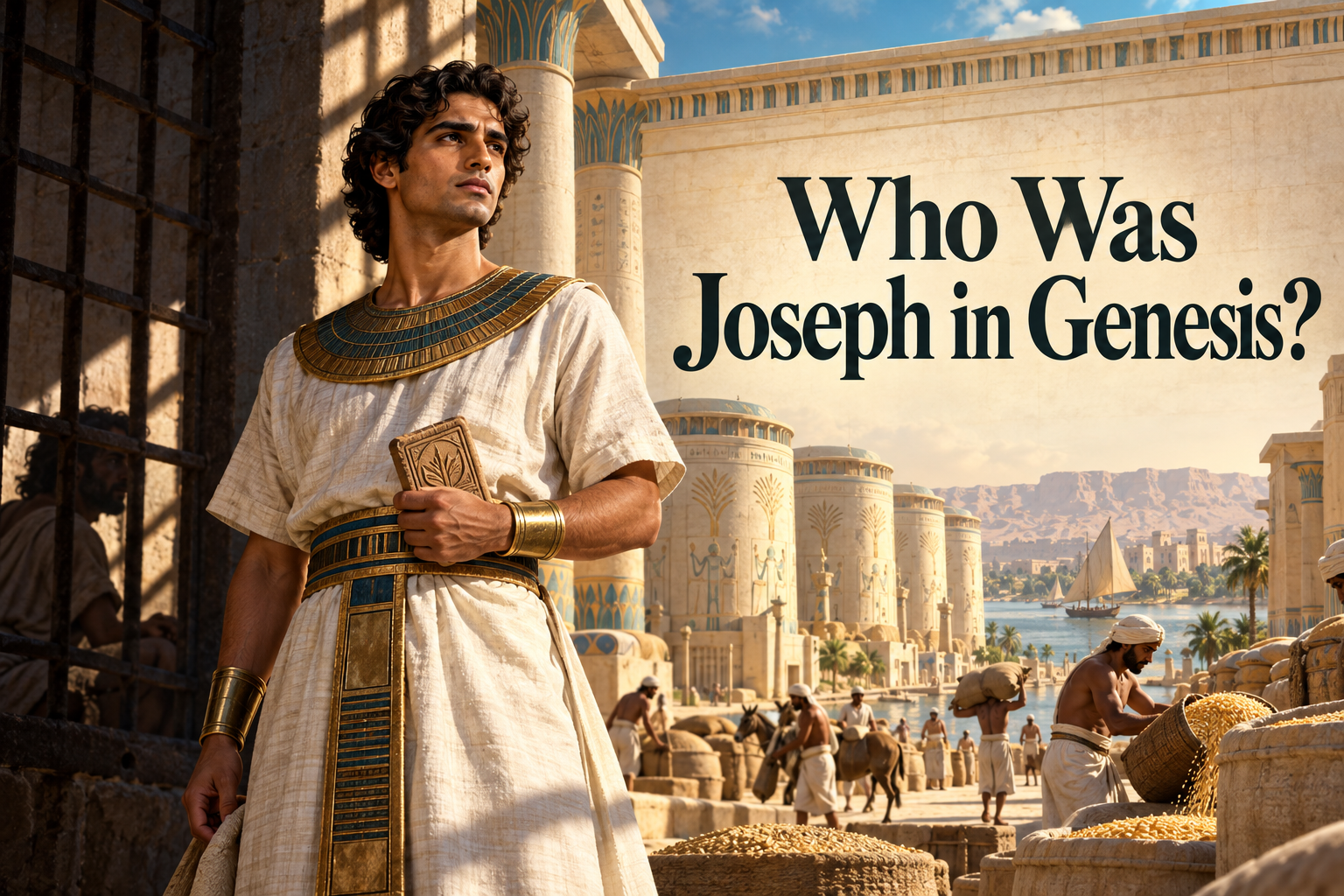
Joseph in Genesis is the son of Jacob and Rachel, not Joseph the husband of Mary who served as Jesus’ earthly father. The two men share a name, dreams, and a reputation for faithfulness, which is one reason they are easily confused in a quick Bible discussion. Genesis gives its Joseph one of Scripture’s longest continuous personal stories: a favored son is trafficked by his brothers, enslaved in Egypt, falsely accused, imprisoned, elevated to power, and finally reconciled with the family that betrayed him. It is an extraordinary rise, but the story never lets us forget the pit beneath the palace.
The favored son
Joseph was Jacob’s eleventh son and Rachel’s first. Genesis 37 introduces him at seventeen, tending flocks with some of his brothers and bringing a bad report about them to their father. Jacob loves Joseph more than his other sons because he is the son of his old age and gives him a special garment. The Hebrew phrase ketonet passim may describe a long-sleeved, ornamented, or multicolored robe; the familiar “coat of many colors” is possible, but not certain. Whatever it looked like, the garment publicly marked Joseph’s privileged status.
Joseph then reports two dreams in which his family bows before him. His brothers interpret the dreams as claims to rule, and even Jacob rebukes him, though Jacob keeps the matter in mind. Readers sometimes diagnose Joseph as an arrogant teenager, but Genesis doesn’t directly condemn him for telling the dreams. It does show that favoritism, youthful speech, and existing family resentments combine explosively. The dreams are ultimately fulfilled, yet a true revelation can still enter a household whose members aren’t prepared to hear it well.
Sold by his brothers
When Joseph goes to find his brothers near Dothan, they see him at a distance and plot to kill “the dreamer.” Reuben persuades them to put him in a pit, intending to rescue him later. Judah proposes selling him rather than killing him, and Joseph is taken toward Egypt by traders identified in the passage as Ishmaelites and Midianites. Scholars have long debated whether the shifting labels preserve intertwined versions of the tradition, while other interpreters regard them as overlapping descriptions of the same trading group. Either way, Joseph is trafficked for silver and carried away against his will.
The brothers dip Joseph’s garment in goat’s blood and let Jacob conclude that a wild animal killed him. Their deception repeats patterns already embedded in the family: Jacob once used a goat and a garment to deceive his father, and now his sons use them against him. That literary symmetry doesn’t mean Jacob deserved to lose a child or that Joseph’s enslavement was divine payback. Genesis is showing how deception reproduces itself across generations unless somebody finally chooses another way.
Enslaved in Potiphar’s house
In Egypt, Joseph is sold to Potiphar, an officer of Pharaoh. Genesis repeatedly says the Lord is with Joseph, and Potiphar eventually puts him in charge of the household. Success doesn’t make Joseph free; he remains an enslaved foreigner whose security depends on his owner. That imbalance becomes crucial when Potiphar’s wife repeatedly demands sex from him.
Joseph refuses, appealing to his master’s trust and to God. When she grabs his garment, he leaves it behind and runs. She then uses the garment as evidence for a false accusation and portrays Joseph as a Hebrew brought into the household to mock or assault them. The unnamed woman has social power, and Joseph has virtually none. The scene concerns sexual coercion as well as temptation: an enslaved man resists someone capable of destroying him for saying no.
Potiphar sends Joseph to prison. Some readers infer that the relatively restrained punishment shows Potiphar doubted his wife’s accusation, since execution might have been expected, but Genesis doesn’t state his motive and we shouldn’t pretend it does. Later Jewish and Islamic traditions give Potiphar’s wife names and elaborate her story, most famously as Zuleikha in Islamic literature. Those traditions may be culturally important, but the biblical narrator leaves her unnamed and keeps the focus on Joseph’s integrity and vulnerability.
Dreams in prison and at court
The Lord is with Joseph in prison, where the warden entrusts responsibilities to him. Joseph interprets the dreams of Pharaoh’s cupbearer and baker, insisting that interpretations belong to God. The predictions come true: the cupbearer is restored, the baker is executed, and the cupbearer forgets Joseph for two years. Joseph’s gift opens a door, but not on his preferred schedule.
When Pharaoh dreams of seven healthy cows consumed by seven gaunt cows and seven full heads of grain swallowed by thin ones, the cupbearer finally remembers Joseph. Brought from prison, Joseph again denies that the interpretive power is his own. He explains that seven years of abundance will be followed by seven years of severe famine and recommends storing grain under capable administration. Pharaoh places Joseph over Egypt, gives him an Egyptian name, and arranges his marriage to Asenath, daughter of an Egyptian priest.
Joseph’s two sons reflect his attempt to make sense of exile. He names the first Manasseh because God has made him forget his trouble and his father’s household, and the second Ephraim because God has made him fruitful in the land of his suffering. “Forget” can’t mean literal amnesia; Joseph’s later response to his brothers shows that the past remains close. The names express survival, gratitude, and the complicated work of building a life in the country where he arrived in chains.
Power during famine
Joseph’s storage program saves lives when famine arrives. People from Egypt and surrounding lands buy grain, and his brothers eventually come from Canaan and bow before him without recognizing him. Yet Genesis 47 also describes the long-term concentration of power. As the famine continues, Egyptians surrender their money, livestock, land, and finally themselves to Pharaoh in exchange for food and seed; the priests’ land is exempt, and Joseph establishes a continuing fifth owed to the crown.
The narrator reports this policy without an explicit moral verdict, and interpreters disagree about how to assess it. Joseph acts within an ancient royal economy and prevents starvation, but the result also strengthens Pharaoh by making the population dependent on the state. We shouldn’t force the passage into either a modern defense of economic centralization or an accusation that ignores the emergency. It is enough to recognize that the same Joseph who was enslaved comes to administer a system in which Egyptians describe themselves as Pharaoh’s servants.
Testing the brothers
Joseph recognizes his brothers and accuses them of being spies. He keeps Simeon in custody, demands that they return with Benjamin, secretly restores their money, and later plants his silver cup in Benjamin’s sack. These actions can feel harsh, especially because Jacob and the brothers don’t know what Joseph knows. Some interpreters view the tests as revenge; others see a strategy to learn whether the brothers have changed and to bring the whole family safely to Egypt. Genesis doesn’t give Joseph an inner monologue explaining every step, but his repeated private weeping shows he isn’t coldly enjoying their fear.
The decisive moment comes when Judah offers to remain enslaved in Benjamin’s place rather than send their father into grief. Years earlier, Judah proposed selling Joseph; now he is willing to become the slave so that Rachel’s other son can go free. Joseph can no longer control himself. He sends the Egyptians out, reveals his identity, and weeps so loudly that the household of Pharaoh hears.
Providence without excuses
Joseph tells his brothers not to be distressed because God sent him ahead to preserve life. After Jacob’s death, when they again fear revenge, he says, “You intended evil against me, but God intended it for good” (Genesis 50:20). That confession is not a claim that selling a brother was secretly righteous or that God compelled the brothers to do evil. Joseph names their intention accurately before describing God’s larger purpose. Providence means human wickedness couldn’t prevent God from saving; it doesn’t mean the wickedness ceases to belong to those who chose it.
Joseph forgives his brothers and provides for their families, but reconciliation comes after truth, testing, and evidence of change. The story isn’t a demand that victims immediately trust those who harmed them or place themselves back in danger. Joseph has authority, information, and room to discern what his brothers have become. His eventual embrace is grace, not denial.
Death, bones, and descendants
Jacob adopts Joseph’s sons Ephraim and Manasseh as his own, giving them tribal standing within Israel. He deliberately gives the younger Ephraim the greater blessing, continuing Genesis’s repeated reversal of ordinary birth order. Joseph objects but finally accepts his father’s decision. Later biblical writers can therefore speak of the “house of Joseph” or the tribes of Joseph, especially Ephraim and Manasseh, even though no single tribe normally bears Joseph’s name.
Joseph dies in Egypt at 110 years old and is embalmed. Before his death, he makes the Israelites swear to carry his bones from Egypt when God brings them to the promised land. Exodus says Moses takes the bones during the departure, and Joshua 24 records their burial at Shechem. Hebrews 11 treats this request as an act of faith: Joseph belongs to Egypt by office and burial practice, but his hope remains tied to God’s promise.
History, literature, and later interpretation
No surviving Egyptian record has been securely identified as an independent reference to Joseph, and Genesis doesn’t name the Pharaoh under whom he served. Egyptian features in the story, including names, offices, embalming, court life, and famine administration, give the narrative a recognizable setting but don’t prove a specific date. Scholars propose settings ranging across the second and first millennia BC and debate whether the account preserves early memory, later literary artistry, or both. The Joseph story should be read as Scripture without claiming archaeology has verified details it hasn’t.
Christian readers have long noticed parallels between Joseph and Jesus: both are beloved sons, rejected by their own, handed over for silver, brought low, and used by God to save others. These patterns make Joseph a fitting type, a person whose story anticipates features of Christ’s work. Genesis doesn’t identify him as a direct messianic prediction, however, and resemblance shouldn’t erase difference. Joseph becomes an Egyptian administrator who saves people from famine; Jesus is the crucified and risen Messiah who saves from sin and death.
Joseph’s life is compelling because it refuses easy moral arithmetic. Faithfulness leads him into prison before it leads him to authority, power enables him to preserve life while also entangling him in Pharaoh’s system, and forgiveness grows without calling evil good. The dreamer does rise, but his greatest act isn’t wearing an official robe. It is using the power his brothers feared to feed the people who once sold him.