
Who Was Joshua?
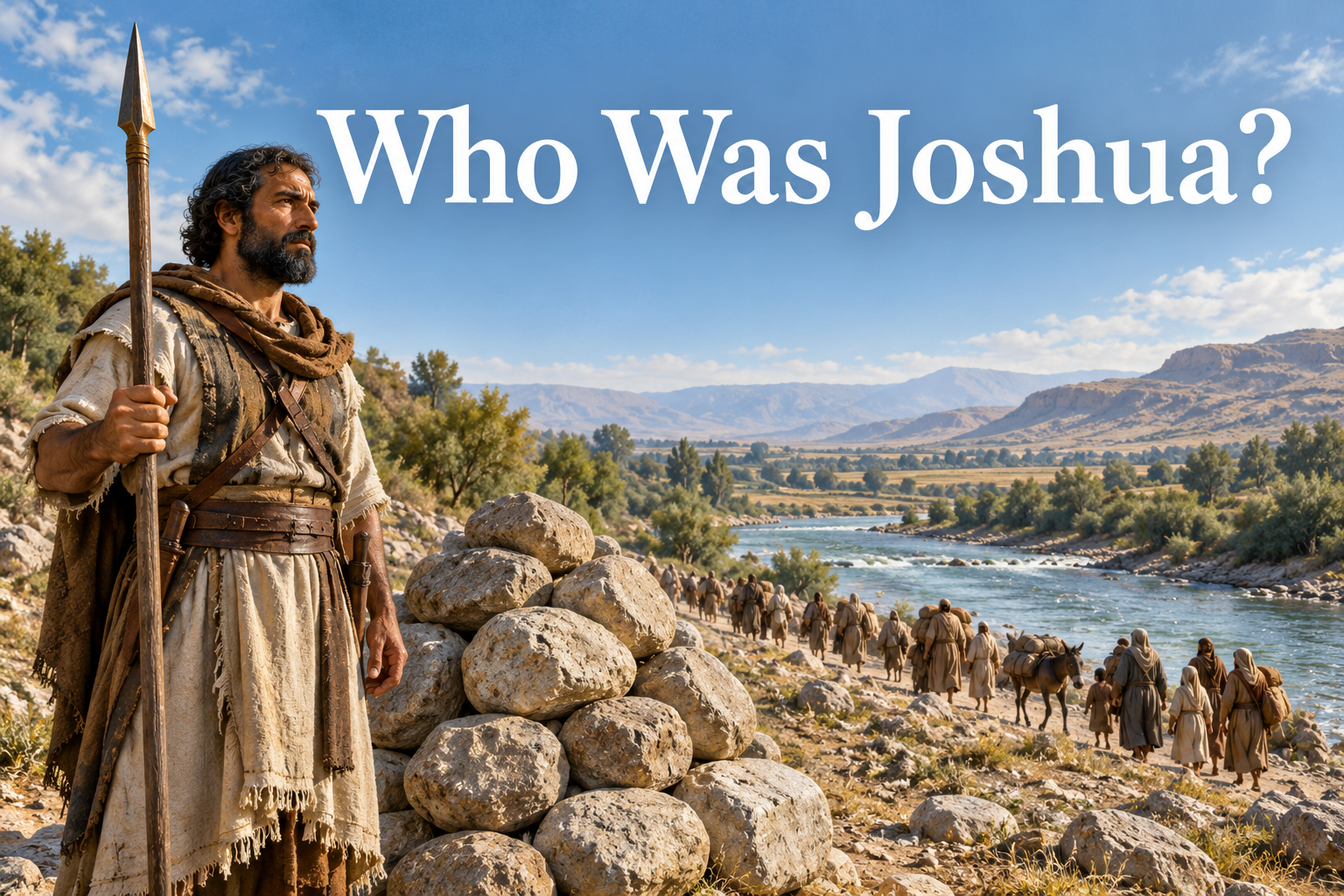
Joshua is remembered as the leader who brought Israel into Canaan, but he first appears as an assistant learning to serve under Moses. He commands troops, waits near the mountain, guards the tent of meeting, scouts the land, and spends years in a generation that refuses to enter it. By the time the Jordan opens before him, Joshua has already lived through slavery’s aftermath, wilderness rebellion, divine judgment, and the death of his mentor. His biography is about courage and covenant loyalty, but it also leads directly into the difficult moral and historical questions raised by Israel’s conquest traditions.
From Hoshea to Moses’ assistant
Joshua was the son of Nun from the tribe of Ephraim. Numbers 13:16 says Moses changed his name from Hoshea, meaning “salvation,” to Joshua, meaning “the Lord saves.” The change does not erase Joshua’s role, but it locates deliverance in God rather than in the leader. The Greek form of Joshua’s name is Jesus, a connection Hebrews 4 uses when distinguishing the rest Joshua gave Israel from the fuller rest still offered through Christ.
Joshua first appears commanding Israel’s fighters against Amalek while Moses stands above the battle with the staff of God (Exodus 17). The victory requires Joshua’s action in the valley and the sustained intercession represented on the hill. Later Joshua accompanies Moses partway up Sinai and remains connected with the tent of meeting. When Eldad and Medad prophesy in the camp, Joshua urges Moses to stop them, but Moses refuses to guard his status and wishes that all the Lord’s people were prophets. Joshua’s loyalty was genuine, though at that stage it could become protective in a way Moses had to correct.
As one of twelve men sent to scout Canaan, Joshua joined Caleb in opposing the majority report. All the scouts agreed that the land was fruitful and its inhabitants formidable. The dispute concerned what those facts meant in light of God’s promise. Ten scouts spread fear, the people talked of returning to Egypt, and Joshua and Caleb tore their clothes and urged trust. The congregation threatened to stone them. Faithfulness did not consist of pretending the obstacles were small; it consisted of refusing to treat those obstacles as greater than God.
Commissioned after Moses
God identified Joshua as a man in whom was the Spirit and told Moses to commission him before Eleazar and the assembly. Moses laid hands on him and invested him with authority. Deuteronomy repeatedly tells Joshua to be strong and courageous, not because confidence was his natural temperament but because the task could reasonably produce fear. He would lead a new generation after Israel’s defining prophet died, cross a flooded river, confront fortified cities, and distribute a land not yet fully possessed.
Joshua 1 ties courage to obedience rather than bravado. Joshua is to meditate on the book of the law and act according to it. God’s promised presence does not grant him permission to improvise morally; it binds him more closely to the covenant. The tribes east of the Jordan reaffirm their commitment to fight alongside their relatives, giving the new leader public support that Moses’ generation had often withheld.
Before crossing the Jordan, Joshua sent two spies to Jericho. Rahab hid them, confessed that the Lord had given Israel the land, and secured protection for her household. Her presence complicates any reading that treats every Canaanite as spiritually identical or beyond mercy. She is a Canaanite woman and sex worker who responds in faith, joins Israel, and later appears in Jesus’ genealogy and among the examples of faith in Hebrews and James.
Jordan, Jericho, and covenant warfare
When the priests carrying the ark stepped into the Jordan, the waters stopped and Israel crossed on dry ground. Twelve stones were taken from the river as a memorial so future children would ask what they meant. Joshua then circumcised the wilderness generation and celebrated Passover at Gilgal. The sequence places covenant identity and remembrance before military advance. Israel does not enter merely as an army seeking territory but as a people accountable to the God who delivered them.
At Jericho, an armed figure identified as commander of the Lord’s army refused Joshua’s attempt to place him on one human side or the other. Joshua fell in worship and received instructions. Israel marched around the city, the walls fell, and the city was placed under the ban, with Rahab’s household spared. The text presents Jericho as divine judgment and a firstfruits victory belonging to God rather than plunder for private enrichment.
The killing of entire populations in Joshua, including children, is morally disturbing and should be treated as such. Christian interpretations differ. Some emphasize unique divine judgment within salvation history, some read the language as conventional ancient war rhetoric that states total destruction even when survivors remain, and some see the accounts as theologically shaped memories whose descriptions should not be treated as modern battlefield reporting. These approaches are not interchangeable, but all responsible Christian readings should reject using Joshua to authorize ethnic cleansing, colonial seizure, or violence by the church.
Achan’s theft from Jericho’s devoted goods led to Israel’s defeat at Ai. After a process of identification, Achan, his household, and possessions came under judgment. The collective dimensions are difficult, and the wording has generated debate about the family’s knowledge and participation; the text does not narrate individual interviews. What it does emphasize is that Joshua cannot treat covenant violation within Israel as less serious than Canaanite evil. The leader who conquers others is himself under judgment.
Strategy, deception, and unfinished conquest
The Gibeonites responded to Israel’s advance by pretending to come from a distant country. Joshua and Israel’s leaders examined their worn supplies but did not inquire of the Lord, then made a treaty. When the deception emerged, Israel honored the oath and made the Gibeonites workers associated with the sanctuary. Joshua’s mistake was real, yet keeping the covenant once sworn prevented one failure from becoming another. Later, in 2 Samuel 21, Saul’s violence against the Gibeonites is treated as bloodguilt against Israel.
Joshua’s southern and northern campaigns include the famous day when the sun stood still and the defeat of a coalition led by Hazor. The poetic words about sun and moon can be read phenomenologically, as people still speak of sunrise, and their relationship to the cited Book of Jashar suggests an older victory poem embedded in the narrative. Proposals involving eclipses or unusual astronomical events remain speculative. The theological claim is clear: the Lord fought for Israel; the physical mechanism and exact chronology are not explained in modern scientific terms.
The book can say Joshua took the whole land and also list substantial territories and peoples that remained. This is not necessarily careless contradiction. Ancient conquest summaries commonly describe decisive dominance without implying that every town was occupied, and Joshua itself moves from major campaigns to the slower work of tribal possession. Judges opens by showing that this work remained incomplete and uneven. The Bible’s own presentation is more complex than the popular picture of one rapid, uniform sweep across Canaan.
Archaeology and the conquest
Archaeology does not provide a simple confirmation of Joshua’s campaigns. Jericho was destroyed at several points in its long history, but the major fortified city of the Late Bronze Age does not align neatly with common dates proposed for the biblical conquest. The identification and occupation history of Ai are also debated. Hazor did suffer a major destruction in the thirteenth century BC, yet archaeology cannot identify the destroyers with certainty. Different sites display different histories rather than one uniform destruction layer across Canaan.
Many archaeologists understand early Israel as emerging largely from within Canaanite society, while some scholars allow that an exodus group and memories of conflict may have joined that indigenous population. The Merneptah Stele shows that a people called Israel existed in Canaan by the late thirteenth century BC, but it does not name Joshua or recount a conquest. These findings should restrain confident claims on all sides. They neither provide Joshua’s military diary nor make material evidence capable of deciding every theological and literary question.
Inheritance and covenant renewal
Much of Joshua’s later work involved allotting territory rather than fighting. Caleb received Hebron, the daughters of Zelophehad received their inheritance in keeping with God’s command through Moses, and cities were designated for Levites and for refuge. Joshua himself received Timnath-serah after the tribal allotments. The order is fitting: the leader did not secure his own estate first.
Joshua’s farewell speeches warned Israel not to confuse possession of land with automatic security. At Shechem he reviewed God’s actions from Abraham through the exodus and called the people to choose whom they would serve. His declaration that he and his household would serve the Lord is often displayed as a private family motto, but in context it is a public rejection of rival gods and a covenant demand placed before the nation. Joshua also warned that their confident promise would carry real responsibility.
Joshua died at 110 and was buried in his inheritance. The book says Israel served the Lord during Joshua’s lifetime and during the elders who outlived him and knew what the Lord had done. That praise contains a quiet warning: firsthand memory would not sustain every later generation automatically. Joshua led faithfully, but he could not choose covenant loyalty for those who came after him.
Joshua’s name announces the deepest truth of his life: the Lord saves. He displayed courage, patience, military skill, and fidelity, but he also needed correction, failed to seek God before the Gibeonite treaty, and led campaigns whose violence demands sober moral engagement. His achievement was never meant to make conquest a permanent model for God’s people. In Christian reading, Joshua’s partial rest points beyond itself to Jesus, who bears the same name and brings his kingdom through a cross rather than a sword.