
Who Was King Ahab?
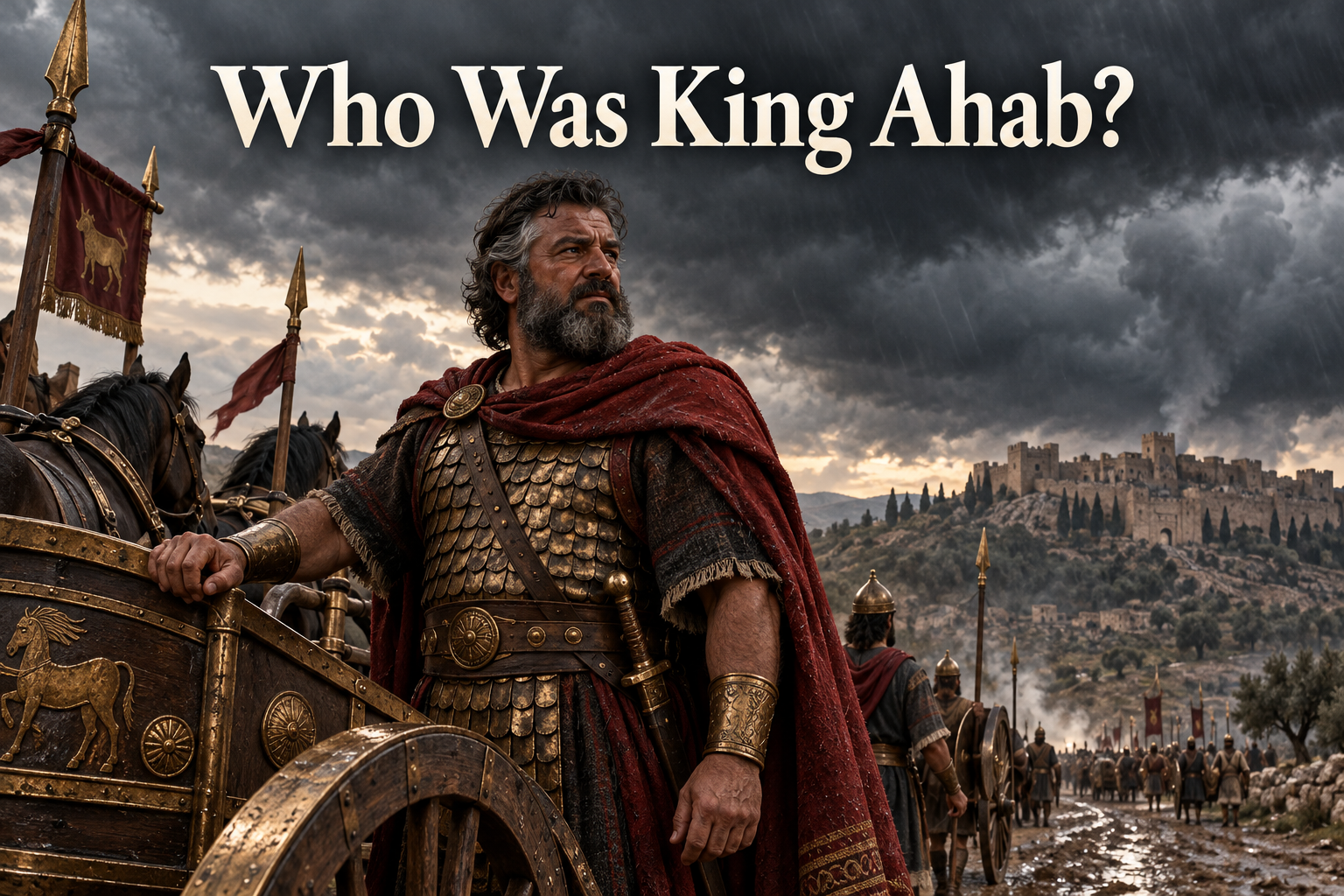
King Ahab is remembered as one of Israel’s worst rulers, and the biblical verdict is deserved. He sponsored Baal worship, tolerated the murder of God’s prophets, seized Naboth’s vineyard after a judicial killing, and repeatedly resisted the word of the Lord. He was also a powerful ninth-century BC monarch whose military reach appears outside the Bible. Political ability and covenant faithfulness are not the same gift. Ahab’s reign is what happens when a capable king uses strength to preserve a dynasty while treating truth, worship, and ordinary people as negotiable.
Son of Omri and king in Samaria
Ahab was the son of Omri, founder of a dynasty that made Samaria the capital of the northern kingdom. First Kings 16:29 says Ahab ruled Israel for twenty-two years. His father had strengthened the state, and Assyrian records later continued calling Israel the “house of Omri” even after Omri’s descendants were gone. Ahab inherited a kingdom with growing regional weight, not a minor village chiefdom.
He married Jezebel, daughter of Ethbaal king of the Sidonians. The marriage likely served diplomacy and trade with the Phoenician coast, but Kings evaluates its religious consequences. Ahab built a temple and altar for Baal in Samaria and made an Asherah, doing more to provoke the Lord than the kings before him. Jeroboam’s calves had already corrupted northern worship; Ahab added royal support for a powerful Phoenician cult.
Elijah, drought, and Carmel
Elijah the Tishbite announced that no dew or rain would fall except at his word. The drought directly challenged Baal’s reputation as a storm and fertility deity and brought suffering across the land. First Kings 18 contrasts Ahab, who searches for grass to preserve royal animals, with his official Obadiah, who hides and feeds one hundred prophets while Jezebel is killing them. The chapter does not say Ahab personally ordered every death, but he ruled the household and kingdom in which the persecution operated.
When Ahab met Elijah, he called the prophet the troubler of Israel. Elijah reversed the accusation: Ahab and his father’s house had abandoned the Lord’s commands and followed the Baals. At Mount Carmel, Elijah challenged the prophets of Baal to a public test, and fire consumed his water-soaked offering. The people confessed that the Lord is God, rain returned, and Ahab rode back toward Jezreel.
The same chapter says Elijah ordered the seizure of Baal’s prophets and slaughtered them at the Kishon Valley. The narrative presents this within a covenant contest against royal idolatry, but the mass killing should not become a model for Christian action against religious opponents. Elijah’s later story itself includes divine correction when he assumes zeal and violence have left him alone. Ancient judgment narrative and the church’s mission are not interchangeable categories.
Wars with Aram
Ahab fought repeated wars with Ben-hadad of Aram-Damascus. First Kings 20 portrays an Aramean coalition besieging Samaria and making humiliating demands for Ahab’s silver, gold, wives, and children. An unnamed prophet promised victory so Ahab would know the Lord, and Israel defeated a much larger force. The next year, Aramean advisers claimed Israel’s God was a god of the hills rather than the plains, and another victory disproved their territorial theology.
Ahab spared Ben-hadad, called him his brother, and made a treaty that restored cities and commercial privileges. Diplomatically, the agreement may have created a useful partner against larger threats. A prophet nevertheless condemned Ahab for releasing a man placed under divine judgment. Kings repeatedly shows Ahab treating prophetic commands as factors to negotiate rather than words governing the king.
Outside the Bible, the Kurkh Monolith of Assyrian king Shalmaneser III names Ahab of Israel among the coalition that fought Assyria at Qarqar in 853 BC. The inscription credits him with a very large chariot force and ten thousand soldiers, figures that may contain royal exaggeration but still indicate substantial military resources. First Kings never mentions Qarqar. The external record therefore expands the political picture without verifying every biblical episode or overturning its theological assessment.
Naboth’s vineyard
Ahab wanted a vineyard beside his palace in Jezreel and offered Naboth a better vineyard or payment. Naboth refused because the land was his ancestral inheritance. Ahab returned home resentful, lay on his bed, turned his face away, and would not eat. His initial offer was not theft, but his response revealed a king unable to accept that royal desire had a lawful limit.
Jezebel promised to obtain the vineyard. Using Ahab’s seal, she wrote to the elders and nobles of Naboth’s city, called a fast, arranged false witnesses, and had Naboth accused of cursing God and king. He was taken outside the city and stoned. Second Kings 9:26 later refers to the blood of Naboth and his sons, suggesting that his heirs also died, though 1 Kings 21 focuses on Naboth. The proceeding used religious law and public institutions to disguise murder as justice.
After Naboth’s death, Ahab went down to possess the vineyard. Elijah met him there and announced that dogs would lick his blood and that judgment would consume his house. Ahab called Elijah his enemy, but the prophet was not hostile because he exposed the crime; the king had made truth feel like enmity. Royal passivity did not absolve Ahab. He benefited from the killing, took the property, and bore responsibility for what was done under his authority.
Ahab tore his clothes, fasted, wore sackcloth, and moved humbly. God acknowledged the humility and delayed the full dynastic disaster until his son’s days. The response is surprisingly merciful, but it does not resurrect Naboth or return the vineyard. Repentance can be real while consequences and restitution remain serious questions.
Micaiah and the last battle
Ahab allied with King Jehoshaphat of Judah and proposed retaking Ramoth-gilead from Aram. About four hundred prophets promised victory, but Jehoshaphat asked whether another prophet of the Lord was available. Ahab admitted that Micaiah son of Imlah existed but said he hated him because Micaiah never prophesied good concerning him. The complaint summarized Ahab’s relationship to revelation: he judged the messenger by whether the message supported policy.
Micaiah first echoed the favorable prediction sarcastically, then described Israel scattered like sheep without a shepherd. He also reported a heavenly vision in which a lying spirit enticed Ahab through his prophets. The scene has generated debate about divine deception, prophetic perception, and the literary form of heavenly council visions. At minimum, Ahab was not deprived of warning. He heard the truth plainly and imprisoned the prophet who spoke it.
Ahab entered battle in disguise while Jehoshaphat wore royal robes. Aramean chariot commanders nearly attacked Jehoshaphat before realizing he was not Israel’s king. Then an archer drew his bow without identifying Ahab and struck him between pieces of armor. Ahab remained propped in his chariot until evening and died as the battle failed. His attempt to escape a targeted death only placed him in the path of an apparently random arrow.
The chariot was washed at the pool of Samaria, where dogs licked Ahab’s blood, fulfilling Elijah’s word in the form reported by Kings. The text also mentions an ivory house and the cities Ahab built. Archaeologists have found carved ivories at Samaria, though many date from later periods and cannot simply be labeled Ahab’s furniture. They illuminate elite wealth in the northern capital without identifying a particular royal room.
Family, dynasty, and later memory
Ahab’s sons Ahaziah and Joram ruled after him, and his daughter or close dynastic descendant Athaliah married into Judah’s royal house. The alliance gave the Omride family influence in both kingdoms but also spread its religious and political conflicts south. Jehu’s later coup destroyed Ahab’s house with extreme violence, claiming fulfillment of prophetic judgment while also pursuing power. The Bible can describe judgment through a political purge without requiring readers to approve every act committed during it.
Ahab appears briefly in 2 Chronicles mainly through his alliance with Jehoshaphat, while later Jewish and Christian memory often pairs him permanently with Jezebel as shorthand for corrupt rule. The shorthand captures much but can hide their distinct responsibility. Jezebel initiated Naboth’s judicial murder; Ahab wanted the land, surrendered his authority to the scheme, and took possession when the victim was dead. He was not an innocent husband overwhelmed by a stronger wife.
A powerful king under judgment
Ahab is one of the earliest Israelite kings named in a contemporary foreign inscription, which makes him historically visible in a way many biblical figures are not. The Kurkh Monolith knows his military contribution, not Elijah, Carmel, or Naboth. Kings knows the international wars but evaluates the reign by covenant standards. The sources answer different questions, and neither should be made to say what it does not.
Ahab could plan campaigns, negotiate treaties, build cities, and field chariots. He could also humble himself briefly when judgment became personal. What he did not learn was to let God’s word and a neighbor’s rights limit royal desire before disaster forced the issue. His reign warns that public competence cannot compensate for worship bent toward power and justice bent toward the king.