
Who Was King Cyrus the Great?
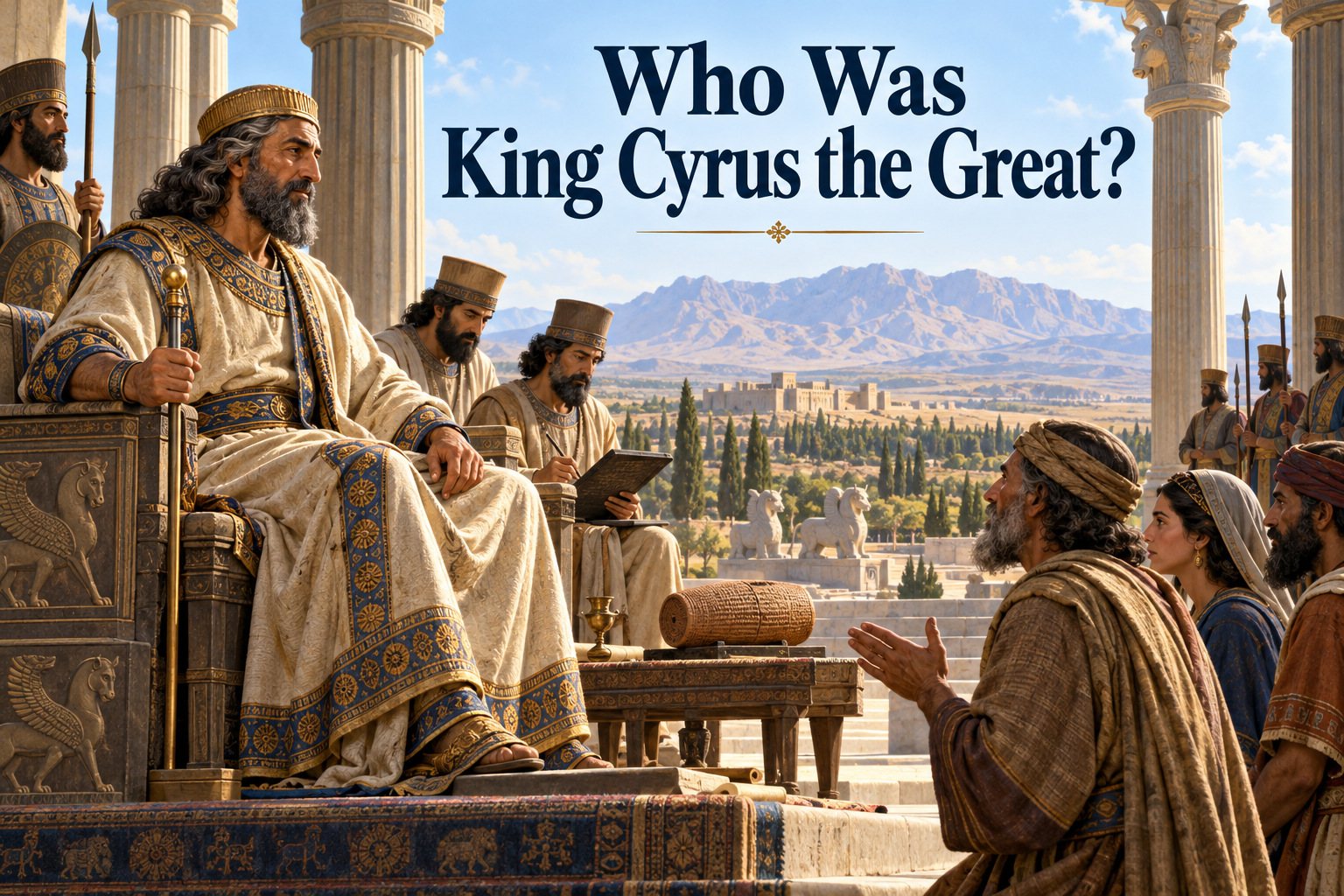
Cyrus the Great is one of the rare biblical figures whose career can be studied through substantial evidence outside the Bible. Persian inscriptions, Babylonian records, Greek historians, and archaeology all help reconstruct the founder of the Achaemenid Empire. Scripture gives him a remarkable place within that history: Isaiah calls this foreign ruler the Lord’s “anointed,” and Ezra credits him with authorizing the rebuilding of the Jerusalem temple. That does not mean Cyrus converted to Israel’s faith or understood his conquests as the prophets did. It means the God of Israel could use an emperor who did not know him to open a road home.
Founder of the Persian Empire
Cyrus II was born around 600 BC and succeeded his father Cambyses I as king of Anshan around 559. He belonged to a Persian royal house that ruled east of the Persian Gulf, though ancient stories about his ancestry and childhood disagree sharply. Herodotus tells a famous tale in which the Median king Astyages tries to kill the infant Cyrus after a threatening dream, while other traditions give Cyrus very different parents and beginnings. These stories belong to royal memory and legend; contemporary inscriptions are firmer evidence for his dynasty than the dramatic infancy accounts.
Cyrus rebelled against Astyages and took control of the Median realm in the 550s BC. He then defeated Croesus of Lydia in western Anatolia and absorbed territories stretching toward the Aegean. By combining Persian leadership with existing Median and local administrative structures, he built an empire larger than any the region had yet seen. His achievement was not simply conquering land but governing diverse peoples without demanding that every province abandon its own institutions and gods.
The capture of Babylon
In 539 BC, Cyrus’s forces defeated the Babylonian army and entered Babylon. The Babylonian Chronicle reports that the city was taken without a major battle inside it and that Cyrus later entered in peace. Babylonian texts portray the conquest as the will of Marduk, Babylon’s chief god, who had rejected King Nabonidus and chosen Cyrus. This is royal theology written for a Babylonian audience, not evidence that Cyrus privately worshiped Marduk in the way a Babylonian priest did.
Cyrus adopted the titles “king of Babylon” and “king of the lands,” presented himself as restorer of order, and retained much of the region’s administrative machinery. His empire could speak different religious languages to different peoples because local legitimacy was part of imperial strategy. That policy was more tolerant than mass deportation and temple destruction, but it was not modern religious liberty. Cyrus remained a conqueror claiming universal rule, collecting tribute, and presenting political success as divine favor.
What the Cyrus Cylinder says
The Cyrus Cylinder is a clay document written in Babylonian cuneiform after the conquest. It praises Cyrus, condemns Nabonidus, credits Marduk with choosing the new king, and describes the restoration of divine images and displaced communities to their sanctuaries. The text fits a well-established Mesopotamian pattern in which a victorious ruler restores proper worship and depicts himself as the answer to a god’s displeasure with the previous king.
The Cylinder does not mention Jerusalem, Judah, or the Jewish exiles. It therefore is not a copy of the decree recorded in Ezra and should not be advertised as direct proof of that decree. It does show that returning displaced peoples and restoring temples belonged to Cyrus’s broader imperial policy. The biblical authorization for Jerusalem is historically plausible within that policy even though the surviving Babylonian proclamation addresses other communities.
Modern publicity has sometimes called the Cylinder the first charter of human rights. That description goes well beyond the ancient text, which is a royal foundation document and piece of imperial propaganda rather than a declaration of equal individual rights. Cyrus’s comparatively restorative policy deserves recognition without turning a sixth-century BC monarch into a modern constitutional reformer. Admiration becomes less useful when it requires anachronism.
Cyrus in Isaiah
Isaiah 44:28 names Cyrus as the shepherd who will carry out God’s purpose and declare that Jerusalem be rebuilt and the temple foundation laid. Isaiah 45:1 goes further and calls him the Lord’s “anointed,” the Hebrew word from which “Messiah” comes. In this setting the title marks Cyrus as a ruler commissioned for a particular task. It does not identify him as the promised Davidic Messiah or make him a member of Israel’s covenant community.
The passage says God takes Cyrus by the right hand to subdue nations, open doors, and release captives. It also says Cyrus did not know the Lord, a qualification repeated in Isaiah 45:4-5. Scripture therefore interprets Cyrus’s victories from Israel’s theological perspective without claiming that Cyrus shared that interpretation. Babylonian writers could say Marduk chose him, while Isaiah says the Lord called him by name; the two sources reveal different claims about who truly governs history.
The naming of Cyrus has generated debate about the composition and dating of Isaiah 40-55. Traditional readings hold that the eighth-century prophet Isaiah predicted Cyrus by name well in advance, while many scholars understand these chapters as the work of an inspired exilic prophet speaking near the end of Babylonian rule. That debate does not erase the passage’s theological claim. In the canonical book, Cyrus’s rise is presented as God’s announced act of liberation.
The decree in Ezra
Ezra 1:1-4 says that in Cyrus’s first year as king of Babylon, the Lord stirred his spirit to issue a proclamation allowing the Jerusalem temple to be rebuilt. The decree invites members of the exiled community to go up and directs neighbors to support them with silver, gold, goods, animals, and freewill offerings. Cyrus also released temple vessels that Nebuchadnezzar had taken from Jerusalem and entrusted them to Sheshbazzar, called the prince of Judah.
The proclamation speaks in strongly Jewish language, including Cyrus’s acknowledgment that the Lord, the God of heaven, charged him to build the temple. Some scholars regard it as a Hebrew adaptation or theological presentation of an authentic Persian authorization rather than a verbatim transcript from the royal chancery. Ancient decrees could be translated and contextualized for the communities receiving them. Historical caution about wording is not the same as denying that Persian permission stood behind the return.
Ezra 6:1-5 reports that a search under Darius I found a memorandum at Ecbatana recording Cyrus’s authorization, the temple’s dimensions, royal funding, and the return of sacred vessels. The Aramaic memorandum differs in form and detail from the proclamation in Ezra 1, which may reflect distinct public and archival versions. It also anchors the later rebuilding effort in a policy issued by Cyrus even though the temple was not completed during his reign.
Return, restoration, and limits
Second Chronicles 36:22-23 closes with Cyrus’s proclamation and an invitation to go up to Jerusalem. The ending turns the catastrophe of exile toward restoration, but it does not suggest that every Judean returned. Many families remained in Babylonia and other parts of the empire, where Jewish communities continued for centuries. The “return from exile” was a real movement and theological turning point, not the instantaneous emptying of the diaspora.
The first stages of temple restoration were difficult. Local opposition, limited resources, imperial transitions, and the community’s own priorities delayed the work until the reign of Darius I. Cyrus opened political space and returned vessels, but leaders such as Sheshbazzar, Zerubbabel, Joshua, Haggai, and Zechariah belonged to the long work of rebuilding. No decree, however generous, could rebuild communal life by itself.
Death and succession
Cyrus died in 530 BC, but the circumstances remain disputed. Herodotus says he was killed fighting the Massagetae under Queen Tomyris, who placed his head in a container of blood. Other ancient accounts place his death in different eastern conflicts, while Xenophon portrays him dying peacefully at home. These sources do not let us reconstruct his final days with confidence. Cyrus was buried at Pasargadae in a stone tomb that still survives.
His son Cambyses II succeeded him and conquered Egypt. Later Persian kings, including Darius I and Artaxerxes I, would shape the circumstances in which the restored Judean community, temple, walls, and law developed. Cyrus founded the imperial framework; he did not personally supervise the entire biblical restoration period.
Cyrus’s biblical legacy
Jewish and Christian tradition has often celebrated Cyrus as a model benevolent ruler. Some later interpreters have even tried to turn him into a secret worshiper of Israel’s God, but the biblical text does not require that claim and the Persian evidence does not establish it. Isaiah’s point is stronger: God can call and use a ruler who does not know him.
Cyrus was neither a modern champion of democracy nor merely a cynical propagandist. He was an ancient conqueror whose restoration policies differed significantly from the deportation practices that had devastated Judah. Scripture remembers the opening he created and identifies God’s purpose within it. The emperor called himself king of the world; the prophets placed even that claim beneath the rule of the One who called him by name.