
Who Was King Hezekiah?
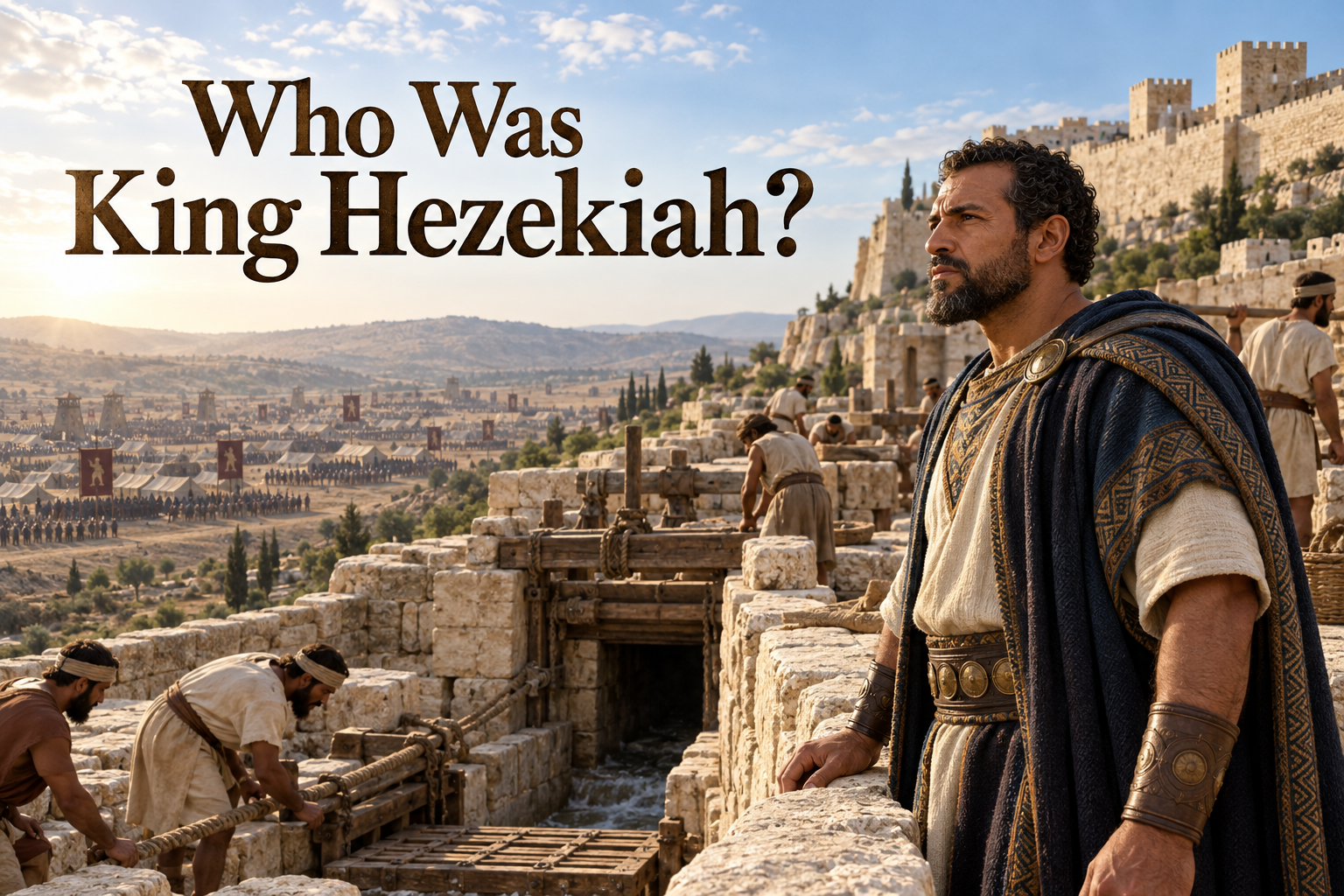
Hezekiah ruled Judah while the Assyrian Empire was turning the political map of the ancient Near East into an imperial possession. The northern kingdom of Israel fell during his reign, fortified cities across Judah were captured, and Jerusalem itself faced an Assyrian army. Second Kings remembers him as a king who trusted the Lord with unusual resolve. It also preserves his illness, his imprudent welcome of Babylonian envoys, and a response to future judgment that sounds uncomfortably relieved because the disaster would not arrive in his lifetime.
A reforming king under imperial pressure
Hezekiah was the son of King Ahaz and ruled Judah from Jerusalem. Second Kings says he began at twenty-five and reigned twenty-nine years, while synchronisms among the biblical kings have generated debates about coregencies and exact dates (2 Kings 18:1–2). His father had adopted Assyrian religious and political practices, but Hezekiah reversed much of that policy. He removed high places, smashed sacred pillars, cut down the Asherah, and destroyed the bronze serpent Moses had made because people were burning incense to it.
The bronze serpent episode is especially instructive. Numbers 21 presents the object as God’s means of healing during a wilderness judgment, but a God-given sign had become an object of illicit worship. Hezekiah called it Nehushtan, essentially “a piece of bronze.” Faithfulness sometimes requires removing a cherished religious object after its use has been corrupted; historical pedigree does not make idolatry safe.
Chronicles expands the reform with a temple cleansing, renewed sacrifices, and a Passover invitation extending beyond Judah to survivors from the northern tribes (2 Chronicles 29–31). Some responded with mockery, while others came to Jerusalem. The celebration required pastoral flexibility because many participants were not ritually prepared, and Hezekiah prayed for those who sought God despite irregular purification. The Chronicler’s account emphasizes worship restored through repentance rather than ceremony performed with mechanical precision.
Scholars debate how far Hezekiah’s centralization of worship reached and how quickly local shrines disappeared. Archaeological changes at sites such as Arad, Beersheba, and Lachish have sometimes been connected with his reforms, but dating and interpretation are contested. The biblical writers evaluate the policy theologically; archaeology can illuminate changes in cultic practice without identifying the king’s motive from stones alone.
The fall of Israel and Hezekiah’s rebellion
During Hezekiah’s reign, Assyria captured Samaria and ended the northern kingdom. Second Kings interprets Israel’s fall through covenant unfaithfulness rather than Assyrian strength alone (2 Kings 17). Judah survived, but survival meant living beside an empire that deported populations and punished rebellion with calculated terror. Hezekiah initially served Assyria and then rebelled, apparently as part of the upheaval following Sargon II’s death.
Sennacherib invaded Judah in 701 BC and captured its fortified cities. Hezekiah sent tribute to Lachish, admitting that he had offended and stripping gold from the temple doors to meet the demand (2 Kings 18:13–16). Sennacherib’s annals independently name Hezekiah of Judah, boast of capturing forty-six fortified towns, and say the king was confined in Jerusalem “like a bird in a cage.” Assyrian royal inscriptions magnify imperial victory, but their agreement on the campaign, Hezekiah, tribute, and Jerusalem’s survival is historically significant.
The Assyrians also decorated Sennacherib’s palace at Nineveh with reliefs portraying the siege and capture of Lachish. Prisoners, deportees, siege equipment, and executions display what Judah suffered outside Jerusalem. The Bible’s focus on the capital can make the deliverance sound painless if Lachish is forgotten. Jerusalem survived while other Judean communities were conquered and their people killed or displaced.
The siege of Jerusalem
Sennacherib’s representatives approached Jerusalem and addressed its officials and people. The Rabshakeh mocked Hezekiah’s alliance options, attacked confidence in the Lord, and claimed that Hezekiah’s removal of high places had offended the very God he trusted. The argument cleverly reinterpreted religious reform as religious sabotage. He also offered an attractive imperial peace in which each family could enjoy its own vine and fig tree before deportation to another land (2 Kings 18:17–35).
Hezekiah tore his clothes and sought a word from Isaiah. When he later received Sennacherib’s threatening letter, he spread it before the Lord in the temple and prayed. He did not claim Judah deserved rescue. He asked God to save Jerusalem so the kingdoms of the earth would know that the Lord alone is God (2 Kings 19:14–19). Isaiah announced that the Assyrian king would not enter the city.
Second Kings reports that the angel of the Lord struck 185,000 in the Assyrian camp and that Sennacherib returned to Nineveh. The biblical narrative attributes Jerusalem’s deliverance directly to God. Assyrian records do not report a catastrophic loss, which is unsurprising in royal victory texts, but neither do they claim to have captured Jerusalem. Proposed natural explanations involving epidemic or military disruption remain historical reconstructions, not independently established descriptions of the biblical event.
Isaiah’s theology cuts against triumphalism. Jerusalem was not saved because fortifications made it invincible or because every inhabitant was righteous. God defended the city for his own sake and for David’s sake. Later generations would make the mistake of treating the temple as a guarantee against judgment, a confidence Jeremiah explicitly condemned. One deliverance cannot be converted into a permanent exemption from repentance.
Preparation, water, and administration
Chronicles says Hezekiah strengthened Jerusalem’s walls, organized weapons, and stopped water sources outside the city before the Assyrian arrival. A tunnel cut through bedrock brought water from the Gihon Spring to the Pool of Siloam. The Siloam Inscription, discovered inside the tunnel, describes workers cutting from opposite directions until they met. It does not name Hezekiah, but the engineering work and inscription provide material context for the water system associated with his preparations.
Archaeology also shows Jerusalem expanding substantially in the late eighth century BC, likely in part because refugees arrived from the fallen northern kingdom and devastated Judean towns. A broad defensive wall enclosed part of the western hill. These finds fit a city responding to demographic growth and military danger, though assigning every construction phase to a single biblical verse would overstate the evidence.
Illness, prayer, and Babylonian visitors
Hezekiah became mortally ill, and Isaiah told him to put his house in order. The king wept and prayed, and God promised fifteen additional years. Isaiah prescribed a fig poultice, and the shadow’s movement served as a sign (2 Kings 20:1–11). The account joins prayer, prophetic word, a physical treatment, and a miraculous sign without forcing readers to choose only one as the means God used.
Merodach-baladan of Babylon sent envoys after hearing of Hezekiah’s illness. Hezekiah displayed his treasuries, weapons, and wealth. Isaiah responded that everything would eventually be carried to Babylon and that some of Hezekiah’s descendants would serve there. The visit may have involved diplomatic exploration as well as courtesy, since Babylon opposed Assyria, but Kings does not spell out a treaty. Political reconstruction is plausible; it is not explicit narrative.
Hezekiah answered that the word of the Lord was good, reasoning that there would be peace in his lifetime. The remark may include humble acceptance of judgment, but its explicit concern for present peace sounds narrow beside the future loss his descendants would suffer. Scripture does not end his biography with a spotless portrait. Trust in the Assyrian crisis did not prevent vanity or short-range thinking afterward.
Hezekiah’s legacy
Hezekiah died and was buried among the Davidic kings. Kings gives him exceptional praise for trusting the Lord, while Chronicles remembers widespread honor at his burial. Isaiah, Micah, and the wisdom tradition are also associated with his era; Proverbs 25:1 says Hezekiah’s men copied additional proverbs of Solomon. Later tradition expands his learning and piety, but those expansions should not be confused with the biblical notices.
Hezekiah is one of the better-attested kings of Judah. Sennacherib’s prisms name him, the Lachish reliefs depict the campaign, and archaeology illuminates Jerusalem’s defenses and water works. These sources confirm the international crisis and important features of its setting, but they do not verify every speech, prayer, or miracle. The Bible and Assyrian annals also write for different purposes: one interprets covenant history, while the other advertises imperial power.
His life shows faith operating under pressure without turning prudence into unbelief. He prayed and fortified, sought Isaiah and managed water, trusted God and negotiated tribute. He also learned that yesterday’s faithfulness does not eliminate tomorrow’s temptation. Jerusalem’s rescue was not proof that Hezekiah had become untouchable; it was evidence that the Lord remained sovereign even when Assyria appeared to own the world.