
Who Was King Jehoshaphat?
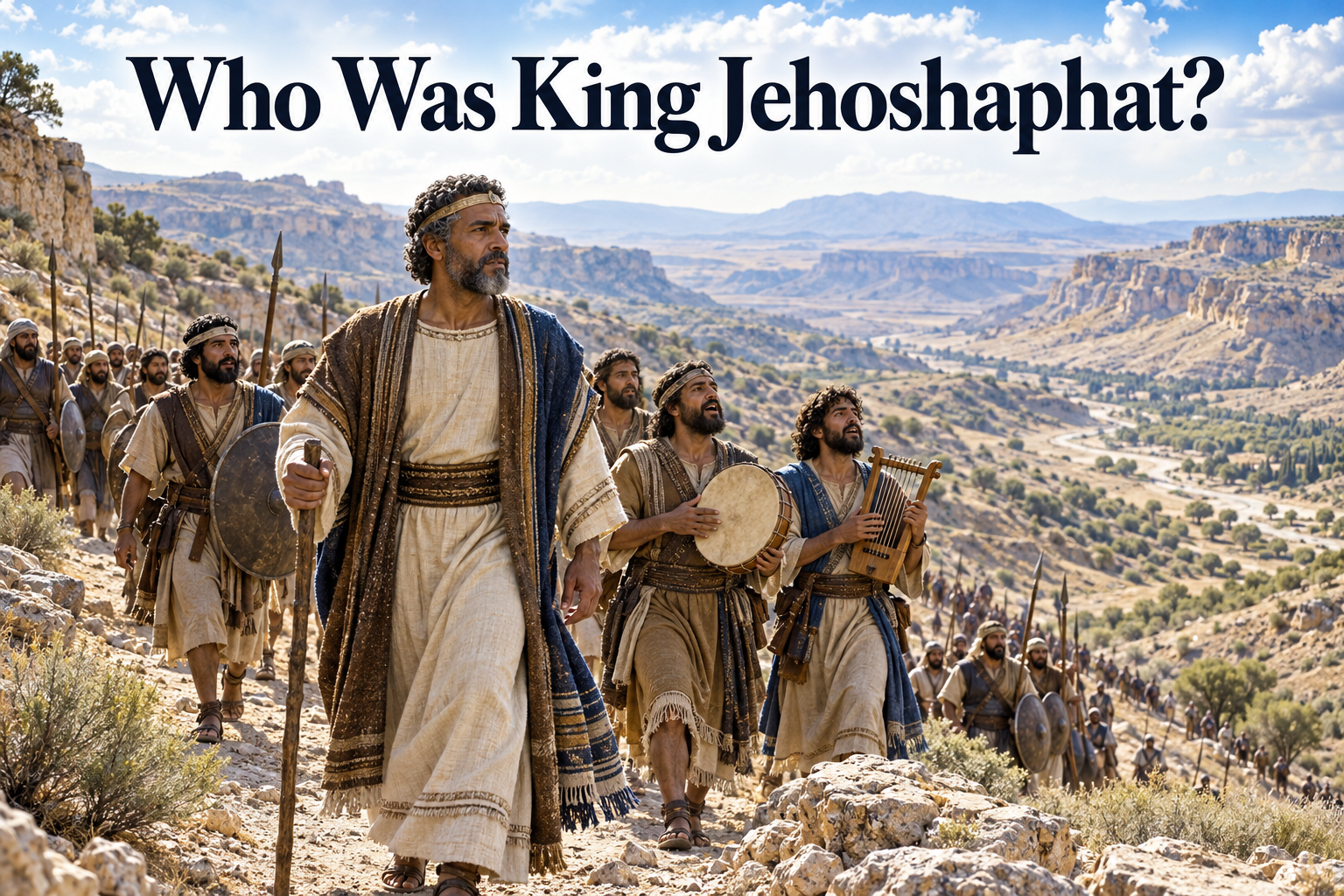
King Jehoshaphat of Judah wanted justice at home, worship centered on the Lord, and peace with the northern kingdom. Those were worthy aims. His problem was that peace became entanglement with Ahab’s dynasty, and cooperation repeatedly placed him inside wars and ventures shaped by rulers whose values he did not share. Jehoshaphat was one of Judah’s better kings, but the Bible does not confuse a favorable overall verdict with an unblemished record. His life asks how a faithful leader can pursue peace without lending credibility and strength to destructive power.
Asa’s son on David’s throne
Jehoshaphat was the son of King Asa and Azubah daughter of Shilhi. According to 1 Kings 22:42, he was thirty-five when he became king and ruled Judah for twenty-five years. Kings says he walked in the ways of Asa and did what was right in the Lord’s sight, though the high places were not removed and people continued sacrificing there. This is a strong evaluation with an explicit limitation.
Second Chronicles 17:6 says Jehoshaphat removed high places and Asherah poles, while 2 Chronicles 20:33 later agrees that high places remained. Interpreters explain the tension in several ways: he may have removed sites associated with other gods but not local shrines used for worship of the Lord, his reforms may have been partial, or Chronicles may preserve differing traditional evaluations. The text does not require us to pretend a reform was either total or nonexistent. Jehoshaphat could move Judah toward faithfulness without eliminating every entrenched practice.
Teaching and strengthening Judah
Chronicles describes Jehoshaphat strengthening garrisons and fortified cities while receiving tribute from surrounding peoples. It also reports that he sent officials, Levites, and priests through Judah with the Book of the Law to teach in the towns. The program linked national strength to public instruction rather than military capacity alone. Whether every administrative detail can be independently reconstructed, the Chronicler’s ideal is clear: reform requires people to know the covenant, not merely a king to issue orders.
Jehoshaphat later appointed judges in Judah’s fortified cities and established a central court in Jerusalem. He instructed them to judge for the Lord, avoid injustice, show no partiality, and take no bribe. Second Chronicles 19:4-11 presents this as a religious responsibility because corrupt courts misrepresent God’s own justice. A king could not claim devotion while allowing local power to sell verdicts.
Historians debate whether Chronicles describes ninth-century institutions directly or presents later judicial structures through Jehoshaphat’s reign. There is no external administrative archive that settles the question. The account remains important to the biblical portrait: unlike kings remembered mainly for buildings or battles, Jehoshaphat is praised for taking the ordinary machinery of justice seriously.
Alliance with Ahab
Jehoshaphat made peace with Israel after generations of hostility, and a marriage joined his son Jehoram to Ahab’s family. Political reconciliation between the two Hebrew kingdoms could reduce bloodshed and strengthen both against regional enemies. The marriage also tied David’s house to the religious and dynastic ambitions of Ahab and Jezebel. Its consequences would become severe when Athaliah later seized power in Judah.
Ahab invited Jehoshaphat to campaign against Ramoth-gilead. Jehoshaphat answered, “I am as you are, my people as your people, my horses as your horses,” then asked to inquire first for the word of the Lord. About four hundred prophets promised success, but Jehoshaphat sensed that something was missing and requested another prophet. Micaiah son of Imlah predicted defeat and Ahab’s death.
Despite hearing the warning, Jehoshaphat went into battle. Ahab disguised himself while asking Jehoshaphat to wear royal robes, leaving the southern king as the most obvious target. Aramean chariot commanders surrounded Jehoshaphat until he cried out and they recognized he was not Ahab. Chronicles says the Lord helped him and drew them away. Jehoshaphat’s desire for alliance had placed him in a battle he knew was prophetically condemned and in a costume his ally was unwilling to wear.
When Jehoshaphat returned safely, the prophet Jehu son of Hanani rebuked him for helping the wicked and loving those who hated the Lord. The prophet also acknowledged good in him, including his removal of Asherah poles and resolve to seek God. The balanced verdict matters. One disastrous alliance did not make every reform false, but a record of reform did not make the alliance harmless.
The crisis in the wilderness
Second Chronicles 20 tells of a coalition from Moab, Ammon, and associated peoples approaching Judah through the wilderness near En-gedi. Jehoshaphat was afraid and proclaimed a fast, gathering Judah at the temple. His public prayer appealed to God’s rule, recalled the gift of the land, and admitted that Judah had no power or plan equal to the threat. The confession was not passivity; it was a refusal to disguise dependence as strategy.
The Spirit of the Lord came upon Jahaziel, who told Judah that the battle belonged to God. Jehoshaphat appointed singers to praise the Lord as the army went out. The enemy coalition turned against itself, and Judah found the forces destroyed. The people gathered plunder and named the place the Valley of Beracah, or blessing, before returning to Jerusalem with music.
The account is distinctive to Chronicles and cannot be matched to an external campaign record. Its theological purpose is obvious without making it fictional by definition: Judah’s king succeeds when he openly depends on God rather than borrowing confidence from an ungodly alliance. The violence remains part of an ancient war narrative. It should not be converted into a promise that worship music guarantees military victory or that modern nations can label their wars the Lord’s battle.
Ships, alliances, and repeated compromise
Near the end of his reign, Jehoshaphat joined Ahab’s son Ahaziah in building ships at Ezion-geber for trade. Second Chronicles 20:35-37 says a prophet condemned the alliance and the ships were wrecked before sailing. First Kings 22:48-49 reports the wreck and says Jehoshaphat then refused Ahaziah’s offer to send servants on a renewed voyage. The accounts can be read as an initial partnership followed by refusal after disaster, though each writer emphasizes a different part of the episode.
Second Kings 3 also places Jehoshaphat in a campaign with Ahab’s son Joram against King Mesha of Moab. When the coalition ran out of water, Jehoshaphat again asked for a prophet, and Elisha provided direction. The campaign ended after Mesha sacrificed his firstborn son on the city wall and great wrath came against Israel, a difficult phrase whose source and meaning are debated. The allies withdrew without securing the intended result.
The Mesha Stele, a ninth-century BC Moabite inscription, independently names King Mesha and celebrates his revolt against Israelite domination under Omri’s dynasty. It presents events from Moab’s theological and royal perspective and does not reproduce the biblical account line by line. Together, the inscription and 2 Kings establish a real context of Israelite-Moabite conflict while leaving the relationship between individual campaigns open to study.
Family consequences
Jehoshaphat gave gifts and fortified cities to his sons while reserving the kingdom for Jehoram as firstborn. After becoming secure, Jehoram killed his brothers and some officials with the sword. Second Chronicles connects Jehoram’s evil reign with his marriage into Ahab’s house. Jehoshaphat did not order those murders, but his dynastic strategy helped create the setting in which they occurred.
Athaliah later attempted to destroy Judah’s royal heirs and ruled the kingdom herself until a surviving child, Joash, was revealed. Her actions belong to her responsibility, not Jehoshaphat’s, yet the family alliance outlived its architect. Political marriages can promise peace for one reign while carrying conflict into the next generation. Scripture’s long view exposes costs that short-term diplomacy can hide.
History and biblical portrait
No known contemporary inscription securely names Jehoshaphat. Archaeological research suggests Judah expanded its activity toward the Shephelah, Negev, and Arabah during the ninth century BC, which fits the broader setting of fortifications and Red Sea trade without proving his personal building program. The Mesha Stele confirms regional kingdoms and conflicts connected with Omri’s dynasty. Chronicles remains the source for many of Jehoshaphat’s reforms and the invasion defeated near Jerusalem.
Kings gives Jehoshaphat a concise positive evaluation and emphasizes his cooperation with Ahab. Chronicles expands him into a reformer, teacher, judge-maker, praying king, and repeatedly compromised ally. Those portraits are not enemies. Together they show a ruler whose heart was directed toward God but whose foreign and family policy repeatedly outran his discernment.
A good king with dangerous friends
Jehoshaphat’s best leadership strengthened justice, taught the law, sought prophetic guidance, and admitted helplessness before God. His recurring failure was not simple friendship with sinners; every ruler dealt with flawed neighbors. It was binding Judah’s fortunes to rulers after prophetic warnings had exposed the character of their projects. Cooperation became complicity when he supplied people, horses, legitimacy, and family ties to ventures he should have refused.
The final biblical verdict remains favorable because Jehoshaphat genuinely sought the Lord and did much good. That grace should not be weaponized to silence criticism of his alliances, nor should his compromises erase the justice he pursued. He is a useful model precisely because he is not a simple one: a faithful king can pray well, reform courts, and still need the courage to say no to the wrong invitation.