
Who Was King Manasseh of Judah?
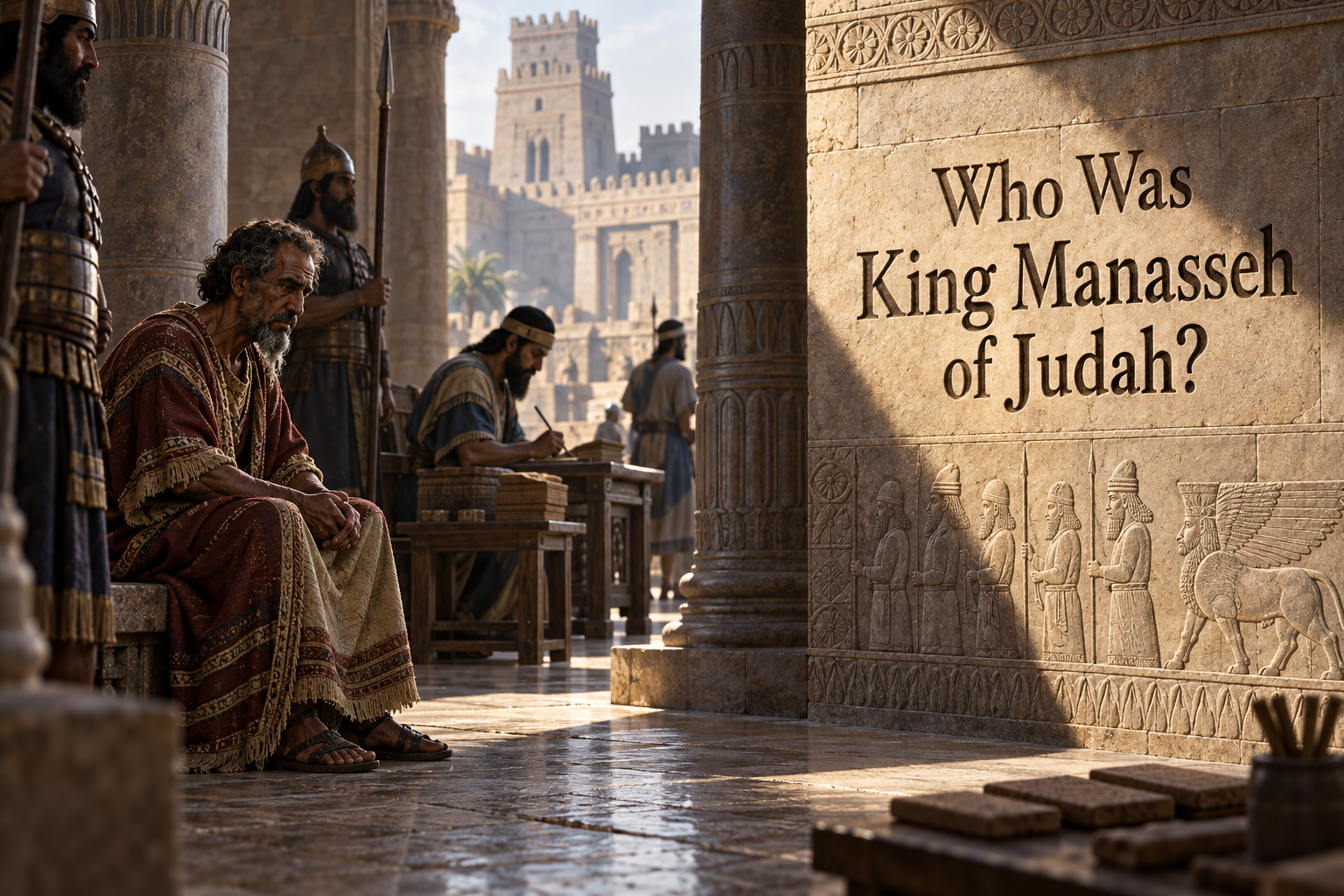
King Manasseh of Judah should not be confused with Manasseh, the elder son of Joseph who became the ancestor of an Israelite tribe. The king lived many centuries later and ruled from Jerusalem after his father Hezekiah. Second Kings portrays him as Judah’s worst monarch, responsible for idolatry, occult practice, child sacrifice, and innocent blood. Chronicles adds captivity, repentance, restoration, and reform. Reading the accounts together gives a severe picture of evil and an equally striking claim about mercy, without making repentance erase the damage of a long reign.
Hezekiah’s son and Assyria’s vassal
Manasseh became king at twelve and reigned fifty-five years, the longest reign credited to any king of Judah (2 Kings 21:1). Exact dates vary slightly among modern chronologies, and some scholars propose an early coregency with Hezekiah to account for the age and synchronisms. Scripture does not explicitly describe that coregency. What is clear is that Manasseh inherited a kingdom battered by Sennacherib’s invasion and living under Assyrian dominance.
Assyrian inscriptions independently name Manasseh king of Judah. Esarhaddon lists him among western rulers required to supply materials and labor for imperial building, while Ashurbanipal includes him among vassal kings who supported an Egyptian campaign. These records do not describe his religious policies, but they place him securely in the seventh-century imperial world. Judah appears to have remained a compliant vassal during much of his reign, which may help explain its political stability and his longevity.
Political accommodation may also provide context for Assyrian cultural influence, but it cannot by itself explain or excuse Manasseh’s worship. The biblical writers interpret his actions as covenant rebellion, not unavoidable diplomacy. Historical reconstruction can show why Assyrian symbols and practices carried prestige; it cannot turn Manasseh into a passive victim of fashion.
Reversing Hezekiah’s reform
Manasseh rebuilt the high places his father had destroyed, erected altars for Baal, made an Asherah, and worshiped the host of heaven. He placed pagan altars in the temple courts, practiced divination and sorcery, consulted mediums, and set a carved image in the temple (2 Kings 21:2–7). The concentration of offenses is deliberate. Manasseh did not merely tolerate rural customs; he brought rival worship into the sanctuary identified with the Lord’s name.
Second Kings also says he made his son pass through fire. The phrase is generally understood as child sacrifice, though interpreters debate some ritual details. Whatever the precise procedure, the text condemns it as an abomination rather than an approved form of devotion. Religious sincerity does not sanctify violence against children.
The king shed so much innocent blood that Jerusalem was filled “from end to end” (2 Kings 21:16). Scripture does not identify all the victims. Later Jewish tradition claims Manasseh had the prophet Isaiah sawn apart, and Hebrews 11:37 may allude to a martyrdom by sawing. Hebrews names neither the victim nor the killer, and Kings and Chronicles do not record Isaiah’s death. The tradition is ancient and possible; it remains later tradition rather than an explicit biblical report.
Manasseh’s religious policy also affected people who had little power to resist a king. Temple personnel, families, and local communities lived under practices backed by royal authority, while dissent could be dangerous in a reign remembered for bloodshed. We cannot recover the experiences of most ordinary Judeans from surviving records. The silence of their names should not turn the king’s offenses into an abstract catalog of ritual violations.
God sent prophets to announce that Jerusalem and Judah would face disaster comparable to Samaria’s fall. The image of wiping a dish and turning it upside down communicates thorough judgment. Kings later identifies Manasseh’s sins and innocent blood as major reasons Judah’s punishment could no longer be postponed (2 Kings 23:26; 24:3–4). His personal choices became public policy, and public policy formed a generation.
The different emphasis of Chronicles
Second Chronicles agrees about Manasseh’s evil but records an episode absent from Kings. Assyrian commanders captured him with hooks, bound him, and took him to Babylon. In distress he humbled himself and prayed, and God restored him to Jerusalem (2 Chronicles 33:10–13). Manasseh then recognized that the Lord is God.
No surviving Assyrian inscription records this arrest. That silence does not prove it did not happen, especially because imperial records are selective, and Assyrian rulers sometimes summoned or detained vassals. Esarhaddon and Ashurbanipal both exercised authority in Babylon, so the destination is historically possible. It remains, however, a biblical claim from Chronicles rather than an event independently confirmed by Assyrian documentation.
Some readers treat the Chronicler’s account as a contradiction of Kings; others see complementary selections serving different theological purposes. Kings explains why Jerusalem eventually fell and therefore emphasizes Manasseh’s enduring damage. Chronicles often emphasizes humility, prayer, and restoration and therefore preserves his late repentance. Neither book says repentance reversed every consequence.
After returning, Manasseh strengthened Jerusalem’s defenses, removed foreign gods and the idol from the temple, restored the Lord’s altar, and commanded Judah to serve the Lord. Yet the people continued sacrificing at high places, though now said to be for the Lord. Reform after decades of corruption was incomplete. A king can repent genuinely and still discover that habits institutionalized under his authority do not disappear on command.
The Prayer of Manasseh
Chronicles says Manasseh’s prayer and prophetic words were recorded in sources available to its author, but it does not preserve the prayer itself. A later penitential work known as the Prayer of Manasseh gives eloquent words of confession to the king. It appears in some Christian collections and liturgies but is not part of the Jewish canon and is placed among the Apocrypha in many Christian Bibles. It should be read as later devotional tradition, not assumed to be the lost prayer mentioned by Chronicles.
The later prayer captures a theological truth present in Chronicles: no history of evil places a repentant person beyond God’s mercy. That truth must not be distorted into cheap grace. Manasseh’s victims are not restored to life, and Judah continues to bear the effects of his reign. Forgiveness reconciles the sinner to God; it does not declare that injury never occurred.
Manasseh in history and archaeology
Manasseh’s appearance in inscriptions of Esarhaddon and Ashurbanipal makes him one of Judah’s externally attested kings. The records depict him as a subordinate within Assyria’s network of western rulers, not as an independent imperial player. Archaeology suggests economic recovery and settlement growth in parts of Judah during the seventh century, including the development of the Beersheba Valley and trade tied to Assyrian systems. Connecting every trend directly to Manasseh’s decisions would go beyond the evidence.
A recently reported fragment of an Assyrian cuneiform sealing found near Jerusalem appears to concern royal correspondence over a delayed payment and dates broadly to the late eighth or seventh century. It does not name Manasseh, and suggested settings include more than one Judean reign. It is therefore evidence of Assyrian-Judean administration, not a personal artifact of Manasseh. Responsible history resists turning a plausible association into a royal signature.
Death and legacy
Manasseh died and was buried in the garden of his palace rather than in the customary royal tombs. His son Amon succeeded him and continued his idolatry without the repentance Chronicles attributes to his father. Amon was assassinated after two years, and the people installed Manasseh’s grandson Josiah. That succession joined inherited corruption, political instability, and the possibility of reform in another generation.
Manasseh’s biography poses a difficult question: what does repentance mean when a leader has already shaped a society toward evil? Chronicles answers that humility and prayer can bring personal restoration. Kings answers that historical consequences can outlive personal change. Both truths matter. Denying mercy makes repentance pointless, while denying consequence insults victims and misunderstands how power works.
The king is therefore neither merely a monster nor a convenient conversion story. He was a historically attested ruler whose policies did terrible harm, a vassal navigating Assyrian domination, and, according to Chronicles, a humbled man who finally acted to undo what he could. The tragedy is that he could not undo it all. Grace reached Manasseh, but Judah still needed more than Manasseh’s late reform.