
Who Was King Nebuchadnezzar II?
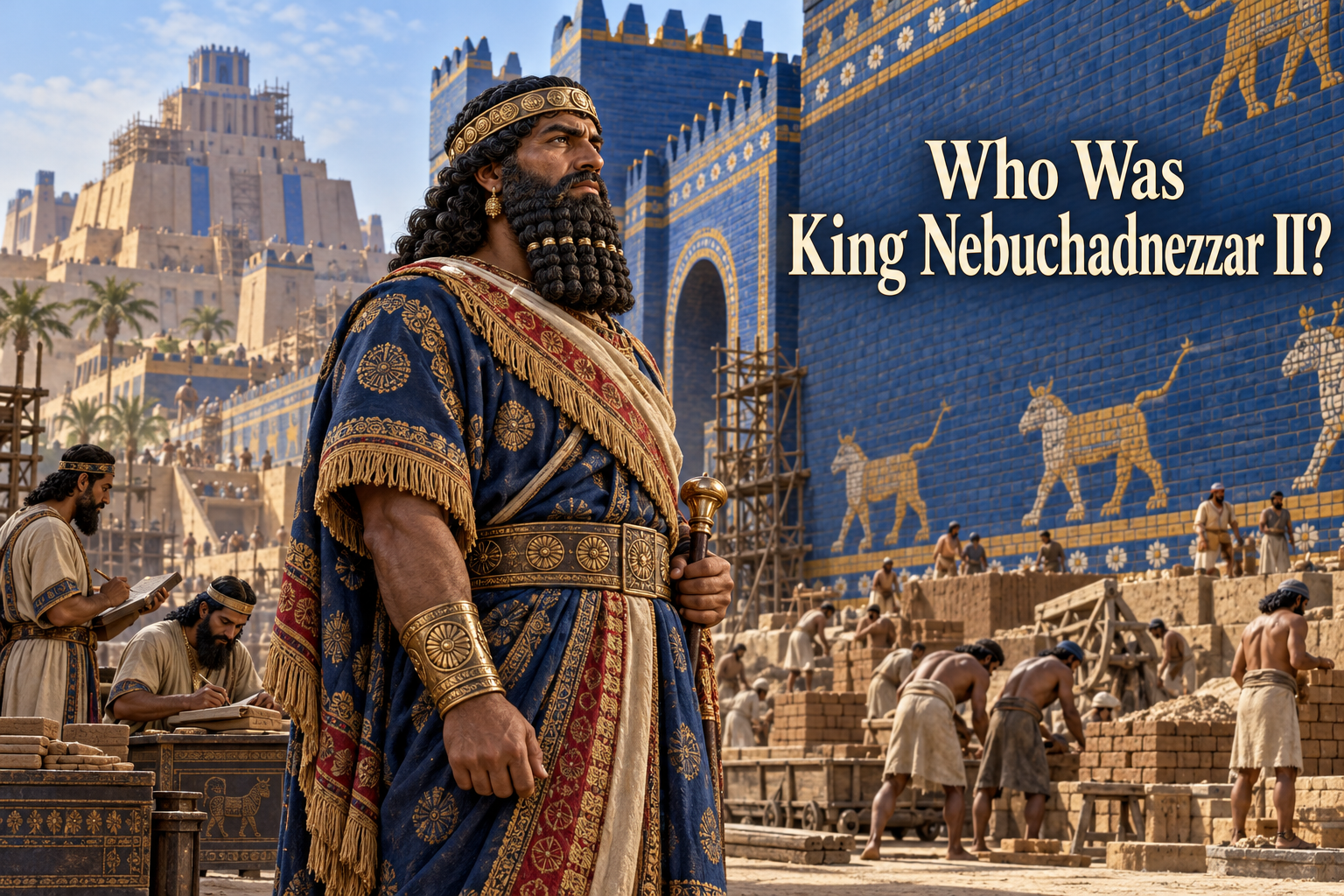
Nebuchadnezzar II was the most powerful king of the Neo-Babylonian Empire and the foreign ruler who destroyed Jerusalem and its temple. Babylonian inscriptions celebrate him chiefly as a builder chosen by the gods Marduk and Nabu. The Bible remembers him as conqueror, instrument of divine judgment, proud monarch, and, in Daniel, a king forced to learn that heaven rules. Those sources need to be read in their own contexts before being brought into conversation, because royal inscriptions, Judean narratives, archaeology, and later tradition answer different questions.
From crown prince to emperor
Nebuchadnezzar was the son of Nabopolassar, who rebelled against Assyria and founded the Neo-Babylonian dynasty. His Akkadian name, Nabu-kudurri-usur, invokes the god Nabu and is commonly understood along the lines of “Nabu, protect my heir” or “protect the boundary.” English Bibles use both Nebuchadnezzar and Nebuchadrezzar, reflecting variant transmission of the name. The king should be distinguished from Nebuchadnezzar I, who ruled Babylon more than five centuries earlier.
As crown prince, Nebuchadnezzar led Babylonian forces against Egypt and the remaining Assyrian allies at Carchemish in 605 BC. The Babylonian Chronicle reports the defeat and pursuit of the Egyptian army. When Nabopolassar died, Nebuchadnezzar returned quickly to Babylon and took the throne. He reigned from 605 to 562 BC, creating the stability and monumental building program for which Neo-Babylonian Babylon became famous.
Jeremiah 46 connects Egypt’s defeat at Carchemish with Nebuchadnezzar’s advance. Daniel 1 dates an early deportation of Judeans to the third year of Jehoiakim, which has generated chronological discussion because the Babylonian Chronicle and Kings frame the first securely dated capture of Jerusalem in 597 BC. Proposals include different regnal counting systems, a preliminary incursion, or literary chronology. No surviving Babylonian record independently confirms a Jerusalem deportation in 605.
Jerusalem, Jehoiachin, and Zedekiah
Judah shifted between submission and resistance as Babylon replaced Assyria and defeated Egyptian influence. Nebuchadnezzar besieged Jerusalem in 597 BC after Jehoiakim’s rebellion. Jehoiakim died during the crisis, and his son Jehoiachin surrendered after a brief reign. The Babylonians deported the king, royal family, officials, warriors, and skilled workers and carried away temple and palace treasures (2 Kings 24:8–17).
The Babylonian Chronicle provides unusually close external confirmation. It states that in Nebuchadnezzar’s seventh year he besieged the city of Judah, captured it, seized its king, and appointed a ruler of his own choice. The tablet does not use the biblical kings’ names in the preserved lines, but the date and sequence correspond to Jehoiachin’s removal and Zedekiah’s appointment. Babylonian ration tablets later name Jehoiachin, king of Judah, and his sons among recipients in the royal system.
Zedekiah eventually rebelled despite an oath of loyalty. Nebuchadnezzar returned, besieged Jerusalem, and directed the campaign that ended in 587 or 586 BC. After Zedekiah’s capture, his sons and officials were killed at Riblah, and he was blinded and taken to Babylon. Nebuzaradan, the Babylonian commander, burned the temple, palace, and houses and dismantled the walls (2 Kings 25:1–21). The text distinguishes Nebuchadnezzar’s imperial authority from subordinates who performed particular actions.
Jeremiah repeatedly calls Nebuchadnezzar God’s servant, not because the Babylonian king worshiped the Lord or acted humanely, but because God used his empire to judge Judah and surrounding nations. The title describes divine sovereignty over an unwitting ruler, not moral approval of imperial violence. Jeremiah also announces judgment on Babylon. An instrument of judgment remains accountable for its own pride and cruelty.
Babylon rebuilt
Nebuchadnezzar’s own inscriptions say far more about construction than conquest. He rebuilt and embellished temples, palaces, fortifications, streets, and ceremonial approaches in Babylon and other cities. Stamped bricks and foundation cylinders bear his name across the site. The Ishtar Gate and Processional Way, decorated with glazed brick animals associated with Babylonian deities, belonged to the monumental capital his building program shaped.
A cylinder in the British Museum describes his restoration of temples and ziggurats at Babylon and Borsippa, repair and expansion of his father’s palace, and construction of defenses. Another inscription tradition celebrates Babylon’s walls. These are royal documents intended to honor the king and the gods, so they are not neutral administrative reports. Their abundance nevertheless leaves no doubt that Nebuchadnezzar was a major builder.
Ancient Greek writers later described Babylon’s splendor, and the Hanging Gardens became one of the traditional Seven Wonders of the ancient world. No extant Babylonian inscription securely credits Nebuchadnezzar with the Hanging Gardens, and archaeology has not settled their location or even whether the famous gardens were in Babylon rather than another city such as Nineveh. The romantic story that he built them for a homesick wife is later tradition, not established biography.
Nebuchadnezzar in Daniel
The book of Daniel places several court narratives in Nebuchadnezzar’s reign. In Daniel 2 the king dreams of a statue made of successive metals, and Daniel reveals both the dream and its interpretation: earthly kingdoms will give way to the kingdom God establishes. Nebuchadnezzar honors Daniel and acknowledges his God, but the recognition does not yet become steady humility.
Daniel 3 portrays the king erecting a great golden image and commanding officials to worship it. Shadrach, Meshach, and Abednego refuse and are thrown into a blazing furnace, where God preserves them. Nebuchadnezzar then praises their God and threatens anyone who speaks against him. The response is still imperial: he moves from enforced worship of the image to a violent decree protecting Israel’s God. Amazement at a miracle has not yet taught him that faith cannot be produced by threat.
In Daniel 4 Nebuchadnezzar narrates a dream of a great tree cut down and a period of humiliation in which he lives like an animal until acknowledging the Most High. The chapter describes his reason returning and his kingdom being restored. Historians have no Babylonian record of such an episode, and proposals connecting it with Nabonidus’s long absence from Babylon or the Prayer of Nabonidus among the Dead Sea Scrolls remain disputed. Those parallels may illuminate how stories of humbled kings circulated, but they do not identify the individuals as the same man.
Daniel’s narratives make theological claims about empire, pride, faithful witness, and God’s rule. Scholars debate the book’s date and literary development, with traditional readings locating Daniel’s core testimony in the sixth century BC and many critical scholars placing its final form in the second century BC. That debate matters because the historical setting and the individual court episodes do not have the same kinds of independent evidence. The historical Nebuchadnezzar is abundantly attested; the episodes in Daniel are known from the biblical text.
What archaeology and texts can establish
Nebuchadnezzar is one of the best-attested rulers who appears in the Bible. Babylonian chronicles establish his early campaigns and the 597 capture of Jerusalem. His building inscriptions survive in large numbers, and archaeology reveals the monumental capital associated with his reign. Judean destruction layers at Jerusalem and Lachish correspond to Babylon’s campaigns, while exilic archives show Judeans living and working in Babylonia.
The evidence does not support every popular claim. No securely identified portrait allows us to know his face, no inscription narrates the madness of Daniel 4, and no contemporary Babylonian text names Zedekiah. The so-called Tower of Babel should not be casually identified with a structure built by Nebuchadnezzar, although he restored Babylon’s great ziggurat, Etemenanki, centuries after the setting Genesis implies. Similarity and later rebuilding are not identity.
The destruction of Jerusalem is historically secure, but even there precision matters. The Babylonian Chronicle’s preserved text narrates 597, not the final 587/586 siege. The later destruction is reconstructed from Kings, Jeremiah, chronology, and archaeology. Strong evidence does not become stronger by attributing every fact to the wrong tablet.
Death and legacy
Nebuchadnezzar died in 562 BC after about forty-three years on the throne. His son Amel-Marduk succeeded him and later released Jehoiachin from confinement, gave him a place of honor, and provided for him (2 Kings 25:27–30). Babylon entered a period of rapid royal turnover before Nabonidus took power. In 539 BC Cyrus of Persia captured Babylon, ending the empire Nebuchadnezzar had made formidable.
Later Jewish and Christian imagination often makes Nebuchadnezzar the face of pagan arrogance, while later regional traditions sometimes magnify him as a legendary builder or conqueror. The Bible itself is more precise. Jeremiah can call him God’s servant, Kings can record his devastation, and Daniel can portray him praising the Most High after humiliation. None of those perspectives turns him into a covenant king or excuses the suffering his armies caused.
Nebuchadnezzar demonstrates how Scripture speaks about rulers outside Israel. God’s sovereignty can work through them without endorsing their gods, propaganda, or brutality. Their achievements can be real and their pride judged. The king rebuilt Babylon until it looked permanent, but his dynasty soon faltered and his empire fell within a generation. Daniel’s point survives the bricks: however imposing the statue, human kingdoms do not receive the final word.