
Who Was King Solomon?
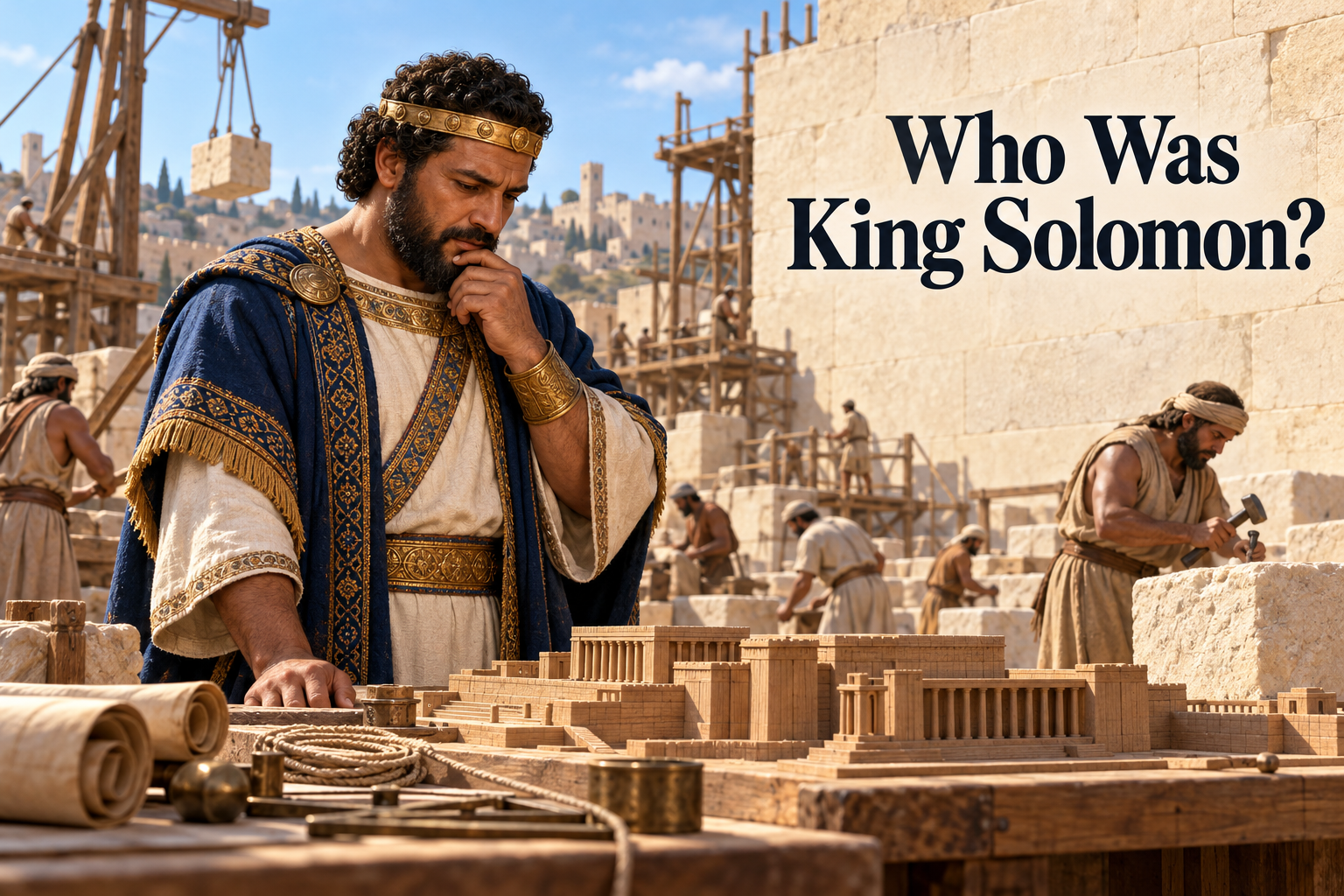
Solomon is remembered for wisdom, wealth, the Jerusalem temple, and a kingdom at peace. He is also remembered for forced labor, political marriages, accumulated luxury, and worship compromised by allegiance to other gods. First Kings does not present these as two unrelated Solomons. The wise king who discerned truth in a difficult case could still fail to govern his own desires. His reign displays the glory Israel associated with David’s dynasty and the fractures that would soon split it.
A contested succession
Solomon was a son of David and Bathsheba, born after the death of the child conceived in David’s abuse of Bathsheba and murder of Uriah. David and Bathsheba named him Solomon, a name related to peace, and the Lord loved him. Through Nathan the prophet he also received the name Jedidiah, “beloved of the Lord” (2 Samuel 12:24–25). First Chronicles also names Nathan, Shammua, and Shobab as sons of David and Bathsheba; the Nathan in that list is Solomon’s brother, not Nathan the prophet.
Solomon did not inherit the throne without opposition. When David was old, his son Adonijah gathered royal display, important allies, and a sacrificial feast and declared himself king. Nathan alerted Bathsheba, and together they pressed David to act on his oath that Solomon would reign. David ordered Solomon anointed at Gihon, and the public celebration ended Adonijah’s immediate bid (1 Kings 1).
The transition remained violent. Adonijah later asked to marry Abishag, David’s former attendant, a request Solomon interpreted as a renewed claim to the kingdom. Solomon ordered his execution, removed Abiathar from the priesthood, and had Joab killed at the altar after reminding his officers of Joab’s murders. Shimei was later executed after violating restrictions placed upon him. Some actions answered real threats or bloodguilt, but the opening chapters deliberately show the kingdom being established through calculated force as well as divine promise.
The gift and limits of wisdom
At Gibeon, God appeared to Solomon in a dream and invited him to ask for what he desired. Solomon requested a listening heart to judge the people and distinguish good from evil. God commended the request and granted wisdom, along with riches and honor. The famous case of two women claiming the same baby then demonstrated Solomon’s discernment: his proposed division of the child exposed the true mother’s compassion (1 Kings 3:16–28).
The proposal was a judicial strategy, not approval of harming a child. Solomon read the women’s responses and returned the living son to his mother. The episode also shows ordinary women, identified as sex workers, receiving direct access to royal justice. Their occupation does not make their grief trivial or their testimony disposable.
First Kings credits Solomon with proverbs, songs, knowledge of the natural world, and international fame. Proverbs, Ecclesiastes, and Song of Songs have all been associated with him, though the nature of that association differs. Proverbs contains collections linked to Solomon as well as material attributed to other figures and later collectors. Ecclesiastes presents the words of Qoheleth, a Davidic king in Jerusalem, without naming Solomon directly, and Song of Songs can be translated as by, for, about, or belonging to Solomon. Traditional attribution deserves respect, but the texts themselves leave room for composition, collection, and editorial history.
Building the temple
Solomon’s defining achievement was the temple in Jerusalem. He worked with Hiram of Tyre, imported cedar and skilled labor, and organized large labor forces. The building provided a permanent center for the ark and Israel’s sacrificial worship. Its design communicated holiness through graded spaces, priestly access, and symbolic imagery drawn from creation and royal architecture.
At the dedication, Solomon acknowledged that even heaven could not contain God, much less a building (1 Kings 8:27). He prayed that God would hear prayers directed toward the temple, forgive sin, uphold justice, respond to disaster and repentance, and hear the foreigner who came because of God’s name. The temple was central, but it was not a box holding a manageable deity. Its purpose depended on God’s presence and covenant mercy.
Solomon also built his own palace complex, a project that took thirteen years compared with seven for the temple. The chronological comparison may simply reflect scale and complexity, but it contributes to the book’s quiet questions about royal priorities. He conscripted labor from Israel and subjected remaining Canaanite populations to forced labor. Administrative achievement came with a human cost, and the later tribes’ complaint about Solomon’s heavy yoke shows that the cost was remembered.
Wealth, diplomacy, and the queen of Sheba
Solomon’s kingdom benefited from trade, tribute, alliances, and control of strategic routes. First Kings describes gold, ships, horses, chariots, luxury goods, and a throne of ivory overlaid with gold. The queen of Sheba came with hard questions, observed his wisdom and prosperity, and praised the Lord for placing him on the throne to maintain justice (1 Kings 10:1–9). Jesus later referred to her journey when rebuking those who ignored wisdom greater than Solomon’s.
The location of Sheba is generally associated with the kingdom of Saba in southwestern Arabia, centered in present-day Yemen, though connections across the Red Sea complicate a simple map. No surviving inscription identifies the visiting queen by name or independently confirms the meeting. Later Jewish, Christian, Ethiopian, and Islamic traditions greatly expand her story, including names and relationships not supplied by Kings. Those traditions have rich histories of their own but are not additional verses of the biblical account.
Solomon’s splendor also reads like a sustained encounter with the warnings for kings in Deuteronomy 17:16–17. He multiplied horses, especially through Egyptian trade, accumulated enormous silver and gold, and multiplied wives. First Kings can celebrate the reach of his reign while showing the covenant danger built into its machinery. Success is not self-authenticating.
Women, idolatry, and a divided heart
Solomon loved many foreign women and had seven hundred royal wives and three hundred concubines according to First Kings 11. Royal marriages created diplomatic relationships, so politics was certainly involved, but the text describes personal attachment as well. The women’s national identities are named because their gods become the issue. The narrator says they turned Solomon’s heart after other gods when he was old.
The blame belongs to Solomon. His wives lived within marriage arrangements shaped by royal power, and the text condemns his choice to build shrines and participate in compromised worship. It would be unfair to turn unnamed foreign women into a generic warning that women corrupt good men. Solomon possessed authority, knowledge, and repeated divine warning; he was responsible for how he used them.
God announced that the kingdom would be torn from Solomon’s son, though one tribe would remain for David’s sake and the division would not occur during Solomon’s lifetime. Adversaries arose, and Jeroboam received a prophetic promise of rule over ten tribes. Solomon attempted to kill him, repeating the pattern of threatened kings seeking to destroy future rivals. The reign associated with peace ended with fear and a succession crisis already forming.
History, archaeology, and Solomon’s scale
Archaeologists and historians debate the size and organization of the tenth-century BC kingdom associated with David and Solomon. Excavations at Jerusalem, Hazor, Megiddo, Gezer, Khirbet Qeiyafa, and other sites have produced competing chronologies and interpretations. Some scholars argue for a substantial centralized kingdom compatible in broad outline with the biblical account; others see a smaller highland polity whose splendor was amplified by later writers. No inscription from Solomon’s lifetime securely names him.
The ninth-century BC Tel Dan Stele’s reference to the House of David supports the later existence of a Davidic dynasty, but it does not establish the dimensions of Solomon’s empire or identify his building projects. Monumental gates once confidently assigned to Solomon have been redated or reassessed by different archaeological schools. The evidence is significant but not self-interpreting. A gate cannot tell us which biblical king signed the construction order.
The Bible itself is theological history rather than a royal building report. Kings evaluates Solomon by covenant faithfulness, not simply by whether he could organize labor and trade. Archaeology may refine our understanding of state formation and urban development; it cannot measure wisdom, verify a dream, or decide whether God accepted a dedication prayer. Historical humility is not a retreat from Scripture but a refusal to make artifacts say more than they can.
Solomon’s legacy
Solomon reigned forty years and was buried in the City of David. His son Rehoboam inherited the throne and rejected pleas to lighten the harsh labor imposed by his father. The northern tribes seceded, and the united kingdom fractured. First Kings attributes the division both to Solomon’s idolatry and to Rehoboam’s foolishness, allowing divine judgment and human choice to operate together.
Later Scripture remembers Solomon’s glory and wisdom while refusing to make him the final king. Jesus spoke of Solomon’s splendor but said the lilies were clothed more beautifully, and he claimed to be greater than Solomon (Matthew 6:28–29; 12:42). Solomon built a house for God but could not contain God, governed Israel but could not govern his own loves, and left a kingdom that split almost immediately. His wisdom remains a gift, yet his life warns that knowing what is right and desiring what is right are not the same achievement.