
Who Was Lazarus of Bethany?
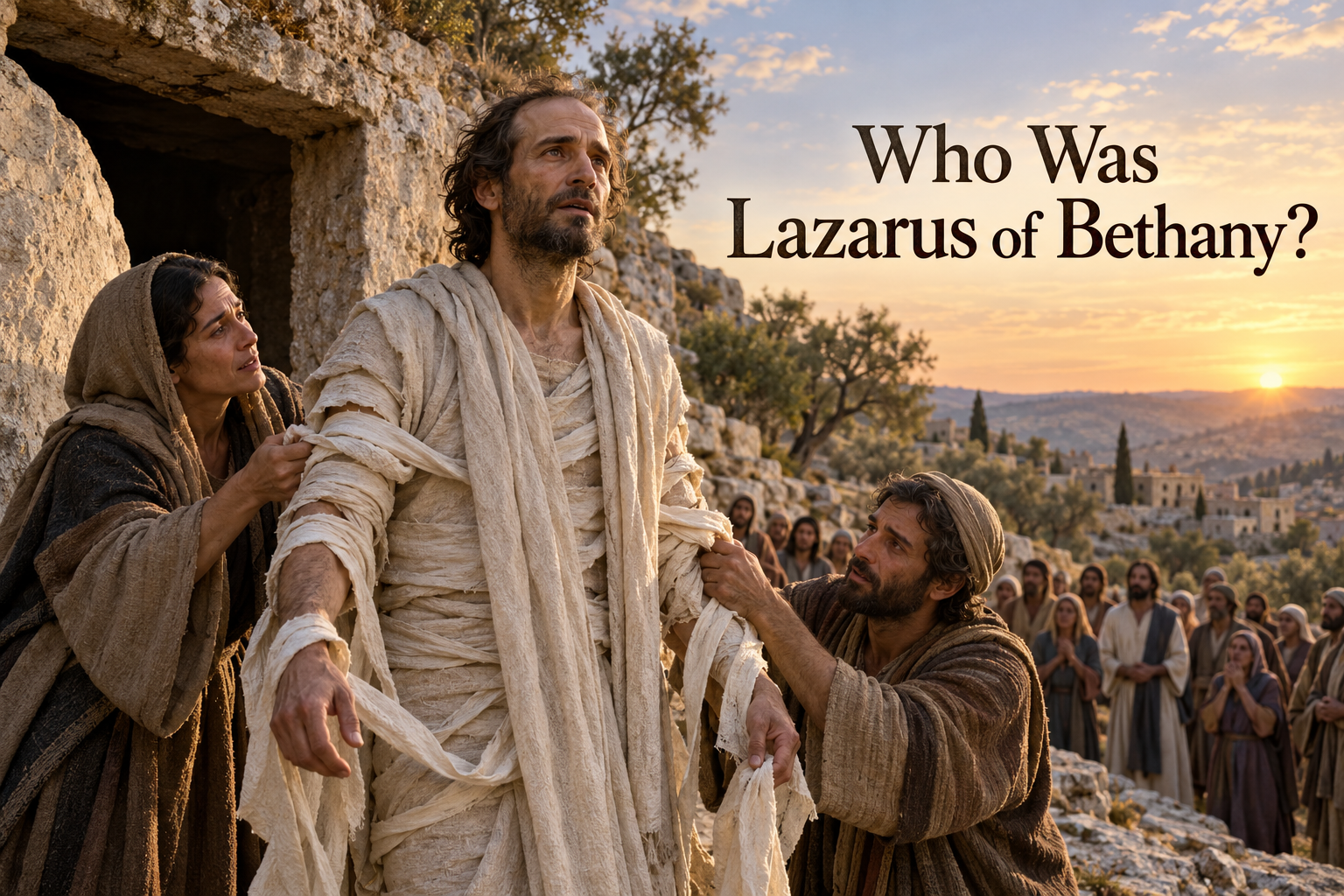
Lazarus of Bethany is the man Jesus raised from the dead shortly before his final entry into Jerusalem. He was the brother of Martha and Mary, lived in a village near Jerusalem, and belonged to a family Jesus loved. His death and restoration form the climactic sign in John’s Gospel, revealing Jesus as “the resurrection and the life” while accelerating the plot to kill him. Lazarus never speaks a recorded word, but what happens to him forces nearly everyone around him to decide what they think about Jesus.
He shouldn’t be confused with the poor man named Lazarus in Jesus’ story about a rich man and the afterlife (Luke 16:19-31). That Lazarus is a character in a parable told in Luke; Lazarus of Bethany is presented in John as a friend of Jesus with two named sisters. The shared name doesn’t make them the same person. Keeping them distinct prevents details from one story from being imported into the other.
A Family Jesus Loved
John introduces Lazarus through his sisters and their urgent message: “Lord, he whom you love is ill” (John 11:1-3). The Gospel then says explicitly that Jesus loved Martha, Mary, and Lazarus. This family isn’t described as part of the Twelve, but their home appears to have been a place of friendship and hospitality. Bethany lay near Jerusalem, about fifteen stadia away, commonly estimated at roughly two miles (John 11:18). Its location makes the family’s story especially important as Jesus moves toward the city and his death.
John identifies Mary as the woman who anointed Jesus and wiped his feet with her hair, an event narrated in the next chapter. She shouldn’t automatically be identified with Mary Magdalene or with the unnamed “sinful woman” in Luke’s Gospel. Christian tradition often merged these women, but the New Testament doesn’t. Lazarus’s family consists of Martha, Mary of Bethany, and Lazarus, and the text gives no additional genealogy or marital history.
The sisters’ message assumes Jesus can help, yet it doesn’t dictate how. Jesus responds that the illness will serve God’s glory and then remains where he is for two more days (John 11:4-6). John places the delay beside the declaration of Jesus’ love, making it impossible to explain the delay as simple indifference. Still, the narrative doesn’t ask us to call the sisters’ anguish painless or unreal. Divine purpose and human grief stand together in a way that resists easy slogans.
Death, Delay, and Danger
When Jesus announces that Lazarus has “fallen asleep,” the disciples take him literally, so Jesus tells them plainly that Lazarus has died. He then proposes returning to Judea, where opponents had recently tried to stone him. Thomas understands the danger and grimly tells the others to go and die with him (John 11:7-16). The journey is therefore about more than reversing one death. By going to Lazarus’s tomb, Jesus moves toward the hostility that will lead to his own.
By the time Jesus arrives, Lazarus has been in the tomb four days. John doesn’t explain the number by citing a belief that the soul hovered near the body for three days, and later rabbinic formulations shouldn’t be read back into the verse as certain background. The stated fact makes the death unmistakable and leaves no room for the idea that Lazarus merely fainted. The household is surrounded by mourners, and both sisters tell Jesus that if he had been there, their brother wouldn’t have died.
Martha goes out to meet Jesus and confesses faith even through disappointment. Their conversation moves from a general hope in resurrection on the last day to Jesus’ claim, “I am the resurrection and the life” (John 11:20-27). Martha then identifies him as the Messiah, the Son of God, the one coming into the world. The scene doesn’t portray her as spiritually inferior to Mary. She gives one of the Gospel’s clearest confessions before she sees her brother restored.
Jesus at the Tomb
Mary meets Jesus with the same anguished sentence Martha used, but her encounter unfolds differently. She falls at his feet, and the mourners weep with her. John describes Jesus as deeply moved and troubled, using language that can carry anger as well as sorrow (John 11:28-35). Interpreters debate whether the anger is directed at death, unbelief, the mourning scene, or some combination. What isn’t debatable is that Jesus doesn’t remain emotionally untouched by the suffering he is about to reverse.
“Jesus wept” is famously brief, but it isn’t sentimental decoration. The one who knows resurrection is coming still enters the grief of the bereaved. His tears don’t indicate helplessness, and his power doesn’t cancel compassion. Christians sometimes rush mourners toward a correct doctrine of heaven before making room for loss. At Lazarus’s tomb, truth and tears belong together.
Jesus orders the stone removed. Martha protests that after four days there will be an odor, another blunt confirmation that everyone expects decay rather than recovery. Jesus prays aloud so the crowd may understand his relation to the Father, then calls, “Lazarus, come out!” (John 11:38-44). The dead man emerges still bound in gravecloths, and Jesus tells the people to unbind him and let him go.
Raised, but Not Yet the Final Resurrection
Lazarus truly returns to life in John’s account, but his raising isn’t identical to Jesus’ resurrection. Lazarus comes back into ordinary mortal existence and emerges needing others to remove his burial wrappings. Jesus rises never to die again, inaugurating the new creation Christians await. The Gospel doesn’t narrate Lazarus’s eventual death, but there’s no suggestion that he became immortal on that day. The distinction is why theologians sometimes call Lazarus’s experience a restoration or resuscitation without denying the miracle.
The sign reveals Jesus’ authority over death, yet Lazarus isn’t treated as a prop with no personal cost. He endured illness, death, burial, and a return to a community suddenly consumed by controversy. John doesn’t tell us what Lazarus remembered or felt, so reports of his experience beyond death are inventions. His silence protects the story from becoming a tour of the afterlife. The focus stays on Jesus, whose voice summons the dead.
Nor should the account be turned into a promise that faithful people will be spared bereavement now. Lazarus was loved and still became ill; his sisters were loved and still grieved. The miracle is a sign pointing to Jesus’ identity and the final resurrection, not a guarantee that every present illness will end in immediate recovery. Christian hope faces death honestly because it rests on Christ’s victory, not because believers are asked to deny the grave.
The Man Others Wanted Dead
Many witnesses believe in Jesus after seeing what happened, while others report it to the Pharisees. The chief priests and Pharisees gather the council and fear that Jesus’ signs will provoke Roman action against their place and nation. Caiaphas argues that one man should die for the people, and from that day they plan Jesus’ death (John 11:45-53). John interprets the high priest’s political calculation as an unwitting prophecy. That theological irony doesn’t make the plot morally right; fear and expediency still drive leaders toward killing an innocent man.
Lazarus appears again at a dinner in Bethany where Martha serves and Mary anoints Jesus. He reclines at the table with Jesus, a public sign that his restoration wasn’t a momentary illusion (John 12:1-2). A large crowd comes not only to see Jesus but also to see Lazarus. The chief priests then plan to kill Lazarus because his existence is leading many people to believe (John 12:9-11). Scripture doesn’t say whether they carried out that plan, so claims that Lazarus escaped or was martyred at this point go beyond the text.
History, Place, and Tradition
Bethany was a real settlement on the eastern side of the Mount of Olives, and archaeology confirms habitation and burial activity in the area during antiquity. A traditional tomb of Lazarus has drawn pilgrims for centuries. That site may preserve early local memory, but its identification can’t be established as archaeological proof that this was Lazarus’s specific burial place. Material remains illuminate the setting; they don’t verify the miracle or name the occupant John describes.
No known contemporary inscription or non-Christian source securely identifies Lazarus of Bethany. That absence isn’t unusual for a private villager, though it means historical claims must remain modest. The Gospel of John is the source for his illness, death, raising, and later danger. Readers may accept John as truthful testimony without claiming more external corroboration than exists.
Later traditions sent Lazarus in different directions. An Eastern tradition made him a bishop in Cyprus, while medieval Western legends brought him and his sisters to southern France. The traditions conflict and arise too late to supply dependable first-century biography. Churches may commemorate them as part of devotional history, but they shouldn’t be presented as though John continued the story in an unwritten final chapter.
The Friend Who Became a Sign
Lazarus is remembered because he came out of a tomb, but John first identifies him as someone Jesus loved. That order matters. The miracle isn’t a display performed on an anonymous body; it takes place amid friendship, lament, family confidence, misunderstanding, and tears. Jesus confronts death as an enemy while standing with people wounded by it.
The result is both life and danger. Lazarus is restored to his sisters, yet his presence intensifies the decision around Jesus and even makes him a target. He becomes a living witness without delivering a speech. His story points beyond the temporary extension of one man’s life to the one who entered death and defeated it. Lazarus came out still wrapped for burial; Jesus would leave his graveclothes behind, and that is where the sign finally leads.