
Who Was Leah?
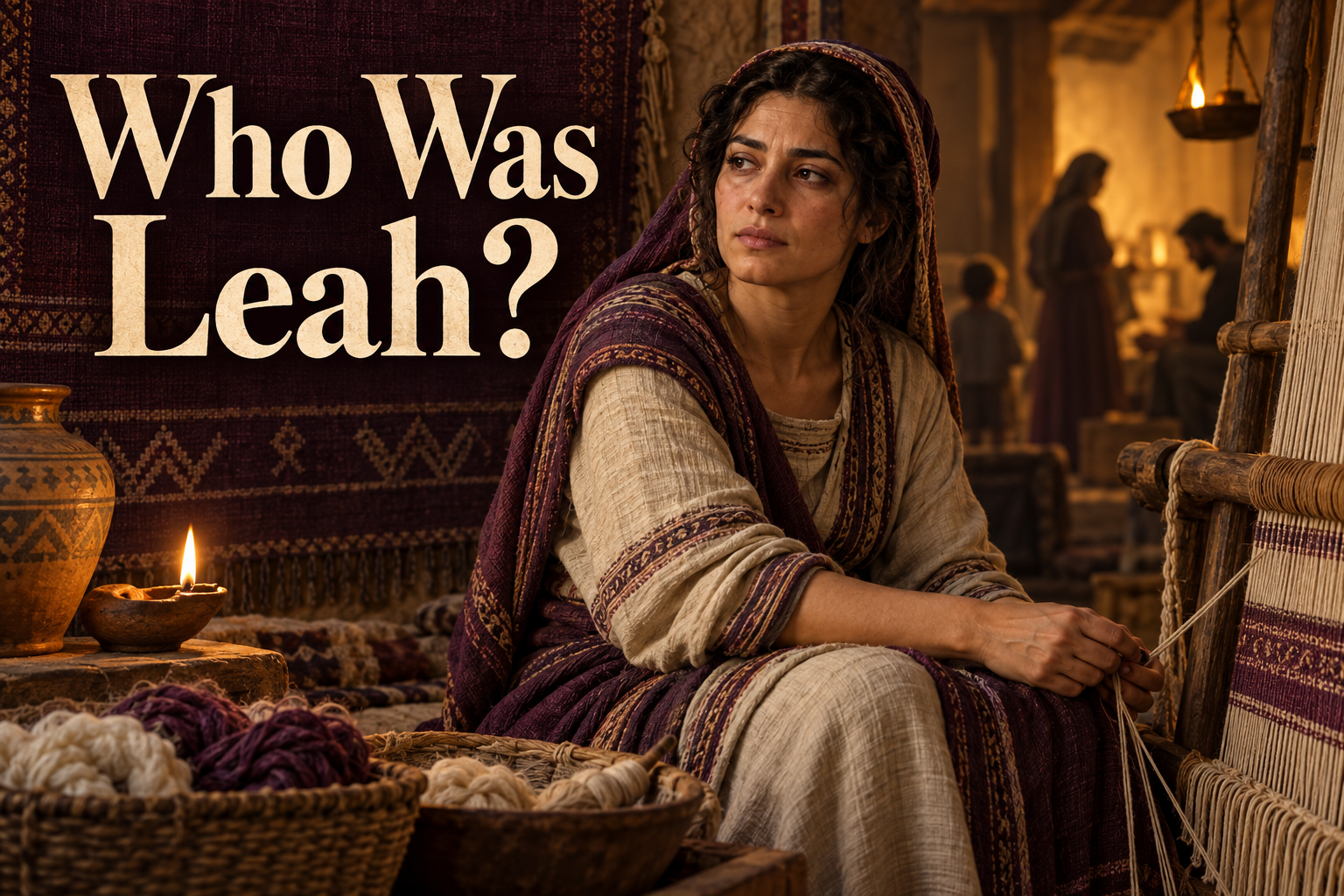
Leah enters Genesis as the daughter Jacob didn’t intend to marry. Her father uses her in a wedding-night deception, her husband openly prefers her sister, and much of her adult life unfolds inside a contest for affection and children. Yet the Bible doesn’t leave her as an unwanted footnote. Leah becomes the mother of six sons and a daughter, an ancestor of Israel’s priestly and royal lines, and one of the women later remembered as having built the house of Israel. Her story is painful precisely because God works through her life without calling the conditions imposed on her good.
Laban’s older daughter
Leah was the older daughter of Laban and the sister of Rachel. Genesis 29 describes Leah’s eyes with a Hebrew word that can mean weak, tender, or delicate, then contrasts her with Rachel, who is said to have a beautiful figure and appearance. The verse has inspired plenty of speculation about Leah’s looks, most of it more confident than the language allows. What the narrative makes unmistakable is that Jacob loves Rachel and agrees to work seven years to marry her.
At the wedding, Laban substitutes Leah for Rachel. The text doesn’t explain how the deception succeeds, and it doesn’t tell us whether Leah consented, resisted, or had any meaningful choice. In a household controlled by her father, she may have had very little power over the arrangement. Jacob discovers the switch the next morning and confronts Laban, who appeals to the local custom of marrying the older daughter first. He then gives Rachel to Jacob after the bridal week in exchange for another seven years of labor.
The result is a polygamous marriage built on fraud and favoritism. Genesis narrates polygamy because it belonged to the world of the patriarchs; it doesn’t present the arrangement as a model. The household soon fills with jealousy, bargaining, competition, and wounded children. Laban’s scheme may solve his immediate problem, but everyone else lives with the consequences.
The wife who wasn’t loved
Genesis says the Lord sees that Leah is hated and opens her womb while Rachel remains childless. Some translations soften the word to “unloved,” since the comparison may mean loved less, but Leah’s naming of her children shows that the rejection felt severe. She names her first son Reuben because the Lord has seen her misery and she hopes Jacob will now love her. Simeon’s name is connected with the Lord hearing that she is unloved. When Levi is born, she hopes her husband will finally become attached to her.
With Judah, something changes in Leah’s words: “This time I will praise the Lord.” The text doesn’t say she no longer wanted Jacob’s love, and it would be sentimental to pretend that years of rejection disappeared in a sentence. Still, the name marks a turn from measuring her worth entirely by her husband’s response. Judah will become the ancestor of David’s royal line and, in Christian understanding, of Jesus the Messiah. Leah couldn’t see that future, but Genesis allows readers to see how much of Israel’s story comes through the woman Jacob didn’t choose.
Children in a household rivalry
When Leah stops bearing for a time, she gives her enslaved servant Zilpah to Jacob, and Zilpah bears Gad and Asher. Rachel has already done the same with Bilhah. Ancient households could use enslaved women as surrogates, but describing the custom doesn’t make it consensual or righteous. Bilhah and Zilpah are placed in sexual and reproductive service by people who control them, and the sons they bear are claimed within the rivalry of the two sisters. Genesis records the practice with remarkable frankness, while the suffering that follows the whole arrangement keeps us from treating it as divine endorsement.
The rivalry becomes especially visible when Leah’s son Reuben finds mandrakes, plants associated in the ancient world with fertility. Rachel asks for some, and Leah replies that Rachel has taken her husband and now wants her son’s mandrakes as well. Rachel bargains away Jacob’s company for the night in exchange for the plants. Leah goes out to meet him and announces that she has hired him, language that shows how thoroughly intimacy has become part of the household economy. The scene is almost painfully domestic: two sisters with legitimate wounds negotiate around a husband whose preference has helped set them against each other.
Leah then bears Issachar, Zebulun, and Dinah. Her hopes remain visible in the names; after Zebulun she says that perhaps her husband will honor her because she has borne him six sons. The narrative values these children as founders of Israel’s tribes, but it also shows the emotional cost of treating fertility as a competition for security. Leah has considerable reproductive success and still longs to be cherished. Children can be gifts without being tools capable of repairing a marriage.
Leah as Dinah’s mother
Leah is the mother of Dinah, whose violation in Genesis 34 leads to deception and mass violence. The chapter focuses on Jacob, Dinah’s brothers, Shechem, and Hamor; it tells us nothing about Leah’s response. We shouldn’t fill that silence with invented speeches or assume that a mother’s grief didn’t matter because the narrator didn’t record it. Dinah herself is also denied a speaking voice, while men debate marriage, honor, property, circumcision, revenge, and survival around her.
Translations and interpreters have debated some details of Dinah’s encounter with Shechem, but the text describes her as taken, sexually violated, and humiliated. Simeon and Levi answer that wrong by deceiving the men of the city, killing them while they are recovering from circumcision, and taking women and children as plunder. Jacob later condemns their violent anger in Genesis 49. Nothing in the chapter requires us to choose between minimizing sexual violence and approving collective slaughter; the narrative exposes a family and a city in which women bear the cost of male power.
Leaving Laban and returning to Canaan
When Jacob prepares to leave Laban, he consults Rachel and Leah. The sisters answer together that their father has treated them like foreigners, sold them, and consumed what was paid for them. Their words show that they understand the economic dimension of their marriages and share a grievance deeper than their rivalry. They support Jacob’s departure and recognize the wealth God has given him as provision for them and their children.
On the journey toward Esau, Jacob arranges his family in groups, placing the servants and their children first, Leah and her children next, and Rachel and Joseph last. The order appears to place the favored wife and son in the most protected position. Even during crisis, the family’s hierarchy remains visible. Leah crosses into Canaan as the mother of most of Jacob’s sons, but not as the wife he places nearest himself.
Burial and remembrance
Genesis doesn’t narrate Leah’s death. We learn of her burial only near the end of Jacob’s life, when he asks his sons to bury him in the cave of Machpelah. He says Abraham and Sarah were buried there, Isaac and Rebekah were buried there, and “there I buried Leah.” Rachel had died on the road and was buried near Ephrath, but Leah rests in the ancestral family tomb beside Jacob. The text doesn’t describe a late romance between them, though later readers have sometimes inferred one from the burial arrangement.
Leah’s legacy extends through her children. Levi becomes the ancestral tribe of Israel’s priests, and Judah becomes the tribe of Davidic kings. In Ruth 4:11, the elders of Bethlehem bless Ruth by invoking Rachel and Leah, “who together built up the family of Israel.” Rachel is named first in that conventional pairing, but Leah’s place as a matriarch is secure. Later Jewish tradition remembers her among Israel’s founding mothers, and Christian genealogy traces Jesus through her son Judah.
Narrative, history, and interpretation
There is no independent archaeological record naming Leah as an individual. Genesis preserves her within the patriarchal family narrative, and scholars disagree about how much specific biographical memory lies behind these traditions. The names of her sons also correspond to Israelite tribes, so the story functions at both family and national levels. That literary dimension doesn’t require treating Leah as unreal, but it does mean archaeology can’t reconstruct her private life or verify the scenes Genesis tells.
Leah’s biography is sometimes turned into a simple lesson that God rewards the less attractive sister with children. That reading accepts a shallow standard the story itself complicates. Her worth doesn’t depend on winning a beauty contest, producing more sons than Rachel, or eventually receiving a husband’s attention. God sees a woman suffering rejection and gives her a central place in Israel’s future, but the births don’t make Laban’s deception or Jacob’s favoritism acceptable.
Leah never gets the love story Jacob offered Rachel. Scripture doesn’t hide that loss, and it doesn’t require us to call an unjust family arrangement blessed merely because God brought blessing from it. Her life matters because she is seen by God when the people closest to her measure her by usefulness and preference. The unwanted bride becomes a mother of Israel, not because pain was secretly good, but because human failure didn’t have the authority to erase her.