
Who Was Lydia?
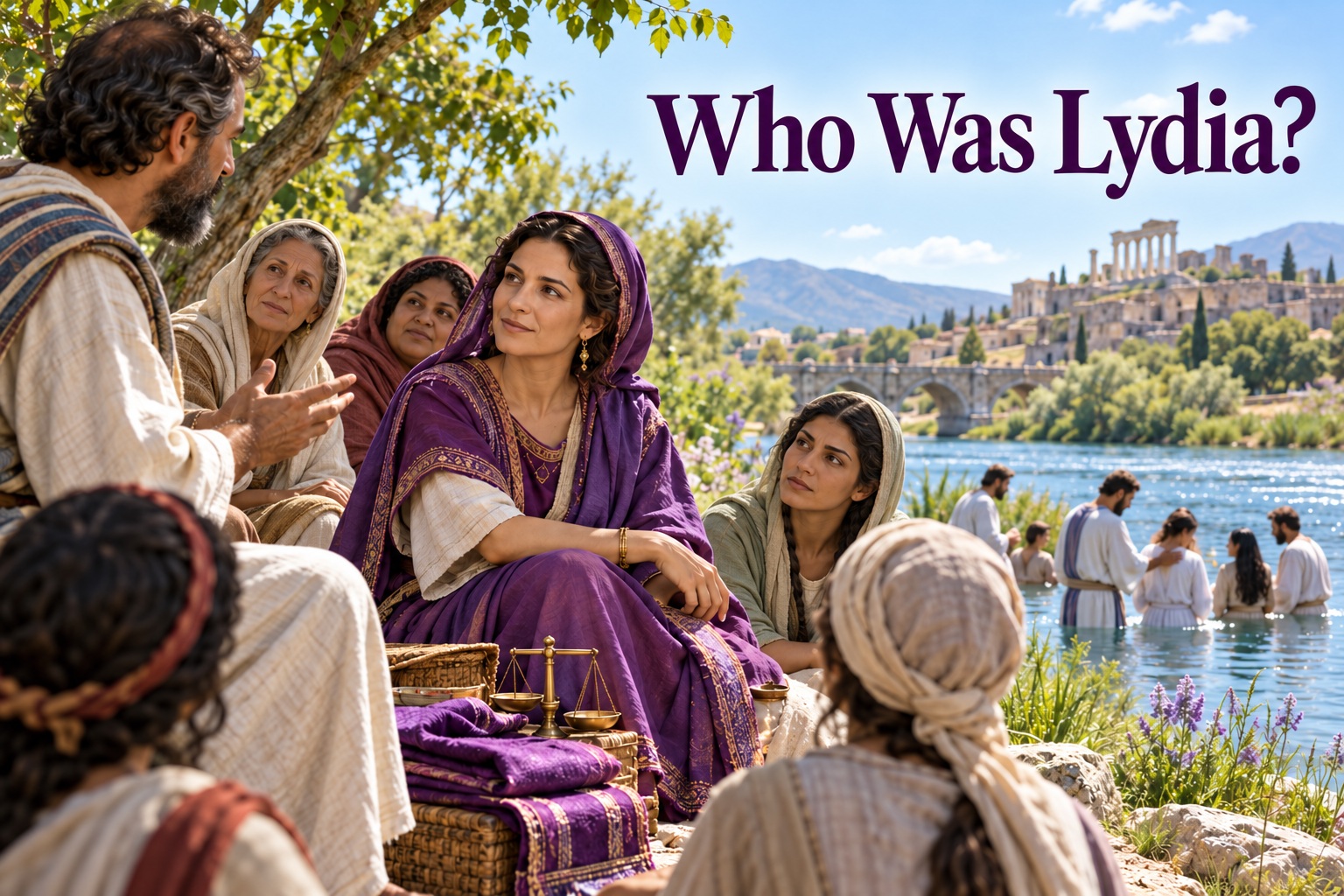
Lydia appears in Acts for only a few verses, but the door of her house stays open through the whole episode. Paul and his companions meet her at a riverside prayer gathering, she responds to the gospel, and her household is baptized. She then persuades the missionaries to accept her hospitality. After Paul and Silas leave prison, they return to her home and encourage the believers there. Luke doesn’t call Lydia the pastor of the Philippian church, a wealthy merchant, or the first Christian in Europe, though all three claims have appeared in retellings. What he does tell us is enough to show a woman whose faith quickly became a base for Christian community.
From Thyatira to Philippi
Lydia was from Thyatira, a city in western Asia Minor in the region historically known as Lydia. Her personal name may therefore have sounded to ancient hearers like “the Lydian woman,” leading some scholars to wonder whether it was a name, an ethnic designation, or both. By the time Acts introduces her, she was living or conducting business in Philippi, a Roman colony in Macedonia. The city took pride in its Roman identity, and Paul’s visit followed his vision of a Macedonian man calling for help (Acts 16:9-12). The first person Luke describes responding there wasn’t the man from the vision but a woman from across the Aegean.
Acts calls Lydia a seller of purple goods. That could refer to dyed cloth, garments, or material connected with the purple trade; the exact scale of her business isn’t given. Purple could be associated with costly textiles and elite status, but not every purple product used the rarest dye, and a dealer wasn’t automatically rich. Lydia had a household and enough control of a home to host several travelers and later a gathering of believers, which suggests resources and independence. It doesn’t tell us whether she was born free, formerly enslaved, married, widowed, or unmarried. Claims that she was an affluent executive may be possible, but they run farther than Luke’s evidence.
A worshiper of God by the river
On the Sabbath, Paul and his companions went outside the city gate to a river, where they expected to find a place of prayer. They sat down and spoke with the women gathered there. Scholars often infer that Philippi had no synagogue, perhaps because there weren’t enough Jewish men to establish one, but Acts doesn’t actually explain why the meeting took place by the river. A location near water could have been useful for ritual washing, and open-air prayer sites were known in the wider Jewish world. Beyond that, certainty would be borrowed rather than earned.
Luke describes Lydia as a “worshiper of God,” a phrase Acts uses for Gentiles attracted to the God of Israel and connected in some way with Jewish worship. Such people could honor Israel’s God and participate in synagogue life without having fully converted to Judaism. Lydia was therefore not hearing Israel’s Scriptures and hopes for the first time. As Paul spoke, Luke says, “the Lord opened her heart to listen eagerly to what was said” (Acts 16:14). Her response joins divine initiative and human attention without turning either into a competitor. God opened her heart, and Lydia listened and acted.
She and her household were baptized, after which she urged the missionaries, “If you have judged me to be faithful to the Lord, come and stay at my home.” The sentence carries both humility and determination; Luke adds that she prevailed upon them. Some traditions appeal to Lydia’s household baptism in debates about infant baptism, while others assume every member personally believed. The passage says neither that infants were present nor that they were absent. A household in the Roman world could include relatives, dependents, enslaved workers, and others attached to the home. Lydia’s baptism is explicit, but the ages and individual experiences of the remaining members aren’t supplied.
A home becomes a gathering place
Lydia’s invitation did more than solve the travelers’ lodging problem. Homes were essential to the spread of the early Christian movement because congregations generally met in domestic spaces rather than dedicated church buildings. A host supplied shelter, meals, social connections, and a place where new believers could gather. Hospitality could also carry risk. Paul and Silas soon attracted official hostility, and opening one’s house to them made Christian allegiance visible in a colony where public order and Roman loyalty mattered.
After Paul and Silas were beaten, jailed, and released, they went to Lydia’s house. There they saw and encouraged “the brothers and sisters” before departing (Acts 16:40). By then the house appears to have become a meeting point for a small community. Lydia may well have exercised leadership as its host and patron, since household heads commonly carried influence within groups that met under their roofs. Luke doesn’t give her a title, however, and he doesn’t describe the church’s internal roles. It is fair to recognize the leadership implied by her initiative without converting a sound inference into a recorded office.
She is sometimes called the first European convert to Christianity. Acts presents her as the first named convert during Paul’s mission in Macedonia, on territory now regarded as Europe. The larger slogan needs qualification. Geography wasn’t divided in quite the same cultural terms, Jewish followers of Jesus had already reached Rome, and Acts doesn’t claim that no Christian had ever set foot in Europe before Lydia’s baptism. “First named convert in Paul’s Macedonian mission” is less dramatic, but it is what the text allows us to say.
Lydia and the church at Philippi
Paul’s later letter to the Philippians shows a mature congregation marked by partnership in the gospel and material support for his ministry. It is tempting to place Lydia behind every reference to generosity, but Paul doesn’t name her in the letter. We can’t identify her with Euodia, Syntyche, the “true companion,” or any other unnamed figure. She may have remained central to the church, moved elsewhere, died before the letter was written, or simply gone unmentioned in a document addressing other concerns. The silence gives us no basis for choosing among those possibilities.
Later Christian traditions honored Lydia as a saint and sometimes credited her with an extended ministry. These traditions reflect the natural desire to know what happened after Acts, but they don’t provide secure details about her later life or death. Even the claim that she was a widow belongs to reconstruction rather than the biblical text. Lydia should be remembered with the distinctions intact: Acts tells us something substantial about her conversion, hospitality, and household, while leaving most of her biography unknown.
Faith that made room
Lydia’s short story brings together several themes important to Luke’s account of the church. The gospel crosses a regional boundary, but it arrives through an existing network of prayer, work, travel, and hospitality. A woman already oriented toward Israel’s God hears the message about Jesus and responds with public identification through baptism. Her private home then becomes a place where a new community can take shape. Mission in Acts advances through preaching and the Spirit’s direction, but also through meals, spare rooms, and people willing to attach their reputations to one another.
We don’t need to inflate Lydia’s wealth or assign her an office to appreciate her importance. Luke depicts her as attentive, decisive, persuasive, and generous. She didn’t merely make an individual profession and return to business as usual. She made room for the messengers, for her household, and for the believers who needed encouragement after a public confrontation with Roman authorities. In Philippi, the church’s first address may have been not an institution but Lydia’s open door.