
Who Was Mary, Mother of Jesus?
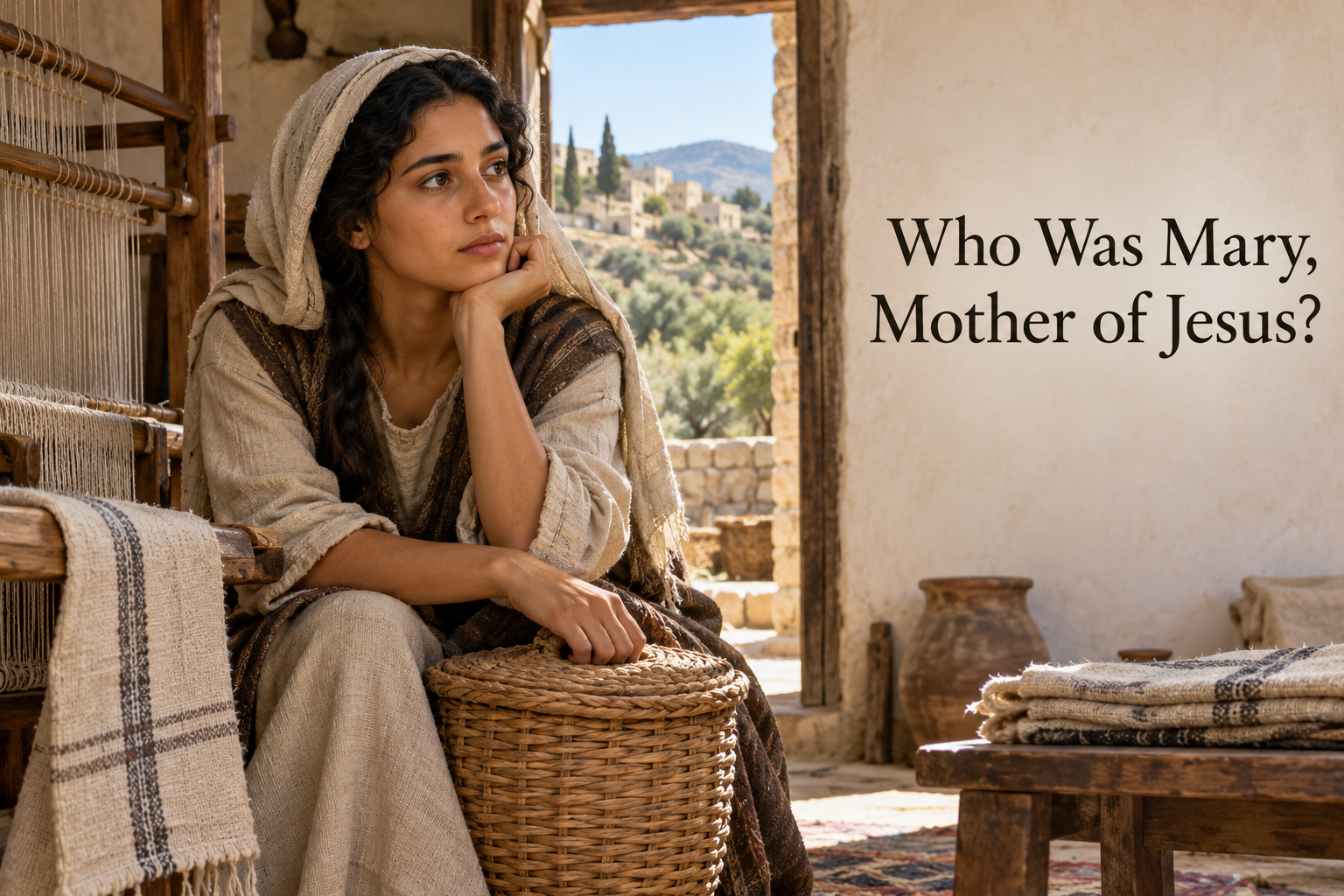
Mary, the mother of Jesus, should not be confused with Mary Magdalene, Mary of Bethany, or the other women named Mary in the New Testament. She was a Jewish woman from Nazareth who received an impossible calling: to bear Israel’s Messiah while still a virgin. The Gospels present her as favored, thoughtful, courageous, sometimes perplexed, and faithful through suffering. Christian traditions agree that she is the virgin mother of Jesus and a model disciple, then differ sharply over doctrines and devotional practices that developed around her.
Favored by God
Luke introduces Mary as a virgin betrothed to Joseph, a descendant of David. Gabriel greeted her as favored and announced that she would conceive a son named Jesus, who would be called Son of the Most High and receive David’s throne. Mary asked how this would happen since she did not know a man. The angel answered that the Holy Spirit would come upon her and the power of the Most High would overshadow her (Luke 1:26–35).
The virginal conception is explicit in both Matthew and Luke and belongs to historic Christian confession. It is not a claim that sexual relations or ordinary conception are impure. The point is that Jesus’ coming is God’s initiative and that the child is uniquely the Son of God. Matthew also connects the conception with Isaiah’s Immanuel prophecy, whose immediate historical setting and fuller fulfillment in Christ require careful interpretation.
Mary answered, “I am the Lord’s servant,” accepting a calling that could expose her to shame, broken betrothal, and danger. Her response is genuine obedience, but it should not be romanticized as though she faced no social cost. Joseph initially planned to divorce her quietly until an angel explained the pregnancy. God’s favor placed Mary within extraordinary grace and extraordinary vulnerability.
Mary and Elizabeth
Gabriel gave Elizabeth’s pregnancy as a sign that nothing would be impossible with God. Mary traveled to the hill country and greeted her relative. Elizabeth was filled with the Holy Spirit, John leaped in her womb, and Elizabeth called Mary blessed among women and the mother of her Lord. Mary’s blessedness is therefore biblical language, not a later Catholic invention (Luke 1:39–45).
Mary responded with the song traditionally called the Magnificat. She magnified God as Savior, celebrated mercy toward the humble, and announced the reversal of proud rulers, the rich, and the hungry. The song is deeply rooted in Israel’s Scriptures, especially Hannah’s prayer. Mary’s worship is not passive sweetness; it interprets the coming Messiah as God’s action against human pride and for covenant mercy (Luke 1:46–55).
Some ancient manuscripts and a few early witnesses have prompted discussion about whether Elizabeth rather than Mary originally spoke the song, but the overwhelming manuscript tradition attributes it to Mary, and that remains the standard text. The debate belongs to textual criticism, not to a hidden alternative biography. Mary’s voice in Luke is among the most theologically substantial speeches given to a woman in the New Testament.
Birth, signs, and a sword
Mary traveled with Joseph to Bethlehem, where Jesus was born and laid in a manger. Luke does not say she rode a donkey, and it does not describe an innkeeper refusing them. The familiar details come from artistic convention or assumptions about the word often translated “inn,” which may refer to a guest room. The Gospel emphasizes humble circumstances and the shepherds’ angelic announcement rather than supplying every feature of a Christmas scene.
Mary treasured and pondered the shepherds’ words. At the temple, Simeon praised God for salvation and told Mary that a sword would pierce her own soul as Jesus exposed the thoughts of many (Luke 2:19; 2:34–35). Her vocation would include wonder and pain. Being chosen did not spare her from misunderstanding, anxiety, or grief.
Matthew portrays Mary and the child receiving the Magi and then fleeing with Joseph to Egypt because Herod sought Jesus’ life. Matthew does not report Mary’s words during the danger. Her presence is real, but Joseph receives the warning dreams and takes action. Later art and tradition have richly imagined the flight; the Gospel itself is brief.
Mary as mother and disciple
When Jesus was twelve, Mary and Joseph lost track of him during a pilgrimage return and found him in the temple after three days. Mary spoke honestly about their distress. Jesus answered that he must be in his Father’s house or affairs, and they did not understand. Mary treasured these things, showing reflective faith that could preserve a word before grasping it fully (Luke 2:41–51).
At Cana, Mary told Jesus that the wedding hosts had no wine. His reply, “Woman, what does this have to do with me?” sounds harsh in English but uses a respectful form of address while establishing that his hour and mission are not controlled by family pressure. Mary told the servants to do whatever he said, and Jesus performed his first sign (John 2:1–11). Her last recorded words in John direct attention away from herself and toward obedience to Jesus.
Mark reports an occasion when Jesus’ mother and brothers came seeking him while people said he was out of his mind. Jesus identified those who do God’s will as his true family (Mark 3:20–35). Interpreters debate how directly Mary shared the brothers’ concern. The episode should not be used either to condemn her wholesale or to erase the real tension. Biological closeness to Jesus did not eliminate the need for discipleship.
Mary stood near the cross, where Jesus entrusted her to the beloved disciple and the disciple to her (John 19:25–27). She had once carried him; now she watched him die. Acts later places her in prayer with the disciples and Jesus’ brothers before Pentecost (Acts 1:14). The last canonical picture of Mary is not isolated royal glory but shared dependence in the praying church.
Theotokos and the identity of Jesus
Christians have long called Mary Theotokos, meaning God-bearer or Mother of God. The title does not mean Mary originated Christ’s divine nature or existed before God. It protects the confession that the one she bore is one person, truly God and truly human. The Council of Ephesus in AD 431 affirmed the title in a Christological controversy over how to speak about Jesus’ unity.
Many Protestants hesitate over the phrase because it can be misunderstood or tied to devotional practices they reject. Used in its historic Christological sense, however, it says something essential about Jesus, not that Mary is divine. Luke itself calls her the mother of Elizabeth’s Lord. Christians can explain the term carefully without requiring identical forms of devotion.
Where Christian traditions differ
Catholic and Orthodox Christians teach Mary’s perpetual virginity. Catholics usually understand Jesus’ brothers as relatives, while Orthodox tradition often sees them as Joseph’s children from an earlier marriage. Many Protestants understand the brothers and sisters as later children born to Mary and Joseph. The relevant Greek family terms and Gospel wording permit arguments, but no canonical passage provides an explicit later household genealogy that ends the discussion.
The Catholic Church teaches the Immaculate Conception, meaning Mary was preserved from original sin from the first moment of her conception by Christ’s grace. This doctrine concerns Mary’s conception, not Jesus’ virginal conception. Eastern Orthodoxy honors Mary as all-holy and without personal sin but does not frame the question through the Catholic definition of original sin. Most Protestants believe Mary was a faithful but ordinarily fallen human being saved by grace, noting that she calls God her Savior.
Catholics teach that Mary was assumed body and soul into heavenly glory at the end of her earthly life. Orthodox Christians celebrate her Dormition, ordinarily affirming that she died and was glorified by her Son. Most Protestants do not regard either teaching as established because the New Testament does not describe Mary’s death or bodily assumption. Even an official Orthodox explanation acknowledges that no biblical or early historical source narrates the feast’s event.
Catholics and Orthodox ask Mary and other saints to intercede, distinguishing veneration from worship owed to God alone. Most Protestants believe prayer should be directed to God through Christ and regard invocation of saints as lacking New Testament warrant. Fair description should not accuse Catholics and Orthodox of officially worshiping Mary, nor pretend the disagreement is only vocabulary. The traditions differ about heavenly intercession, authority, and the role of church tradition.
Mary’s legacy
No independent inscription securely identifies Mary, and the New Testament does not name her parents, give her age, or narrate her death. The Protoevangelium of James later names her parents Joachim and Anna and tells of her childhood in the temple. These stories profoundly shaped Christian art and devotion, but the work is a second-century apocryphal gospel, not an eyewitness supplement to Luke.
Mary should neither be reduced to a background figure nor enlarged until she obscures her Son. Scripture honors her as favored, blessed, courageous, and present from incarnation to cross and praying church. She received grace, answered in faith, pondered what she did not understand, and endured the sword Simeon promised. Her own song gives the right perspective: generations call her blessed because the Mighty One did great things for her.