
Who Was Mary of Bethany?
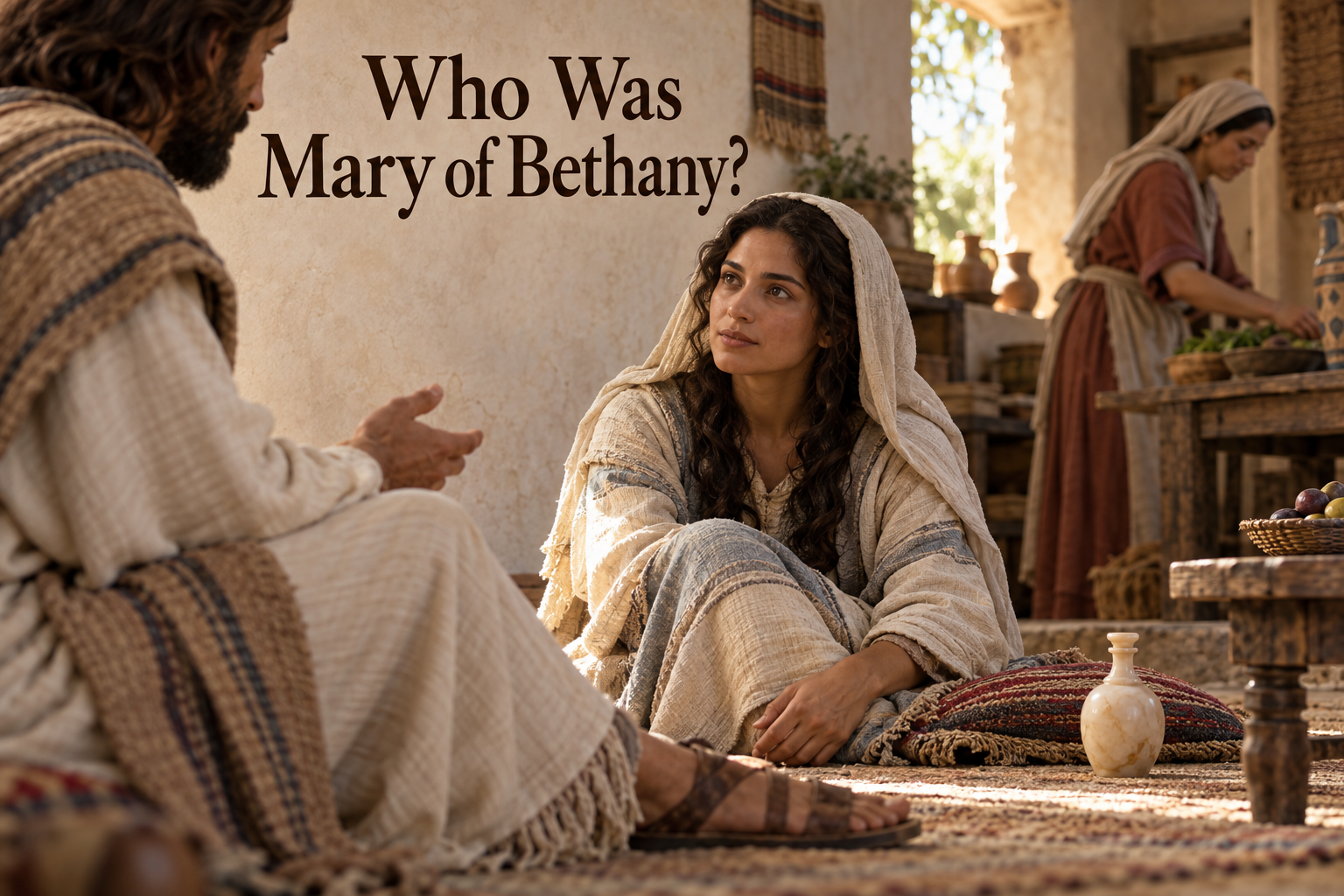
Mary of Bethany is remembered for sitting at Jesus’ feet, grieving at his feet, and pouring costly perfume over them. Those scenes have often been blended with stories about other women named Mary or with an unnamed woman in Luke, producing a composite figure the Gospels themselves never create. Mary of Bethany was the sister of Martha and Lazarus, living in a village near Jerusalem. Within that small circle of friends, she appears as a disciple who listened closely, loved deeply, and understood something about Jesus’ approaching death before many others did.
Mary, Martha, and the Better Portion
Luke introduces Martha welcoming Jesus into her home while Mary sits at the Lord’s feet and listens to his teaching (Luke 10:38-42). Sitting at a teacher’s feet is the posture of a disciple, not a description of laziness. Martha becomes distracted by extensive service and asks Jesus to make Mary help. Jesus responds with affection, recognizes Martha’s anxiety, and says that Mary has chosen the better portion.
The point isn’t that practical work is spiritually inferior or that meals prepare themselves. Luke elsewhere treats service as honorable, and Jesus himself serves others. The problem is that Martha’s good work has become anxious and resentful, while Mary has recognized that receiving Jesus’ word must come first. Jesus also defends a woman’s place among his learners in a culture where household expectations could easily have kept her occupied elsewhere.
Mary’s posture shouldn’t be forced into a modern argument the passage wasn’t written to settle. Luke doesn’t tell us whether she later taught publicly or held a formal office. He does show Jesus welcoming her as a genuine disciple and refusing to send her back to the expected domestic task. That is already significant, and it doesn’t need embellishment to make the point stronger.
Grief at Lazarus’s Tomb
John identifies Bethany as the village of Mary, Martha, and their brother Lazarus, whom Jesus loved (John 11:1-5). When Lazarus became ill, the sisters sent word to Jesus, but he remained where he was for two more days. By the time he arrived, Lazarus had been in the tomb four days. The delay is explained within John’s larger purpose of revealing God’s glory, but the sisters still experienced it as the absence of someone they trusted.
Martha first met Jesus outside the village, while Mary remained in the house until Martha privately told her that the Teacher was calling. Mary then rose quickly, fell at Jesus’ feet, and said, “Lord, if you had been here, my brother wouldn’t have died” (John 11:17-32). Her words match Martha’s earlier statement, joining faith and lament in the same sentence. She believes Jesus could have prevented the death, yet she doesn’t disguise the pain of his delay.
When Jesus saw Mary and the mourners weeping, he was deeply moved and wept before going to the tomb (John 11:33-44). Christians have long discussed the exact force of John’s language, which can include indignation as well as sorrow. At minimum, Jesus doesn’t scold Mary for grieving or answer her pain with a detached lecture. He enters the grief, confronts the tomb, and calls Lazarus out. The sign points beyond one family’s relief toward Jesus’ claim to be the resurrection and the life, but John doesn’t make the family’s tears unreal along the way.
Anointing Jesus at Bethany
Six days before Passover, a dinner was given in Jesus’ honor at Bethany. Martha served, Lazarus reclined at the table, and Mary poured a large quantity of costly perfume on Jesus’ feet, wiping them with her hair (John 12:1-3). Judas objected that the perfume could have been sold for the poor, though John says his concern was dishonest because he stole from the common purse. Jesus defended Mary and connected her act with the day of his burial (John 12:4-8).
Matthew and Mark also describe an unnamed woman anointing Jesus at Bethany in the house of Simon the leper, pouring perfume on his head shortly before the arrest (Matthew 26:6-13; Mark 14:3-9). Many readers understand these as versions of the same event John attributes to Mary, while others think details differ enough to leave the question open. If they describe one occasion, the accounts emphasize different features rather than giving a camera-angle transcript. We can identify John’s woman confidently as Mary of Bethany; identifying the unnamed woman in Matthew and Mark with her is reasonable but not explicitly stated in those Gospels.
Mary’s act was lavish, intimate, and socially conspicuous. The perfume represented substantial value, and letting down her hair to wipe Jesus’ feet disregarded ordinary reserve. Jesus doesn’t treat the act as wasteful sentiment. He receives it as preparation for burial, turning an expression of devotion into a sign that his death is near. In the Synoptic accounts, the woman’s action will be remembered wherever the gospel is preached, even though those writers don’t preserve her name.
Mary of Bethany Is Not Mary Magdalene
The New Testament names several women Mary, and they shouldn’t be merged simply because later art and preaching did so. Mary Magdalene came from Magdala, traveled with Jesus, witnessed the crucifixion and burial, and encountered the risen Christ. Mary of Bethany is identified by her village and by her siblings Martha and Lazarus. No Gospel says they are the same woman.
Mary of Bethany also shouldn’t be confidently identified with the unnamed “sinful woman” who anoints Jesus’ feet in a Pharisee’s house in Galilee (Luke 7:36-50). Luke’s scene occurs earlier, has a different host and setting, and centers on forgiveness. In the Western church, a famous sermon by Pope Gregory I in the late sixth century helped popularize the merging of that woman, Mary Magdalene, and Mary of Bethany. Eastern Christian tradition generally kept them distinct, and modern biblical scholarship usually does as well.
Later traditions about Mary of Bethany’s travels vary. Some Western legends place her and her siblings in southern France, while Eastern traditions connect them with other locations. These stories arose centuries after the New Testament and can’t be treated as established biography. Scripture gives no account of Mary’s later ministry or death, so a careful biography stops where the evidence stops.
A Disciple Who Paid Attention
Mary speaks only once in the recorded scenes, but her actions carry considerable weight. She listens when Jesus teaches, brings honest grief when her brother dies, and honors Jesus as danger closes around him. Her discipleship is neither passive nor merely emotional. It is attentive enough to interrupt normal expectations and costly enough to draw criticism.
The Gospels don’t say that Mary understood the coming cross in every detail. Jesus interprets her anointing in relation to his burial, which may reveal more about the act than Mary herself could have explained. Still, she gives him honor while others calculate the expense, and Jesus refuses to let her devotion be belittled. Mary of Bethany should be remembered on the terms the text provides: not as a reformed prostitute or an alternate name for Mary Magdalene, but as a beloved friend and serious disciple of Jesus.