
Who Was Miriam?
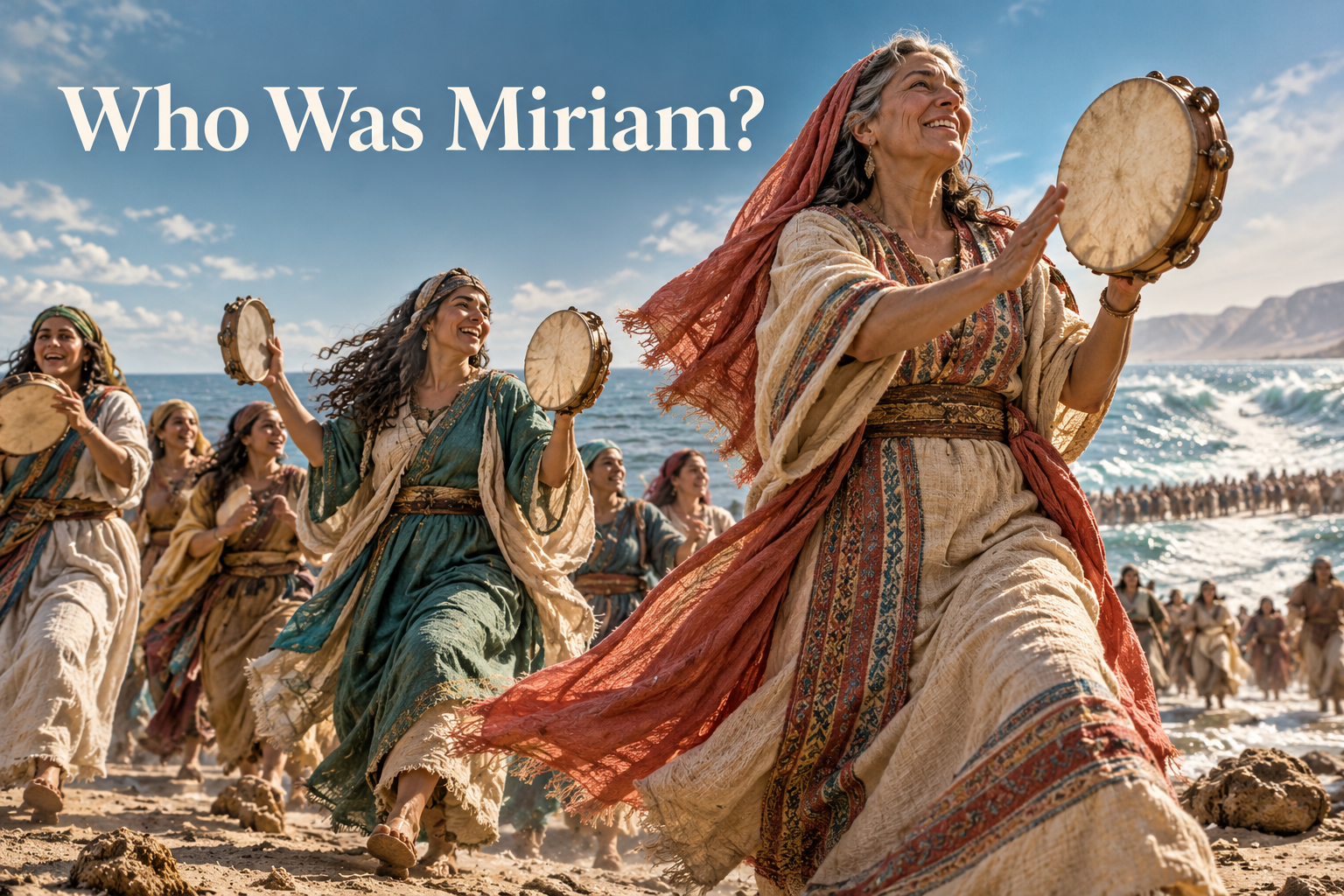
Miriam appears at several turning points in Israel’s story, yet Scripture never gives us a continuous account of her life. She stands near the Nile while Moses is an infant, leads Israel’s women after the crossing of the sea, challenges Moses in the wilderness, and dies before Israel enters Canaan. She is also explicitly called a prophetess and later named alongside Moses and Aaron as one of the leaders God sent before Israel. That is a remarkable record, even though many details readers would like to know are left unstated. To understand Miriam, we have to pay attention both to what the Bible says and to what later tradition added.
The sister who watched from the riverbank
Miriam is usually identified with the unnamed sister of Moses in Exodus 2. Pharaoh had ordered Hebrew sons to be thrown into the Nile, so Moses’ mother placed him in a basket among the reeds while his sister watched from a distance to see what would happen. When Pharaoh’s daughter found the child, the girl approached her and offered to find a Hebrew woman to nurse him. She then brought the baby’s own mother. The plan allowed Moses to be protected in Pharaoh’s household while spending his earliest years with his family.
Exodus 2 doesn’t call the sister Miriam, but the identification is the natural reading of the Torah as a whole. Numbers 26:59 names Miriam as the daughter of Amram and Jochebed and the sister of Aaron and Moses. Since the girl at the river was old enough to observe events and speak intelligently to Pharaoh’s daughter, Miriam must have been older than Moses if she is the same sister. Scripture doesn’t tell us her exact age, and it doesn’t describe a long conversation between mother and daughter before the basket was placed in the water. Later retellings sometimes fill in those blanks, but the biblical narrative is content to show a courageous girl acting at exactly the right moment.
Her action matters because the exodus begins before Moses ever confronts Pharaoh. Hebrew midwives defy the king, Moses’ mother refuses to surrender her child, Pharaoh’s daughter shows compassion, and the child’s sister has the nerve to speak across a dangerous social boundary. God isn’t named as the direct actor in this scene, but the reader can see providence working through a series of human choices. Miriam’s first contribution to Israel’s deliverance is quiet, practical, and easily overlooked. Without it, the rest of Moses’ story would look very different.
Miriam the prophetess at the sea
Miriam is first named in Exodus 15:20, after Israel has crossed the sea and the Egyptian forces have been overwhelmed. The text calls her “Miriam the prophetess, Aaron’s sister.” She takes a timbrel, the women follow her with timbrels and dancing, and she leads them in a refrain celebrating the Lord’s victory. This isn’t background entertainment after the important men have finished speaking. In the biblical world, music and public celebration interpreted what God had done and helped the community remember it.
What does the title “prophetess” mean in Miriam’s case? Scripture doesn’t preserve a collection of her oracles, and it doesn’t explain when she received the title. It does, however, present her as a recognized spiritual leader who gives voice to the meaning of God’s deliverance. Some scholars have argued that Miriam’s song may preserve an especially early form of Israel’s victory tradition, while others think her brief refrain deliberately echoes the longer song attributed to Moses. Those literary questions are worth discussing, but they don’t change the final form of Exodus: both Moses and Miriam lead God’s people in confessing that the Lord has triumphed.
Micah 6:4 gives us another important piece of evidence. Speaking for God, the prophet reminds Israel, “I sent before you Moses, Aaron, and Miriam.” Miriam isn’t presented there merely as somebody’s sister. She belongs to the leadership God provided when he brought Israel out of slavery. Moses had a unique role, and Aaron’s priestly office was his own, but Scripture doesn’t require us to shrink Miriam in order to preserve those distinctions. Her leadership was real because God sent her.
The challenge to Moses
Numbers 12 records the most difficult episode in Miriam’s story. Miriam and Aaron speak against Moses because of the Cushite woman he had married, and they ask whether the Lord has spoken only through Moses. The complaint begins with Moses’ wife but quickly exposes a dispute about prophetic authority. The text never clearly tells us whether the Cushite woman is Zipporah described in an unusual way or another wife, nor does it fully explain why the marriage became an issue. Confident claims about their motives usually go beyond the evidence.
God responds by affirming that Miriam and Aaron may indeed receive revelation while distinguishing Moses’ calling from theirs. Other prophets receive dreams and visions, but Moses speaks with God in an exceptionally direct way. Miriam is then afflicted with a severe skin condition, often translated “leprosy,” although the Hebrew term covers conditions broader than what modern medicine calls Hansen’s disease. Aaron confesses their sin, Moses cries out for her healing, and she remains outside the camp for seven days. Israel doesn’t move on until she is restored.
Readers often ask why Miriam alone bears the visible punishment when both siblings spoke. The Hebrew grammar may place her in the lead, and some interpreters have taken that as evidence that she initiated the complaint, but the narrative doesn’t explicitly settle the matter. Aaron is rebuked and immediately admits shared guilt. It is better to leave the unanswered question open than to invent a reason that makes the scene more comfortable. What the passage makes clear is that genuine spiritual leaders can act out of envy or presumption, and prior usefulness doesn’t place anyone beyond correction.
The incident shouldn’t erase everything else Scripture says about Miriam. Numbers portrays a serious failure, but Micah still remembers her as a leader sent by God. The Bible regularly tells the truth about its central figures without reducing them to their worst moment. Moses also failed, as did Aaron, and none of them entered the promised land. Miriam’s story is neither a spotless tribute nor a cautionary tale with nothing else to say.
Her death and the traditions that followed
Numbers 20:1 reports Miriam’s death and burial at Kadesh in a single sentence. Immediately afterward, the congregation has no water, a sequence that later Jewish interpreters found significant. Rabbinic tradition developed the idea of “Miriam’s well,” a miraculous source of water that accompanied Israel because of her merit and disappeared when she died. That tradition honors her importance and draws on the placement of the stories, but Numbers itself never says that a traveling well followed her.
Other Jewish traditions identify Miriam with Puah, one of the midwives who defied Pharaoh, or connect her by marriage to other prominent Israelite families. Some describe her prophetic insight before Moses’ birth or supply details about her burial. These interpretations show how strongly later readers sensed that the Torah’s brief notices point to a larger life. They may be valuable as examples of Jewish reflection, but they shouldn’t be reported as though they were facts contained in Scripture.
Christian readers have sometimes connected Miriam’s water tradition with Paul’s reference in 1 Corinthians 10 to the spiritual rock that accompanied Israel. Paul identifies the rock with Christ; he doesn’t mention Miriam or endorse every later story about her well. The distinction matters. A tradition can help us see how a community remembered a biblical figure without becoming part of the biblical account.
Why Miriam matters
Miriam’s importance isn’t based on an imagined biography. The canonical evidence is already substantial: she helped preserve Moses’ life, was called a prophetess, led Israel’s women in worship, and was remembered as one of three leaders sent by God during the exodus. Scripture also records her grave mistake and her restoration to the community. That combination gives us a person rather than a plaster saint.
Her story also corrects a common way of telling the exodus as though God worked through one heroic man while everyone else watched. Moses occupies the central human role, but he wasn’t alone. Women resisted Pharaoh before Moses could resist him, and Miriam helped Israel interpret its deliverance after it came. God used different forms of leadership without making every calling identical.
We don’t need to turn Miriam into everything later readers wished her to be, and we shouldn’t turn her failure into everything she was. The Bible honors her more carefully than either approach. She was a prophet, a leader, a sister, a worshiper, and a fallible servant of God. Remembering all of that is the best way to remember Miriam.