
Who Was Moses?
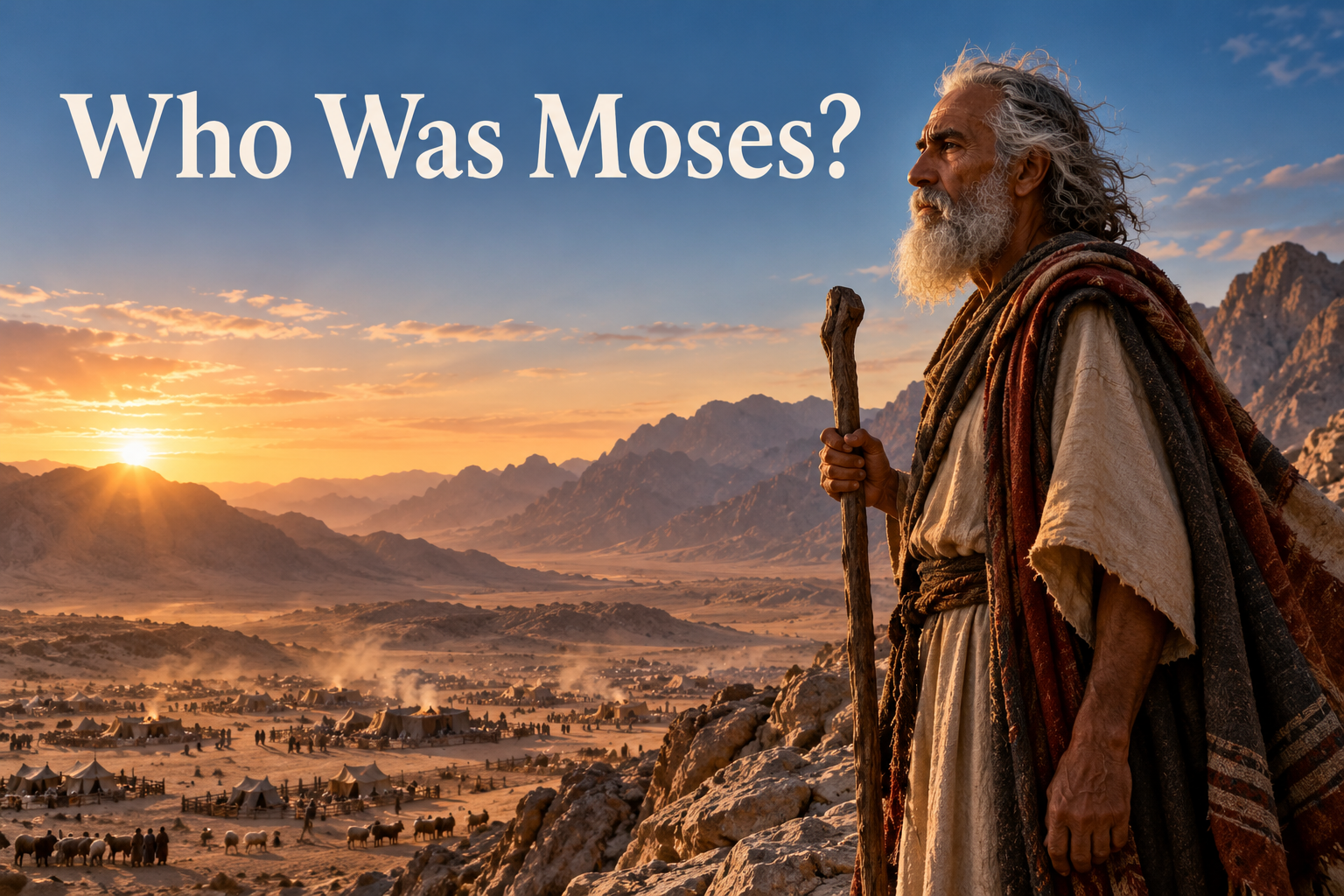
Moses is the central human figure in Israel’s exodus from Egypt, but the Bible never lets him become the hero who saves everyone by force of personality. He survives infancy because women defy Pharaoh, resists his calling because he feels inadequate, confronts Egypt because God sends him, and leads Israel while repeatedly asking why God gave him the job. He speaks with God with extraordinary intimacy, yet he also becomes angry, fails publicly, and dies outside the land he spent forty years approaching. His greatness is real, but it is the greatness of a servant whose authority depends on the God he serves.
A child rescued from Pharaoh
Exodus opens with a new Pharaoh enslaving the Israelites and ordering the deaths of their infant sons. Moses’ mother hid him for three months, placed him in a basket among the reeds, and stationed his sister nearby. Pharaoh’s daughter found the child, recognized him as a Hebrew, and chose to raise him. Through the sister’s quick action, Moses’ own mother was hired to nurse him. The narrative quietly defeats Pharaoh’s policy through women he overlooks: the Hebrew midwives, a mother, a sister, and even his own daughter.
Pharaoh’s daughter named him Moses because she drew him from the water. The biblical explanation plays on the Hebrew verb for drawing out, while many scholars also note that mose appears as an Egyptian name element meaning “born of” or “child of.” That linguistic background fits the Egyptian setting, but it does not independently prove the biography. Scripture says Moses grew up in Pharaoh’s household, while Acts 7:22 adds that he was educated in all the wisdom of the Egyptians. Exodus itself does not describe his curriculum or give the Pharaoh a name.
As an adult, Moses saw an Egyptian beating a Hebrew and killed the Egyptian after looking around. He buried the body in the sand, and the next day a Hebrew exposed what he had done. The killing may have arisen from outrage at oppression, but Exodus does not present it as Moses’ divine commission to liberate Israel. He acted violently, concealed the body, and fled when Pharaoh sought his life. The deliverer first appears not as a polished statesman but as a compromised fugitive.
Midian and the burning bush
Moses fled to Midian, defended a group of women at a well, and was welcomed into the household of their father, called Reuel in Exodus 2 and Jethro elsewhere. He married Zipporah and named their first son Gershom, associating the name with his life as a resident foreigner. Years passed while Moses tended his father-in-law’s flock. The man raised near royal power received his next assignment while doing ordinary pastoral work in the wilderness.
At Horeb, the mountain of God, Moses saw a bush burning without being consumed. God called him by name, identified himself as the God of Abraham, Isaac, and Jacob, and said that he had seen Israel’s affliction and heard its cry. The commission was not based on Moses noticing a problem God had missed. God was sending him because God had determined to act. When Moses asked God’s name, he received the difficult declaration often translated “I AM WHO I AM,” followed by the covenant name represented in English Bibles as the Lord.
Moses answered with a series of objections: Who am I? What is your name? What if they do not believe me? I am slow of speech. Please send someone else. Some interpreters diagnose a speech disorder, while others see ordinary reluctance or a conventional claim of inadequacy; the text does not settle the medical question. God promised to be with him, gave signs, and appointed Aaron to speak with him. The exchange is encouraging to hesitant people, but it is not sentimental. God accommodates Moses’ weakness and also becomes angry at his refusal.
On the journey back to Egypt, Exodus 4:24–26 records a brief and notoriously difficult incident in which the Lord sought to kill Moses, or possibly his son, until Zipporah circumcised her son and touched the foreskin to someone’s feet. The pronouns and the phrase “bridegroom of blood” are ambiguous, and confident retellings often supply details the Hebrew does not. At minimum, the passage connects covenant obedience, circumcision, danger, and Zipporah’s decisive action. Moses cannot confront Pharaoh as covenant messenger while treating the covenant sign as irrelevant.
Before Pharaoh
Moses and Aaron demanded that Pharaoh let Israel go to worship the Lord. Pharaoh responded by increasing the people’s workload, and the Israelite supervisors blamed Moses and Aaron for making their situation worse. Liberation did not arrive as a smooth rise in morale. Moses returned to God with the accusation that matters had deteriorated since he began speaking. The complaint is uncomfortable, but it belongs to the biblical portrait of a leader who brings bewilderment to God rather than dressing it in religious language.
The plague narratives present a contest over whose authority governs Israel and creation. Water becomes blood, frogs and insects overwhelm the land, disease and hail destroy, darkness covers Egypt, and the firstborn die. The text sometimes says Pharaoh hardened his heart, sometimes that his heart was hard, and sometimes that God hardened it. Interpretations differ over the timing and relationship of human refusal and divine judgment. Whatever theological model one adopts, Pharaoh is not portrayed as an innocent ruler deprived of freedom without context; he has enslaved a people, ordered children killed, and repeatedly broken his word.
The death of Egypt’s firstborn is still a terrible judgment, and its inclusion in Scripture should not be made painless by a sermon illustration. Israel was instructed to slaughter lambs, mark doorframes with blood, and eat in readiness to leave. Passover became the annual remembrance of deliverance from slavery. Christian readers see Christ as the Passover lamb, especially in the New Testament, but that confession should be built upon rather than substituted for the exodus setting in which the feast first appears.
At the sea, Israel found itself trapped between Pharaoh’s forces and the water. Moses told the people that the Lord would fight for them, and God opened a path through the sea while the pursuing Egyptian army was overwhelmed. Exodus 14 and the poem in Exodus 15 describe the event with different literary textures, including a strong east wind and direct divine action. Attempts to explain every feature through tides or weather may illuminate possible physical means, but they cannot demonstrate the event or remove the text’s claim that Israel’s deliverance came from God.
Prophet, lawgiver, and intercessor
In the wilderness, Moses led a community that quickly faced thirst, hunger, enemies, and internal distrust. At Sinai, God called Israel to be a treasured possession, a kingdom of priests, and a holy nation, then gave the covenant commandments. Moses served as mediator, moving between the divine presence and the people. The Torah is traditionally called the Law of Moses, but within the narrative Moses is not its inventor. He receives, teaches, writes, judges, and administers what God commands.
Jethro saw Moses handling disputes from morning until evening and warned that both Moses and the people would wear out. Moses accepted his father-in-law’s advice and appointed capable leaders to share the work. That episode matters because spiritual authority did not make him immune to poor administration or too important to learn from an outsider. Later, when elders were gathered to help bear the burden, Moses wished that all the Lord’s people were prophets rather than jealously guarding his status (Numbers 11:29).
The golden calf brought Moses’ roles into painful collision. While he was on the mountain, Aaron made a calf from the people’s gold and proclaimed a festival. God announced judgment, and Moses interceded by appealing to God’s promises and reputation among the nations. When he reached the camp, however, he shattered the tablets, burned and ground the calf, scattered it on water, and made Israel drink. Levites then killed about three thousand men at Moses’ command. The narrative presents covenant rebellion and judgment, but the violence should be reported honestly rather than turned into an excuse for religious coercion.
Moses repeatedly interceded when Israel rebelled, most notably after the spies’ report led the people to refuse entry into Canaan. He appealed to God’s character as slow to anger and abundant in steadfast love while acknowledging that forgiveness does not make evil inconsequential. Numbers portrays him as exceptionally humble, yet it also records moments of exasperation. When the people complained about water at Meribah, Moses called them rebels and struck the rock twice instead of carrying out God’s instruction as given. God told Moses and Aaron that because they had not trusted him to uphold his holiness, they would not lead the assembly into the land.
Moses, violence, and difficult commands
Moses’ final years include warfare and judgments that disturb modern readers, including the campaign against Midian in Numbers 31. The chapter reports the killing of males and nonvirgin women and the taking of girls as captives. One may discuss the ancient war setting, Midian’s earlier role in the Baal-peor crisis, and the text’s theology of judgment, but none of that makes the suffering imaginary. Christians should not lift commands from Israel’s national life and use them to authorize violence by the church, whose mission advances through witness, service, and the gospel rather than holy war.
Deuteronomy presents Moses giving covenant instruction to a new generation on the plains of Moab. He reviews the journey, warns against idolatry and injustice, teaches Israel to love the Lord, and insists that covenant loyalty must shape public and private life. The book says Moses wrote down this law, while its closing account of his death naturally speaks from a later narrative vantage point. Jews and Christians have understood Mosaic authorship in different ways, ranging from direct composition of nearly the whole Pentateuch to substantial Mosaic tradition shaped through later inspired scribes. Scripture’s authority does not require pretending those compositional questions do not exist.
Death and legacy
Moses viewed the land from Mount Nebo and died in Moab at 120, with his burial place unknown. Deuteronomy says no prophet like him had arisen in Israel, one whom the Lord knew face to face. Yet the same book promises a prophet like Moses, a text the New Testament applies to Jesus. Moses is therefore both incomparable within Israel’s story and a servant who points beyond himself. At the transfiguration he appears with Elijah speaking with Jesus, but the voice from the cloud directs the disciples to listen to the Son.
No contemporary Egyptian text names Moses, Aaron, the plagues, or Israel’s departure, and archaeology has not verified a large population traveling through Sinai for forty years. Scholars range from viewing the exodus as largely literary memory to proposing a smaller historical departure later expanded in Israel’s tradition. Egyptian settings, names, and known movements of Semitic-speaking people into and out of Egypt provide context, not proof. The earliest widely accepted extrabiblical mention of Israel is the Merneptah Stele from the late thirteenth century BC, which locates a people called Israel in Canaan but says nothing about Moses.
For the biblical writers, Moses’ importance does not depend on an Egyptian monument preserving his name. He is the reluctant messenger through whom God confronts oppression, forms a covenant people, and gives instruction meant to order life under divine rule. His failures prevent reverence from becoming flattery, and his unfinished journey keeps him from replacing God as the story’s center. Moses dies within sight of the land, but the word entrusted through him continues to call God’s people toward freedom, holiness, justice, and faithful love.