
Who Was Naomi?
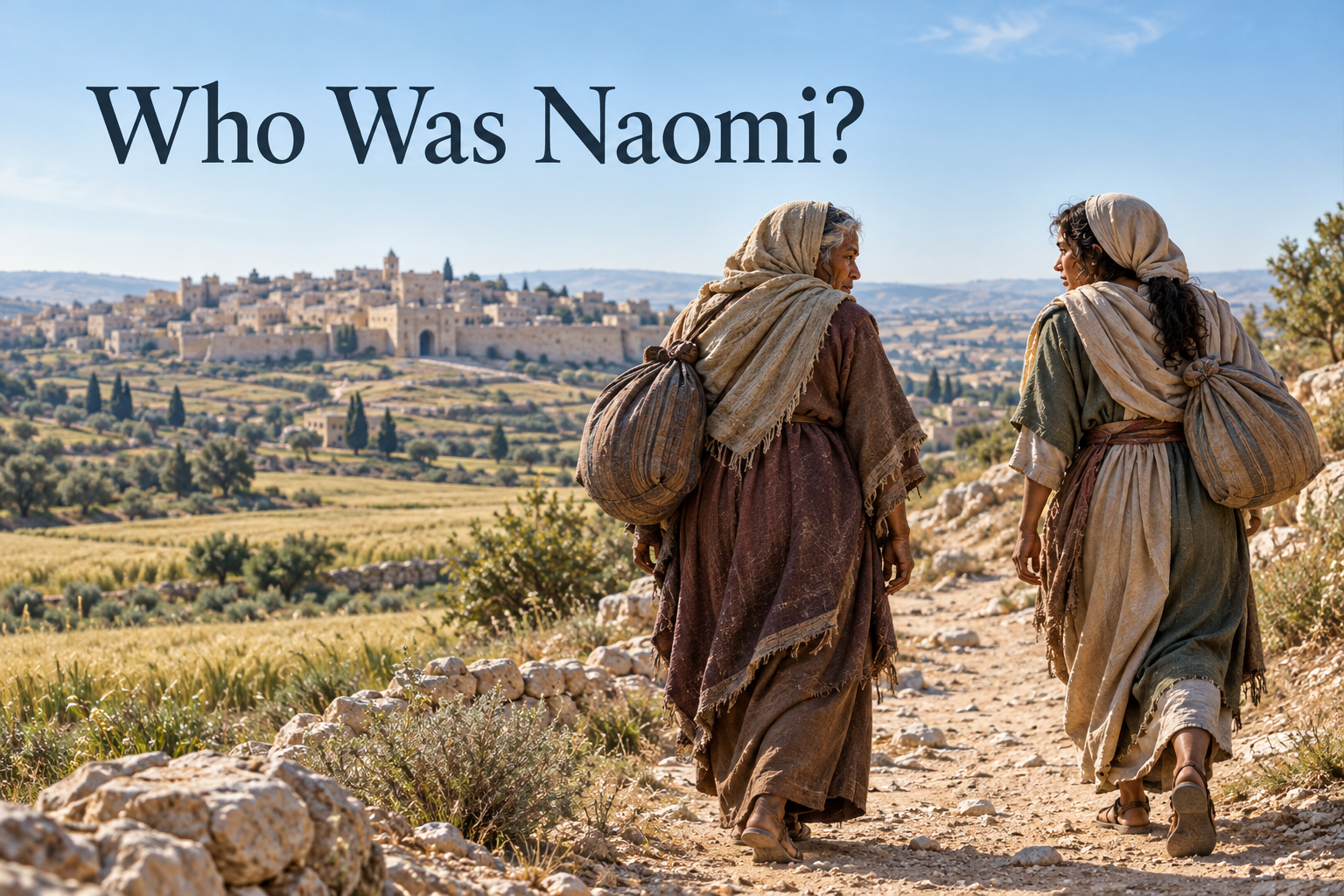
Naomi’s story begins with famine and ends with a child in her arms, but the road between those scenes is not a tidy lesson about staying cheerful. She buried her husband and both sons in a foreign land, returned to Bethlehem with no obvious means of support, and told her neighbors that the Almighty had dealt bitterly with her. The book of Ruth doesn’t rebuke her for speaking that way. Instead, it lets loyal love reach her through ordinary acts of courage, work, generosity, and family responsibility.
Loss in Moab
Naomi was married to Elimelech and had two sons, Mahlon and Chilion. During a famine in the days when the judges ruled, the family left Bethlehem in Judah and lived in Moab (Ruth 1:1–2). Scripture doesn’t say that the move was sinful, though readers have sometimes assumed the family’s later deaths were punishment for leaving the land. The narrator reports the famine, migration, and deaths without giving that explanation, so it is better not to supply one.
Elimelech died, and Naomi’s sons married Moabite women named Orpah and Ruth. After about ten years, both sons also died, leaving the three women without husbands or children (Ruth 1:3–5). In the ancient world this was not only emotional devastation but an economic crisis. Naomi had lost the household relationships through which land, labor, protection, and old-age care normally came.
When Naomi heard that the Lord had provided food for Judah, she began the journey home with her daughters-in-law. Along the way she urged them to return to their mothers’ homes, praying that the Lord would show them the same faithful kindness they had shown the dead and Naomi herself (Ruth 1:6–13). Her insistence wasn’t rejection disguised as courtesy. She believed she had no sons or future to offer and wanted the younger women to have another opportunity for marriage and security.
Orpah tearfully returned, while Ruth bound herself to Naomi and Naomi’s people with one of Scripture’s strongest pledges of loyalty. Ruth promised to go where Naomi went, live where she lived, accept her people and God, and remain with her until death (Ruth 1:14–18). These words are often read at weddings, but their original setting is a widowed foreign woman committing herself to her widowed mother-in-law. Naomi didn’t create Ruth’s loyalty, but she had evidently lived in a way that made such loyalty possible.
“Call me Mara”
Bethlehem stirred when Naomi returned, and the women asked whether this was really her. Naomi replied that they should call her Mara, meaning “bitter,” because the Almighty had made her life bitter. She said she had gone away full and returned empty (Ruth 1:19–21). Ruth was standing beside her, so “empty” wasn’t a denial that Ruth existed. It expressed how thoroughly Naomi’s husband, sons, status, and expected future had been taken from her.
Naomi attributed her suffering to God’s hand, yet the book doesn’t pause to endorse or correct every part of that interpretation. Biblical lament often speaks to God with a frankness that polished religious speech avoids. Naomi didn’t stop believing in the Lord; she brought her pain into that belief and refused to pretend it felt like blessing. Her words give bereaved people room to tell the truth without turning grief into unbelief.
The two women arrived as the barley harvest began (Ruth 1:22). That small chronological note begins the movement from scarcity toward provision. Israel’s law instructed landowners not to harvest every edge or retrieve every dropped stalk, leaving food for the poor and resident foreigner (Leviticus 19:9–10). Ruth went to glean, and Naomi remained at home until she returned with an unexpectedly generous amount of grain.
Naomi, Ruth, and Boaz
When Ruth told Naomi that she had worked in the field of a man named Boaz, Naomi immediately recognized him as one of their family redeemers. She blessed the Lord for not abandoning his kindness toward the living and the dead, and she advised Ruth to remain with Boaz’s workers for safety (Ruth 2:17–23). This is the first clear change in Naomi’s speech after her bitter homecoming. Provision had not erased her losses, but it allowed her to see that the family’s story might not be over.
After the harvest, Naomi proposed a plan to seek “rest,” or a secure home, for Ruth. She instructed Ruth to wash, dress, and approach Boaz privately at the threshing floor after he lay down, then uncover his feet and wait for his direction (Ruth 3:1–5). The scene carries risk and sexual ambiguity, although the narrative portrays Ruth and Boaz as acting honorably. Naomi’s strategy was bold and could have exposed Ruth to misunderstanding. It also aimed at moving Boaz from generous protection to a public decision about family responsibility.
Ruth asked Boaz to spread his garment over her because he was a redeemer, and Boaz praised her loyalty. He explained that a nearer relative had the first right and promised to resolve the matter legally (Ruth 3:6–13). Ruth returned before she could be recognized, carrying grain Boaz had provided. Naomi then told her to wait because Boaz would not rest until he settled the matter that day (Ruth 3:14–18). Her judgment of his character proved accurate.
At the town gate, Boaz negotiated with the nearer redeemer and publicly committed himself to acquire Elimelech’s property and marry Ruth in order to preserve the deceased family’s name (Ruth 4:1–10). The legal combination is more complicated than a simple application of one statute: it joins family redemption of property with responsibility for a widow and the dead man’s line. Naomi didn’t attend the recorded gate meeting, but her knowledge of kinship and her plan had brought the issue there.
Naomi’s restored household
Boaz married Ruth, and the Lord enabled her to conceive a son. The women of Bethlehem addressed Naomi, praising God for providing a redeemer and saying that Ruth was better to her than seven sons (Ruth 4:13–15). That remarkable praise challenges the idea that only sons could embody family loyalty and worth. The Moabite daughter-in-law Naomi once tried to release had become the human means through which her household was renewed.
Naomi took the child, Obed, held him close, and cared for him. The neighborhood women celebrated that a son had been born to Naomi, not because she was his biological mother but because his birth restored continuity and hope to her family (Ruth 4:16–17). Obed became the father of Jesse and grandfather of David. Naomi therefore stands within the story of Israel’s kingship, though the book never reduces her to a link in a genealogy.
Why Naomi matters
Naomi is neither the flawless spiritual mentor of sentimental retellings nor the bitter obstacle Ruth had to overcome. She is a grieving woman whose theology, judgment, and hope move through real loss. She blesses her daughters-in-law, tries to free them from obligation, recognizes Boaz’s generosity, understands the family’s legal possibilities, and works toward Ruth’s security. At times she sees only emptiness, but she keeps taking the next available step.
Her story also refuses a cheap explanation of providence. God is named as giver of food and conception, yet much of the restoration comes through Ruth gleaning, Boaz obeying the spirit of God’s law, and Naomi using hard-earned wisdom. The ending doesn’t replace Elimelech, Mahlon, or Chilion, and it doesn’t tell bereaved readers that a later joy cancels an earlier grave. It shows that faithful love can build a future without denying the losses that made such a future necessary.