
Who Was Nehemiah?
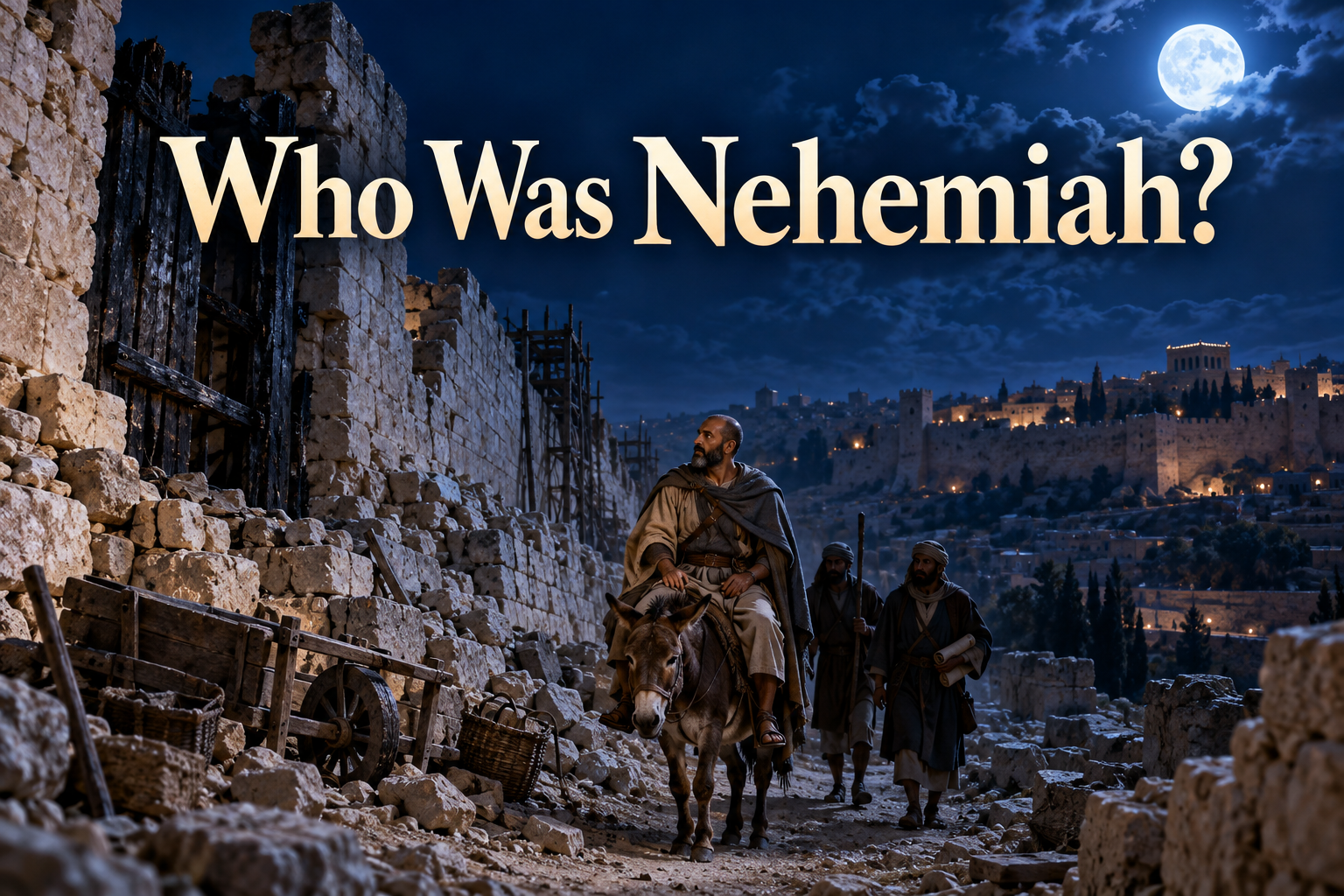
Nehemiah is often presented as the Bible’s great project manager: he inspected a ruined wall, organized teams, answered opposition, and completed the work in fifty-two days. That is true, but it is only part of him. Nehemiah was a Persian court official, governor, reformer, intercessor, economic critic, and sometimes a physically forceful disciplinarian. He could refuse a governor’s food allowance to ease the people’s burden and later beat men and pull out their hair over covenant violations. His memoir gives us a leader of courage and prayer whose severity should not be edited out of the portrait.
Cupbearer to Artaxerxes
Nehemiah served as cupbearer to King Artaxerxes, usually identified as Artaxerxes I. A royal cupbearer was not simply a servant who carried drinks. The office required close access, trust, and courtly judgment because poisoning was a real political danger. Nehemiah’s position helps explain why he could petition the king directly and receive letters, timber, and authority for work in Judah.
Nehemiah 1 says that Hanani and other men from Judah reported that Jerusalem’s survivors were in great trouble and that the city’s wall remained broken and its gates burned. Nehemiah wept, fasted, and prayed, confessing Israel’s sin and appealing to God’s covenant mercy. He did not begin with a construction schedule. His public action grew from grief, confession, and a willingness to identify himself with the community’s failure.
In the twentieth year of Artaxerxes, conventionally 445 BC, the king noticed Nehemiah’s sadness and asked what he wanted. Nehemiah prayed briefly and requested permission to rebuild the city of his ancestors’ graves. He also requested letters for safe passage and timber from the royal forest. Prayer and preparation appear in the same conversation; dependence on God did not prevent a specific materials list.
Governor of Yehud
Nehemiah traveled to Jerusalem with military officers and cavalry, unlike Ezra’s earlier decision not to request an escort. Scripture commends neither approach by condemning the other. Upon arrival, Nehemiah waited three days and then inspected the walls at night with a small group. Only after seeing the damage himself did he tell officials, priests, nobles, and workers what he proposed.
He later identifies himself as governor of Judah, the Persian province commonly called Yehud. Nehemiah 5:14 says he served in that role for twelve years, from Artaxerxes’s twentieth through thirty-second year, before returning to the king and later obtaining permission to go back to Jerusalem. He was both a Judean reformer and an imperial appointee. The book does not treat those identities as simple opposites.
Rebuilding under pressure
Nehemiah 3 organizes the wall project by families, guilds, priests, officials, and residents responsible for particular sections. The chapter’s long list makes a theological point through administration: Jerusalem was rebuilt by distributed work, not solitary heroism. Some nobles refused to bend their shoulders to the task, while other participants repaired more than one section. Leadership made room for uneven response without allowing the project to wait for unanimous enthusiasm.
Sanballat the Horonite, Tobiah the Ammonite official, and Geshem the Arab opposed the work through ridicule, threats, political accusation, and attempted intimidation. Their concerns were not necessarily irrational from a Persian administrative perspective; a fortified Jerusalem could alter regional power. Nehemiah nevertheless understood their campaign as opposition to a task God had given. He answered with prayer, guards, weapons, and work schedules.
Builders carried materials with one hand and weapons with the other, while a trumpeter remained near Nehemiah to summon help. The imagery is dramatic, but no battle occurs during the rebuilding. Nehemiah’s security measures deterred violence rather than initiating it. The wall was completed in fifty-two days according to Nehemiah 6:15, and the opponents recognized that the work had been accomplished with God’s help.
What archaeology can establish
Archaeologists agree that Persian-period Jerusalem was smaller than the later city, concentrated around the old southeastern ridge and temple area. Identifying a particular surviving wall segment as Nehemiah’s work is difficult because Jerusalem’s fortifications were destroyed, rebuilt, reused, and excavated amid later construction. Finds can clarify the city’s scale and occupation; they do not give us a plaque reading “Nehemiah built this section.”
Documents from Elephantine in Egypt mention a Sanballat associated with the governorship of Samaria, and later Wadi Daliyeh documents attest additional governors bearing the family name. These finds strongly support the name and office within Persian-period Samaria. Whether every reference belongs to the exact individual in Nehemiah requires chronological care, since the name recurred across generations. External context is valuable without being stretched into personal verification.
Economic injustice inside the walls
The most dangerous crisis came from within the community. During a food shortage and tax pressure, poorer Judeans mortgaged fields, borrowed money, and sold sons and daughters into debt service. Nehemiah 5 records a great outcry against Jewish nobles and officials who were charging interest and acquiring the property and labor of their neighbors. A completed wall would mean little if the city protected creditors while families lost their children.
Nehemiah became angry, took counsel with himself, and confronted the nobles in a public assembly. He demanded restoration of fields, vineyards, houses, and interest, then made the creditors swear before priests that they would comply. He also shook out the fold of his garment as a symbolic curse against anyone breaking the promise. Public economic wrongdoing required public accountability and material repair, not a vague invitation to feel sorry.
Nehemiah acknowledged that he and his associates were lending money and grain and called for the charging of interest to stop. He also refused the governor’s food allowance because the burden on the people was already heavy. He fed a large table from his own resources. The memoir naturally presents his conduct from his perspective, but the policy matches his reform: leaders should not solve public problems by transferring the cost to people least able to bear it.
Ezra, the law, and communal worship
After the wall was complete, Nehemiah worked to populate and order Jerusalem. In Nehemiah 8 he appears with Ezra as the law is read and explained to the assembly. The people wept, but the leaders instructed them to celebrate, share food, and rejoice. The wall created a protected city; Scripture and worship were meant to shape the life inside it.
Scholars debate whether Ezra’s mission preceded Nehemiah, followed it, or was arranged by the final editor into its present sequence. The traditional chronology places Ezra in 458 and Nehemiah in 445 BC, while an alternative dates Ezra to Artaxerxes II in 398. Their joint appearance is part of the canonical narrative, but no external source settles the historical order. The books should not be forced into certainty they do not provide.
Nehemiah also supervised the dedication of the wall with two thanksgiving processions, music, and sacrifice. The celebration did not glorify fortification for its own sake. Jerusalem’s security, temple service, generosity, and covenant obedience were presented as parts of one restored life.
A second term and severe reforms
After returning to the Persian court, Nehemiah later came back to Jerusalem and found old problems renewed. Tobiah had been given a room in the temple courts, Levites had left their service because their portions were neglected, merchants were conducting business on the Sabbath, and Judean men had married women from surrounding peoples. Nehemiah threw Tobiah’s household goods out, restored temple provisions, shut the city gates for Sabbath, and threatened traders camping outside.
His response to intermarriage was especially severe. Nehemiah 13:25 says he rebuked the men, cursed them, beat some, and pulled out their hair. He focused on children who no longer spoke the language of Judah and invoked Solomon’s foreign wives as a warning. Cultural and covenant continuity were his stated concerns, not a modern biological theory of race, but physical coercion remains physical coercion. The text reports it as part of his reforming zeal without requiring readers to imitate it.
Nehemiah expelled a grandson of the high priest who had married into Sanballat’s family. The action protected his understanding of priestly holiness but also intensified the boundary between Jerusalem and Samaria. Later hostility between Judeans and Samaritans had a long development, and it should not all be projected into one marriage. Nehemiah’s decisions helped define a community while also narrowing who could belong within its leadership.
History, memoir, and legacy
Large portions of Nehemiah use first-person narration and are commonly called the Nehemiah Memoir. Many scholars regard this material as containing genuine personal records later arranged within Ezra-Nehemiah, though the extent of editing is debated. No independent inscription names Nehemiah securely, but Persian chronology, provincial titles, Aramaic documents, and Samaritan evidence fit the administrative world he describes.
Nehemiah repeatedly asks God to remember him, sometimes for good and sometimes against opponents. The prayers can sound self-conscious because this is a leader writing his own account and defending contested actions. They also reveal that he wanted his work judged by God rather than merely by the king who appointed him. His memoir is both testimony and argument.
Nehemiah’s wall was important, but his deeper battles concerned fear, exploitation, worship, and communal identity. He showed that prayer can produce plans, that security without justice is hollow, and that leaders may sacrifice privilege for the people they govern. He also shows how reforming conviction can harden into coercion. The builder deserves admiration, and the governor still needs moral scrutiny; Scripture gives us enough detail to do both.