
Who Was Nicodemus?
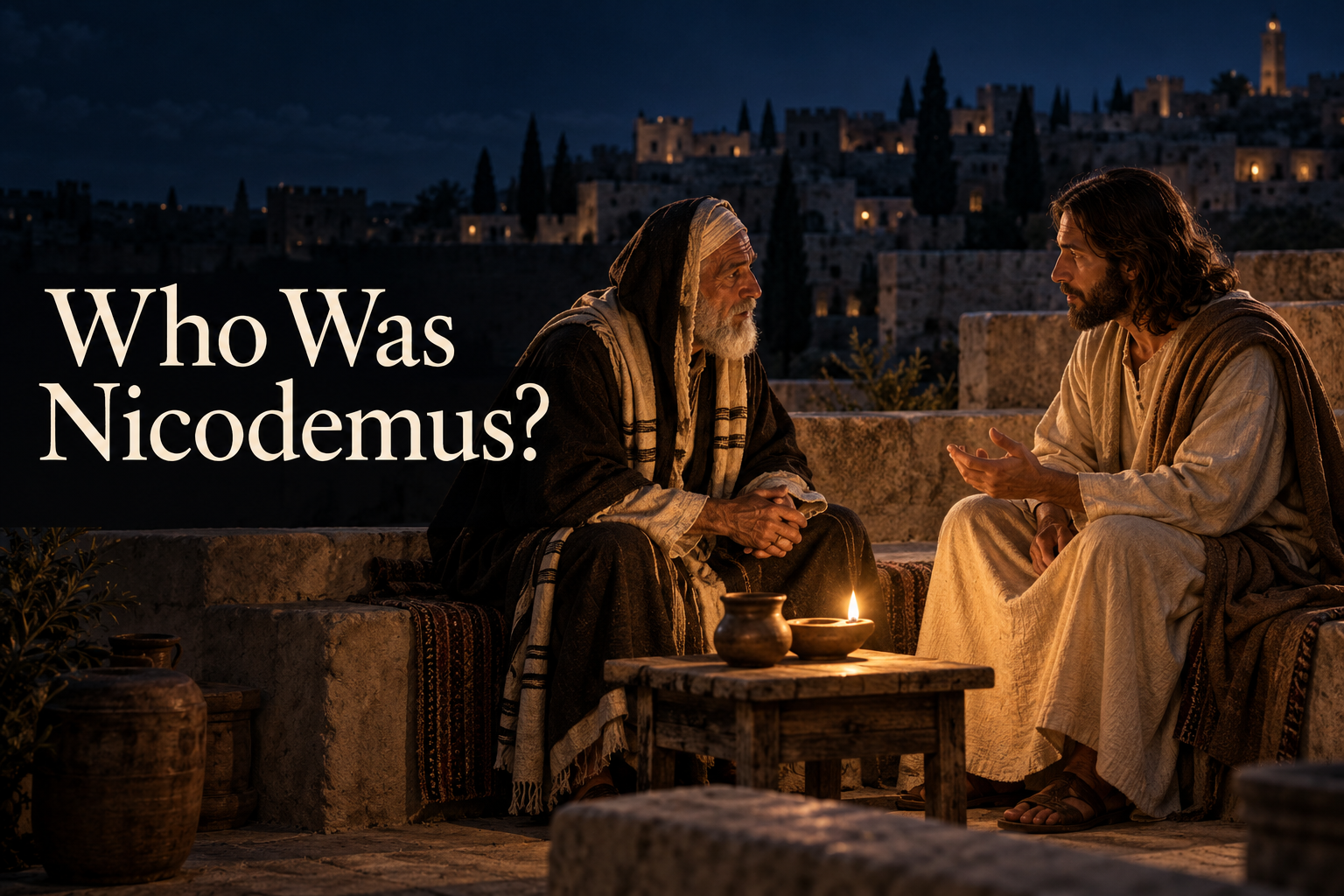
Nicodemus is one of those people in the Gospels who seems to understand that something extraordinary is happening, even though he hasn’t quite figured out what to do about it. He was a Pharisee, a member of the Jewish ruling council, and a man who knew the Scriptures. Yet when he came to Jesus with questions, he discovered that religious education and spiritual understanding aren’t necessarily the same thing. John mentions Nicodemus three times, and those appearances give us a revealing picture of a man wrestling with the claims of Jesus.
A Pharisee Comes to Jesus at Night
Nicodemus first appears in John 3, where he’s described as a Pharisee and a ruler of the Jews. The reference to a ruler probably means he belonged to the Sanhedrin, the council that exercised religious and certain judicial responsibilities among the Jewish people. Pharisees were known for their careful attention to the Law and its interpretation, and Nicodemus would have been regarded as a serious religious teacher. Jesus even calls him ‘the teacher of Israel’ in John 3:10, suggesting that he held a position of some distinction.
John tells us that Nicodemus came to Jesus at night. People have often assumed that he was afraid to be seen speaking with someone who had already attracted controversy, and that’s certainly possible. But John doesn’t explicitly tell us why he chose that hour. Nighttime also fits one of the Gospel’s recurring contrasts between darkness and light. Whatever his reason, Nicodemus didn’t arrive simply to pick a fight. He acknowledged that Jesus had come from God as a teacher, reasoning that no one could perform such signs unless God was with him (John 3:2).
Jesus answered him with a statement that seems, at first, to come out of nowhere: unless someone is born again, he cannot see the kingdom of God (John 3:3). The Greek word translated ‘again’ can also carry the sense of ‘from above,’ and both ideas fit the conversation. Nicodemus took the saying in a physical sense and asked how an old man could enter his mother’s womb a second time. Jesus was speaking about a new beginning brought about by the Spirit, not another physical birth. His response challenged the assumption that religious heritage, learning, or social standing could produce the life of God’s kingdom.
What Jesus Taught Nicodemus
Jesus went on to speak of being born of water and the Spirit, the difference between flesh and Spirit, and the mysterious activity of the wind (John 3:5–8). Christians have disagreed about the precise meaning of ‘water’ in this passage. Some understand it as a reference to baptism, while others connect it to cleansing and renewal promised in passages such as Ezekiel 36:25–27. The central point is clear enough: the life Jesus describes comes from God’s Spirit. Nicodemus, who was accustomed to explaining the Law to others, now found himself being asked to reconsider how a person enters God’s kingdom.
The conversation then turns to the Son of Man being lifted up, just as Moses lifted up the serpent in the wilderness (John 3:14–15; Numbers 21:4–9). Jesus connects the promise of life with faith in him, and the passage leads into John’s famous declaration of God’s love for the world in John 3:16. There is some debate over exactly where Jesus’ spoken words end and John’s explanatory comments begin, since ancient Greek manuscripts didn’t use modern quotation marks. Either way, the teaching belongs to the same account and presents Jesus as the one through whom God offers life to a world in need of rescue.
Nicodemus Speaks Up
Nicodemus appears again in John 7:45–52, when the chief priests and Pharisees are frustrated that officers sent to arrest Jesus have returned without him. As the leaders criticize those who are impressed by Jesus, Nicodemus raises a procedural objection: does their Law judge a man before hearing him and learning what he has done? It’s a modest intervention, not a public declaration that Jesus is the Messiah. Still, it matters. Nicodemus insists that even a controversial teacher deserves a fair hearing, and his colleagues respond by challenging him rather than addressing the substance of his question.
We should be careful not to turn that moment into more than John says. Nicodemus doesn’t deliver a speech defending every claim Jesus has made, and the Gospel doesn’t describe him joining the disciples at that point. But neither is he merely standing by in silence. His willingness to question the council’s treatment of Jesus suggests that his earlier conversation hadn’t simply been forgotten. John allows us to see a man whose response to Jesus is developing, though not in a straight line that the narrator explains for us.
At the Burial of Jesus
Nicodemus makes his final biblical appearance after the crucifixion. Joseph of Arimathea, described as a disciple of Jesus who had kept his allegiance secret for fear of the Jewish authorities, receives permission from Pilate to take Jesus’ body. Nicodemus joins him, bringing a mixture of myrrh and aloes weighing about a hundred Roman pounds, a very substantial quantity of burial spices (John 19:38–42). Together they wrap Jesus’ body in linen cloths with the spices and place him in a nearby new tomb because the Jewish day of Preparation is drawing to a close.
It’s striking that John identifies Nicodemus as the man who had first come to Jesus at night. The detail invites readers to remember that earlier conversation while watching him take part in Jesus’ burial. This time Nicodemus is involved in an act that would hardly have been inconspicuous. The Gospel doesn’t explicitly call him a disciple or tell us when he came to believe, so we shouldn’t pretend to know more than it reveals. Nevertheless, his participation in caring for Jesus’ body is a significant act of respect and devotion at a moment when many others had scattered.
What Happened to Nicodemus?
The New Testament doesn’t tell us what happened to Nicodemus after Jesus’ burial. Later Christian traditions describe him as a believer and sometimes connect him with suffering for his allegiance to Jesus, but those accounts aren’t established by the Gospel itself. There is also an ancient work known as the Gospel of Nicodemus, associated with traditions about Jesus’ trial and descent to the dead. Despite its title, it wasn’t written by the Nicodemus of John’s Gospel and shouldn’t be treated as an eyewitness account of his life.
What makes Nicodemus memorable isn’t that John supplies a complete biography. It’s that we meet him at three different moments: asking questions, objecting to an unfair judgment, and helping bury the man he once approached in private. He begins with the confidence of a respected teacher and encounters a truth that unsettles his assumptions. John leaves some questions about his personal faith unanswered, but the movement of the story is hard to miss. Nicodemus reminds us that knowing a great deal about religion and recognizing what God is doing are not always the same thing, and that a person’s response to Jesus may become clearer over time.