
Who Was Noah?
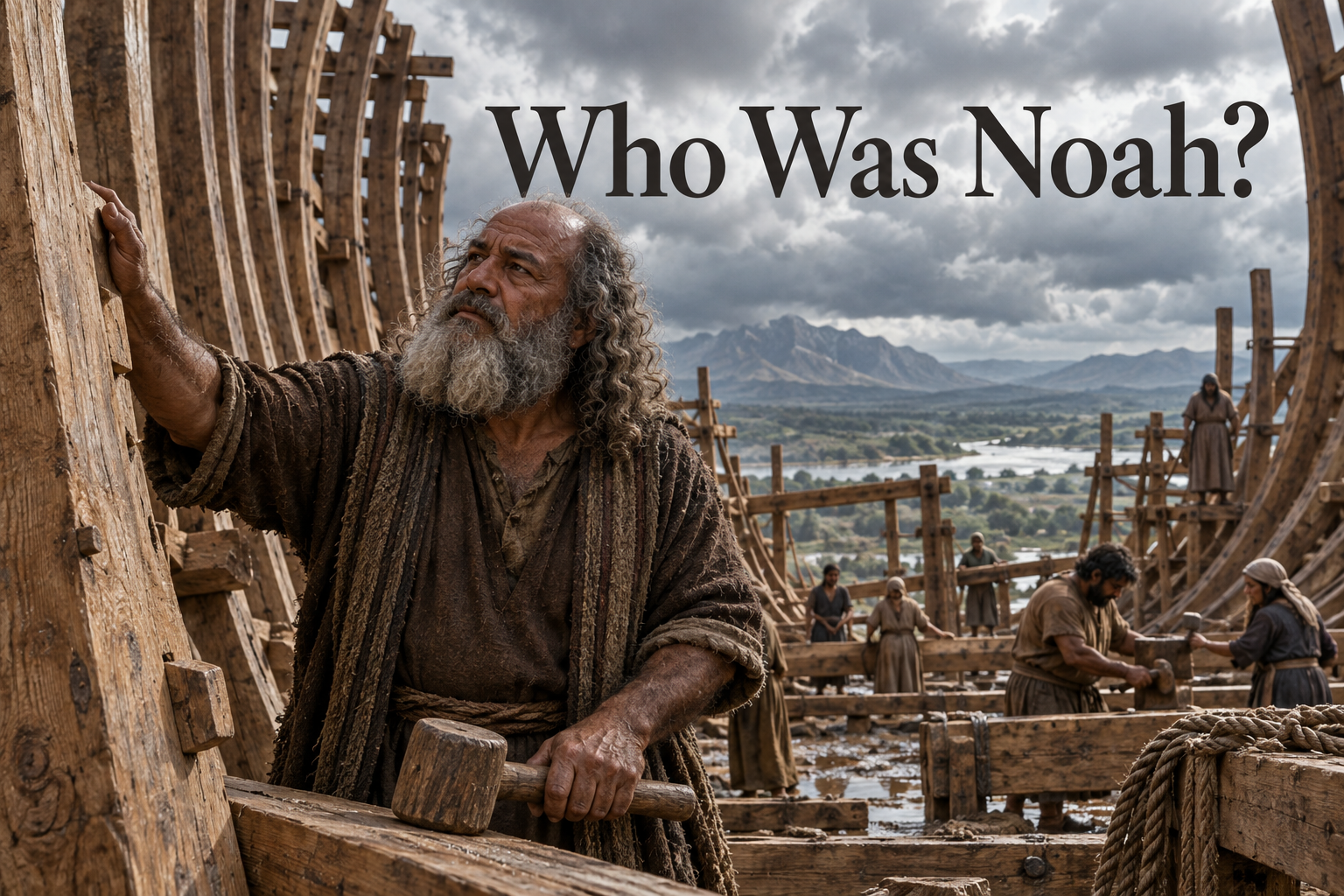
Noah is one of the Bible’s best-known figures, which can make it easy to remember the animals and miss the man. Genesis presents him at a point when human violence and corruption had filled the earth. He isn’t introduced as a shipbuilder, explorer, or founder of a civilization. He is introduced as a man who found favor with God and then obeyed a command that must have looked unreasonable until the rain came.
A righteous man in a violent world
Noah first appears in a genealogy running from Adam through Seth. His father, Lamech, names him in hope that he will bring relief from the painful toil associated with the cursed ground (Genesis 5:28-29). The text doesn’t explain exactly how Lamech understood that hope, and Noah doesn’t remove the curse. His story does, however, become a major turning point in the relationship between God, humanity, and the earth.
Genesis describes a world in which human wickedness was pervasive and the earth was filled with violence (Genesis 6:5-8). Against that background, Noah is called righteous and blameless among his contemporaries, and he is said to have walked with God (Genesis 6:9). “Blameless” doesn’t mean that Noah was sinless. It describes integrity and faithfulness, especially in contrast with the society around him. The story later includes his own shame and family disorder, so Genesis isn’t quietly turning him into a flawless hero.
The ark and the flood
God told Noah to build an ark because judgment was coming upon a corrupt earth. Genesis gives its dimensions, construction material, internal divisions, and purpose, then describes Noah gathering his family, animals, and food (Genesis 6:11-22). Readers naturally wonder how every practical detail worked, but the narrative’s emphasis is more direct: God warned Noah, provided a means of preservation, and Noah did what God commanded. His obedience wasn’t a technique for controlling the disaster; it was a response of trust to God’s word.
The flood account describes waters covering the land, the death of creatures outside the ark, and the ark floating above the devastation (Genesis 7:11-24). Christians disagree about the geographical extent of the flood and about how the account relates to geology, ancient chronology, and other Near Eastern flood traditions. Some read it as a global event covering the entire planet, while others understand its universal language from the horizon of the biblical world. Parallels with Mesopotamian flood stories are real, but similarity doesn’t by itself establish whether Genesis borrowed, preserved a shared memory, or deliberately retold a familiar kind of story to make different claims about God. Scripture presents the flood as divine judgment on human violence, not as a quarrel among unstable gods or an accident caused by humanity making too much noise.
After the waters receded, Noah sent out birds to test whether the ground was dry. God then instructed the family and animals to leave the ark (Genesis 8:1-19). Noah’s first recorded act outside was to build an altar and offer sacrifices. God promised not to strike the ground again in the same way because of humanity and affirmed the regular rhythms of the created order (Genesis 8:20-22). The account doesn’t pretend that the flood cured the human heart; in fact, it says otherwise. Judgment restrained evil, but it didn’t recreate humanity as morally innocent.
The covenant with Noah
God blessed Noah and his sons, renewed the command to multiply, and gave instructions recognizing both the value of animal life and the unique accountability attached to shedding human blood. He then established a covenant with Noah, his descendants, and every living creature, promising that a flood would never again destroy all flesh. The rainbow served as the sign of that covenant (Genesis 9:1-17). This is broader than a private promise to one religious family. The covenant embraces the human family and the animal world, showing that God’s purposes concern the whole creation.
Later Jewish and Christian thinkers developed ethical systems sometimes called the Noahide laws from this portion of Genesis and related passages. Those systems are later interpretation, not a list labeled that way in the flood narrative itself. What Genesis plainly gives is a post-flood order in which human life has dignity because people bear God’s image, violence is answerable to God, and divine mercy places limits on judgment.
Noah after the flood
Noah’s final scene is not the tidy ending usually painted on nursery walls. He planted a vineyard, became drunk, and lay exposed in his tent. Ham saw his father’s nakedness, while Shem and Japheth covered Noah without looking. When Noah awoke, he pronounced a curse on Canaan, Ham’s son, and blessings connected with Shem and Japheth (Genesis 9:18-29). The text leaves questions about the exact nature of Ham’s offense and why Canaan receives the curse. Proposals range from voyeuristic dishonor to some form of sexual violation, but the more specific theories go beyond what Genesis states.
This passage has been grotesquely misused to justify racial slavery, especially by identifying Ham or Canaan with African peoples and treating servitude as a divine racial decree. Genesis says nothing of the kind. The curse concerns Canaan, not an alleged racial category, and no responsible reading can turn an obscure family episode into permission to enslave human beings. That history of interpretation is a warning that biblical authority and human misuse of the Bible are not the same thing.
Noah elsewhere in Scripture
Later biblical writers remember Noah as a real example of righteousness, judgment, and deliverance. Ezekiel places him alongside Daniel and Job as an exceptionally righteous man, while stressing that even such righteousness couldn’t shield an unrepentant nation (Ezekiel 14:14). Jesus compares the unsuspecting routine of life before the flood with conditions preceding the coming of the Son of Man (Matthew 24:37-39). Hebrews emphasizes Noah’s faith in responding to a warning about things not yet seen (Hebrews 11:7), and Peter calls him a preacher of righteousness (2 Peter 2:5).
First Peter also connects the flood, salvation through water, and baptism, while carefully locating salvation in Christ’s resurrection rather than in the physical act of washing (1 Peter 3:18-22). Christians interpret some details of that difficult passage differently, but Noah’s function is clear enough: his household passed through judgment because God provided rescue. The New Testament doesn’t use Noah to satisfy every curiosity about the ancient world. It uses him to call readers to trust, obedience, and sober confidence in God’s judgment and mercy.
What Noah’s life shows
Noah stands at the meeting point of a ruined world and a renewed beginning. He obeyed when obedience required years of work and when the promised event couldn’t yet be seen. Yet his later failure makes it impossible to treat him as the answer to humanity’s deepest problem. The flood survivor still needed grace, and his family still carried sin into the new world.
That tension is why Noah remains more than a figure in a children’s story. His life shows that God takes violence seriously, preserves life through judgment, binds himself by covenant, and works through imperfect people. The ark carried a family into a fresh beginning, but it didn’t carry humanity back into Eden. The story leaves readers waiting for a deliverance that reaches deeper than survival.