
Who Was Priscilla?
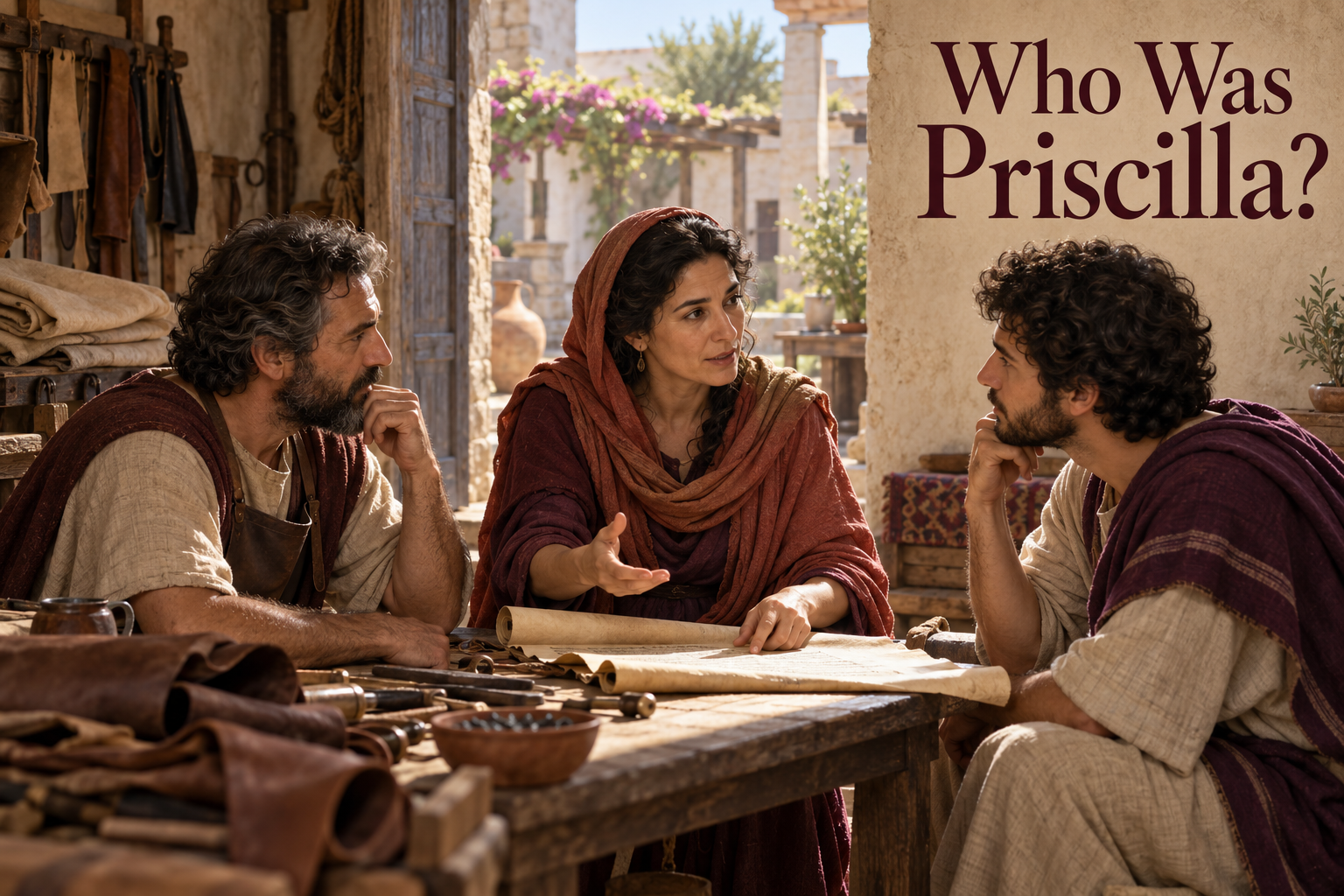
Priscilla was a Jewish Christian who, together with her husband Aquila, became one of the apostle Paul’s trusted coworkers. The New Testament never gives us a long account of her life, but the scattered references are enough to show a woman deeply involved in the ministry of the early church. She and Aquila supported Paul’s missionary work, hosted believers in their home, and helped instruct a gifted preacher whose understanding of the gospel was incomplete.
Priscilla and Aquila Meet Paul
Priscilla first appears in Acts 18, where Paul meets her and Aquila in Corinth. Aquila was a Jew from Pontus who had recently arrived from Italy with his wife because the emperor Claudius had ordered Jews to leave Rome (Acts 18:1–2). The expulsion is commonly dated to around AD 49, although the exact circumstances and scope are debated. Paul stayed and worked with the couple because they shared the same trade, traditionally translated as tentmaking. The Greek term can refer more broadly to working with leather or related materials, so we shouldn’t assume we know every detail of their workshop.
They were more than Paul’s business associates. When Paul left Corinth for Syria, Priscilla and Aquila accompanied him as far as Ephesus (Acts 18:18–19). Their willingness to relocate shows how closely their lives had become connected with the spread of the gospel. The New Testament gives no indication that they had a formal missionary title, but their practical support, hospitality, and teaching made them important partners in the work.
Teaching Apollos in Ephesus
One of the most revealing episodes involving Priscilla occurs after Paul leaves Ephesus. A Jewish man named Apollos arrived from Alexandria. Acts describes him as eloquent, knowledgeable in the Scriptures, fervent in spirit, and accurate in what he taught about Jesus, but says he knew only the baptism of John (Acts 18:24–25). When Priscilla and Aquila heard him speaking boldly in the synagogue, they took him aside and explained the way of God more accurately (Acts 18:26).
Luke doesn’t give us a transcript of that conversation, so we shouldn’t claim to know precisely which doctrines they explained. The passage does show that Priscilla participated with Aquila in instructing a capable male teacher. They didn’t humiliate Apollos publicly or dismiss everything he already knew. They recognized both his gifts and the limits of his understanding, then helped him become better equipped for ministry. Apollos went on to serve effectively in Achaia, using the Scriptures to demonstrate that Jesus was the Christ.
A Church in Their Home
Paul later greets Prisca and Aquila in Romans 16:3–5, calling them his coworkers in Christ Jesus and saying that they had risked their necks for his life. He adds that the churches of the Gentiles were grateful to them and sends greetings to the church meeting in their house. Prisca is the shorter form of the name Priscilla, and the two names refer to the same woman. We aren’t told exactly when or how they endangered themselves for Paul, so it’s best not to attach the remark to an incident Scripture never identifies.
The couple also appears in 1 Corinthians 16:19, where Paul sends greetings from Aquila and Prisca and the church in their house, and in 2 Timothy 4:19. These references suggest a ministry that extended across several locations and years. Early Christian congregations often met in homes rather than purpose-built church buildings, and opening one’s home could involve considerable expense and responsibility. Priscilla and Aquila helped provide the setting in which believers worshiped, learned, and formed a community.
What Priscilla’s Ministry Tells Us
Priscilla’s name appears before Aquila’s in several New Testament references, including Acts 18:18 and Romans 16:3. Some interpreters think this suggests she was particularly prominent in their ministry, while others caution that the order of names alone can’t establish their respective roles. The text doesn’t call her a pastor or an apostle, and it doesn’t tell us whether she held a formal church office. It does identify her as Paul’s coworker and place her directly in the instruction of Apollos.
Christians disagree about how passages concerning women teaching in the church should be applied, and Priscilla’s example belongs in that larger discussion. Whatever position someone takes on church offices, it would be difficult to read Acts 18 honestly and conclude that women had no meaningful role in explaining Christian truth. Priscilla’s ministry wasn’t built around public recognition. It was built around faithful work, hospitality, sound instruction, and a willingness to help others serve Christ more effectively.